


Iraq Starts Excavation of Large Mass Grave Left by ISIS

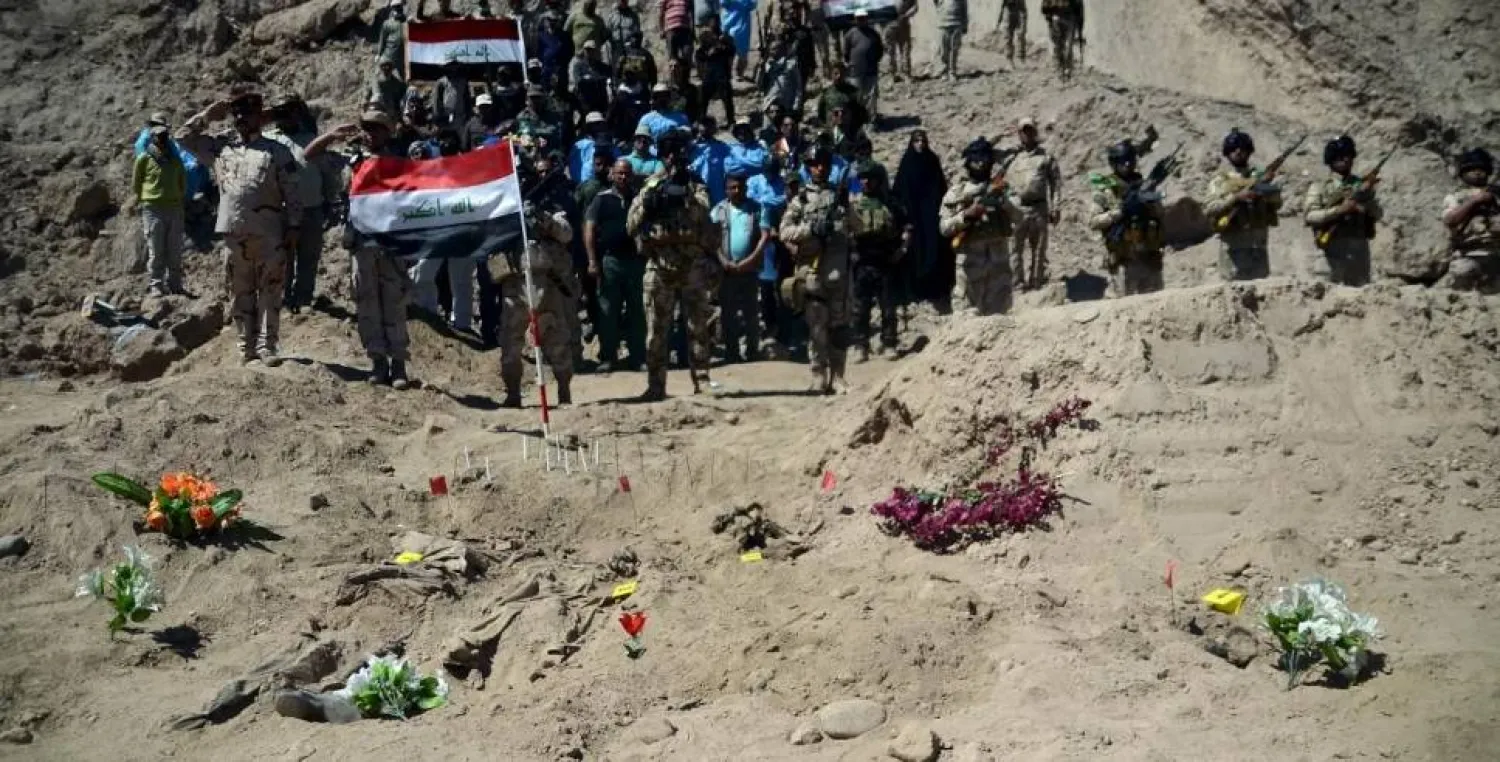
Iraqi soldiers salute as they stand next to a mass grave for soldiers from Camp Speicher who have been killed by ISIS militants. REUTERS/Stringer
TT

Iraq Starts Excavation of Large Mass Grave Left by ISIS

Iraqi soldiers salute as they stand next to a mass grave for soldiers from Camp Speicher who have been killed by ISIS militants. REUTERS/Stringer

Iraqi officials have begun the excavation of what is believed to be a mass grave left behind by the ISIS extremist group during its rampage across the country a decade ago.

Local authorities are working with the judiciary, forensic investigations, Iraq’s Martyrs’ Foundation, and the directorate of mass graves to carry out the excavation of the site of a sink hole in al-Khafsa, south of the northern city of Mosul, the state-run Iraqi News Agency reported Sunday.

Ahmad Qusay al-Asady, head of the Martyrs Foundation’s mass graves excavation department, told The Associated Press that his team began work at Khasfa on Aug. 9 at the request of Nineveh province’s Gov. Abdulqadir al-Dakhil.

The operation is initially limited to gathering visible human remains and surface evidence while preparing for a full exhumation that officials say will require international support.

After an initial 15 days of work, the foundation’s Mosul teams will build a database and start collecting DNA samples from families of suspected victims.

Al-Asady explained that laboratory processing and a DNA database must come first to ensure proper identification. Full exhumations can only proceed once specialized assistance is secured to navigate the site’s hazards, including sulfur water and unexploded ordnance.

Khasfa is “a very complicated site,” he said.

Based on unverified accounts from witnesses and families and other unofficial testimonies, authorities estimate that thousands of bodies could be buried there, he said.

Scores of mass graves containing thousands of bodies of people believed to have been killed by the extremist group have been found in Iraq and Syria.

At its peak, ISIS ruled an area half the size of the United Kingdom in Iraq and Syria and was notorious for its brutality. It beheaded civilians and enslaved and raped thousands of women from the Yazidi community, one of Iraq’s oldest religious minorities.

The group was defeated in Iraq in July 2017, when Iraqi forces captured the northern city of Mosul. Three months later, it suffered a major blow when Kurdish forces captured the Syrian northern city of Raqqa, which was the group’s de-facto capital. The war against ISIS officially ended in March 2019, when US-backed and Kurdish-led fighters of the Syrian Democratic Forces captured the eastern Syrian town of Baghouz, which was the last sliver of land the extremists controlled.

Rabah Nouri Attiyah, a lawyer who has worked on more than 70 cases of missing people in Nineveh, told the AP that information he obtained from the foundation and different Iraqi courts during his investigations points to Khasfa as “the largest mass grave in modern Iraqi history."

Al-Asady, however, said investigators “cannot confirm yet if it is the largest mass grave” to be found in Iraq, “but according to the size of the space, we estimate it to be one of the largest.”

Attiyah said roughly 70% of the human remains at Khasfa are believed to belong to Iraqi army and police personnel, with other victims including Yazidis.

He said he has interviewed numerous eyewitnesses from the area who saw ISIS fighters bring people there by bus and kill them. “Many of them were decapitated,” he said.

Attiyah’s own uncle and cousin were police officers killed by ISIS, and he is among those hoping to identify and recover the remains of loved ones.

Testimonies and witness statements, as well as findings from other mass graves in Nineveh, indicate that most of the military, police and other security forces personnel killed by ISIS are expected to be found at Khasfa, along with Yazidis from Sinjar and Shiite victims from Tal Afar, he said.



Report: Israel Aims to Ensure More Palestinians Are Let Out of Gaza Than Back in

 A general view of destroyed houses in areas marked as 'Yellow Line' by the Israeli military, in east of Gaza City, January 16, 2026. (Reuters)
A general view of destroyed houses in areas marked as 'Yellow Line' by the Israeli military, in east of Gaza City, January 16, 2026. (Reuters)
TT

Report: Israel Aims to Ensure More Palestinians Are Let Out of Gaza Than Back in

 A general view of destroyed houses in areas marked as 'Yellow Line' by the Israeli military, in east of Gaza City, January 16, 2026. (Reuters)
A general view of destroyed houses in areas marked as 'Yellow Line' by the Israeli military, in east of Gaza City, January 16, 2026. (Reuters)

Israel wants to restrict the number of Palestinians entering Gaza through the border crossing with Egypt to ensure that more are allowed out than in, three sources briefed on the matter told Reuters ahead of the border's expected opening next week.

The head of a transitional Palestinian committee backed by the US to temporarily administer Gaza, Ali Shaath, announced on Thursday that the Rafah Border Crossing - effectively the sole route in or out of Gaza for nearly all of the more than 2 million people who live there - would open next week.

The border was supposed to have opened during the initial phase of President Donald Trump's plan to end the war, under a ceasefire reached in October between Israel and Hamas.

Earlier this month, Washington announced that ‌the plan had now ‌moved into the second phase, under which Israel is expected to ‌withdraw ⁠troops further from ‌Gaza and Hamas is due to yield control of the territory's administration. The Gaza side of the crossing has been under Israeli military control since 2024.

The three sources, who spoke on condition of anonymity due to the sensitivity of the issue, said it was still not clear how Israel planned to enforce limits on the number of Palestinians entering Gaza from Egypt, or what ratio of exits to entries it aimed to achieve.

Israeli officials have spoken in the past about encouraging Palestinians to emigrate from Gaza, although they deny intending to transfer the population out by ⁠force. Palestinians are highly sensitive to any suggestion that Gazans could be expelled, or that those who leave temporarily could be barred from returning.

The ‌Rafah Crossing is expected to be staffed by Palestinians affiliated with the ‍Ramallah-based Palestinian Authority and monitored by EU personnel, ‍as took place during an earlier, weeks-long ceasefire between Israel and Hamas early last year.

The Israeli prime ‍minister's office did not immediately respond to a request for comment for this story. The military referred questions to the government, declining to comment.

An Israeli official told Reuters the government would determine when the border would open and that Palestinians would not be able to leave or enter Gaza without approval from Israel.

The three sources said that Israel also wants to establish a military checkpoint inside Gaza near the border, through which all Palestinians entering or leaving would be required to pass and be subjected to Israeli security checks.

The US ⁠Embassy in Israel did not immediately respond to a request for comment on whether Washington supported Israel in limiting the number of Palestinians entering Gaza or setting up a checkpoint to screen those entering and leaving.

Under the initial phase of Trump's plan, the Israeli military partially pulled back its forces within Gaza but retained control of 53% of the territory including the entire land border with Egypt. Nearly all of the territory's population lives in the rest of Gaza, under Hamas control and mostly in makeshift tents or damaged buildings.

The sources said that it was not clear how individuals would be dealt with if they were blocked by Israel's military from passing through its checkpoint, particularly those entering from Egypt.

The Israeli government has repeatedly objected to the opening of the border, with some officials saying Hamas must first return the body of an Israeli police officer held in Gaza, the final human ‌remains of a hostage due to be transferred under the ceasefire's first phase.

US officials in private say that Washington, not Israel, is driving the rollout of the president's plan to end the war.


Report: US Pressures Iraq to ‘Rapidly’ Disarm Iran-Backed Factions

Iraqi border security force personnel patrol in their armored vehicles along the border with Syria, in Sinjar district, northern Iraq on January 22, 2026. (AFP)
TT

Report: US Pressures Iraq to ‘Rapidly’ Disarm Iran-Backed Factions

Iraqi border security force personnel patrol in their armored vehicles along the border with Syria, in Sinjar district, northern Iraq on January 22, 2026. (AFP)

US officials have been pressuring Iraq to disarm Iran-backed armed factions, reported the Financial Times on Friday.

“In tense meetings with senior Iraqi political leaders tasked with forming the next government, US officials have in recent weeks also pushed the Iraqis to produce a ‘credible’ plan to rapidly disarm the groups,” it said.

Washington is exerting pressure on senior Iraqi politicians to form a government that excludes those factions, amid US President Donald Trump's efforts to curb Tehran's influence in Baghdad.

The newspaper quoted informed sources as saying that American officials threatened to take punitive measures if Baghdad did not do so, including economic measures, such as limiting dollar flows related to Iraqi oil sales.

Since 2003, under an arrangement after the American invasion of Iraq, Washington has been sending Baghdad cash shipments worth billions of dollars annually via monthly air freight flights, which are funds collected from Iraqi oil sales, the proceeds of which are deposited in the country's account with the Federal Reserve.

However, the United States has long been concerned that armed factions and Iran would use these funds. In 2015, Washington temporarily suspended dollar supplies to Baghdad amid concerns that they were flowing to Tehran and the ISIS extremist group.

The sources said that Iraqis fear instability and the outbreak of an economic crisis if Washington stops these supplies again.


Israel Aims to Ensure More Palestinians Are Let Out of Gaza than Back In

People stand at the gate of the border crossing between Egypt and the Gaza Strip, in Rafah, Egypt, February 11, 2025. REUTERS/Amr Abdallah Dalsh
TT

Israel Aims to Ensure More Palestinians Are Let Out of Gaza than Back In

People stand at the gate of the border crossing between Egypt and the Gaza Strip, in Rafah, Egypt, February 11, 2025. REUTERS/Amr Abdallah Dalsh

Israel wants to restrict the number of Palestinians entering Gaza through the border crossing with Egypt to ensure that more are allowed out than ​in, three sources briefed on the matter said ahead of the border's expected opening next week.

The head of a transitional Palestinian committee backed by the US to temporarily administer Gaza, Ali Shaath, announced on Thursday that the Rafah Border Crossing - effectively the sole route in or out of Gaza for nearly all of the more than 2 million people who live there - would open next week.

The border was supposed to have opened during the initial phase of President Donald Trump's plan to end the war, under a ceasefire reached in October between Israel and Hamas.

Earlier this month, Washington announced that the plan had now ‌moved into the ‌second phase, under which Israel is expected to withdraw troops further from ‌Gaza ⁠and ​Hamas ‌is due to yield control of the territory's administration. The Gaza side of the crossing has been under Israeli military control since 2024.

The three sources, who spoke on condition of anonymity due to the sensitivity of the issue, said it was still not clear how Israel planned to enforce limits on the number of Palestinians entering Gaza from Egypt, or what ratio of exits to entries it aimed to achieve, Reuters reported.

Israeli officials have spoken in the past about encouraging Palestinians to emigrate from Gaza, although they deny intending to transfer the population out by force. Palestinians ⁠are highly sensitive to any suggestion that Gazans could be expelled, or that those who leave temporarily could be barred from returning.

The Rafah ‌Crossing is expected to be staffed by Palestinians affiliated with the ‍Ramallah-based Palestinian Authority and monitored by EU personnel, ‍as took place during an earlier, weeks-long ceasefire between Israel and Hamas early last year.

The Israeli ‍prime minister's office did not immediately respond to a request for comment for this story. The military referred questions to the government, declining to comment.

The three sources said that Israel also wants to establish a military checkpoint inside Gaza near the border, through which all Palestinians entering or leaving would be required to pass and be subjected to Israeli ​security checks.

Two other sources also said that Israeli officials had insisted on setting up a military checkpoint in Gaza to screen Palestinians moving in and out.

The US Embassy in ⁠Israel did not immediately respond to a request for comment on whether Washington supported Israel in limiting the number of Palestinians entering Gaza or setting up a checkpoint to screen those entering and leaving.

Under the initial phase of Trump's plan, the Israeli military partially pulled back its forces within Gaza but retained control of 53% of the territory including the entire land border with Egypt. Nearly all of the territory's population lives in the rest of Gaza, under Hamas control and mostly in makeshift tents or damaged buildings.

The sources said that it was not clear how individuals would be dealt with if they were blocked by Israel's military from passing through its checkpoint, particularly those entering from Egypt.

The Israeli government has repeatedly objected to the opening of the border, with some officials saying Hamas must first return the body of an Israeli police officer held in Gaza, the ‌final human remains of a hostage due to be transferred under the ceasefire's first phase.

US officials in private say that Washington, not Israel, is driving the rollout of the president's plan to end the war.