
US Envoy Says Israel's Turn to 'Comply' as Lebanon Moves to Disarm Hezbollah

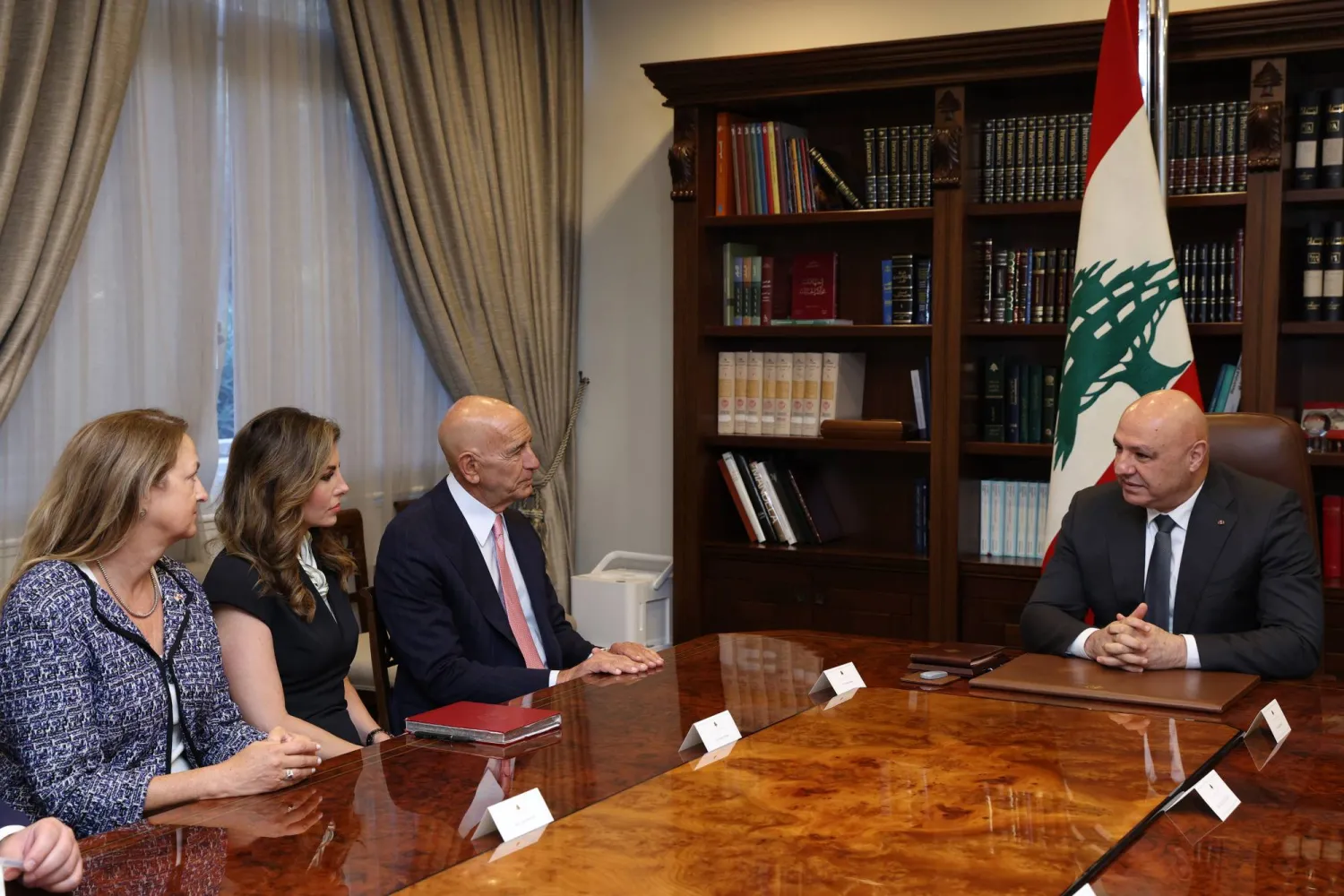
A handout photo made available by the Lebanese Presidency press office shows Lebanese President Joseph Aoun (R) meeting with US Ambassador to Turkey and Special Envoy to Syria Tom Barrack (2-R), senior adviser at US Mission to the UN, Morgan Ortagus (2-L) and US Ambassador to Lebanon Lisa A. EPA/LEBANESE PRESIDENCY HANDOUT
TT

US Envoy Says Israel's Turn to 'Comply' as Lebanon Moves to Disarm Hezbollah

A handout photo made available by the Lebanese Presidency press office shows Lebanese President Joseph Aoun (R) meeting with US Ambassador to Turkey and Special Envoy to Syria Tom Barrack (2-R), senior adviser at US Mission to the UN, Morgan Ortagus (2-L) and US Ambassador to Lebanon Lisa A. EPA/LEBANESE PRESIDENCY HANDOUT

US envoy Tom Barrack on Monday called on Israel to honor commitments under a ceasefire that ended its war with Hezbollah, after the Lebanese government launched a process to disarm the militant group. 

Under the November truce agreement, weapons in Lebanon were to be restricted to the state and Israel was to fully withdraw its troops from the country, although it has kept forces at five border points it deems strategic. 

"I think the Lebanese government has done their part. They've taken the first step. Now what we need is Israel to comply," Barrack said following a meeting in Beirut with Lebanese President Joseph Aoun at the Presidential Palace in Baabda. 

The meeting was also attended by Morgan Ortagus, Deputy United States Special Envoy to the Middle East . 

Asked by reporters about whether he expected to see Israel fully withdraw from Lebanese territory, Barrack said that "that's exactly the next step" needed. 

To the US diplomat, "the next step is we need participation on the part of Israel, and we need an economic plan for prosperity, restoration and renovation" in Lebanon, weighed down by dire political and economic crises in recent years. 

Barrack said Washington was "in the process of now discussing with Israel what their position is", adding that "in the next few weeks you're going to see progress on all sides." 

"It means a better life for the people... and at least the beginning of a roadway to a different kind of dialogue" in the region, he said. 

The US diplomat's visit comes less than two weeks after Lebanon's cabinet tasked the army with developing a plan to disarm Iran-backed Hezbollah by the end of the year -- an unprecedented step since civil war factions gave up their weapons decades ago. 

A second cabinet meeting on August 7 tackled a US proposal that includes a timetable for Hezbollah's disarmament, with Washington pressing Lebanon to take action on the matter. 

The cabinet endorsed the introduction of the US text, which lists 11 objectives including "ensuring the sustainability" of the November ceasefire agreement with Israel, and "the gradual end of the armed presence of all non-governmental entities, including Hezbollah, in all Lebanese territory". 

Israel routinely carries out air strikes in Lebanon despite the ceasefire, and has signaled it would not hesitate to launch destructive military operations if Beirut failed to disarm Hezbollah. 

Barrack on Monday stressed that "dealing with Hezbollah, as we've always said, is a Lebanese process". 


Israeli Forces Kill Three Palestinians in Gaza, Local Authorities Say

 Palestinians walk past destroyed buildings in the northern Gaza Strip, Friday, Jan. 2, 2026. (AP)
Palestinians walk past destroyed buildings in the northern Gaza Strip, Friday, Jan. 2, 2026. (AP)
TT

Israeli Forces Kill Three Palestinians in Gaza, Local Authorities Say

 Palestinians walk past destroyed buildings in the northern Gaza Strip, Friday, Jan. 2, 2026. (AP)
Palestinians walk past destroyed buildings in the northern Gaza Strip, Friday, Jan. 2, 2026. (AP)

Israeli forces shot and killed at least three Palestinians in separate incidents in the southern Gaza Strip city of Khan Younis on Sunday, local health authorities said.

Medics reported that the dead included a 15-year-old boy, a fisherman killed outside areas still occupied by Israel in the enclave, and a third man who was shot and killed east ‌of the city in ‌areas under Israeli ‌control.

The ⁠Israeli military ‌had no immediate comment on the reported incidents.

Israel has carried out repeated air strikes since a ceasefire took effect in October, saying they are aimed at preventing attacks or destroying militant infrastructure.

Gaza’s health ministry says 420 ⁠Palestinians have been killed since the ceasefire began, while ‌fighters have killed three Israeli soldiers.

Israel ‍and Hamas have ‍traded blame for violations of the ceasefire ‍agreement brokered under US President Donald Trump.

Israel retained control of 53% of Gaza under the first phase of Trump's plan, which involved the release of hostages held by gunmen in Gaza and of Palestinians detained ⁠by Israel.

The final hostage remains to be handed over are those of an Israeli police officer killed on October 7, 2023 - the day Gazan fighters invaded Israel, killing 1,200 and taking some 250 hostages, according to Israeli tallies.

Israel's military assault on Gaza has killed more than 71,000 Palestinians, according to the Gaza health ministry, and led ‌to accusations of genocide and war crimes that Israel denies.


Hezbollah Blocks Hopes for a Smooth Start to Phase Two of Weapons Exclusivity

Members of Lebanon’s Civil Defense work to extinguish flames after an Israeli airstrike hit a car in the town of Khiam, southern Lebanon (AP). 
TT

Hezbollah Blocks Hopes for a Smooth Start to Phase Two of Weapons Exclusivity

Members of Lebanon’s Civil Defense work to extinguish flames after an Israeli airstrike hit a car in the town of Khiam, southern Lebanon (AP). 

Hezbollah has dashed Lebanese hopes of a smooth transition to the second phase of the state’s weapons exclusivity plan, due to begin next week north of the Litani River.

The group revived conditions it set last year, arguing that UN Security Council Resolution 1701 applies solely to areas south of the Litani, while any steps beyond that must be addressed within a broader “national defense strategy.”

Its position comes as Israel escalates threats of a possible ground operation inside Lebanon aimed at eliminating what it calls Hezbollah’s threat.

Lebanese Army Commander General Rodolphe Haykal is expected to present his fourth and final report on the army’s operational achievements in enforcing weapons exclusivity south of the Litani during a Cabinet session next week.

Although the army has reiterated its readiness to carry out any task assigned by the political leadership, government observers doubt that a mandate to launch phase two will be issued smoothly, given Hezbollah’s refusal to cooperate.

Prime Minister Nawaf Salam has sought to ease the party’s concerns, stressing that “these weapons are Lebanese, and no one wants to hand them over to Israel.”

In a televised interview on Friday, he said weapons exclusivity simply means that arms must be under the authority of the Lebanese state, dismissing fears of internal conflict.

Government efforts to prevent a new round of fighting with Israel are running up against Israeli threats of escalation should Lebanon fail to meet its commitments on weapons control.

Israeli media reported that Tel Aviv is considering a ground incursion into Lebanon while continuing near-daily airstrikes. Israel’s public broadcaster said Hezbollah has partially rebuilt its capabilities during the ceasefire, and that Israel views the Lebanese government as unable to rein in the group.

Israeli sources also indicated that the administration of US President Donald Trump does not rule out an Israeli ground operation, but has urged Prime Minister Benjamin Netanyahu to delay any decision to allow further dialogue with Beirut.

Israel has continued intermittent strikes inside Lebanon. On Saturday, three people were wounded in an airstrike on the town of Khiam in southern Lebanon, according to Lebanese officials. The Israeli army said it had targeted a Hezbollah operative.

In response, Hezbollah lawmaker Hussein Jishi said the party had fully complied with Resolution 1701 and cooperated with the Lebanese state, the army, and international forces under the ceasefire declared on November 27, 2024. He said Lebanese leaders and UN peacekeepers had confirmed there was no evidence of violations south of the Litani.

Jishi insisted that Resolution 1701 applies only to that area, while issues beyond it are an internal Lebanese matter to be resolved through national consensus and a comprehensive defense strategy, rejecting calls for disarmament outside that framework as unrealistic and driven by external agendas.


UK Says Conducted Joint Strike with France on ISIS Site near Palmyra

A handout photo made available by the Royal Air Force (RAF) on 03 January 2025 shows a Royal Air Force Typhoon aircraft preparing to take off at an undisclosed location in the Middle East. EPA/SGT LEE GODDARD HANDOUT
TT

UK Says Conducted Joint Strike with France on ISIS Site near Palmyra

A handout photo made available by the Royal Air Force (RAF) on 03 January 2025 shows a Royal Air Force Typhoon aircraft preparing to take off at an undisclosed location in the Middle East. EPA/SGT LEE GODDARD HANDOUT

The British Ministry of Defense said it cooperated with France on Saturday night to strike an underground facility in Syria that had likely been used by the ISIS group to store weapons, AFP reported.

"Royal Air Force aircraft have completed successful strikes against Daesh in a joint operation with France," the ministry said in a statement, using the Arabic acronym for ISIS.

"This facility had been occupied by Daesh, most likely to store weapons and explosives. The area around the facility is devoid of any civilian habitation," the statement added.

The ministry said there was no indication the bombing north of the ancient site of Palmyra had posed any risk to civilians.

ISIS was territorially defeated in Syria in 2019 but still maintains a presence, particularly in the country's vast desert.

Palmyra, home to UNESCO-listed ancient ruins, was once controlled by the extremist fighters.

Last month, Washington said a lone ISIS gunman in Palmyra attacked American personnel, killing two US soldiers and a US civilian.

US forces said they struck dozens of ISIS targets in Syria in retaliation.