


Sudanese Lay First Bricks to Rebuild War-torn Khartoum

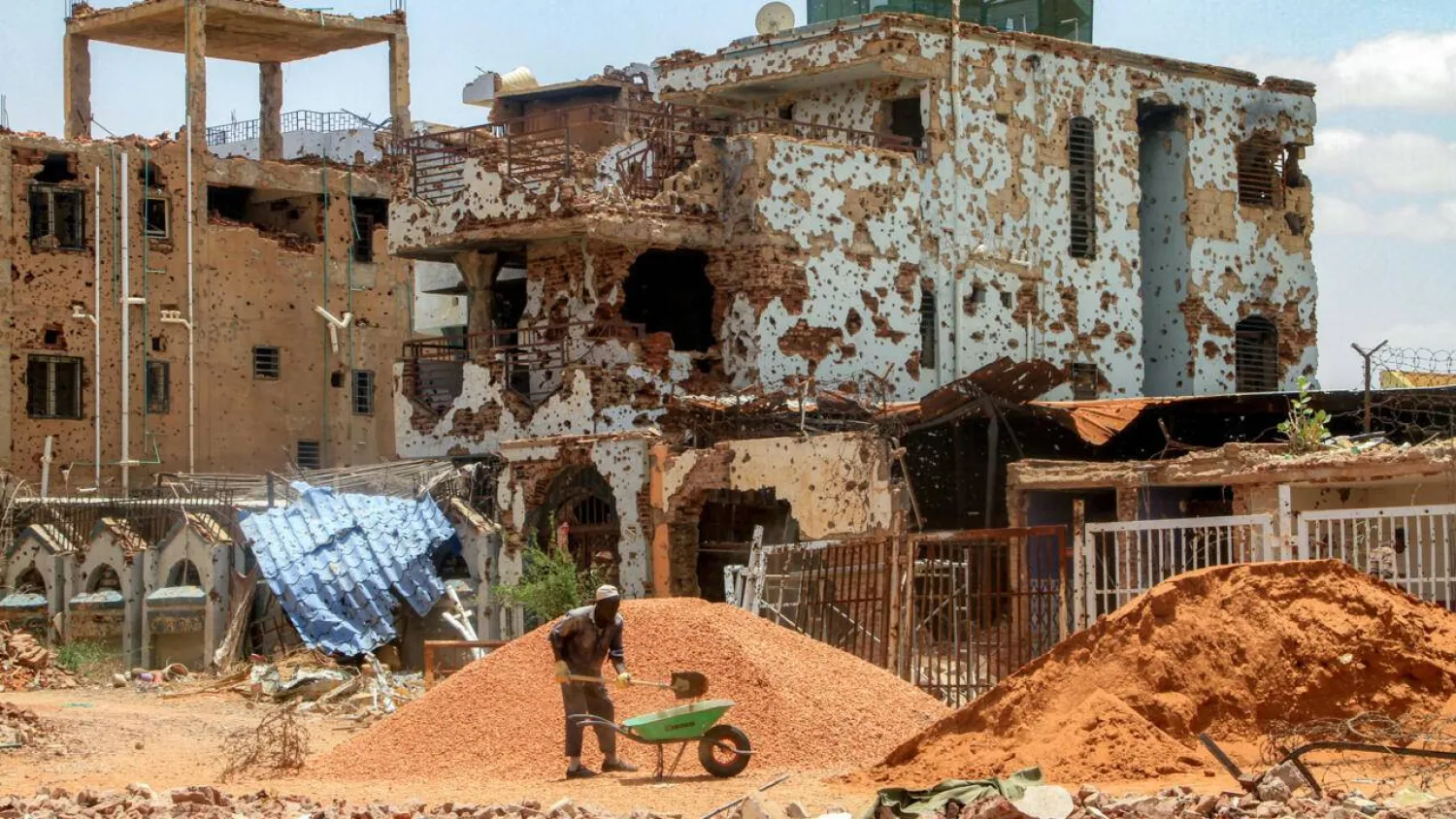
(FILES) A worker shovels pebbles from a mound into a wheelbarrow near a heavily-damaged buildings at a site in the Lamab suburb on the southwestern outskirts of Sudan's capital Khartoum. Ebrahim Hamid / AFP/File
TT

Sudanese Lay First Bricks to Rebuild War-torn Khartoum

(FILES) A worker shovels pebbles from a mound into a wheelbarrow near a heavily-damaged buildings at a site in the Lamab suburb on the southwestern outskirts of Sudan's capital Khartoum. Ebrahim Hamid / AFP/File

On the streets of Sudan's capital Khartoum, builders clear rubble from houses pockmarked with bullet holes, haul away fallen trees and repair broken power lines, in the city's first reconstruction effort since war began over two years ago.

Fighting between Sudan's army and the paramilitary Rapid Support Forces (RSF), which broke out in April 2023, has left the capital battered and hollowed out.

But reconstruction -- led by government agencies and youth-led volunteer groups -- has finally begun to repair hospitals, schools and water and power networks, AFP reported.

"We are working to restore the state's infrastructure," volunteer Mostafa Awad said.

Once a thriving metropolis of nine million people, Khartoum's skyline is now a jagged silhouette of collapsed buildings.

Electrical poles lean precariously or lie snapped on the ground in the streets. Cars, stripped for parts, sit burnt-out and abandoned, their tires melted into the asphalt.

AFP correspondents saw entire residential blocks standing with their exterior walls ripped away in the fighting.

Danger remains within the soot-stained buildings as authorities slowly work to clear tens of thousands of unexploded bombs left behind by fighters.

The UN warns Khartoum is "heavily contaminated by unexploded ordnance", and this month said landmines have been discovered across the capital.

Sudan's war has killed tens of thousands, displaced 13 million and plunged the nation into the world's worst hunger and displacement crisis.

'Proud national capital'

Until the army pushed the RSF out of Khartoum in March, the capital -- where four million alone were displaced by fighting -- was a battlefield.

Before they left, paramilitary fighters stripped infrastructure bare, looting everything from medical equipment and water pumps to copper wiring.

"Normally in a war zone, you see massive destruction... but you hardly ever see what happened in Khartoum," the UN's resident and humanitarian coordinator Luca Renda said.

"All the cables have been taken away from homes, all the pipes have been destroyed," he told AFP, describing systematic looting of both small and large-scale items.

Today, power and water systems remain among the city's greatest challenges.

The head of east Khartoum's electricity department, Mohamed al-Bashir, described "massive damage" in the capital's main transformer stations.

"Some power stations were completely destroyed," he told AFP, explaining the RSF had "specifically targeted transformer oil and copper cables".

Vast swathes of Khartoum are without electricity, and with no reliable water supply, a cholera outbreak gripped the city this summer.

Health officials reported up to 1,500 new cases a day in June, according to the UN.

On his first visit to Khartoum last month, Sudan's prime minister pledged a wide-scale recovery effort.

"Khartoum will return as a proud national capital," Kamil Idris said.

Even as war rages on elsewhere in the country, the government has begun planning its return from its wartime capital Port Sudan.

Taking shape

On Tuesday, it announced central Khartoum -- the devastated business and government district where some of the fiercest battles took place -- would be evacuated and redesigned.

The UN estimates the rehabilitation of the capital's essential facilities to cost around $350 million, while the full rebuilding of Khartoum "will take years and several billion dollars", Renda told AFP.

Hundreds have rolled up their sleeves to start the long and arduous rebuilding work, but obstacles remain.

"We faced challenges such as the lack of raw materials, especially infrastructure tools, sanitation (supplies) and iron," said Mohamed El Ser, a construction worker.

"Still, the market is relatively starting to recover," he told AFP.

In downtown Khartoum, a worker, his hands coated in mud, stacks bricks beside a crumbling building.

AFP correspondents accompanied workers carefully refitting pipes into what once was a family home, while nearby others lifted slabs of concrete and mangled metal into wheelbarrows.

On one road that had been a front line, a man repaired a downed streetlight while others dragged a felled tree onto a flatbed truck.

The UN expects up to two million people to make their way back to Khartoum by the end of the year.

Those who have already returned, estimated to be in the tens of thousands, say life is still difficult, but there's reason for hope.

"Honestly, there is an improvement in living conditions," said Ali Mohamed, who recently returned.

"There is more stability now, and real services are beginning to come back, like water, electricity and even basic medical care."



French Delegation in Algeria to Mend Ties, Rebuild Trust

Chairman of the Algerian Economic Renewal Council, center
TT

French Delegation in Algeria to Mend Ties, Rebuild Trust

Chairman of the Algerian Economic Renewal Council, center

A delegation from the Mouvement des Entreprises de France (Medef) is set to visit Algeria on Thursday, with its president Patrick Martin leading around 40 senior company executives, in an economic push aimed at repairing trade relations strained by political tensions over the past two years.

According to sources within the French diplomatic network based in Algeria, the mission seeks to inject new momentum into direct economic dialogue between the two sides and to restore the position of French companies in the Algerian market.

The visit is also seen as a practical step toward rebuilding trust between economic stakeholders, with the goal of moving past a period of stagnation and reviving trade and investment flows.

Reports cited by Algerian daily El Watan on Wednesday, quoting sources close to the Algerian Economic Renewal Council - the country’s largest employer body - said Medef’s visit will last two days.

The trip comes after a prolonged period of tension in bilateral relations that has affected economic exchanges. Observers say the move is not merely a protocol visit but an attempt to relaunch dialogue between business communities on both sides.

The main objective is to resume talks within the framework of the Algeria-France Economic Relations and Friendship Council, chaired by businessman Kamel Moula, who also heads the Algerian Economic Renewal Council, at a time when French economic presence in Algeria has significantly declined in recent years.

Sources from the Algerian Economic Renewal Council told Asharq Al-Awsat that the planned meetings in Algiers will be limited to bilateral sessions focusing on priority sectors, notably food security and energy - through projects linked to solar power and green hydrogen - as well as healthcare, digitalization and construction.

The mission offers French companies an opportunity to reaffirm their presence and reassure partners of their long-term commitment, the same sources said. It also aims to address certain obstacles, including lengthy administrative procedures, which are estimated to have tripled since 2024.

Observers consider the visit a key test of prospects for reviving economic relations between the two countries.

The Medef visit comes amid signs of a gradual political thaw in relations between Algiers and Paris. A visit by French Interior Minister Laurent Nunez to Algeria in February, during which he was received by President Abdelmadjid Tebboune at the presidential palace, helped pave the way for a measured easing of tensions.

In recent media comments, Michel Bisac, head of the Algerian-French Chamber of Commerce and Industry, warned of the potential fallout from the political crisis between Algeria and France, fueled by political and media circles close to the far right. The crisis erupted in summer 2024 after Paris recognized Moroccan sovereignty over Western Sahara.

“We are in a very delicate situation,” Bisac said, expressing regret over threats “not only to political ties but also economic relations between the two countries.”

He added that if Algeria were to apply to France the same trade measures it previously imposed on Spain after Madrid backed Morocco’s autonomy plan for Western Sahara in 2022, “the bill would be costly for the French economy, with losses approaching 4.8 billion euros.”

That figure reflects the value of French exports to Algeria, a key pillar for several industrial sectors’ foreign trade. Bisac noted that around 6,000 French companies currently operate “for and with Algeria,” supplying goods and services or engaging in industrial partnerships.

“These companies would face serious difficulties if the situation worsens,” he warned, stressing the growing fragility of bilateral economic exchanges. “Until recently, I had great hope ... but today I want to clearly stress the need to avoid escalation.”


Lebanon Sets Ceasefire as Condition for Talks with Israel

A child stands on the rubble of a building destroyed by an Israeli air strike in the southern Lebanese town of Kfarsir (AFP)
TT

Lebanon Sets Ceasefire as Condition for Talks with Israel

A child stands on the rubble of a building destroyed by an Israeli air strike in the southern Lebanese town of Kfarsir (AFP)

Lebanon will not enter negotiations with Israel until a ceasefire is firmly in place, President Joseph Aoun said, calling for a unified national stance.

He also stressed the need to prioritize the return of displaced residents to their villages, alongside a crackdown on weapons stockpiles and any armed presence.

A second meeting between Lebanon’s ambassador to Washington, Nada Hamadeh Moawad, and Israeli ambassador Yechiel Leiter is scheduled for Thursday at the State Department. The talks are expected to focus on extending the truce and setting a framework for negotiations, including timing and venue.

Ahead of the meeting, Israeli Foreign Minister Gideon Saar described Lebanon as a “failed state effectively run by Iran through Hezbollah,” adding that the group was “a common enemy of Israel and Lebanon”

He said disputes such as border demarcation could be resolved, but called Hezbollah the main obstacle and urged Beirut to cooperate against it.

Aoun has been working to close ranks among political factions and build backing for the negotiating track. Contacts are ongoing to extend the ceasefire, he said, pledging efforts to end what he described as the country’s “abnormal conditions.”

He insisted any talks would proceed without compromising sovereignty, saying there would be no concessions “except in what serves Lebanon’s interests and those of all its people.”

The planned negotiations would hinge on a full halt to Israeli attacks, a complete withdrawal from Lebanese territory, the return of detainees and deployment of the army along the international border, alongside the launch of reconstruction efforts. The return of displaced residents remains a central priority, he underlined.

The president chaired a security meeting focused on maintaining stability. He called for stricter enforcement of government measures, stronger deployment of security forces and closer coordination among agencies.

He also ordered raids on suspected arms depots. “No one will be allowed to obstruct security measures or undermine stability,” he said, calling the preservation of civil peace a “red line.”

Separately, discussions with a parliamentary committee focused on documenting damage caused by Israel, with the aim of presenting evidence - including photos and videos - to international bodies. Legal files are also being prepared in cooperation with the Beirut Bar Association.

Committee members praised efforts to shore up the ceasefire and push for lasting stability, particularly in the south, as well as moves to bring Lebanon’s case to regional and international forums.

Hezbollah has rejected the prospect of direct talks. MP Hassan Ezzedine said such calls were “rejected and condemned,” describing them as a departure from Lebanon’s national principles and Arab identity.

He also called for “genuine national unity” to face external pressure, adding that the group would not accept imposed boundaries or buffer zones.


Israeli Strikes in Southern Lebanon Kill Lebanese Journalist

This photo released by the Lebanese Civil Defense, show Lebanese Red Cross volunteers and Civil Defense workers carrying the body of the Lebanese journalist Amal Khalil killed in an Israeli airstrike, in al-Tayri village, south Lebanon, Wednesday, April 22, 2026. (Lebanese Civil Defense via AP)
TT

Israeli Strikes in Southern Lebanon Kill Lebanese Journalist

This photo released by the Lebanese Civil Defense, show Lebanese Red Cross volunteers and Civil Defense workers carrying the body of the Lebanese journalist Amal Khalil killed in an Israeli airstrike, in al-Tayri village, south Lebanon, Wednesday, April 22, 2026. (Lebanese Civil Defense via AP)

Israeli strikes on southern Lebanon on Wednesday killed Lebanese journalist Amal Khalil and wounded a photographer while they were working near the border with Israel, according to a senior Lebanese military official.

Earlier, the Israeli military said in a statement it had received reports that two journalists were injured as a result of its strikes.

The death of Khalil, 43, brought the death toll on Wednesday to five people. It was the deadliest day since a 10-day ceasefire was announced on April 16 to halt hostilities between Israel and Hezbollah.

Khalil and freelance photographer Zeinab Faraj were covering developments near the town of al-Tayri when an Israeli strike hit the vehicle in ⁠front of them.

⁠They ran into a nearby house, which was then also targeted by an Israeli strike, Lebanon's health ministry, the senior Lebanese military official and press advocates said.

Lebanese rescuers were able to retrieve Faraj, who had suffered a head wound.

When rescuers returned to help Khalil, the Israeli military dropped a sound grenade, blocking their access to the damaged building, the senior military official said.

Lebanon's Prime Minister Nawaf Salam said the targeting of journalists and the ⁠obstruction of relief efforts constituted "war crimes."

"Lebanon will spare no effort in pursuing these crimes before the relevant international bodies," he said on X.

Information Minister Paul Morcos said Khalil "was targeted by the Israeli army while carrying out her professional duty"

"The targeting of journalists is a grave crime and a blatant violation of international humanitarian law," he added on X.

The health ministry said Israel's military "prevented the completion of the humanitarian mission by firing a sound grenade and live ammunition at the ambulance."

Rescuers were able to return to the site about four hours after the initial strike. After another three hours of searching through the rubble, they were able to retrieve her lifeless body, the senior military official said.

Two people were killed in the first strike on the car, Lebanese state media reported.

The ⁠Israeli military said it ⁠identified two vehicles that left a military structure used by Hezbollah and crossed the "forward defense line," the term Israel's military uses to refer to the delineation of the zone of southern Lebanon that Israeli troops are occupying.

It said the cars "approached the troops in a manner that posed an immediate threat to their safety" and that it struck one of the vehicles, then a nearby building.