


Israel Hits Gaza Hospital Twice, Killing at Least 20 People, Including Five Journalists

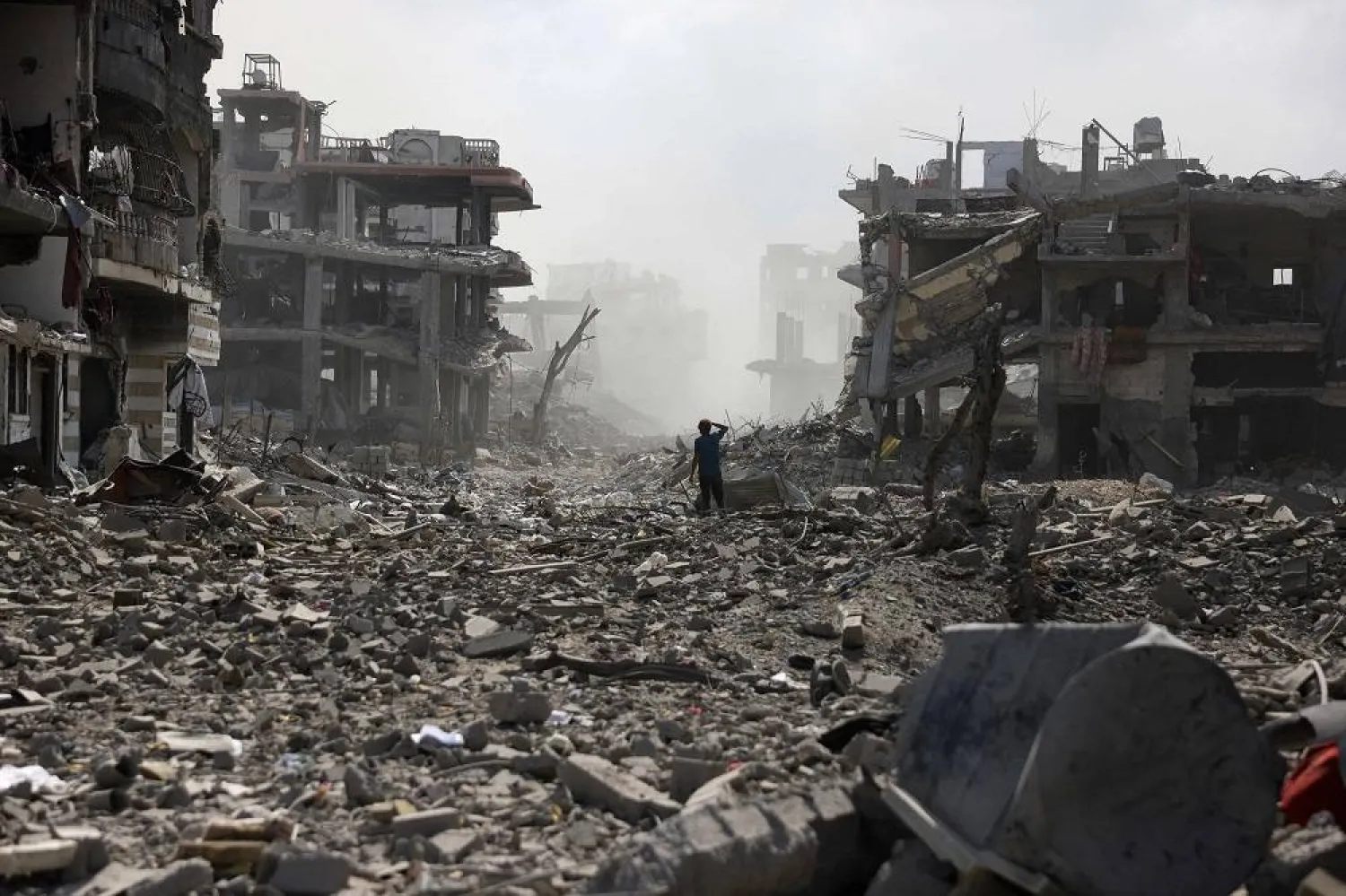
A Palestinian youth stands on a street strewn with rubble following an explosion in the Saftawi neighborhood, west of Jabalia in the northern Gaza Strip on August 25, 2025, amid the ongoing war between Israel and the Palestinian group Hamas. (AFP)
TT

Israel Hits Gaza Hospital Twice, Killing at Least 20 People, Including Five Journalists

A Palestinian youth stands on a street strewn with rubble following an explosion in the Saftawi neighborhood, west of Jabalia in the northern Gaza Strip on August 25, 2025, amid the ongoing war between Israel and the Palestinian group Hamas. (AFP)

Israel struck one of the main hospitals in the Gaza Strip with a missile Monday and then fired another as journalists and rescue workers rushed to the scene, killing at least 20 people and wounding scores more, local health workers said. 

It was among the deadliest of several Israeli strikes that have hit both hospitals and journalists over the course of the 22-month war sparked by Hamas' Oct. 7, 2023, attack, and the attack came as Israel plans to widen its offensive to heavily populated areas. 

The first strike hit a top floor of a building at Nasser Hospital in the southern city of Khan Younis. Minutes later, as journalists and rescuers in orange vests rushed up an external staircase, a second missile hit, said Dr. Ahmed al-Farra, head of Nasser’s pediatrics department. 

Among those killed was 33-year-old Mariam Dagga, a visual journalist who had worked for The Associated Press. Dagga regularly reported for multiple outlets from the hospital, including a recent story for the AP on doctors struggling to save children from starvation. 

Another victim was Mohammed Salama, who worked for Qatar-based broadcaster Al Jazeera, Moaz Abu Taha, a freelance journalist who worked with several news organizations including occasionally contributing to Reuters, and Ahmed Abu Aziz.   

Photographer Hatem Khaled, also a Reuters contractor, was wounded. 

The Israeli military said it struck targets in the area of the hospital. It said it would investigate, and that it “regrets any harm to uninvolved individuals and does not target journalists as such.” 

A Reuters spokesperson said in a statement: "We are devastated to learn that cameraman Hussam al-Masri, a contractor for Reuters, was killed this morning in Israeli strikes on Nasser hospital in Khan Younis in Gaza. Moaz Abu Taha, a freelance journalist whose work had been occasionally published by Reuters, was also killed, and photographer Hatem Khaled, a Reuters contractor, was wounded."   

"We are urgently seeking more information and have asked authorities in Gaza and Israel to help us get urgent medical assistance for Hatem," the spokesperson added. 

Israel has attacked hospitals multiple times throughout the war, asserting that Hamas embeds itself in and around the facilities, though Israeli officials rarely provide evidence. Hamas security personnel have been seen inside such facilities over the course of the war, and parts of those sites have been off limits to reporters and the public. 

The hospitals that remain open have been overwhelmed by the dead, wounded and now by increasing numbers of malnourished as parts of Gaza are now in famine. 

A doctor describes ‘chaos, disbelief and fear’ 

The first Israeli strike at around 10:10 a.m. hit the hospital’s fourth floor, which has surgical operating rooms and doctor’s residences, killing at least two people, said Zaher al-Waheidi, head of the records department at the Gaza Health Ministry. 

The second strike on the stairwell killed 18 others, including rescuers and the journalists, al-Waheidi told the AP. He said around 80 people were wounded, including many who were in the hospital’s courtyard. 

Journalists often used the external staircase as a location for live TV spots and to pick up an internet signal. 

A British doctor working on the floor that was hit said the second strike came before people could start evacuating from the first. 

“Just absolute scenes of chaos, disbelief and fear,” the doctor said. They described wounded people leaving trails of blood as they entered the ward. The hospital was already overwhelmed, with patients with IV drips lying on the floor in the corridors in stifling heat. 

The doctor spoke on condition of anonymity in line with regulations from their organization to avoid reprisals from Israeli authorities. 

“It leaves me in another state of shock that hospitals can be a target,” the doctor said. “You go to work as a health care professional, and you should be protected in the place you work. But you are not." 

Nasser Hospital has withstood raids and bombardment during the war, with officials repeatedly noting critical shortages of supplies and staff. 

A June strike on the hospital killed three people, according to the Health Ministry. The military said at the time that it targeted a Hamas command and control center. A March strike on its surgical unit days after Israel ended a ceasefire killed a Hamas official and a 16-year-old boy. 

Prime Minister Benjamin Netanyahu’s office did not immediately respond to questions about Monday's strikes. They came days after the Israeli military's Arabic spokesperson urged health officials to evacuate patients from northern Gaza to facilities in the south ahead of Israel's offensive in Gaza City. 

More Palestinians killed while seeking aid  

Al-Awda Hospital said Israeli gunfire killed six aid-seekers trying to reach a distribution point in central Gaza and wounded another 15. 

The shootings were the latest in the Netzarim Corridor, a military zone where UN convoys have been overrun by looters and desperate crowds, and where people have been shot and killed while heading to sites run by the Gaza Humanitarian Foundation, an Israeli-backed American contractor. 

The GHF denied that any shootings had occurred near its site. There was no immediate comment from the Israeli military, which has said after previous shootings that it only fires warning shots. 

Al-Awda said two Israeli strikes in central Gaza killed six Palestinians, including a child. Shifa Hospital in Gaza City said three Palestinians, including a child were killed in a strike there. 

One of the deadliest wars for journalists  

The war in Gaza has been one of the bloodiest for media workers, with 189 Palestinian journalists killed by Israeli fire, according to the Committee to Protect Journalists.  

It called for "the international community to hold Israel accountable for its continued unlawful attacks on the press". 

More than 1,500 health workers have also been killed, according to the UN. 

The Palestinian Journalists Syndicate condemned Israel for the strikes, saying it represented "an open war against free media, with the aim of terrorizing journalists and preventing them from fulfilling their professional duty of exposing its crimes to the world".   

The syndicate said more than 240 Palestinian journalists have been killed by Israeli fire in Gaza since the war started.   

Two weeks ago, Israel killed prominent Al Jazeera correspondent Anas Al-Sharif and four other journalists in a strike. In that attack, Israel acknowledged targeting Sharif and said he worked for Hamas, which the broadcaster denied. 

Israel has barred all foreign journalists from entering the Gaza Strip since the start of the war in 2023. Reporting from the territory throughout the war has been produced by Palestinian journalists, many of whom have worked for many years for international media organizations, including wire services such as Reuters and the Associated Press. 

Israel has also separately said it is investigating the death of Issam Abdallah, a Reuters journalist killed in southern Lebanon by Israeli tank fire in October 2023 after the Gaza conflict erupted. Israel has not announced any findings. 

The health ministry said Sunday that at least 62,686 Palestinians have been killed in the war. It does not distinguish between fighters and civilians but says around half have been women and children. The ministry is part of the Hamas-run government and staffed by medical professionals. The UN and independent experts consider it the most reliable source on war casualties. Israel disputes its figures but has not provided its own. 

The war began when Hamas-led fighters abducted 251 people and killed around 1,200 people, mostly civilians, in the 2023 attack. Most of the hostages have been released in ceasefires or other deals, but 50 remain in Gaza, with around 20 believed to be alive. 

Hostages’ families fear a new offensive will further endanger their loved ones, and Israel has seen mass protests calling for a ceasefire deal that would bring them home. 


Egyptian Gaza Relief Group Says Israeli Strike on Photographers Was Deliberate

An aid distribution point in northern Gaza operated by the Egyptian Relief Committee (Egyptian Relief Committee)
TT

Egyptian Gaza Relief Group Says Israeli Strike on Photographers Was Deliberate

An aid distribution point in northern Gaza operated by the Egyptian Relief Committee (Egyptian Relief Committee)

The spokesperson for the Egyptian Relief Committee in Gaza, Mohamed Mansour, said Israel deliberately targeted three photojournalists while they were carrying out a humanitarian mission inside the Netzarim camp, an area located about six kilometers away from Israeli army forces.

Mansour told Asharq Al-Awsat that the attack was “a continuation of Israeli pressure on the committee’s work since it began operating, as part of the occupation’s efforts to tighten restrictions on anyone attempting to provide relief work and humanitarian services to the people of Gaza.”

The Israeli army killed three photojournalists on Wednesday who were working as a media team for the Egyptian Relief Committee for Gaza.

Field sources told Asharq Al-Awsat that the victims were Mohammed Salah Qashta, Abdul Raouf Shaat, and Anas Ghneim.

They were carrying out a filming mission using a small drone and cameras to document stages of work at camps that the Egyptian committee is helping to establish.

Mansour stressed that “the targeting of the photographers will only increase the committee’s determination to provide relief services and shelter to the Palestinian people.”

He said the committee would continue its work as usual to be “a genuine support for the people of the Strip, amid extremely complex security conditions.”

Israeli Army Radio reported, citing sources, that Egypt sent an angry message to Israel following the attack in Gaza in which Palestinians working for the Egyptian committee for the reconstruction were killed.

According to the radio report, Egypt expressed its protest that the attack took place outside the boundaries of the so-called yellow line, in an area that does not pose a threat to Israeli forces.

For its part, the Israeli army claimed it had targeted suspects operating a “Hamas-affiliated drone” in central Gaza.

In a statement on Wednesday, the army said: “Following the identification of the drone and due to the threat it posed to the forces, the Israeli army precisely struck the suspects who were operating the drone.”

The army said the details were under review.


Israel Launches Wave of Fresh Strikes on Lebanon

Smoke and sparks ascend from the site of an Israeli airstrike that targeted a building in the southern Lebanese village of Kfour on January 21, 2026. (AFP)
TT

Israel Launches Wave of Fresh Strikes on Lebanon

Smoke and sparks ascend from the site of an Israeli airstrike that targeted a building in the southern Lebanese village of Kfour on January 21, 2026. (AFP)

Israel launched fresh strikes on what it said were Hezbollah targets in south Lebanon after raids earlier Wednesday killed two people, the latest violence despite a year-old ceasefire with the group.

The state-run National News Agency said Israeli warplanes launched raids on buildings in several south Lebanon towns including Qanarit and Kfour, after the Israeli army issued evacuation warnings to residents identifying sites it intended to strike there.

An AFP photographer was slightly wounded along with two other journalists who were working near the site of a heavy strike in Qanarit.

The Israeli army said it was striking Hezbollah targets in response to the group's "repeated violations of the ceasefire understandings".

Under heavy US pressure and fears of expanded Israeli strikes, Lebanon has committed to disarming Hezbollah.

But Israel has criticized the Lebanese army's progress as insufficient and has kept up regular strikes, usually saying it is targeting members of the Iran-backed group or its infrastructure.

Earlier Wednesday, the health ministry said an Israeli strike on a vehicle in the town of Zahrani, in the Sidon district, killed one person.

An AFP correspondent saw a charred car on a main road with debris strewn across the area and emergency workers in attendance.

Later, the ministry said another strike targeting a vehicle in the town of Bazuriyeh in the Tyre district killed one person.

Israel said it struck Hezbollah operatives in both areas.

A Lebanese army statement decried the Israeli targeting of "civilian buildings and homes" in a "blatant violation of Lebanon's sovereignty" and the ceasefire deal.

It also said such attacks "hinder the army's efforts" to complete the disarmament plan.

This month, the army said it had completed the first phase of its plan to disarm Hezbollah, covering the area south of the Litani river, around 30 kilometers (20 miles) from the Israeli border.

Most of Wednesday's strikes were north of the river.

More than 350 people have been killed by Israeli fire in Lebanon since the ceasefire, according to an AFP tally of health ministry reports.

The November 2024 truce sought to end more than a year of hostilities, but Israel accuses Hezbollah of rearming, while the group has rejected calls to surrender its weapons.


Syria’s Rifaat Al-Assad, ‘Butcher of Hama’, Dies Aged 88, Say Sources

Rifaat al-Assad, uncle of deposed Syrian ruler Bashar al-Assad. (AP file)
TT

Syria’s Rifaat Al-Assad, ‘Butcher of Hama’, Dies Aged 88, Say Sources

Rifaat al-Assad, uncle of deposed Syrian ruler Bashar al-Assad. (AP file)

Rifaat al-Assad, uncle of deposed Syrian ruler Bashar al-Assad and dubbed the "Butcher of Hama" for suppressing an uprising in the 1980s, has died aged 88, two sources close to the family said Wednesday.

Once a pillar of the Assad family's dynastic rule, Rifaat "died after suffering from influenza for around a week", one source who worked in Syria's presidential palace for over three decades told AFP.

A second source, an ex-officer of Syria's army in the Assad era, confirmed the death, saying Rifaat had moved to the United Arab Emirates after his nephew's government was toppled by opposition factions in December 2024, without specifying if he died there.

Rifaat's role in a February 1982 massacre as part of a crackdown on an armed revolt by the Muslim Brotherhood earned him the nickname "the Butcher of Hama", referring to the central Syrian city.

His brother Hafez al-Assad, who ruled Syria at the time, launched the campaign, which government forces carried out under the command of Rifaat, who was the head of the elite "Defense Brigades".

The death toll from 27 days of violence, which took place under a media blackout, has never been formally established, though estimates range from 10,000 to 40,000.

Swiss prosecutors had accused Rifaat of a long list of crimes, including ordering "murders, acts of torture, inhumane treatment and illegal detentions" while an officer in the Syrian army.

He also served as vice president under his brother Hafez but went into exile in 1984 after a failed attempt to overthrow him, moving to Switzerland then France.

He later presented himself as an opponent of his nephew Bashar, who succeeded Hafez in 2000.

In 2021, he returned to Syria from France to escape a four-year prison sentence for money laundering and misappropriation of Syrian public funds.

Two years later, he appeared in a family photo alongside Bashar, the ruler's wife Asma and other relatives.

Shortly after Bashar's ouster, Rifaat crossed into Lebanon and then flew out of Beirut airport, a Lebanese security source said at the time, without specifying his final destination.
