
UN Inquiry on Israeli Violence Hampered by Funding Shortfall, Document Shows

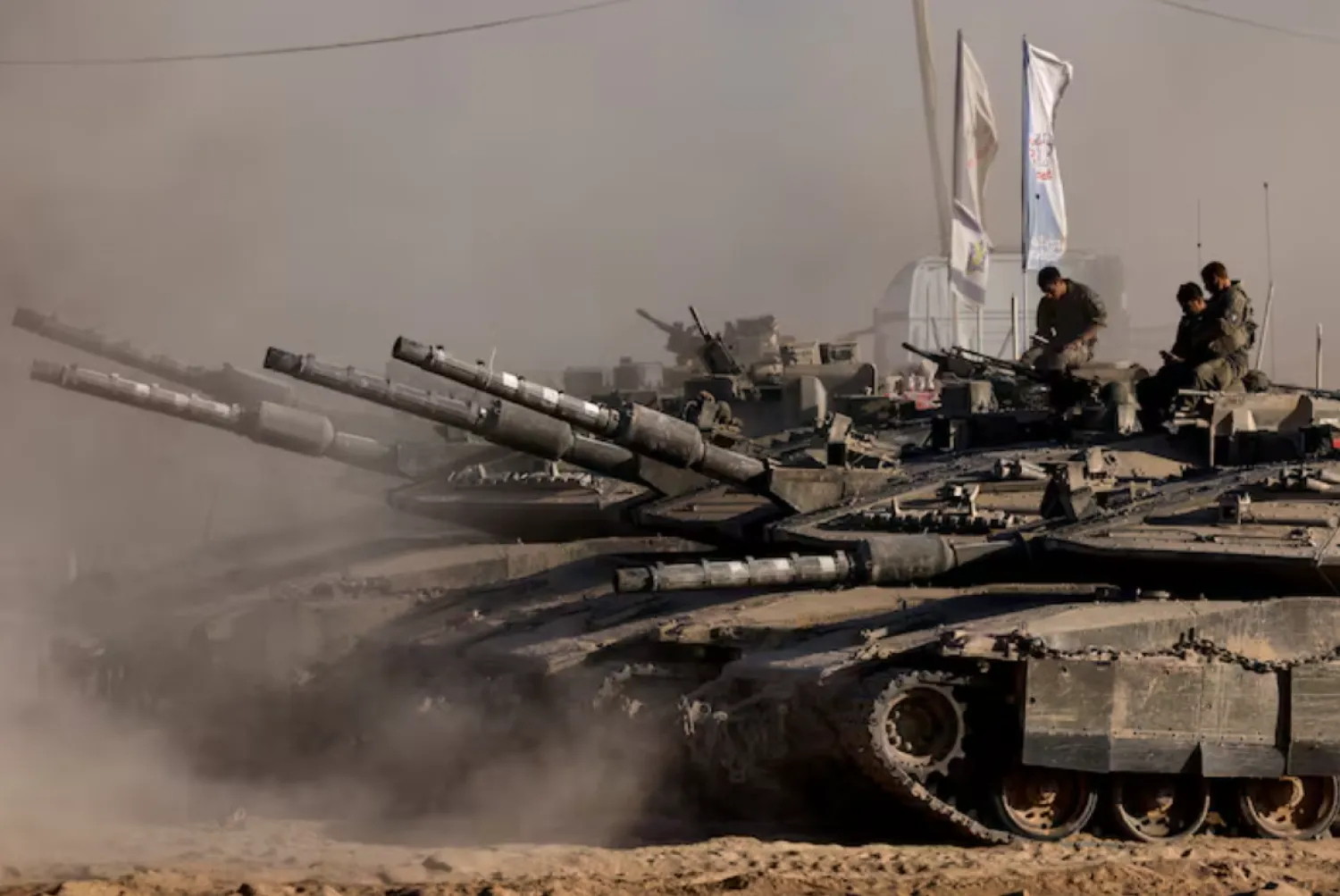
Israeli soldiers sit on top of tanks at the Israel-Gaza border, as seen from Israel, August 26, 2025. REUTERS/Amir Cohen
TT

UN Inquiry on Israeli Violence Hampered by Funding Shortfall, Document Shows

Israeli soldiers sit on top of tanks at the Israel-Gaza border, as seen from Israel, August 26, 2025. REUTERS/Amir Cohen

A team of UN investigators tasked with researching cases of violence by Israeli settlers and the transfer of arms to Israel for use in the Gaza war cannot complete their work because of financial constraints, a document showed. The incident shows how dire funding shortages in the UN system, caused by donor fatigue and belt-tightening, are harming global accountability efforts for abuses after a Congo probe was stalled earlier this year, Reuters reported.

The Independent International Commission of Inquiry on the Occupied Palestinian Territory - established in May 2021 by the Geneva-based Human Rights Council - can provide evidence of international crimes used in pre-trial investigations by tribunals like the International Criminal Court.

Last year the council approved a request from Pakistan to research additional evidence on arms transfers to Israel in the context of the Gaza war and Israeli settler violence.

But Navi Pillay who heads the inquiry told the council's president in an August 6 letter that a lack of funds meant it was unable to hire staff. "The Commission has started informing the sponsors of the two resolutions that it will be unable to produce these mandated reports and present them to the Council in March 2026," said Pillay, who has served as a judge at the ICC and is a former UN High Commissioner for Human Rights. Israel has regularly criticized the commission, which has condemned actions by the Israeli military since it launched its Gaza offensive after the deadly Hamas attacks of October 7, 2023. A backlog of UN mandatory fees, including from top donor the United States which owes around $1.5 billion, has worsened a long-running UN liquidity crisis. In response, the global body plans to cut its budget by 20%.

Overall, 12 of the current 47 voting members on the council - set to meet in September to discuss crises in Sudan and Afghanistan - have outstanding fees, according to a tally by the International Service for Human Rights.

Nada Al Nashif, Deputy High Commissioner for Human Rights, said investigations were now running at around 50% staffing levels.

"Without the timely availability of funds, implementation has become and will continue to be increasingly constrained and in some cases it will simply not be possible," she said.


Gaza Deal: Cairo Talks Aim to Settle Sector’s ‘Administrative Committee’

Displaced Palestinians stand beside a pool of rainwater amid makeshift shelters at the Bureij refugee camp in central Gaza (AFP). 
TT

Gaza Deal: Cairo Talks Aim to Settle Sector’s ‘Administrative Committee’

Displaced Palestinians stand beside a pool of rainwater amid makeshift shelters at the Bureij refugee camp in central Gaza (AFP). 

Cairo is hosting renewed consultations on the Gaza ceasefire agreement, which entered into force on Oct. 10, following the arrival of a delegation from Hamas and amid anticipation of an announcement on the committee that will administer the territory.

Experts told Asharq Al-Awsat that the talks provide an important boost at a critical moment for the second phase of the Gaza agreement, which has been stalled for some time. They stressed that moving forward hinges largely on US will and pressure on Israel.

A Palestinian source said Monday that a Hamas delegation headed by the movement’s leader, Khalil al-Hayya, arrived in Cairo to discuss the second phase and push ahead with the ceasefire deal. The source added that indications suggest the Gaza administration committee will be finalized during the Cairo round, with factions briefed on the names, particularly after recent changes prompted by Israeli objections.

Hamas Political Bureau member Mohammed Nazzal said in televised remarks Sunday night that the delegation would discuss follow-up on implementing the ceasefire amid “major difficulties hindering its application and continued Israeli violations.”

He said the delegation would hold meetings with Palestinian factions and forces, as well as with Egyptian officials, to discuss several files linked to the agreement.

These include ways to consolidate the ceasefire and move to subsequent phases, alongside key issues - foremost the formation of a Palestinian technocratic committee to administer Gaza - aimed at preventing Israeli Prime Minister Benjamin Netanyahu from reneging on or delaying the deal.

Former Egyptian assistant foreign minister and member of the Egyptian Council for Foreign Affairs, Ambassador Rakha Ahmed Hassan, said the Cairo consultations are highly significant and could revive the stalled agreement.

He pointed to anticipation surrounding US President Donald Trump’s announcement of a Peace Council, followed by the Gaza administration committee, adding that discussions would also cover approaches to dealing with weapons in Gaza to undercut Netanyahu’s justifications.

He suggested Hamas would press for full implementation of the first phase first, including opening the Rafah crossing from the Palestinian side, increasing aid, maintaining the ceasefire, and Israel’s withdrawal from Gaza in parallel with any later steps.

On the Egyptian front, Foreign Minister Badr Abdelatty stressed, during a Cairo meeting with Irish Minister for Migration, Trade and Defense Helen McEntee, the importance of announcing a temporary Palestinian technocratic committee to manage daily affairs in Gaza and forming an international stabilization force.


Lebanese Govt Vows to Carry out Second Phase of Plan to Impose State Monopoly over Arms

Lebanese Prime Minister Nawaf Salam and ambassadors of the quintet countries meet at the Grand Serail in Beirut. (Lebanese government's press office)
TT

Lebanese Govt Vows to Carry out Second Phase of Plan to Impose State Monopoly over Arms

Lebanese Prime Minister Nawaf Salam and ambassadors of the quintet countries meet at the Grand Serail in Beirut. (Lebanese government's press office)

Lebanese Prime Minister Nawaf Salam stressed on Monday that his country is determined to carry out the second phase of imposing state monopoly over weapons that the government approved last year.

The army is expected to kick off in February the second phase of the plan, which covers areas north of the Litani River. The first phase, covering south of the river, is close to completion.

Salam received at the Grand Serail in Beirut on Monday ambassadors of the quintet committee overseeing the ceasefire with Israel. The quintet includes Saudi Ambassador to Lebanon Waleed al-Bukhari, French Ambassador Herve Magro, Qatari Ambassador Sheikh Saud bin Abdulrahman Al Thani, Egyptian Ambassador Alaa Moussa, and the United States' Ambassador Michel Issa.

After the talks, Salam said he expressed his gratitude to the envoys for their continued support for his reformist government and the army's disarmament plan.

"I stressed to them our firm determination to implement the second phase of the plan," he added.

Egyptian envoy Moussa said the meeting tackled several issues, including Lebanon's economic reforms and the disarmament plan.

The Lebanese state and army are on the right path, he remarked.

"We have positively assessed the first phase and the state's efforts have been very encouraging," he added.

Moreover, he stressed that Egypt is maintaining its efforts to de-escalate the tensions in Lebanon, especially in the South.

"Our sole goal is to create the circumstances that would ease the tensions," Moussa said.

"We are informing the Lebanese government of all of our efforts. We believe that if the situation is left without Egyptian or non-Egyptian efforts, then the chances of escalation will be greater," he continued.

"We have so far averted the situation from deteriorating," he added.

Meanwhile, Hezbollah has opposed efforts to kick off the second phase of the disarmament plan. It had already objected to its disarmament altogether.

Hezbollah MP Hussein Ezzedine said: "The government should work on getting the enemy to unconditionally withdraw from Lebanese territories it is occupying and release prisoners."

He said it should "avoid making concessions at the expense of the national interest, which will only encourage the enemy to continue to extort" Lebanon.


UN Force Says Israeli Tank Fired near Peacekeepers in Lebanon

United Nations peacekeepers with the UN Interim Force in Lebanon (UNIFIL) patrol in vehicles together with Lebanese soldiers in the Buwayda region of Marjayoun, near the border with Israel in southern Lebanon, on January 8, 2026. (Photo by Rabih DAHER / AFP)
TT

UN Force Says Israeli Tank Fired near Peacekeepers in Lebanon

United Nations peacekeepers with the UN Interim Force in Lebanon (UNIFIL) patrol in vehicles together with Lebanese soldiers in the Buwayda region of Marjayoun, near the border with Israel in southern Lebanon, on January 8, 2026. (Photo by Rabih DAHER / AFP)

The United Nations Interim Force in Lebanon said an Israeli tank fired near its peacekeepers on Monday, and warned that such attacks were becoming "disturbingly common".

UNIFIL has repeatedly reported Israeli fire near or towards its personnel in recent months, and less than two weeks ago said gunfire from an Israeli position hit close to peacekeepers twice, said AFP.

"UNIFIL peacekeepers observed two Merkava tanks move" from an Israel army position inside Lebanese territory "further into Lebanon" on Monday, the force said in a statement.

UNIFIL has acted as a buffer between Israel and Lebanon for decades, and recently has been working with Lebanon's army to support a year-old ceasefire between Israel and militant group Hezbollah.

Under the November 2024 truce, Israel was to withdraw its forces from south Lebanon, but it has kept them in five areas it deems strategic and carries out regular strikes on Lebanon, usually saying it is targeting Hezbollah sites and operatives.

"The peacekeepers requested through liaison channels that the tanks stop their activity," the statement said.

Later, "one of the tanks fired three shells from its main gun, with two impacts approximately 150 meters away from the peacekeepers," UNIFIL said, adding that "as the peacekeepers moved away for safety, they were continuously tracked with a laser from the tanks".

The statement reported no casualties but noted UNIFIL had informed the Israeli army of its activities in the area in advance.

"Attacks like these on identifiable peacekeepers ... are becoming disturbingly common," the statement said, urging a stop to such incidents.

It called them "a serious violation" of United Nations Security Council Resolution 1701, which ended a 2006 war between Israel and Hezbollah and forms the basis of the current truce.

Under heavy US pressure and fears of expanded Israeli strikes, Beirut has committed to disarming Hezbollah, and last week Lebanon's army said it had finished doing so in the area near the border.

UNIFIL's final mandate ends this year, and the force is to leave Lebanon in 2027.