
With Israel’s Offensive Drawing Close, Palestinians in Gaza City Fear Permanent Displacement 

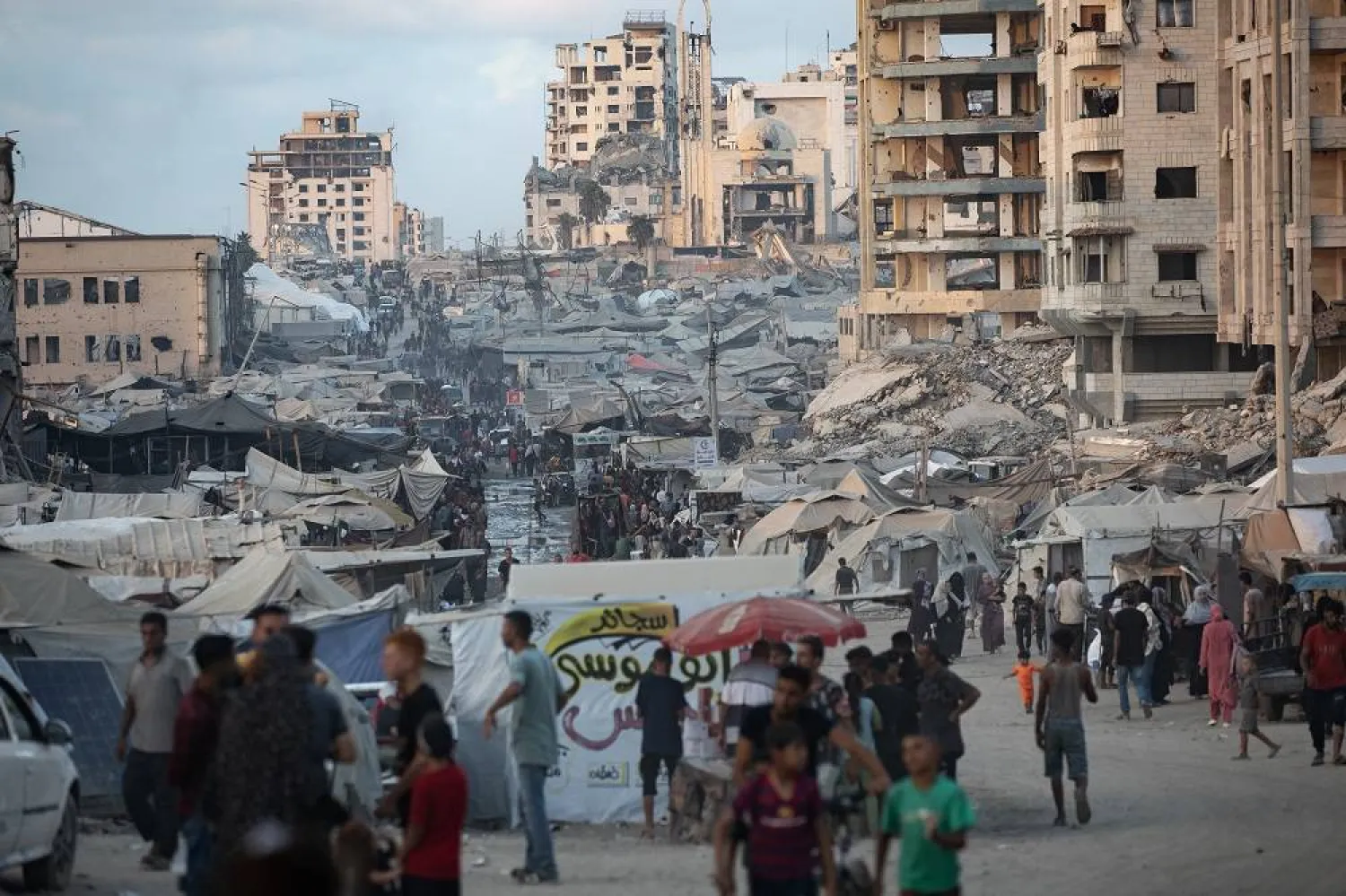
Displaced Palestinians from the northern Gaza Strip flee with their belongings to a displacement camp along Al-Rasheed Street, west of Gaza City, 02 September 2025. (EPA) 
TT

With Israel’s Offensive Drawing Close, Palestinians in Gaza City Fear Permanent Displacement 

Displaced Palestinians from the northern Gaza Strip flee with their belongings to a displacement camp along Al-Rasheed Street, west of Gaza City, 02 September 2025. (EPA) 

As artillery and bombs pound around Gaza's largest city and Israel promises a punishing new offensive, Palestinians in the city are paralyzed with fear unsure where to go, when to leave and if they will ever return.

Israel has declared Gaza City, in the north of the territory, to be a combat zone while the military moves forward with plans to overtake it in a campaign to push Hamas into submission. Parts of the city are already considered “red zones,” where Palestinians have been ordered to evacuate ahead of expected heavy fighting.

That has left residents — many of whom returned after fleeing the city in the initial stages of the Israel-Hamas war — on edge. With Israeli bulldozers razing the ground in occupied neighborhoods and Israeli leaders supporting the mass relocation of Palestinians from Gaza, departing the city now could mean leaving for good. Moving costs thousands of dollars and finding space in the overcrowded south to pitch a tent feels impossible. But staying behind, they say, could be deadly.

“The Israeli forces, when they mark any area by red color and they request the people to leave, they really will destroy it,” said Mohammed Al-Kurdi, who is sheltering in Gaza City along with hundreds of thousands of other Palestinians.

“So it’s like you decide whether to live or die. It’s very simple like that.”

An impossible choice

Since Israel declared the area a combat zone on Friday, a small fraction — some 14,840 Palestinians of the nearly 1 million the UN estimates are in Gaza City — have left their homes in the city as of Monday, most to flee south, according to the Site Management Cluster, a joint humanitarian body that coordinates assistance for people in displacement sites.

A fraction of them, about 2,200, have moved to new places within Gaza City after being displaced by Israeli attacks.

Al-Kurdi, a project manager and consultant, said he can hear Israeli forces from the apartment where he's sheltering as they “erase the area completely.”

Zeitoun was once Gaza City’s largest neighborhood, filled with markets, schools and clinics. Over the last month, large swaths of it and the neighboring area of Sabra have been flattened, according to satellite photos reviewed by The Associated Press from early August and early September. The photos show that entire blocks that have been pummeled or bulldozed into empty, sandy lots.

“It’s not something partial like before. It’s 100%,” he said. “The house, I’m telling my friends, it keeps dancing all the day. It keeps dancing, going right and left like an earthquake.”

Many of the people in the city moved back to the north during a ceasefire in January, hoping to find their homes intact. Al-Kurdi's home was completely destroyed, so he's now living alone in a western area of the city. His children and wife were able to leave Gaza last year. He said he would flee south if his home fell under an evacuation order.

Amjad Shawa, the director of the Palestinian NGO network, left his home in the upscale Rimal neighborhood in the early days of the war and also returned there with his family in January. He, like Al-Kurdi, said his family would likely leave Gaza City if their area receives an evacuation order.

But leaving this time would be different, he said. “Gaza will be leveled and destroyed. Last time, I had my car. There was fuel. Everyone had his income, his money."

Back then, the cities of Rafah and Khan Younis still stood in southern Gaza.

Now, after months of bombardment, “there is no Rafah. Almost no Khan Younis,” Shawa said.

Leaving is nearly impossible for some

For others — medical workers, older and sick people — leaving Gaza City is nearly impossible.

“The elders, they're saying we will die here,” Shawa said. “This has pushed the other members of the family to stay, not to leave.”

“My aunt is elderly and can’t walk, and my mother also struggles with mobility. We have so many belongings and no way to manage them. It feels unthinkable,” said Norhan Almuzaini, medical program officer in northern Gaza for the group Medical Aid for Palestinians.

Amal Seyam is the general director of the Women’s Affairs Center in Gaza. Originally from the Tuffah neighborhood in eastern Gaza City, her home was destroyed by bombardment. For nearly four months, she has been sheltering in the Nasr neighborhood in the city's west, where she stays alongside her colleagues inside the women’s center.

Seyam has been displaced five times since the war began — three times within the city and twice to the south, in Rafah and Khan Younis. Each time, she fled with nothing.

When asked if she would consider leaving Gaza City, she said: “I will only leave when everyone who needs me here leaves. As long as there’s a woman who needs me, I am staying. All of Gaza feels like it’s in the red zone now anyway. The bombing is happening meters from us, not kilometers.”

She paused, her voice breaking into tears.

“Many people have started packing. Many have already left. Do you know what displacement means? It means moving once again, building your life once again, buying new things, blankets, tents, all over again.”

Dire conditions persist throughout Gaza

Those who have left Gaza City over the past few months have found dire conditions elsewhere in Gaza. Their arrival has crowded already overflowing tent camps and sent prices of basic goods up.

Iman El-Naya, from Khan Younis, fled Gaza City three months ago. “The beach is crowded. Everywhere is crowded. There’s no hygiene. It’s a struggle to get water and food.”

“I go and stand in line for water. Getting bread is a struggle. Everything is even more expensive after the people from the north came here.”

Shorouk Abu Eid, a pregnant woman from Gaza City, was displaced to Khan Younis four months ago. She said the arrival of more people from the north is creating an even more tragic situation.

“There is no privacy, no peace of mind. Places I used to walk to in five or 10 minutes are taking me around an hour now because of the congestion. There’s barely 10 centimeters between tents.”

Jamal Abu Reily lamented that the bathrooms are overflowing and that there's so little room for new arrivals.

“How are we going to all fit here? he asked. “Where are they going to stay? In the sea?”


Syria Gives Kurds Four Days to Accept Integration as US Signals End of Support

 A member of the Syrian army stands guard on the road towards Al-Hasakah, following the withdrawal of the Syrian Democratic Forces, Syria, January 20, 2026. (Reuters)
A member of the Syrian army stands guard on the road towards Al-Hasakah, following the withdrawal of the Syrian Democratic Forces, Syria, January 20, 2026. (Reuters)
TT

Syria Gives Kurds Four Days to Accept Integration as US Signals End of Support

 A member of the Syrian army stands guard on the road towards Al-Hasakah, following the withdrawal of the Syrian Democratic Forces, Syria, January 20, 2026. (Reuters)
A member of the Syrian army stands guard on the road towards Al-Hasakah, following the withdrawal of the Syrian Democratic Forces, Syria, January 20, 2026. (Reuters)

Syria's government set a four-day deadline on Tuesday for Kurdish-led forces to agree on integrating their last enclave into the central state as their former main ally, the United States, urged them to do so.

US envoy Tom Barrack in a social media post described integration as the "greatest opportunity" ‌the Kurds ‌now have in Syria.

He added that ‌the ⁠original purpose ‌of the Syrian Democratic Forces as a counterweight to ISIS militants had largely expired, and that the US had no long-term interest in retaining its presence in Syria, signaling the apparent end of Washington's backing.

The SDF, which has lost swathes of territory during government advances in ⁠recent days, said it accepted a ceasefire agreement with the Damascus government ‌and that it would not engage ‍in any military action ‍unless attacked.

A Syrian government statement said it had ‍reached an understanding with the SDF, long backed by the United States in the battle against ISIS, for it to devise an integration plan for Hasakah province or risk state forces entering two SDF-controlled cities.

The government announced a four-day ceasefire and said it had asked ⁠the SDF to submit the name of a candidate to take the role of assistant to the defense minister in Damascus as part of the integration.

The swift reversal for the SDF along one of Syria's main faultlines marks the biggest shift in territorial control in Syria since Sharaa toppled President Bashar al-Assad in 2024 and raises questions over the security of facilities holding ISIS detainees.


Israel Orders Gaza Families to Move in First Forced Evacuation Since Ceasefire

A Palestinian girl walks past the rubble of houses destroyed in Israeli strikes during the war, in Khan Younis, southern Gaza Strip, January 17, 2026. (Reuters)
TT

Israel Orders Gaza Families to Move in First Forced Evacuation Since Ceasefire

A Palestinian girl walks past the rubble of houses destroyed in Israeli strikes during the war, in Khan Younis, southern Gaza Strip, January 17, 2026. (Reuters)

Israeli forces have ordered dozens of Palestinian families in the southern Gaza Strip to leave their homes in the first forced evacuation since October's ceasefire, as residents and Hamas said on Tuesday the military was ​expanding the area under its control.

Residents of Bani Suhaila, east of Khan Younis, said the leaflets were dropped on Monday on families living in tent encampments in the Al-Reqeb neighborhood.

“Urgent message. The area is under Israeli army control. You must evacuate immediately,” said the leaflets, written in Arabic, Hebrew, and English, which the army dropped over the Al-Reqeb neighborhood in the town of Bani Suhaila.

In the two-year war before the US brokered ceasefire was signed in October, Israel dropped leaflets over areas that were subsequently raided or bombarded, forcing some families to move several times.

Residents and a source from the Hamas group said this was the first time they had been ‌dropped since then. ‌The Israeli military did not immediately respond to a request for comment.

SIDES FAR ‌APART ⁠ON ​NEXT PHASES

The ‌ceasefire has not progressed beyond its first phase, under which major fighting has stopped, Israel withdrew from less than half of Gaza, and Hamas released hostages in return for Palestinian detainees and prisoners.

Virtually the entire population of more than 2 million people are confined to around a third of Gaza's territory, mostly in makeshift tents and damaged buildings, where life has resumed under control of an administration led by Hamas.

Israel and Hamas have accused each other of major breaches of the ceasefire and remain far apart on the more difficult steps planned for the next phase.

Mahmoud, a resident from the ⁠Bani Suhaila area, who asked not to give his family name, said the evacuation orders impacted at least 70 families, living in tents and homes, ‌some of which were partially damaged, in the area.

"We have fled ‍the area and relocated westward. It is maybe the ‍fourth or fifth time the occupation expanded the yellow line since last month," he told Reuters by phone ‍from Khan Younis, referring to the line behind which Israel has withdrawn.

"Each time they move it around 120 to 150 meters (yards) inside the Palestinian-controlled territory, swallowing more land," the father-of-three said.

HAMAS CITES STATE OF HUMANITARIAN DISRUPTION

Ismail Al-Thawabta, director of the Hamas-run Gaza government media office, said the Israeli military had expanded the area under its control in eastern Khan Younis five times since ​the ceasefire, forcing the displacement of at least 9,000 people.

“On Monday, 19 January 2026, the Israeli occupation forces dropped warning leaflets demanding the forced evacuation of the Bani Suhaila area in eastern ⁠Khan Younis Governorate, in a measure that falls within a policy of intimidation and pressure on civilians,” Thawabta told Reuters.

He said the new evacuation orders affected approximately 3,000 people.

“The move created a state of humanitarian disruption, increased pressure on the already limited shelter areas, and further deepened the internal displacement crisis in the governorate,” Thawabta added.

Israel's military has previously said it has opened fire after identifying what it called "terrorists" crossing the yellow line and approaching its troops, posing an immediate threat to them.

It has continued to conduct air strikes and targeted operations across Gaza. The Israeli military has said it views "with utmost severity" any attempts by militant groups in Gaza to attack Israel.

Under future phases of the ceasefire that have yet to be hammered out, US President Donald Trump's plan envisages Hamas disarming, Israel pulling out further, and an internationally backed administration rebuilding Gaza.

More than 460 Palestinians and three Israeli soldiers have been reported killed since the ceasefire took ‌effect.

Israel launched its operations in Gaza in the wake of an attack by Hamas-led fighters in October 2023 which killed 1,200 people, according to Israeli tallies. Israel's assault has killed 71,000 people, according to health authorities in the enclave.


Syrian Interior Ministry: 120 ISIS Members Escape from Prison amid Clashes

Civilians cross a collapsed bridge linking Raqqa with its western countryside of Tabqa, northern Syria, 19 January 2026. EPA/AHMAD FALLAHA
TT

Syrian Interior Ministry: 120 ISIS Members Escape from Prison amid Clashes

Civilians cross a collapsed bridge linking Raqqa with its western countryside of Tabqa, northern Syria, 19 January 2026. EPA/AHMAD FALLAHA

Syria's ministry of interior said Tuesday that 120 ISIS members escaped from a prison in northeast Syria a day earlier, amid clashes between government forces and the Kurdish-led Syrian Democratic Forces, which guards the prison.

Security forces recaptured 81 of the escapees, “while intensive security efforts continue to pursue the remaining fugitives and take the necessary legal measures against them,” The Associated Press quoted the statement as saying.

The SDF and the government have traded blame over the escape at a prison in the town of Shaddadeh, amid the breakdown of a ceasefire deal between the two sides.

Also Tuesday, the SDF accused “Damascus-affiliated factions” of cutting off water supplies to the al-Aqtan prison near the city of Raqqa, which it called a “blatant violation of humanitarian standards.”

The SDF, the main US-backed force that fought ISIS in Syria, controls more than a dozen prisons in the northeast where some 9,000 ISIS members have been held for years without trial.

Under a deal announced Sunday, government forces were to take over control of the prisons from the SDF, but the transfer did not go smoothly.

On Monday, Syrian government forces and SDF fighters clashed around two prisons housing members of ISIS in Syria’s northeast.

The clashes came as SDF chief commander Mazloum Abdi was said to be in Damascus to attempt to solidify a ceasefire deal reached Sunday that ended days of deadly fighting during which government forces captured wide areas of northeast Syria from the SDF.

Abdi issued no statement after the meeting and the SDF later issued a statement calling for “all of our youth” to “join the ranks of the resistance," appearing to signal that the deal had fallen apart.

Interim President Ahmad al-Sharaa postponed a planned trip to Germany Tuesday amid the ongoing tensions in northeast Syria.