Hamas Reiterates Readiness for Comprehensive Gaza Deal After Trump Remarks

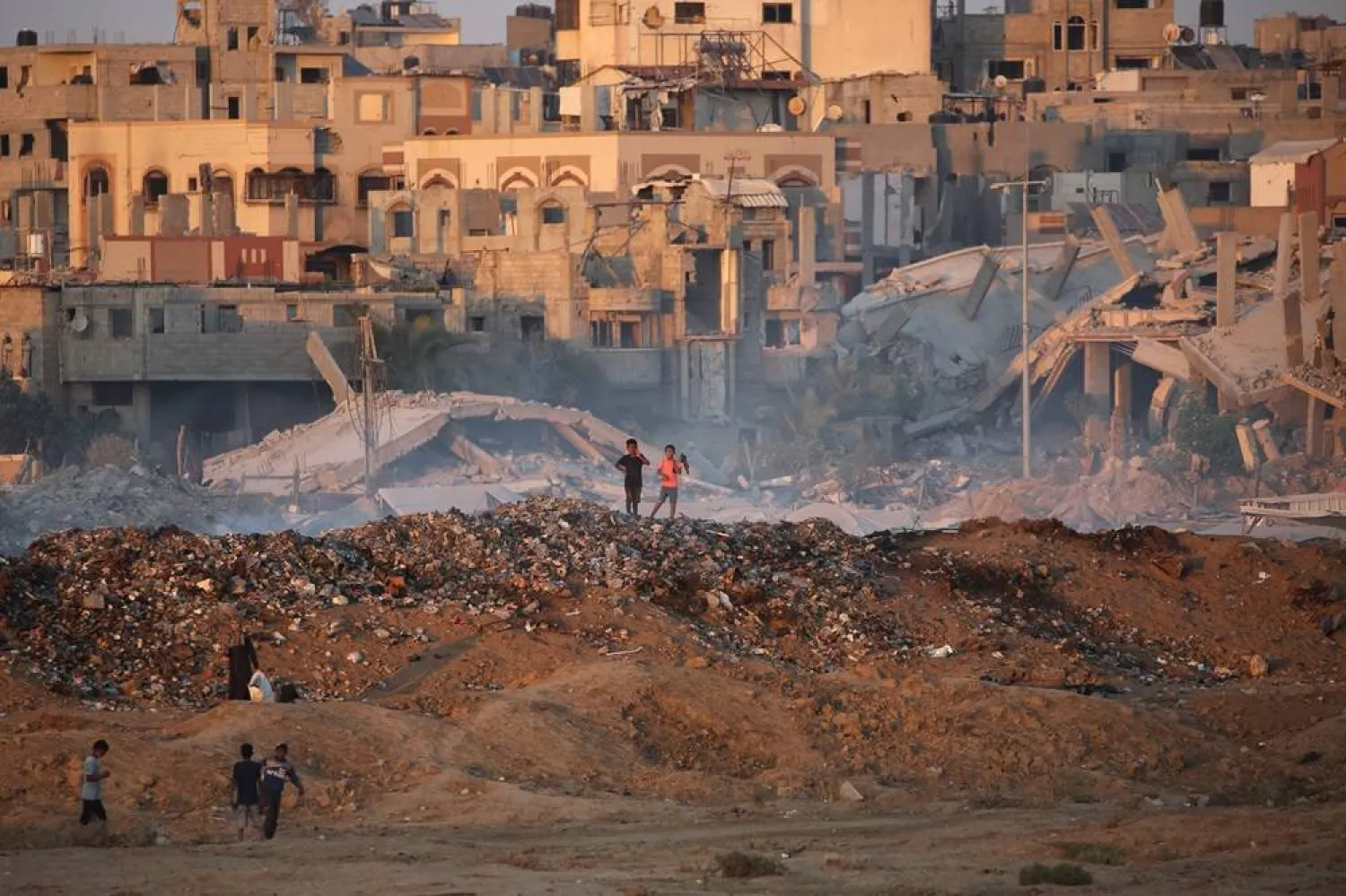
Palestinian children walk over a mound of dirt and trash at the Bureij camp for displaced Palestinians in the central Gaza Strip on September 3, 2025. (AFP)
TT

Hamas Reiterates Readiness for Comprehensive Gaza Deal After Trump Remarks

Palestinian children walk over a mound of dirt and trash at the Bureij camp for displaced Palestinians in the central Gaza Strip on September 3, 2025. (AFP)

Hamas reiterated on Wednesday that it is ready for a comprehensive Gaza deal through which all Israeli hostages are released in exchange for the release of an agreed upon number of Palestinian prisoners.

The group's remarks came shortly after US President Donald Trump called on Hamas to release all 20 hostages.

"Tell Hamas to IMMEDIATELY give back all 20 Hostages (Not 2 or 5 or 7!), and things will change rapidly. IT WILL END!" he said in a post on Truth Social.

Israeli Prime Minister Benjamin Netanyahu's office criticized Hamas' comments in a statement.

"Unfortunately, this is yet another spin by Hamas with nothing new in it," it said.

Netanyahu's office reiterated that the war in Gaza would only end if all hostages were released, Hamas was disarmed, the strip was demilitarized, Israel established security control over the enclave, and an alternative civilian administration was established.

Hamas in August agreed to a 60-day ceasefire proposal with Israel that includes the return of half the hostages held in Gaza and Israel's release of some Palestinian prisoners.

An Egyptian official source said the proposal accepted by Hamas included a suspension of Israeli military operations for 60 days and outlined a framework for a comprehensive deal to end the nearly two-year-old conflict.

Netanyahu said days later that Israel would immediately resume negotiations for the release of all hostages held in Gaza and an end to the war, but on terms acceptable to Israel.


Why Is Hamas Once Again Displaying Its Flags and Threatening a 'New October 7'?

Palestinian Hamas militants stand guard on the day of the release of Keith Siegel,  a US-Israeli dual national hostage held in Gaza since the deadly October 7, 2023 attack, as part of a ceasefire and a hostages-prisoners swap deal between Hamas and Israel, in Gaza City, February 1, 2025. REUTERS/Mohammed Salem
Palestinian Hamas militants stand guard on the day of the release of Keith Siegel, a US-Israeli dual national hostage held in Gaza since the deadly October 7, 2023 attack, as part of a ceasefire and a hostages-prisoners swap deal between Hamas and Israel, in Gaza City, February 1, 2025. REUTERS/Mohammed Salem
TT

Why Is Hamas Once Again Displaying Its Flags and Threatening a 'New October 7'?

Palestinian Hamas militants stand guard on the day of the release of Keith Siegel,  a US-Israeli dual national hostage held in Gaza since the deadly October 7, 2023 attack, as part of a ceasefire and a hostages-prisoners swap deal between Hamas and Israel, in Gaza City, February 1, 2025. REUTERS/Mohammed Salem
Palestinian Hamas militants stand guard on the day of the release of Keith Siegel, a US-Israeli dual national hostage held in Gaza since the deadly October 7, 2023 attack, as part of a ceasefire and a hostages-prisoners swap deal between Hamas and Israel, in Gaza City, February 1, 2025. REUTERS/Mohammed Salem

The reappearance of Hamas flags and those of its military wing, the Al-Qassam Brigades, during the funeral of a field commander killed by Israel after he was targeted while walking was no coincidence. Rather, it was part of a coordinated effort that surprised many observers after a prolonged period during which the movement had refrained from such displays.

The funeral was held for Walid Haniyeh, a field commander in the Al-Qassam Brigades and a relative of former Hamas leader Ismail Haniyeh, who was assassinated by Israel in Tehran in July 2024. It coincided with June 26, the day activists had called for mass protests against Hamas over the deteriorating humanitarian situation in Gaza. The movement paid close attention to the planned mobilization and worked extensively to thwart it, believing that "suspicious" actors were behind it, before the protests ultimately failed to attract significant participation.

Palestinians carry the body of Mohammad Odeh, a commander in the military wing of Hamas, during his funeral in Gaza City on May 27, 2026 (AFP)

Following that funeral, Hamas continued displaying its flags at the funerals of members killed by Israel. Al-Qassam Brigades flags also reappeared, armed men attended the ceremonies, and participants chanted slogans including, "Khaybar, Khaybar, O Jews... October 7 will return." The displays drew the attention of Israeli media, which launched a fresh campaign of incitement against Hamas and the Gaza Strip.

The last time Hamas flags and armed members appeared publicly was during the handover of Israeli hostages under the second prisoner exchange agreement, which began in January 2025, before Israel resumed its military campaign in March of the same year. Israeli forces later used those events to identify Hamas leaders and members who were subsequently killed in a series of targeted assassinations and military operations.

With the scenes recurring recently, particularly as Israeli military operations continue on a smaller scale despite the declared ceasefire in October 2025, Asharq Al-Awsat asked four Hamas sources in the Gaza Strip about the reasons behind the return of flags, armed participants, and the draping of victims' bodies in Hamas and Al-Qassam Brigades flags. All four said the movement's leadership in Gaza had taken a decision, which was circulated across all areas, to resume displaying flags and chanting what they described as "jihadist" slogans at the funerals of members killed by Israel.

Hamas police officers stand guard, amid a ceasefire between Israel and Hamas, in Gaza City, October 11, 2025. REUTERS/Stringer

According to the four sources, each of whom spoke separately, the decision was intended to reaffirm the Hamas leadership's position that the movement remains present and strong, and cannot be defeated through military force or through any Israeli or US plans that bypass an agreement with Hamas over the future of the Gaza Strip and the Palestinian issue as a whole.

One source said one of the reasons behind the move was the calls for what became known as the June 26 public protests. According to the source, Hamas leaders believed there were attempts to create widespread unrest inside Gaza, and wanted the funeral of Walid Haniyeh, held hours before the planned demonstrations, to show that the movement remained strong and cohesive. The other three sources neither confirmed nor denied that account.

All four sources said the armed men appearing at recent funerals were relatives and friends of those killed, some of whom belong to Hamas, and that their participation was neither officially organized nor coordinated.

Regarding threats of repeating October 7 and other slogans described as "jihadist," the sources said such chants are largely spontaneous in their wording. However, an internal directive circulated among officials responsible for organizing local events, including funerals, instructed them to ensure that slogans emphasized the role of the "resistance" and conveyed that it remains active and present, just as it was before the war.

FILE PHOTO: Palestinian Hamas militants stand guard on the day of the handover of hostages held in Gaza since the deadly October 7 2023 attack, as part of a ceasefire and a hostages-prisoners swap deal between Hamas and Israel, in Rafah in the southern Gaza Strip, February 22, 2025. REUTERS/Hatem Khaled/File Photo

Some observers believe the move could provoke Israel and provide it with further justification for escalating military operations in Gaza. Hamas supporters inside and outside the enclave have called for an end to the display of flags and the chanting of such slogans, arguing that Israeli media had exploited them to intensify its campaign of incitement against Gaza, much as it did at the beginning of the war. They also warned that Israeli intelligence could use the funerals to identify field activists and later target them for assassination, as happened previously following prisoner exchanges and other events.

Two Hamas sources acknowledged that such concerns may be valid but argued that Israel does not need additional justifications. They said military operations have continued despite the declared ceasefire, with assassinations and other attacks persisting at varying levels of intensity. According to the sources, more than 1,060 Palestinians have been killed so far as a result of the continuing Israeli military operations.

A third source said: "The reality has certainly changed, and what worked before the war is no longer suited to the current circumstances. But that does not mean complete surrender. Assassinations have repeatedly shown that they do not weaken the movement. Instead, they strengthen its resolve to continue its course."

At the same time, several Israeli television channels and newspapers published reports citing official intelligence assessments submitted to the Israeli military's General Staff and political leadership. The reports claimed Hamas was rebuilding its capabilities in Gaza by manufacturing various types of weapons, restoring some tunnels, and possibly preparing attacks against Israeli forces. They also alleged that the movement continues to reject disarmament, maintain control over humanitarian aid, transfer funds from abroad to Gaza to pay its members, channel funds to its military wing to rebuild its ranks, and recruit new members.

According to the Israeli newspaper Israel Hayom, the Israeli military has intensified targeted assassinations in Gaza in an effort to hinder Hamas' attempts to consolidate its presence while rebuilding its military capabilities. The newspaper quoted a political source as saying: "We are accelerating the pace of assassinations, but remain below the threshold of international criticism. This will continue as long as Hamas is unwilling to disarm."

Fighters from Al-Qassam Brigades, affiliated with Hamas, in the Gaza Strip (Archive)

Meanwhile, Yedioth Ahronoth reported that Yaniv Asor, commander of the Israeli military's Southern Command, has for some time been trying to persuade the General Staff to resume large-scale fighting in Gaza. According to the newspaper, he has so far failed because the political leadership does not currently want to resume full-scale combat, given the constraints imposed by the United States.

The four Hamas sources told Asharq Al-Awsat that Israeli threats and reports in the Hebrew-language media form part of an ongoing campaign of incitement that predates the war, continued throughout it, and persists to this day.

Two of the sources said Hamas is making use of some of the capabilities available to it in preparation to defend Palestinians should Israel resume the war. However, they insisted that the movement does not intend to launch another attack similar to that of October 7, 2023, or any comparable operation. Instead, they said, its objective is to reach an agreement that guarantees Palestinian rights, brings the war to a complete end, ensures humanitarian relief for Gaza's residents, restores the basic necessities of life, and enables the reconstruction of their homes.


Lebanese President Urges US to 'Keep Standing' by Country

FILED - 17 January 2025, Lebanon, Baabda: FILE PHOTO - Lebanese President Joseph Aoun speaks during a press conference at Baabda Palace. Photo: Marwan Naamani/dpa
TT

Lebanese President Urges US to 'Keep Standing' by Country

FILED - 17 January 2025, Lebanon, Baabda: FILE PHOTO - Lebanese President Joseph Aoun speaks during a press conference at Baabda Palace. Photo: Marwan Naamani/dpa

Lebanese President Joseph Aoun on Saturday urged the United States to stand by his country after a recent US-backed framework deal with Israel aiming to permanently end hostilities after the latest Israel-Hezbollah war.

The deal reached in Washington calls for the disarmament of Iran-backed militant group Hezbollah, a gradual Israeli withdrawal from southern Lebanon and the deployment of the Lebanese army there, starting with two "pilot" areas.

Hezbollah has rejected the deal, which does not set a timetable for an Israeli withdrawal.

In a congratulatory message to President Donald Trump marking the United States' 250th anniversary of independence, Aoun urged Washington to "keep always standing beside Lebanon's right and just causes, its institutions, army and people".

Aoun expressed hope that Lebanon could "turn the page on wars... and open a new page of hope, peace and stability".

In a message also marking the independence anniversary, the US embassy in Lebanon said on X that "it is with great pride that we stand with the people of Lebanon as they forge a brighter future -- one of peace, prosperity, and promise long overdue".

Hezbollah drew Lebanon into the Middle East war on March 2 with rocket fire at Israel to avenge the killing of Iran's supreme leader in US-Israeli strikes days earlier.

Israel responded with heavy airstrikes and a ground invasion of southern Lebanon, where its troops still occupy swathes of territory near the border, AFP reported.

An agreement signed by Tehran and Washington on ending the regional war last month also established a ceasefire in Lebanon, which took effect on June 21.

Days later, Lebanon and Israel agreed to the US-backed framework aiming to pave the way for a permanent end to hostilities.

The United Nations International Organization for Migration (IOM) said this week that more than 640,000 displaced people have returned home since June 22.

Lebanese authorities have said the war has killed some 4,300 people and displaced more than one million others.

But many residents are unable to return to towns and villages near the southern border where Israeli troops are still present and many of which have suffered massive destruction.

On a visit to the south on Saturday including the heavily damaged city of Nabatieh, Social Affairs Minister Haneen Sayed said authorities were working on a plan including for "prefabricated houses and rent assistance payments" to help people return home, or to areas nearby.

Israeli has kept up intermittent strikes on south Lebanon despite the ceasefire.

Lebanon's state-run National News Agency (NNA) said an Israeli strike on the village of Mansouri on Saturday wounded one person, also reporting Israeli artillery shelling elsewhere.


Fate of Gaza Strip Eclipsed by Middle East War

04 June 2026, Palestinian Territories, Gaza: Palestinians inspect a damaged house following an Israeli airstrike that targeted an apartment belonging to the Labad family in Gaza City. Photo: Hadi Daoud/APA Images via ZUMA Press Wire/dpa
TT

Fate of Gaza Strip Eclipsed by Middle East War

04 June 2026, Palestinian Territories, Gaza: Palestinians inspect a damaged house following an Israeli airstrike that targeted an apartment belonging to the Labad family in Gaza City. Photo: Hadi Daoud/APA Images via ZUMA Press Wire/dpa

The Gaza war was the spark that touched off years of Middle East conflict culminating in the US-Israeli war with Iran, but as Washington and Tehran wrangle over terms for peace, the devastated territory's fate seems largely out of mind.

"Ever since the United States went to war with Iran, the whole world has forgotten Gaza and its tragedy. We no longer have anyone standing by us," Palestinian Ahmed Jamali, 53, told AFP from the displacement camp in Gaza where he lives.

"We are weak and oppressed, and Israel is doing whatever it wants: killing, destroying and occupying Gaza, while no one in the world lifts a finger."

The apparent inattention paid to the Palestinian territory is all the more striking because it sits at the heart of the chain of events that plunged the region into its most dangerous confrontation in decades.

07 June 2026, Palestinian Territories, Gaza: Mourners gather to bid farewell to several Palestinians, including a child and his father, at al-Shifa Hospital in Gaza City. Photo: Bilal Osama/APA Images via ZUMA Press Wire/dpa

Hamas's unprecedented October 7, 2023 attack on Israel triggered a devastating military response in Gaza, drawing in Tehran-backed allies like Hezbollah in Lebanon and Yemen's Houthis -- and eventually Iran itself.

What began as a local war between Israel and Hamas evolved into a regional conflict and, in turn, a direct confrontation between arch-foes Tehran and Washington.

More than two-and-a-half years later, Gaza remains mired in a severe humanitarian crisis, and despite a fragile ceasefire reached between Israel and Hamas in October 2025, efforts to bring the war to a definitive end have stalled for months.

Although Iranian officials initially spoke of an agreement to end the Middle East war that would encompass the entire region, the preliminary text endorsed by Tehran and Washington last month contains no mention of Gaza.

For analysts, that shows a shift in regional priorities.

"It reflects Hamas's declining strategic value in Iran's eyes," Hugh Lovatt of the European Council on Foreign Relations, told AFP.

Iran has long armed and financed Hamas as part of its "axis of resistance" -- an array of regional forces opposed to Israel and the US -- but the October 2023 attack appears to have fundamentally altered that relationship.

"Iranians do not really care about Gaza. Hamas was an ally, not an Iranian tool," said Israeli military expert Eado Hecht.

"It betrayed them. They did not want war in autumn 2023, it was too early for them."

Palestinians mourn the bodies of Diana Abu Daraz, and her infant daughter, Sewar, who were killed in an Israeli airstrike that struck a tent camp for displaced Palestinians in Khan Younis, Gaza Strip, Tuesday, June 30, 2026. (AP Photo/Abdel Kareem Hana)

Michael Milshtein, another Israeli military analyst, argued that Tehran's calculations have shifted elsewhere.

"It places greater value on preserving Hezbollah as a pillar of the regional balance," he said.

The diplomatic focus has also shifted, with a growing sense of international fatigue over Gaza.

"Gaza is gradually fading from international attention," said Lovatt.

One diplomat involved in negotiations described a widespread belief among governments that "most actors see the issue as insoluble in the short to medium term".

Another veteran diplomat based in Jerusalem told AFP that Gaza's absence from the discussions reflected political paralysis rather than progress.

"Gaza is absent from the agreement not because the war is over, but because no credible political framework exists for the day after," he said.

Israel insists that Hamas must fully disarm before any political transition can begin, while Hamas refuses to surrender its weapons without guarantees that an alternative Palestinian governing authority will replace it.

Neither an international stabilization force nor a credible transitional mechanism has emerged in the months since the ceasefire took effect, both of which were called for in the US-brokered framework that halted the fighting.

Behind the scenes, negotiations over Gaza's future continue in Cairo.

The talks bring together Palestinian factions, including Hamas, alongside the Board of Peace set up by US President Donald Trump and regional players including Qatar and Türkiye.

"Trump may want to give this process a chance," said a source close to the negotiations.

"Whether it succeeds remains to be seen."

Although few details have emerged publicly, diplomatic and security sources told AFP that negotiators are working on a roadmap combining the gradual disarmament of Hamas with the creation of transitional governing authorities for Gaza.

Israeli media has reported that the government would reject such a framework.

"For now, this diplomatic process exists only around the negotiating table," Lovatt said.

"There has been progress, but reconstruction remains a distant prospect, and nothing is changing for the people on the ground."

With diplomacy stalled, concerns are mounting that the fighting could yet resume.

Israeli media have reported military preparations for a possible summer 2026 offensive against Hamas should political negotiations fail.

But military expert Hecht cautioned against assuming that contingency planning meant another war was inevitable.

"Having the military opportunities is not the same as having the political opportunity," he said.

"Preparations are not the same as implementation."

Analyst Milshtein argued that Israel had little leverage left.

In his view, Washington could ultimately pressure Israel to accept a phased disarmament of Hamas alongside a transitional political framework -- or even to withdraw from Gaza.

"Alternatively, Israel could embark on another military adventure. Given this government's record... (it) cannot be ruled out," Milshtein said, adding that Israeli leaders still lacked a coherent long-term strategy.