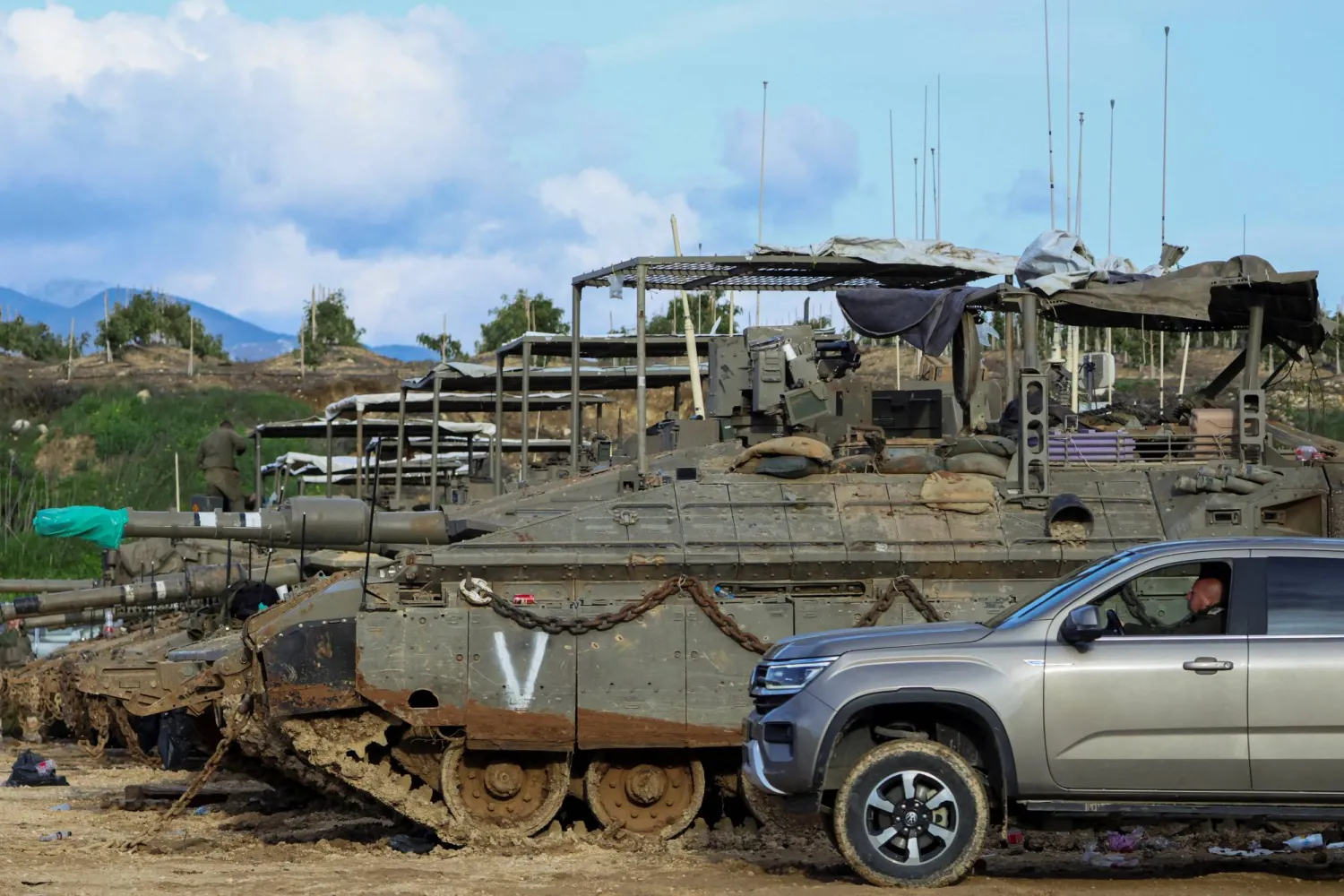
As Israel trades fire with Hezbollah, calls for mass evacuations and sends ground troops deeper into Lebanon, its leaders have hinted at a long-term occupation modeled on the devastating conquest of much of Gaza after Hamas' Oct. 7, 2023, attack.
Israel says it needs to establish a zone of control in the depopulated south to shield its own northern communities, which have faced daily rocket attacks since the Iran-backed militant Hezbollah group joined the wider war. Many in Lebanon fear that could mean the open-ended displacement of over a million people, the flattening of their homes and a loss of territory.
Israel's Defense Minister Israel Katz said this week that it would create a “security zone” up to the Litani River, some 30 kilometers (20 miles) from the border in some places. He said troops would destroy homes, which he claimed were being used by militants, and that residents would not return until northern Israel is safe.
The campaign would mirror the one in Gaza, in which Israeli forces flattened and largely depopulated the eastern half of the Palestinian territory, Katz said on Tuesday. Israel has said it won't withdraw from the enclave until Hamas disarms as part of a US-brokered ceasefire deal.
“We have ordered an acceleration in the destruction of Lebanese homes in contact-line villages to neutralize threats to Israeli communities, in accordance with the model of Beit Hanoun and Rafah in Gaza,” Katz said, referring to border towns that were largely obliterated.
From one war to the next
After a 2024 ceasefire halted Israel's last war with Hezbollah, Israeli forces gradually withdrew from southern Lebanon except for five strategic hilltops along the border.
Lebanese returned to find that homes, infrastructure, and some entire villages destroyed. Israel said it had dismantled Hezbollah infrastructure that could have been used to launch an Oct. 7-style attack, and it continued to strike what it said were militant targets on a near-daily basis after the truce.
Hezbollah resumed it attacks after Israel and the United States launched the war with Iran on Feb. 28, accusing Israel of having repeatedly violated the ceasefire. Israel accused Lebanon's government of failing to carry out its pledge to disarm Hezbollah, despite its unprecedented steps toward criminalizing the group.
In the latest fighting, Israel has launched blistering air raids across Lebanon, killing more than 1,000 people — mostly outside of the border area — and displacing over a million. It has warned residents to evacuate a wide swath of the south, extending from the border to the Zahrani River, some 55 kilometers (34 miles) away.
The Israeli military says it has launched a limited ground operation. Political leaders speak of more ambitious plans.
Bezalel Smotrich, Israel's far-right finance minister and a member of its Security Cabinet, said this week that the current war must end with “fundamental change.”
“The Litani must be our new border with the state of Lebanon,” he said.
Echoes of an earlier occupation Israel invaded southern Lebanon in 1982 during the country's civil war. Hezbollah, established that year, waged a guerrilla campaign that eventually ended the Israeli occupation in 2000.
This time around, Israel has bombed seven bridges over the Litani, the northern edge of a UN-patrolled buffer zone established after previous conflicts. Israel says Hezbollah was using the bridges to move fighters and weapons, and that its military will control the remaining crossings.
Heavy fighting has meanwhile erupted in the town of Khiam, the fall of which would cut off the south from Lebanon's eastern Bekaa Valley, another area with a large Hezbollah presence.
After the bridges were bombed, Lebanese President Joseph Aoun accused Israel of seeking to sever the south from the rest of the country “to establish a buffer zone, entrench the reality of occupation, and pursue Israeli expansion within Lebanese territories.”
UN peacekeepers say the bombing of the bridges and ongoing clashes have hindered their operations and put personnel at risk.
“This is the closest fighting activity we have seen to our positions,” said Kandice Ardel, spokesperson for the UN mission known as UNIFIL. “Bullets, fragments, and shrapnel have hit buildings and open areas inside our headquarters.”
Ardel said peacekeepers at observation points have seen a growing presence of Israeli troops and “engineering assets,” though they have not seen any new military positions built yet.
‘Different shades’ of control
Mohanad Hage Ali, a senior fellow at the Carnegie Middle East think tank in Beirut, said Israel has already established “different shades” of control.
“The first line of borders is a no-man zone. This is basically a large parking lot that is facing Israel,” he said. “There is nothing there, no movement, nothing at all.”
Lebanese movement is restricted farther north. During last year's olive harvest, farmers struggled to reach their groves because of regular Israeli strikes and had to be accompanied by Lebanese troops and UNIFIL peacekeepers, who coordinated with Israel.
Sarit Zehavi, the founder and president of the Alma Institute and a retired Israeli military officer, said Israel will likely establish a more extensive area of control stretching farther north.
She acknowledged that Israel was unlikely to defeat Hezbollah and was at risk of having to maintain a long-term presence in southern Lebanon.
“But the other alternative is to take the risk that we will be slaughtered. It’s as simple as that,” she said.
No diplomatic offramp in sight
Lebanon's government has broken a longstanding taboo by proposing direct talks with Israel. It has also taken action against Hezbollah since the last war, criminalizing its activities and claiming to have dismantled hundreds of military positions.
But neither the US nor Israel has shown any interest in such talks as they focus on the wider war with Iran.
If negotiations occur, Israel could demand major concessions in exchange for relinquishing territory taken by force — an updated version of the decades-old “land for peace” formula.
Israel seized parts of Syria after the overthrow of Syrian President Bashar Assad and is in talks with the new government in Damascus about an updated security arrangement. In Gaza, it has vowed to keep half the territory until the militant Palestinian Hamas group lays down its arms, as each side has accused the other of violating the truce reached in October.
Lebanese who fled their homes are meanwhile in limbo — and some fear they may never return.
Elias Konsol and his neighbors fled the Christian border village of Alma al-Shaab with UNIFIL's help. He was reunited with his mother, who cried in his arms, at a church near Beirut where funeral services were being held for a resident killed in an Israeli strike.
Konsol said there were no weapons or Hezbollah fighters in his village, but it was forced to evacuate anyway.
“We no longer know our fate,” he said. “We don’t know if we will see our homes and village again.”