

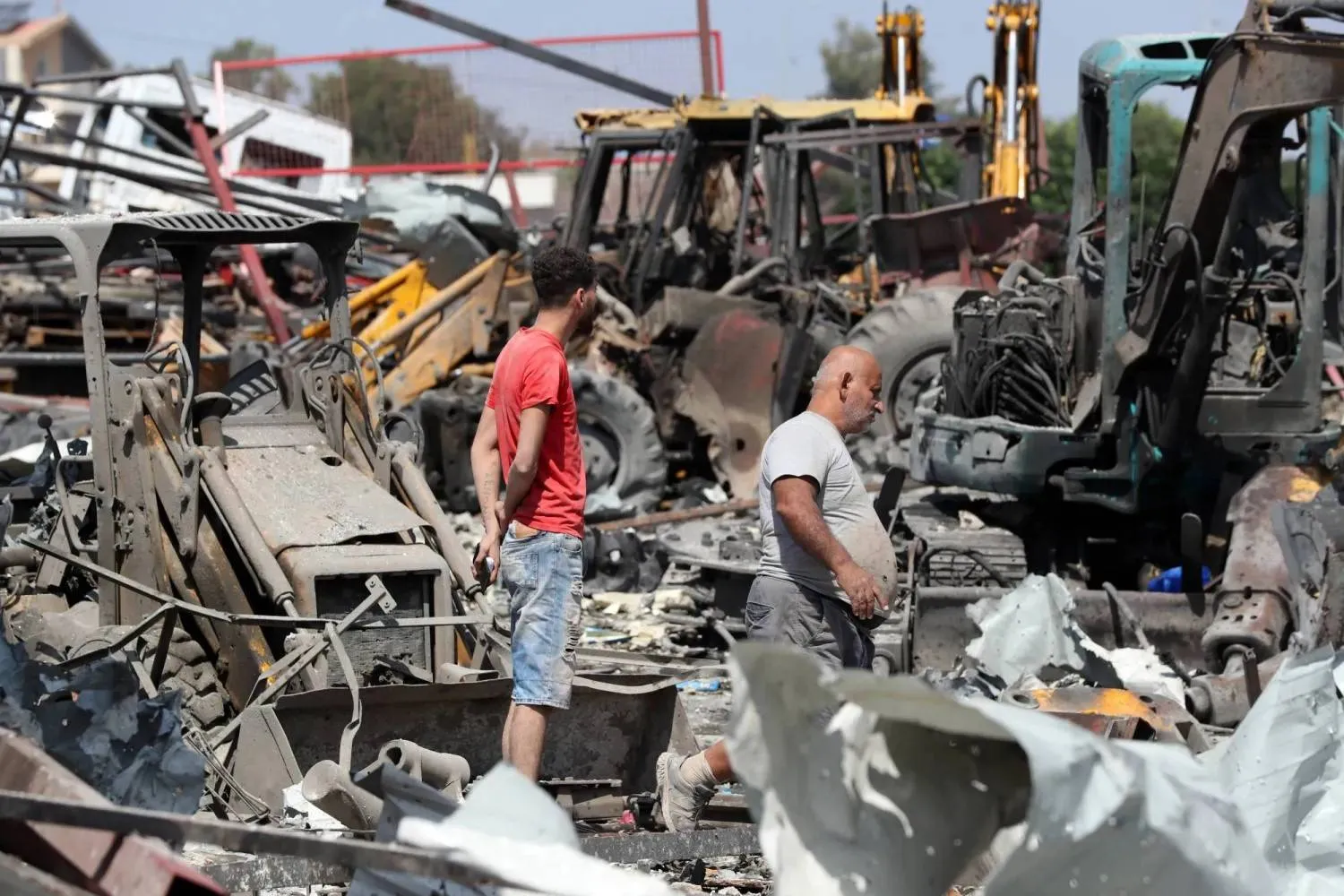

Israel Tells Lebanon It Will Pursue Military Pressures

Lebanese people inspect a site targeted by an Israeli airstrike in the town of Ansarya in southern Lebanon last Thursday (dpa) 
TT

Israel Tells Lebanon It Will Pursue Military Pressures

Lebanese people inspect a site targeted by an Israeli airstrike in the town of Ansarya in southern Lebanon last Thursday (dpa) 

Israeli politicians on Sunday has branded the Lebanese government's plan allowing the army to begin centralizing weapons under its control as “vague, confidential and missing a timetable,” claiming that Hezbollah was pleased with such “compromising solution.”

The politicians also said that in its decision, the Lebanese government wanted to avoid a “confrontation” with Hezbollah, and practically circumvented a radical solution that meets the necessary requirements to achieve stability in the region.

The Israeli reaction was not official. It came through leaks to Hebrew media outlets from several politicians and security officials in Tel Aviv.

Meanwhile, the Yedioth Ahronoth newspaper said the Israeli army believes Hezbollah continues to possess a substantial arsenal, including precision missiles, thousands of rockets and drones, some of which are domestically produced after the fall of Syria’s Assad regime cut off land-based smuggling routes.

The newspaper quoted a high-ranking military official as saying that Hezbollah is actively working to rebuild and upgrade its power, especially in the south and the Bekaa, while the Israeli army is trying to prevent the group’s activities through precision bombing and assassinations.

The official added, “the Lebanese Army is trying but its efforts are limited. First because Hezbollah is determined to regain power, second, because the Lebanese authorities are cautious and fearful and third because the army has not yet eliminated Hezbollah’ influence within its ranks.”

Washington’s Pressures

Another source told Yedioth Ahronoth that Israel is demanding that the US administration supports its plans to defeat Hezbollah militarily.

The source revealed that in return, Washington is demanding that Israel eases its military operations, which are weakening the Lebanese government and its reconstruction efforts.

But Israel insists the Lebanese authority and its army cannot be strengthened without weakening Hezbollah, the source noted.

“There is a proposal on the table presented by the US envoy, Thomas Barrack, to the Lebanese leadership, which includes demands that the Lebanese government has already officially adopted, in its meetings on August 5 and 7,” the source said.

However, he added, “the Lebanese leadership and the army, in its current form, are unable to implement a full disarmament of Hezbollah before the end of 2025. They propose a gradual plan that takes into account Lebanese constraints, within a realistic timetable to dismantle and disarm the party.”

Meanwhile, Israel believes that the long war that started on 7 October 2023 has caused major changes in regional balance, especially in the ranks of the Iranian axis and in Lebanon. Tel Aviv says the West must benefit from this change.

Orna Mizrahi, a senior researcher at the Institute for National Security Studies (INSS), said Israel should now benefit from Hezbollah's weakness.

However, she added, the Israeli military achievements have not, so far, led to a stable security reality and there is no guarantee that they will be maintained in the long term.”

Mizrahi said Hezbollah has not yet been defeated and still poses a threat to Israel while, in parallel, the Lebanese state is still weak.

Earlier, INSS recommended that the Israeli government develop a strategic plan, insisting on the elimination of Hezbollah's military presence in Lebanon.


Lebanon Reaffirms Negotiations as Path to Resolve Dispute with Israel

President Joseph Aoun between Prime Minister Nawaf Salam and Speaker Nabih Berri (Lebanese Presidency file photo)
TT

Lebanon Reaffirms Negotiations as Path to Resolve Dispute with Israel

President Joseph Aoun between Prime Minister Nawaf Salam and Speaker Nabih Berri (Lebanese Presidency file photo)

Senior Lebanese officials reaffirmed their commitment to negotiations with Israel through the international committee tasked with overseeing the November 2024 ceasefire agreement, known as the ceasefire monitoring mechanism, following Hezbollah’s statement on Thursday in which the group told them it rejects any form of political negotiation.

Communication between Lebanon and Israel is limited to a United Nations-backed monitoring mechanism involving France and the US. The two sides meet separately under UN auspices but do not engage in direct talks.

Berri: No to normalization

While President Joseph Aoun underscored Lebanon’s adherence to this mechanism, Parliament Speaker Nabih Berri said there is no alternative to it. Prime Minister Nawaf Salam responded to Hezbollah by saying that decisions of war and peace rest solely with the state.

Berri told Asharq Al Awsat that normalization with Israel is out of the question.

“Anyone calling for normalization should know it is impossible,” he said.

“I remain firm in my position on the mechanism, which brings together all parties, Lebanon, Israel, the United States, France and the United Nations. There is no objection to bringing in civilian specialists when needed, as happened during the demarcation of the Blue Line in 2000, when geological and mapping experts were involved.”

Berri added that Israel’s threats and airstrikes will not alter Lebanon’s stance.

On the electoral law, Berri said he has not yet received the draft. Once it reaches him, he will decide his position. The government had approved a draft law scrapping the six seats allocated to expatriates and allowing overseas voters to cast ballots in their place of residence, according to their electoral registration. Berri and Hezbollah oppose the changes.

Berri has insisted on implementing the current parliamentary election law, saying it remains technically and legally viable. He also questioned why some political actors are backtracking on previous positions “for maneuvers we all know are futile.” He said: “This law was once described by George Adwan (Lebanese Forces deputy leader) as his own. So what was valid in past elections is suddenly not valid today?”

Aoun: We are committed to the November agreement

The President reaffirmed “Lebanon’s commitment to the cessation of hostilities agreement reached in November 2024 under US and French sponsorship.”

Speaking during a meeting with a World Bank delegation, he said Israel had not complied.

“According to this deal, Israel was supposed to withdraw completely and fully from the South sixty days after the agreement, but it still occupies five hills and is escalating its attacks on Lebanon amidst increasing daily threats against the country and its people,” said Aoun.

Salam: Decisions of war and peace rest with the government

The Prime Minister said Lebanon is moving steadily toward reclaiming its natural role within the Arab region.

He voiced satisfaction at “Lebanon’s return to the Arabs and the Arabs’ return to Lebanon,” saying this renewed relationship forms “a foundation for national recovery in technology, the economy and security.”

Speaking at an event dedicated to technology and artificial intelligence, Salam recalled that the government has made a “clear decision” regarding the state’s monopoly over arms, stressing that the Lebanese Army’s plan to achieve this “is progressing according to well-defined stages.”

This plan is still in its first phase, Salam noted, alluding to the disarmament of Hezbollah south of the Litani River.

Responding to Hezbollah’s statement, Salam said that decisions of war and peace lie exclusively with the Lebanese government, which alone is responsible for protecting sovereignty and maintaining stability.

He described Israeli escalation as dangerous and a threat to regional security, saying the government is seeking Arab and international support to stop Israeli attacks on Lebanese territory and strengthen the state’s ability to assert full authority across its land.

On Lebanese-Syrian relations, Salam said the era of interference in Syria’s affairs has ended. Lebanon is committed to a policy of self-distancing and to mutual respect with all Arab states, he reaffirmed.


Satellite Images Appear to Show Attempts to Dispose of Bodies After RSF Seized Sudan’s el-Fasher

 This satellite image from Vantor shows a smoke from a fire at the Saudi hospital in el-Fasher, Sudan, Thursday, Nov. 6, 2025. (©2025 Vantor via AP)
This satellite image from Vantor shows a smoke from a fire at the Saudi hospital in el-Fasher, Sudan, Thursday, Nov. 6, 2025. (©2025 Vantor via AP)
TT

Satellite Images Appear to Show Attempts to Dispose of Bodies After RSF Seized Sudan’s el-Fasher

 This satellite image from Vantor shows a smoke from a fire at the Saudi hospital in el-Fasher, Sudan, Thursday, Nov. 6, 2025. (©2025 Vantor via AP)
This satellite image from Vantor shows a smoke from a fire at the Saudi hospital in el-Fasher, Sudan, Thursday, Nov. 6, 2025. (©2025 Vantor via AP)

New satellite images analyzed Friday appear to show further efforts by the paramilitary Rapid Support Forces to dispose of corpses after they seized and rampaged through the city of el-Fasher in Sudan’s Darfur region.

Images by the Colorado-based firm Vantor show a fire at the Saudi hospital in el-Fasher on Thursday near a collection of white objects seen days earlier in other Vantor photos.

The Yale School of Public Health’s Humanitarian Research Lab described the images as showing the “burning of objects that may be consistent with bodies.”

“The practice of burning bodies is not consistent with Islamic burial practices,” the Yale lab said in its report. “The apparent immolation of objects that may be consistent with human remains complicates any future effort to count the number of people killed since the fall of el-Fasher and to identify and return the remains to family members.”

The Associated Press separately accessed the Vantor images and identified objects corresponding to the Yale lab’s report, including the fire and the white objects. Such objects in other imagery from el-Fasher appear to correspond to dead bodies, showing the scale of the killings in the city.

Earlier satellite images of el-Fasher appear to show mass graves being dug and later covered at two sites in the city, one at a mosque just north of the Saudi hospital where some 460 people reportedly had been killed and another by a former children’s hospital that the RSF had been using as a prison.

The RSF has denied killing anyone at the Saudi hospital.

However, testimonies from those fleeing el-Fasher, online videos and satellite images offer an apocalyptic vision of the attack.

Another satellite image appeared to show the RSF likely blocking an exit to el-Fasher to the west. A new berm had been added to the site, the Yale lab said.

Drones reportedly intercepted

Meanwhile, the Sudanese army intercepted drones fired overnight by its rival paramilitary group on two cities in Sudan's northeast, a military official said Friday.

The army official, who spoke on condition of anonymity to freely discuss the matter, said 15 drones targeted Atbara, a city north of the capital, in River Nile province. He confirmed that strikes caused no casualties. Local media reports said residents heard explosions.

The official added that ground defenses intercepted a smaller-scale drone attack that also targeted Omdruman, the sister city of the capital Khartoum.

The RSF drone strikes come a day after the group announced that it has agreed to a humanitarian truce proposed by a US-led mediator group known as the Quad.

A Sudanese military official told the AP on Thursday that the army welcomes the Quad’s proposal but will only agree to a truce when the RSF completely withdraws from civilian areas and give up weapons per previous peace proposals.

US-led plan for a truce

The war between the RSF and the military began in 2023, when tensions erupted between the two former allies that were meant to oversee a democratic transition after a 2019 uprising.

The fighting has killed at least 40,000 people, according to the WHO, and displaced 12 million. However, aid groups say the true death toll could be many times higher. Over 24 million people are also facing acute food insecurity, according to the World Food Program.

The US-led plan for a truce would start with a three-month humanitarian truce followed by a nine-month political process, said Massad Boulos, a US adviser for African affairs, earlier this week.

Also Friday, the UN’s top human rights body announced it will hold an emergency special session on Sudan on Nov. 14 over recent bloodshed and other violence against civilians in and around the Darfur city of el-Fasher.

The call for the special session by the Human Rights Council in Geneva was led by Britain, Germany, Ireland, the Netherlands and Norway, and has drawn support from two dozen council members in the 47-member-country rights body so far.

Limited aid delivery The RSF’s announcement that it agreed to the truce comes more than a week after the group seized el-Fasher which had been under siege for over 18 months. It was also the last Sudanese military stronghold in Sudan’s western Darfur region.

UNICEF said Thursday that more than 81,000 people have been displaced from el-Fasher since Oct. 26, with rising needs for shelter, food, water and medical care but limited aid delivery.

The UN children agency's report said it identified more than 850 children with acute malnutrition who are now receiving treatment. It added that violence, sexual assaults and looting of health facilities remain rampant across North Darfur, with women and children being the most vulnerable.


Report: Azerbaijan Will Only Send Peacekeepers to Gaza if Fighting Stops Completely

 A Palestinian child holds a piece of wood with the rubble of destroyed buildings in the background, during sunset, amid a ceasefire between Israel and Hamas, in Jabalia, northern Gaza Strip, November 6, 2025. (Reuters)
A Palestinian child holds a piece of wood with the rubble of destroyed buildings in the background, during sunset, amid a ceasefire between Israel and Hamas, in Jabalia, northern Gaza Strip, November 6, 2025. (Reuters)
TT

Report: Azerbaijan Will Only Send Peacekeepers to Gaza if Fighting Stops Completely

 A Palestinian child holds a piece of wood with the rubble of destroyed buildings in the background, during sunset, amid a ceasefire between Israel and Hamas, in Jabalia, northern Gaza Strip, November 6, 2025. (Reuters)
A Palestinian child holds a piece of wood with the rubble of destroyed buildings in the background, during sunset, amid a ceasefire between Israel and Hamas, in Jabalia, northern Gaza Strip, November 6, 2025. (Reuters)

Azerbaijan does not plan to send peacekeepers to Gaza unless there is a complete halt to fighting there between Israel and Hamas, an Azerbaijani Foreign Ministry source told Reuters on Friday.

As part of President Donald Trump's peace plan for Gaza, the US has been speaking to Azerbaijan, Indonesia, the UAE, Egypt, Qatar and Türkiye about possible contributions from those countries to an International Stabilization Force (ISF) of around 20,000 troops.

"We do not want to put our troops in danger. This can only happen if military action is completely stopped," the Azerbaijani source said.

The source noted that any such decision would have to be approved by parliament. The head of the parliamentary security committee told Reuters that it had not yet received any draft bill on the matter.

A US-drafted resolution at the United Nations would authorize the ISF to "use all necessary measures" - meaning force, if necessary - to carry out its mandate to stabilize security in Gaza.

Hamas has not said whether it will agree to disarm and demilitarize Gaza, something it has previously rejected.
