


Israel Presses Ahead with Gaza City Assault, Displaced Palestinians Panic

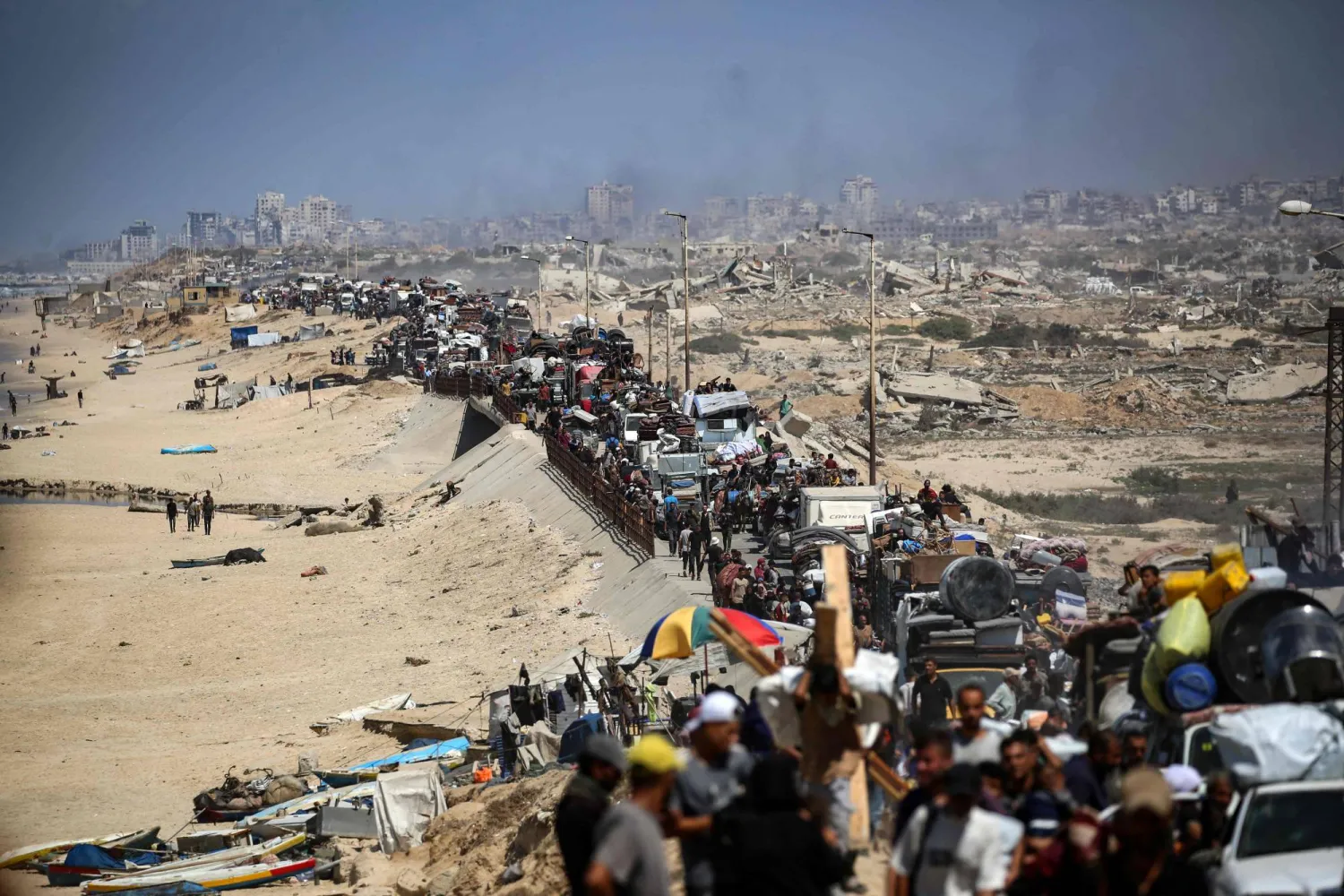
Palestinians from Gaza City move southwards with their belongings, on the coastal road near the Nuseirat refugee camp in the central Gaza Strip, on September 19, 2025. (AFP)
TT

Israel Presses Ahead with Gaza City Assault, Displaced Palestinians Panic

Palestinians from Gaza City move southwards with their belongings, on the coastal road near the Nuseirat refugee camp in the central Gaza Strip, on September 19, 2025. (AFP)

Israel's military said it had expanded operations in Gaza City on Friday and bombarded Hamas infrastructure, while displaced Palestinians traumatized by the advance said they had no means to flee.

"The situation is really bad. All night long, the tank was firing shells," said Palestinian Toufic Abu Mouawad, who left a camp for the displaced with nowhere else to go.

"I want to flee with the boys, the girls, the children. This is the situation that we are living in. It is a very tragic situation. We call on all the Arab countries and the people who have a good conscience to stand with us.”

ISRAELI FORCES ADVANCE ON CENTRAL GAZA CITY

Israeli forces control Gaza City's eastern suburbs and in recent days have been pounding the Sheikh Radwan and Tel Al-Hawa areas, from where they would be positioned to advance on central and western areas, where most of the population is sheltering.

The Gaza health authorities said 33 Palestinians had been killed in the last 24 hours.

On Thursday, the Israel Defense Forces (IDF) said it believed 350,000 people had left Gaza City since the start of September and that about 600,000 remained.

Satellite imagery from September 18, reviewed by Reuters, shows new tents appearing in the areas south of Gaza City after September 5. It also shows crowds of people on the Al-Rashid road and what appear to be vehicles on the Salah al-Din road.

In leaflets dropped over Gaza City, the military had told Palestinians they could use the newly reopened Salah al-Din road to escape to the south.

The army said an airstrike had killed Mahmoud Yusuf Abu Alkhir, whom it identified as deputy head of military intelligence in Hamas’ Bureij Battalion. It said he had taken part in "terrorist attacks against Israeli troops and the state".

Hamas, the group administering Gaza, triggered the war when it attacked Israel on Oct. 7, 2023, killing 1,200 people and taking 251 back to Gaza as hostages, according to Israeli figures.

Families of the remaining 20 or so surviving hostages have been imploring Netanyahu to stop the offensive and instead negotiate a ceasefire with Hamas to free their loved ones.

ISRAELI PROTESTERS CALL FOR HOSTAGES' RELEASE

Dozens of protesters gathered on the Israeli side of the border, calling for an end to the war. They held banners or placards with slogans that included "Stop the genocide in Gaza" and "Free Gaza, isolate Israel".

The armed wing of Hamas said on Thursday that the hostages were distributed throughout the neighborhoods of Gaza City.

"The start of this criminal operation and its expansion means you will not receive any captive, alive or dead," it said in a written statement.

Israel Katz, Israel's defense minister, said on X: "If Hamas does not release the hostages and disarm, Gaza will be destroyed and turned into a monument to the rapists and murderers of Hamas."

In almost two years of fighting, Israel's fierce offensive has killed more than 65,000 Palestinians, according to Gaza health authorities, and demolished most of the structures in the tiny enclave, which is now gripped by hunger and even famine.

Israel says the extent of hunger has been exaggerated and that Hamas could end the war at once if it surrendered, freed the hostages, disarmed and disbanded.

Hamas says it will not disarm until a Palestinian state is established. Numerous attempts to mediate an end to the conflict have failed.

Displaced Palestinian Osama Awad said the Israeli shelling, bombing, airstrikes and naval bombardment were coming closer: "For one week, we have been living nights of horror."

It is a horror that most of Gaza's 2 million Palestinians have experienced over and over again in repeated Israeli onslaughts and multiple displacements.

All around Awad, children sat on top of piles of their families' meager belongings while others moved a few possessions on carts.



Israel Says One Soldier Killed in Lebanon after Vehicle Overturned

Israeli soldiers carrying the coffin of a soldier killed in southern Lebanon during his funeral in Kfar Saba, Israel, on Sunday (dpa)
TT

Israel Says One Soldier Killed in Lebanon after Vehicle Overturned

Israeli soldiers carrying the coffin of a soldier killed in southern Lebanon during his funeral in Kfar Saba, Israel, on Sunday (dpa)

An Israeli military official ‌said ‌on Thursday a ‌soldier ⁠was killed in ⁠southern Lebanon after a vehicle ⁠had ‌overturned.

The official ‌described the ‌incident ‌as an accident, Reuters said.

Earlier, the ‌military said a soldier ⁠had ⁠died during "operational activity".

The pace of violence in Lebanon has eased recently, but Israeli Defense Minister Israel Katz stressed that his forces would remain in southern Lebanon.

“We have stated that, in any case, we will not withdraw, and up to this moment — and this is a diplomatic achievement — there has been no US request for Israel to withdraw from Lebanon,” Katz said in an interview during a conference of local leaders in Tel Aviv.

Israel and Lebanon are currently holding US-mediated talks in Washington aimed at reaching a diplomatic solution to the conflict, including the disarmament of Hezbollah and the withdrawal of Israeli forces.

Since April, Lebanon has engaged in direct talks with Israel under US pressure, with the aim of ending the latest war between Hezbollah and Israel.

Lebanese authorities have stressed their determination to keep Lebanon’s file separate from negotiations involving Iran, Hezbollah’s main backer.

On Wednesday, Lebanese President Joseph Aoun stressed that “the negotiations in Washington are separate from the meetings held in Switzerland last week between the United States and Iran, which were followed by Qatar and Pakistan.”


Iraqi Judiciary Applies ‘Terrorism Provisions’ to Drones

People watch as smoke billows from an oil warehouse in the Kani Qirzhala area on the outskirts of Erbil, the capital of Iraq's autonomous Kurdistan region, following a suspected drone strike, on April 1, 2026. (Photo by AFP)
TT

Iraqi Judiciary Applies ‘Terrorism Provisions’ to Drones

People watch as smoke billows from an oil warehouse in the Kani Qirzhala area on the outskirts of Erbil, the capital of Iraq's autonomous Kurdistan region, following a suspected drone strike, on April 1, 2026. (Photo by AFP)

Iraq’s Supreme Judicial Council has instructed the country’s courts to apply the provisions of the Anti-Terrorism Law to anyone who manufactures, uses, or possesses drones for unlawful purposes, while a security official said the directive is aimed specifically at curbing the activities of armed factions.

In a brief statement on Wednesday, the Council said it had directed the competent courts to enforce Anti-Terrorism Law No. 13 of 2005 against “anyone who manufactures, uses, or possesses drones employed for purposes contrary to the law.”

The law is Iraq’s principal legal framework for prosecuting terrorist crimes that threaten national unity and public safety, carrying penalties of up to the death sentence for perpetrators, instigators, planners, and financiers.

The directive comes amid months of government efforts to bring all weapons under state control and dismantle armed groups operating outside official security institutions.

An Interior Ministry security official told Asharq Al-Awsat that the judicial directive is “exclusively linked to armed factions” and is intended to increase pressure on them. He said the measure places drone-related offenses under terrorism statutes even though Iraqi law permits the use of officially licensed drones, indicating that it is directed at attacks carried out - or potentially to be carried out - by armed factions.

Speaking on condition of anonymity, the official described drones as one of Iraq’s most serious security challenges because they are easy to transport and operate, while the country lacks effective counter-drone capabilities, a weakness exposed during recent attacks.

Since the outbreak of the US-Israeli war against Iran on February 28, armed factions have carried out hundreds of attacks, many involving drones, against civilian and military targets.

Kurdish sources say cities in the Kurdistan Region alone have come under more than 800 attacks by Iran-aligned factions, ostensibly because of the presence of US forces and Iranian Kurdish opposition groups.

The factions have also launched dozens of drone attacks against vital assets in several Gulf states and Jordan, prompting those countries to issue a joint statement on March 25 condemning the attacks and urging Baghdad to take immediate action to halt operations by Iran-backed armed groups.

Iraq has long permitted drones for civilian, commercial, and official security purposes, provided operators obtain prior approval from the Iraqi Civil Aviation Authority and the relevant security agencies.

In early February, the authority introduced new regulations governing licensing, operating requirements, legal obligations, and approved uses, including media production, filmmaking, advertising, tourism, protection of oil and energy pipelines and public utilities, agriculture, environmental monitoring, border security, and official Interior Ministry thermal-drone operations against smugglers.

Drone manufacturing is also “common in Iraq,” according to Ahmed al-Janabi, a software and telecommunications engineer, though primarily for civilian and service-related uses. He said drone components are widely available on Iraqi markets and enter the country through multiple routes, including smuggling networks from Iran via Sulaymaniyah.

Specialized import offices also supply drones, often disguising component shipments. While authorities routinely confiscate unauthorized drones and impose relatively light prison sentences on violators, al-Janabi said the key change is that such offenses are now prosecuted under the Anti-Terrorism Law.


Beirut Transfers 128 Syrian Convicts Home

Lebanese army soldiers secure the area at the entrance of Zawtar al-Gharbiyah village, southern Lebanon, 23 June 2026, amid a ceasefire between Israel and Hezbollah. EPA/WAEL HAMZEH
TT

Beirut Transfers 128 Syrian Convicts Home

Lebanese army soldiers secure the area at the entrance of Zawtar al-Gharbiyah village, southern Lebanon, 23 June 2026, amid a ceasefire between Israel and Hezbollah. EPA/WAEL HAMZEH

Lebanon has transferred 128 Syrian convicts to their home country, a Lebanese security source told AFP on Wednesday, the second batch of handovers under an agreement the two sides signed earlier this year.

Overcrowded Lebanese prisons host around 2,000 Syrian nationals held on various charges.

Many are still awaiting trial, while hundreds have been brought before military courts on charges of "terrorism" or related offences, including attacks on Lebanese forces.

Others are in custody for alleged membership in militant or armed groups that were opposed to now-ousted Syrian president Bashar al-Assad, who was supported by Lebanon's Hezbollah during the Syrian civil war.

The security source, who requested anonymity, said that Beirut "handed over the second batch of Syrian convicts in Lebanon to Damascus, numbering 128 convicts" on Wednesday.

The transfer follows the handover of more than 130 Syrian detainees in March, under an agreement signed between the two countries the previous month, which will cover almost 300 convicts who have served 10 years or more in Lebanese prisons.

Under the agreement, they will be required to complete the remainder of their sentences in Syria.

At least 260 convicts have now been sent to Syria's Adra prison out of 356 in Lebanon's Roumieh, the source added.

The issue of the detainees had been a sticking point in Beirut-Damascus relations following Assad's overthrow in December 2024.

It was discussed by Lebanese Prime Minister Nawaf Salam during his visit to Damascus in May, where he met Syrian President Ahmed al-Sharaa.

Over the past year, both sides have repeatedly expressed their determination to open a new chapter in their relations.