


Iraq's First Industrial-scale Solar Plant Opens in Karbala Desert to Tackle Electricity Crisis

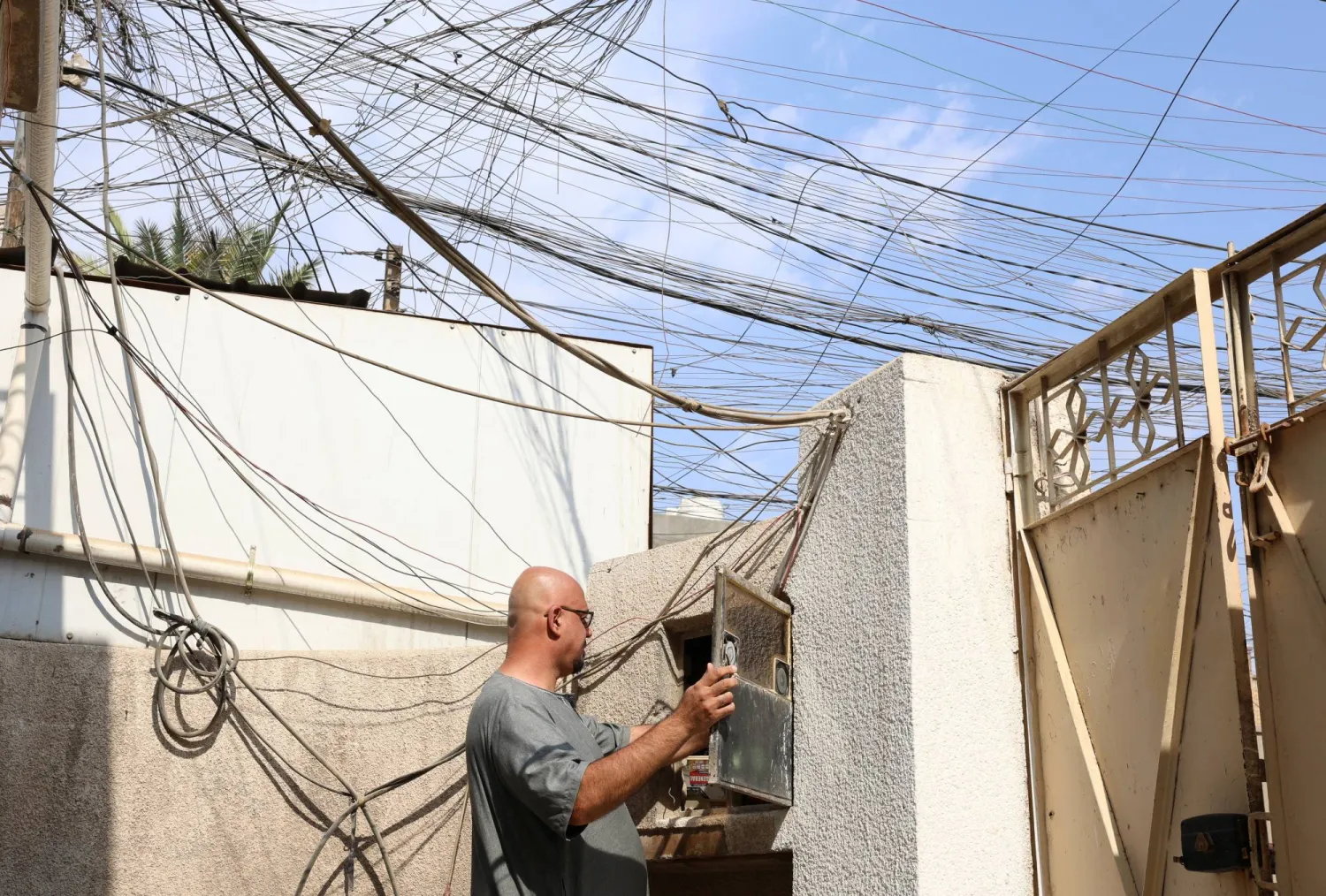
Resident Omar Hameed Abed, 47, checks the electricity switchboard in his home, with a network of generator wires visible above, in Baghdad, Iraq, September 18, 2025. REUTERS/Ahmed Saad
TT

Iraq's First Industrial-scale Solar Plant Opens in Karbala Desert to Tackle Electricity Crisis

Resident Omar Hameed Abed, 47, checks the electricity switchboard in his home, with a network of generator wires visible above, in Baghdad, Iraq, September 18, 2025. REUTERS/Ahmed Saad

Iraq is set to open the country’s first industrial-scale solar plant Sunday in a vast expanse of desert in Karbala province, southwest of Baghdad.

It’s part of a new push by the government to expand renewable energy production in a country that is frequently beset by electricity crises despite being rich in oil and gas, The Associated Press said.

“This is the first project of its type in Iraq that has this capacity,” said Safaa Hussein, executive director of the new solar plant in Karbala, standing in front of row after row of black panels. From above, the project looks like a black-clad city surrounded by sand.

The plant aims to “supply the national network with electricity, and reduce the fuel consumption especially during the daytime peak load, in addition to reducing the negative environmental impact of gas emissions,” he said.

The newly opened solar plant in Karbala will eventually be able to produce up to 300 megawatts of electricity at its peak, said Nasser Karim al-Sudani, head of the national team for solar energy projects in the Prime Minister’s Office. Another project under construction in Babil province will have a capacity of 225 megawatts, and work will also begin soon on a 1,000 megawatt project in the southern province of Basra, he said.

The projects are part of an ambitious plan to implement large-scale solar power projects in an effort to ease the country’s chronic electricity shortages.

Deputy Minister of Electricity Adel Karim said Iraq has solar projects with a combined capacity of 12,500 megawatts either being implemented, in the approval process, or under negotiation. If fully realized, these projects would supply between 15% and 20% of Iraq’s total electricity demand, excluding the semi-autonomous northern Kurdish region, he said.

“All the companies we have contracted with, or are still negotiating with, will sell us electricity at very attractive prices, and we will in turn sell it to consumers,” Karim said, although he declined to disclose the purchase rates.

Despite its oil and gas wealth, Iraq has suffered from decades of electricity shortages because of war, corruption and mismanagement. Power outages are common, especially in the scorching summer months. Many Iraqis have to rely on diesel generators or suffer through temperatures that exceed 50 degrees Celsius (122 degrees Fahrenheit) without air conditioning.

Currently, Iraq produces between 27,000 and 28,000 megawatts of electricity, Karim said, while nationwide consumption ranges from 50,000 to 55,000 megawatts. Power plants fueled by Iranian gas contribute about 8,000 megawatts of the current supply.

Iraq’s heavy reliance on imported Iranian gas, as well as electricity imported directly from Iran to meet its electricity needs, is an arrangement that risks running afoul of US sanctions.

Earlier this year, Washington ended a sanctions waiver for direct electricity purchases from Iran but left the waiver for gas imports in place.



UN Palestinian Aid Agency Says Israeli Police ‘Forcibly Entered’ Compound in Jerusalem 

Offices of the United Nations agency for Palestinian refugees, known as UNRWA, are seen in the Shuafat refugee camp in Jerusalem, Monday, Jan. 27, 2025. (AP)
TT

UN Palestinian Aid Agency Says Israeli Police ‘Forcibly Entered’ Compound in Jerusalem 

Offices of the United Nations agency for Palestinian refugees, known as UNRWA, are seen in the Shuafat refugee camp in Jerusalem, Monday, Jan. 27, 2025. (AP)

Israeli police forcibly entered the compound of the United Nations agency for Palestinian refugees in East Jerusalem early Monday, escalating a campaign against an organization that has been banned from operating on Israeli territory.

The UN Relief and Works Agency for Palestinian Refugees in the Near East, or UNRWA, said in a statement that “sizeable numbers” of Israeli forces including police on motorcycles, trucks and forklifts entered the compound in the Palestinian neighborhood of Sheikh Jarrah and cut communications to the compound.

“The unauthorized and forceful entry by Israeli security forces is an unacceptable violation of UNRWA’s privileges and immunities as a UN agency,” the agency said.

Photos taken by an Associated Press photographer show police cars on the street and an Israeli flag planted on the compound's roof. Photos provided by UNRWA staff show a group of Israeli police officers inside the compound.

Police said in a statement they entered for a “debt-collection procedure” spearheaded by Jerusalem's municipal government, which did not immediately respond to a request for comment.

The raid was the latest action in Israel's campaign against the agency, which provides aid and services to some 2.5 million Palestinian refugees in Gaza, the occupied West Bank and east Jerusalem, as well as 3 million more refugees in Syria, Jordan and Lebanon.

The agency was established to help the estimated 700,000 Palestinians who fled or were driven out of what is now Israel during the 1948 war surrounding Israel’s creation. UNRWA supporters say Israel hopes to erase the Palestinian refugee issue by dismantling the agency. Israel says the refugees should be permanently resettled outside its borders.

For more than a year of the Israel-Hamas war that began Oct. 7, 2023, UNRWA was the main lifeline for Gaza's population, which was largely reliant on aid because of humanitarian crisis unleashed by heavy Israeli bombardment and restrictions on the entry of goods.

Throughout the war, Israel has accused the agency of being infiltrated by Hamas, allegations the UN has denied. After months of mounting attacks from Prime Minister Benjamin Netanyahu and his far-right allies, Israel formally banned it from operating on its territory in January.

The US, formerly the largest donor to UNRWA, halted funding to the agency in early 2024.

UNRWA receives assistance from other agencies UNRWA has since struggled to continue its work in Gaza, with other UN agencies including WFP and UNICEF stepping in to help compensate for a gap UNRWA says is unfillable.

“If you squeeze UNRWA out, what other agency can fill that void?” said Tamara Alrifai, UNRWA’s director of external relations and communications, on the sidelines of the Doha Forum on Saturday.

The agency has been excluded from US-led talks on Phase 2 of the ceasefire, she added.

UNRWA shut down its Jerusalem compound in May after far-right protesters, including at least one member of Israeli Parliament, overran its gate in view of the police. Israel’s far-right has pushed to turn the compound into a settlement and the country's housing minister said last year he had instructed the ministry to “examine how to return the area to the state of Israel and utilize it for housing.”


WHO Says over 100 Killed in Attacks on Sudan Kindergarten and Hospital

Sudanese people who fled El-Fasher rest upon their arrival at the Al-Afad camp for displaced people in the town of Al-Dabba, northern Sudan, on November 19, 2025. (Photo by Ebrahim Hamid / AFP)
TT

WHO Says over 100 Killed in Attacks on Sudan Kindergarten and Hospital

Sudanese people who fled El-Fasher rest upon their arrival at the Al-Afad camp for displaced people in the town of Al-Dabba, northern Sudan, on November 19, 2025. (Photo by Ebrahim Hamid / AFP)

More than 100 people, including dozens of children, were killed in attacks on a kindergarten in Sudan that continued even as parents and caretakers rushed the wounded to a nearby hospital, the World Health Organization said on Monday.

Health facilities in Sudan have repeatedly come under attack near the frontlines of the country's 2-1/2-year civil war. A massacre also occurred in October in the city of El-Fasher, Reuters reported.

The latest attacks on December 4 began with repeated strikes on a kindergarten in South Kordofan state, WHO chief Tedros Adhanom Ghebreyesus said on X. "Disturbingly, paramedics and responders came under attack as they tried to move the injured from the kindergarten to the hospital," he said.

Sudan's Foreign Ministry condemned the attacks that it said were carried out by the Rapid Support Forces using drones.

The WHO database said heavy weapons were used and that 114 people, including 63 children, were killed and 35 wounded.

A WHO spokesperson said the toll combines casualties from the kindergarten strikes, the transfer of patients to the adjacent rural hospital, and attacks at the facility itself. Most children were killed in the initial strike, while parents and medics were later among the victims, he added.

The RSF did not immediately respond to requests for comment. It has previously denied harming civilians and said that it will hold its forces to account for any violations.

Survivors have since been moved to another hospital, and urgent appeals are being made for medical support and blood donations, Tedros said.


Syria’s Sharaa Calls for United Efforts to Rebuild a Year After Assad’s Ouster 

People celebrate and wave Syrian flags as they wait for a parade by the new Syrian army marking the first anniversary of the ousting of the Bashar al-Assad regime in Damascus, Syria, Monday, Dec. 8, 2025. (AP)
TT

Syria’s Sharaa Calls for United Efforts to Rebuild a Year After Assad’s Ouster 

People celebrate and wave Syrian flags as they wait for a parade by the new Syrian army marking the first anniversary of the ousting of the Bashar al-Assad regime in Damascus, Syria, Monday, Dec. 8, 2025. (AP)

President Ahmed al-Sharaa on Monday urged Syrians to work together to rebuild their country, still marred by insecurity and divisions, as they marked a year since the ousting of longtime ruler Bashar al-Assad.  

The atmosphere in Damascus was jubilant as thousands of people took to the streets of the capital, AFP correspondents said, after mosques in the Old City began the day broadcasting celebratory prayers at dawn.  

"What happened over the past year seems like a miracle," said Iyad Burghol, 44, a doctor, citing developments including a warm welcome in Washington by President Donald Trump for Sharaa. 

"People are demanding electricity, lower prices and higher salaries" after years of war and economic crisis, Burghol said. 

"But the most important thing to me is civil peace, security and safety," he added, taking a photo of people carrying a huge Syrian flag and sending it to his friends abroad.  

Sharaa's opposition alliance launched a lightning offensive in late November last year, taking the capital Damascus on December 8 after nearly 14 years of war and putting an end to more than five decades of the Assad family's iron-fisted rule.  

Since then, Sharaa has managed to restore Syria's international standing and has won sanctions relief, but he faces major challenges in guaranteeing security, rebuilding crumbling institutions, regaining Syrians' trust and keeping his fractured country united.  

"The current phase requires the unification of efforts by all citizens to build a strong Syria, consolidate its stability, safeguard its sovereignty, and achieve a future befitting the sacrifices of its people," Sharaa said following dawn prayers at Damascus's famous Umayyad Mosque.  

He was wearing military garb as he did when he entered the capital a year ago.  

- 'Heal deep divisions' -  

As part of the celebrations in Damascus, hundreds of military personnel marched down a major thoroughfare as helicopters flew overhead and people lined the streets to watch.  

Sharaa and several ministers were in attendance, state media reported.  

Monday's events, including an expected speech by Sharaa, are the culmination of celebrations that began last month as Syrians began marking the start of last year's lightning offensive.  

Multi-confessional Syria's fragile transition has been shaken this year by sectarian bloodshed in the country's Alawite and Druze minority heartlands, alongside ongoing Israeli military operations.  

In a statement, United Nations Secretary-General Antonio Guterres said that "what lies ahead is far more than a political transition; it is the chance to rebuild shattered communities and heal deep divisions".  

"It is an opportunity to forge a nation where every Syrian -- regardless of ethnicity, religion, gender or political affiliation -- can live securely, equally, and with dignity," he said in the statement, urging international support.  

On Sunday, the UN Independent International Commission of Inquiry on Syria, which investigates international human rights law violations since the start of the war, warned the country's transition was fragile and said that "cycles of vengeance and reprisal must be brought to an end".  

The US-backed Kurdish-led Syrian Democratic Forces that control swathes of northeast Syria said Monday that "the next phase requires launching a real, inclusive dialogue... and establishing a new social contract that guarantees rights, freedoms and equality".  

The Kurdish administration in the northeast has announced a ban on public gatherings on Monday, citing security concerns, while also banning gunfire and fireworks.  

Under a March deal, the Kurdish administration was to integrate its institutions into the central government by year-end, but progress has stalled.  

On Saturday, a prominent Alawite spiritual leader in Syria urged members of his religious minority, to which the Assad family also belongs, to boycott the celebrations, in protest against the new authorities.