


Facing Global Isolation at UN, a Defiant Netanyahu Says Israel ‘Must Finish the Job’ Against Hamas

Israeli Prime Minister Benjamin Netanyahu addresses the 80th United Nations General Assembly (UNGA) at UN headquarters in New York City, US, September 26, 2025. REUTERS/Jeenah Moon
TT

Facing Global Isolation at UN, a Defiant Netanyahu Says Israel ‘Must Finish the Job’ Against Hamas

Israeli Prime Minister Benjamin Netanyahu addresses the 80th United Nations General Assembly (UNGA) at UN headquarters in New York City, US, September 26, 2025. REUTERS/Jeenah Moon

Encircled by critics and protesters at the United Nations, Israeli Prime Minister Benjamin Netanyahu told fellow world leaders on Friday that his nation "must finish the job" against Hamas in Gaza, giving a defiant speech despite growing international isolation over his refusal to end the devastating war. 

"Western leaders may have buckled under the pressure," he said. "And I guarantee you one thing: Israel won’t." 

Netanyahu's speech, aimed as much at his increasingly divided domestic audience as the global one, began after dozens of delegates from multiple nations walked out of the UN General Assembly hall en masse Friday as he began. 

Responding to countries’ recent decisions to recognize Palestinian statehood, Netanyahu said: "Your disgraceful decision will encourage terrorism against Jews and against innocent people everywhere." 

As the Israeli leader spoke, unintelligible shouts echoed around the hall, while applause came from supporters in the gallery. The US delegation, which has backed Netanyahu in his campaign against Hamas, stayed put.  

The few world powers in attendance, the United States and the United Kingdom, did not send their most senior officials or even their UN ambassador to their section. Instead, it was filled out with more junior, low-level diplomats. 

"Antisemitism dies hard. In fact, it doesn't die at all," Netanyahu said. Netanyahu routinely accuses his critics of antisemitism. 

Netanyahu faces international isolation, accusations of war crimes and growing pressure to end a conflict he has continued to escalate. Friday’s speech was his chance to push back on the international community’s biggest platform. 

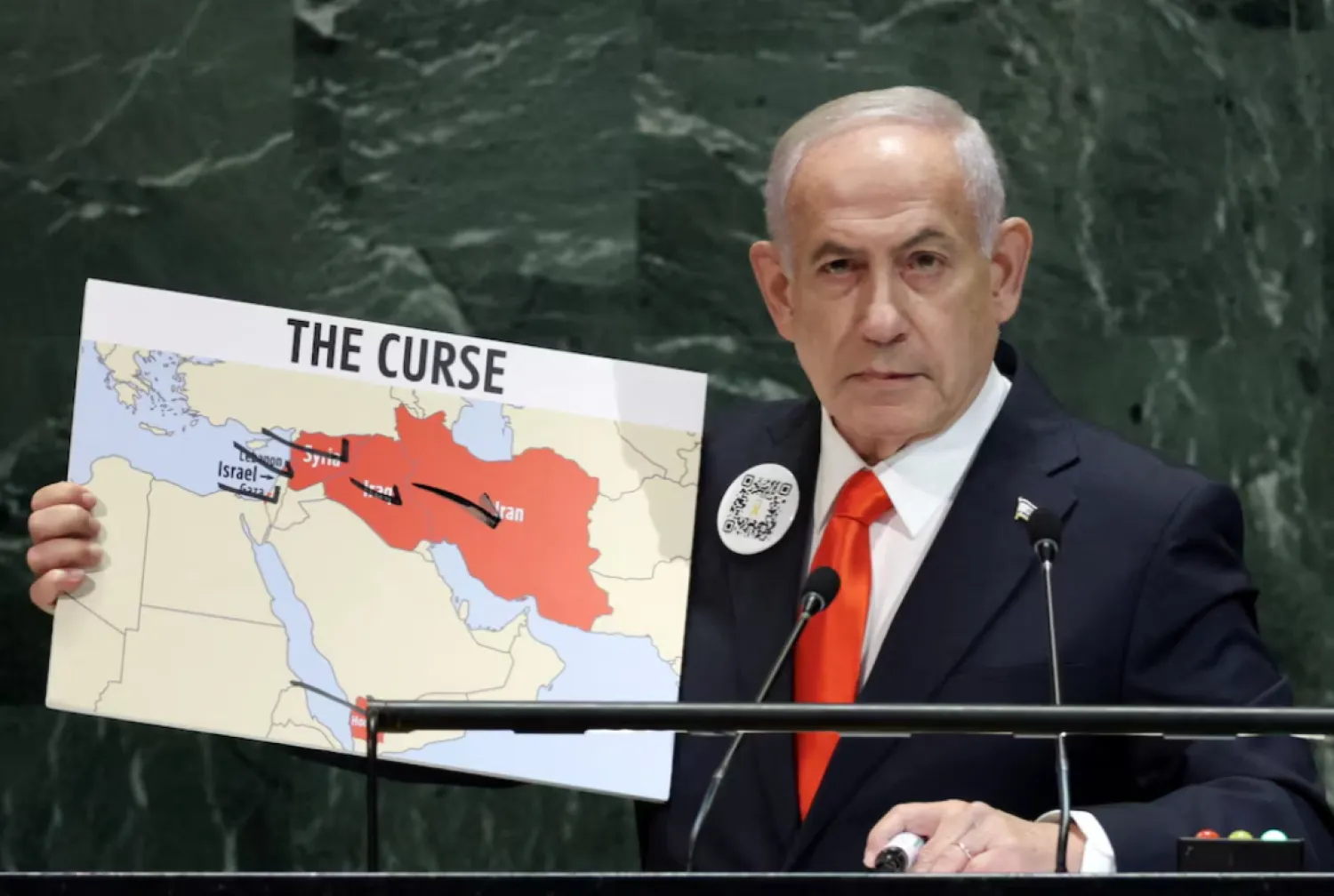
As he has often in the past at the United Nations, Netanyahu held up a visual aid — a map of the region titled "THE CURSE," which chronicles Israel's challenges in its neighborhood. He marked it up with a large marker. He wore -- and pointed out -- a pin with a QR code that leads to a site about the Oct. 7, 2023, Hamas attack that led to the war and about the Israeli hostages taken by the group. Members of the Israeli delegation wore similar pins. 

Netanyahu also frequently praised President Donald Trump, his chief ally in his political and military approach in the region. Netanyahu said the changes across the Middle East have created new opportunities. He said Israel has begun negotiations with Syria aimed at reaching security arrangements with the country’s new government. 

The Israeli government took steps Friday to ensure that those in Gaza heard Netanyahu, setting up loudspeakers at the border to blast his words into the territory. The prime minister's office also claimed that the Israeli army had taken over mobile phones in Gaza to broadcast his message. AP journalists inside Gaza saw no immediate evidence of Netanyahu’s speech being broadcast on phones there. 

Netanyahu said the special measures were taken in an attempt to reach the Israeli hostages still being held in Gaza. He spoke in Hebrew at one point, and he read the names of the 20 who are believed to still be alive. But much of his speech was also aimed at an international audience that is increasingly critical of Israel. 

A closely watched speech  

Netanyahu's annual speech to the UN General Assembly is always closely watched, often protested, reliably emphatic and sometimes a venue for dramatic allegations. But this time, the stakes were higher than ever for the Israeli leader. 

In recent days, Australia, Canada, France, the United Kingdom and others announced their recognition of an independent Palestinian state. The European Union is considering tariffs and sanctions on Israel. The assembly this month passed a nonbinding resolution urging Israel to commit to an independent Palestinian nation, which Netanyahu has said is a non-starter. 

The International Criminal Court has issued an arrest warrant accusing Netanyahu of crimes against humanity, which he denies. And the UN’s highest court is weighing South Africa's allegation that Israel has committed genocide in Gaza, which it vehemently refutes. 

As Netanyahu spoke Friday, hundreds of pro-Palestinian protesters gathered a few blocks from the heavily secured United Nations. 

"Israel has chosen a war against every conscientious human being in this world," said Nidaa Lafi, an organizer with Palestinian Youth Movement, prompting chants of "shame" from the growing crowd. "The masses have come to the irreversible realization that this war was always about the complete ethnic cleansing of Palestine, about the exploitation and the stealing of Palestinian land." 

Opposition to Netanyahu's approach is growing  

At a special session of the UN Security Council this week, nation after nation expressed horror at the 2023 attack by Hamas that killed about 1,200 people in Israel, saw 251 taken hostage and triggered the war. Many of the representatives went on to criticize the response by Israel and call for an immediate ceasefire in Gaza and influx of aid. 

Israel's sweeping offensive has killed more than 65,000 Palestinians in Gaza and displaced 90 percent of its population, with an increasing number now starving. 

While more than 150 countries now recognize a Palestinian state, the United States has not, providing Israel with vociferous support. But Trump pointedly signaled Thursday there are limits, telling reporters in Washington that he wouldn’t let Israel annex the occupied West Bank. 

Israel hasn’t announced such a move, but several leading members in Netanyahu's government have advocated doing so. And officials recently approved a controversial settlement project that would effectively cut the West Bank in two, a move that critics say could doom chances for a Palestinian state. Trump and Netanyahu are scheduled to meet during his visit. 

Netanyahu's office also "instructed civilian groups in cooperation with the army to place loudspeakers on trucks on the Israeli side of the border," it said in a statement, noting that the broadcasts would be arranged so they would not endanger soldiers. 

Palestinians had their UN say the day before  

Netanyahu was preceded at the leaders' meeting a day earlier by Palestinian President Mahmoud Abbas, who addressed the General Assembly via video on Thursday after the US denied him a visa. He welcomed the recent announcements of recognition but said the world needs to do more to make statehood happen. 

"The time has come for the international community to do right by the Palestinian people" and help them realize "their legitimate rights to be rid of the occupation and to not remain a hostage to the temperament of Israeli politics," he said. 

Abbas leads the internationally recognized Palestinian Authority, which administers portions of the West Bank. Hamas won legislative elections in Gaza in 2006 before seizing control from Abbas’ forces the following year. 

Israel captured the West Bank, east Jerusalem and the Gaza Strip in the 1967 Middle East war, then withdrew from Gaza in 2005. The Palestinians want all three territories to form their envisioned state, part of a two-state solution that the international community has embraced for decades. 

Netanyahu opposes it robustly, maintaining that creating a Palestinian state would reward Hamas. In his speech, Netanyahu insisted that Israel is battling radicals on behalf of all nations. 

"You know deep down," he said, "that Israel is fighting your fight." 


How Gaza Armed Gangs Recruit New Members

Security personnel guard trucks carrying aid as they arrive in Rafah, amid the ongoing conflict between Israel and the Palestinian Islamist group Hamas, in the southern Gaza Strip January 17, 2024. (Reuters)
TT

How Gaza Armed Gangs Recruit New Members

Security personnel guard trucks carrying aid as they arrive in Rafah, amid the ongoing conflict between Israel and the Palestinian Islamist group Hamas, in the southern Gaza Strip January 17, 2024. (Reuters)

As Hamas moves to strike armed gangs operating in areas of the Gaza Strip under Israeli army control, the groups are responding with defiance, stepping up efforts to recruit young men and expand their ranks.

Videos posted on social media show training exercises and other activities, signaling that the gangs remain active despite pressure from Hamas security services.

Platforms affiliated with Hamas security say some members have recently turned themselves in following mediation by families, clans and community leaders. The gangs have not responded to those statements. Instead, they occasionally broadcast footage announcing new recruits.

Among the most prominent was Hamza Mahra, a Hamas activist who appeared weeks ago in a video released by the Shawqi Abu Nasira gang, which operates north of Khan Younis and east of Deir al-Balah.

Mahra’s appearance has raised questions about how these groups recruit members inside the enclave.

Field sources and others within the security apparatus of a Palestinian armed faction in Gaza told Asharq Al-Awsat that Mahra’s case may be an exception. They described him as a Hamas activist with no major role, despite his grandfather being among the founders of Hamas in Jabalia.

His decision to join the gang was driven by personal reasons linked to a family dispute, they said, not by organizational considerations.

The sources said the gangs exploit severe economic hardship, luring some young men with money, cigarettes and other incentives. Some recruits were heavily indebted and fled to gang-controlled areas to avoid repaying creditors.

Others joined in search of narcotic pills, the sources said, noting that some had previously been detained by Hamas-run security forces on similar charges. Economic hardship and the need for cigarettes and drugs were among the main drivers of recruitment, they added, saying the gangs, with Israeli backing, provide such supplies.

Resentment toward Hamas has also played a role, particularly among those previously arrested on criminal or security grounds and subjected to what the sources described as limited torture during interrogations under established procedures.

According to the sources, some founders or current leaders of the gangs previously served in the Palestinian Authority security services.

They cited Shawqi Abu Nasira, a senior police officer; Hussam al-Astal, an officer in the Preventive Security Service; and Rami Helles and Ashraf al-Mansi, both former officers in the Palestinian Presidential Guard.

These figures, the sources said, approach young men in need and at times succeed in recruiting them by promising help in settling debts and providing cigarettes. They also tell recruits that joining will secure them a future role in security forces that would later govern Gaza.

The sources described the case of a young man who surrendered to Gaza security services last week. He said he had been pressured after a phone call with a woman who threatened to publish the recording unless he joined one of the gangs.

He later received assurances from another contact that he would help repay some of his debts and ultimately agreed to enlist.

During questioning, he said the leader of the gang he joined east of Gaza City repeatedly assured recruits they would be “part of the structure of any Palestinian security force that will rule the sector.”

The young man told investigators he was unconvinced by those assurances, as were dozens of others in the same group.

Investigations of several individuals who surrendered, along with field data, indicate the gangs have carried out armed missions on behalf of the Israeli army, including locating tunnels. That has led to ambushes by Palestinian factions.

In the past week, clashes in the Zaytoun neighborhood south of Gaza City and near al-Masdar east of Deir al-Balah left gang members dead and wounded.

Some investigations also found that the gangs recruited young men previously involved in looting humanitarian aid.


Israel Permits 10,000 West Bank Palestinians for Friday Prayers at Al Aqsa

Palestinians attend Friday prayers in a mosque following an attack that local Palestinians said was carried out by Israeli settlers, in the village of Deir Istiya near Salfit in the Israeli-occupied West Bank November 14, 2025. REUTERS/Sinan Abu Mayzer
TT

Israel Permits 10,000 West Bank Palestinians for Friday Prayers at Al Aqsa

Palestinians attend Friday prayers in a mosque following an attack that local Palestinians said was carried out by Israeli settlers, in the village of Deir Istiya near Salfit in the Israeli-occupied West Bank November 14, 2025. REUTERS/Sinan Abu Mayzer

Israel announced that it will cap the number of Palestinian worshippers from the occupied West Bank attending weekly Friday prayers at the Al-Aqsa Mosque in east Jerusalem at 10,000 during the holy month of Ramadan, which began Wednesday.

Israeli authorities also imposed age restrictions on West Bank Palestinians, permitting entry only to men aged 55 and older, women aged 50 and older, and children up to age 12.

"Ten thousand Palestinian worshippers will be permitted to enter the Temple Mount for Friday prayers throughout the month of Ramadan, subject to obtaining a dedicated daily permit in advance," COGAT, the Israeli defense ministry agency in charge of civilian matters in the Palestinian territories, said in a statement, AFP reported.

"Entry for men will be permitted from age 55, for women from age 50, and for children up to age 12 when accompanied by a first-degree relative."

COGAT told AFP that the restrictions apply only to Palestinians travelling from the West Bank, which Israel has occupied since the 1967 Arab-Israeli war.

"It is emphasised that all permits are conditional upon prior security approval by the relevant security authorities," COGAT said.

"In addition, residents travelling to prayers at the Temple Mount will be required to undergo digital documentation at the crossings upon their return to the areas of Judea and Samaria at the conclusion of the prayer day," it said, using the Biblical term for the West Bank.

During Ramadan, hundreds of thousands of Palestinians traditionally attend prayers at Al-Aqsa, Islam's third holiest site, located in east Jerusalem, which Israel captured in 1967 and later annexed in a move that is not internationally recognized.

Since the war in Gaza broke out in October 2023, the attendance of worshippers has declined due to security concerns and Israeli restrictions.

The Palestinian Jerusalem Governorate said this week that Israeli authorities had prevented the Islamic Waqf -- the Jordanian-run body that administers the site -- from carrying out routine preparations ahead of Ramadan, including installing shade structures and setting up temporary medical clinics.

A senior imam of the Al-Aqsa Mosque, Sheikh Muhammad al-Abbasi, told AFP that he, too, had been barred from entering the compound.

"I have been barred from the mosque for a week, and the order can be renewed," he said.

Abbasi said he was not informed of the reason for the ban, which came into effect on Monday.

Under longstanding arrangements, Jews may visit the Al-Aqsa compound -- which they revere as the site of the first and second Jewish temples -- but they are not permitted to pray there.

Israel says it is committed to upholding this status quo, though Palestinians fear it is being eroded.

In recent years, a growing number of Jewish ultranationalists have challenged the prayer ban, including far-right politician Itamar Ben Gvir, who prayed at the site while serving as national security minister in 2024 and 2025.


EU Exploring Support for New Gaza Administration Committee, Document Says

Palestinians push a cart past the rubble of residential buildings destroyed during the two-year Israeli offensives, in Gaza City, February 17, 2026. REUTERS/Mahmoud Issa
TT

EU Exploring Support for New Gaza Administration Committee, Document Says

Palestinians push a cart past the rubble of residential buildings destroyed during the two-year Israeli offensives, in Gaza City, February 17, 2026. REUTERS/Mahmoud Issa

The European Union is exploring possible support for a new committee established to take over the civil administration of Gaza, according to a document produced by the bloc's diplomatic arm and seen by Reuters.

"The EU is engaging with the newly established transitional governance structures for Gaza," the European External Action Service wrote in a document circulated to member states on Tuesday.

"The EU is also exploring possible support to the National Committee for the Administration of Gaza," it added.

European foreign ministers will discuss the situation in Gaza during a meeting in Brussels on February 23.
