
Report: Hamas Has Reservations over Some Clauses in Trump’s Gaza Plan, Wants them Changed

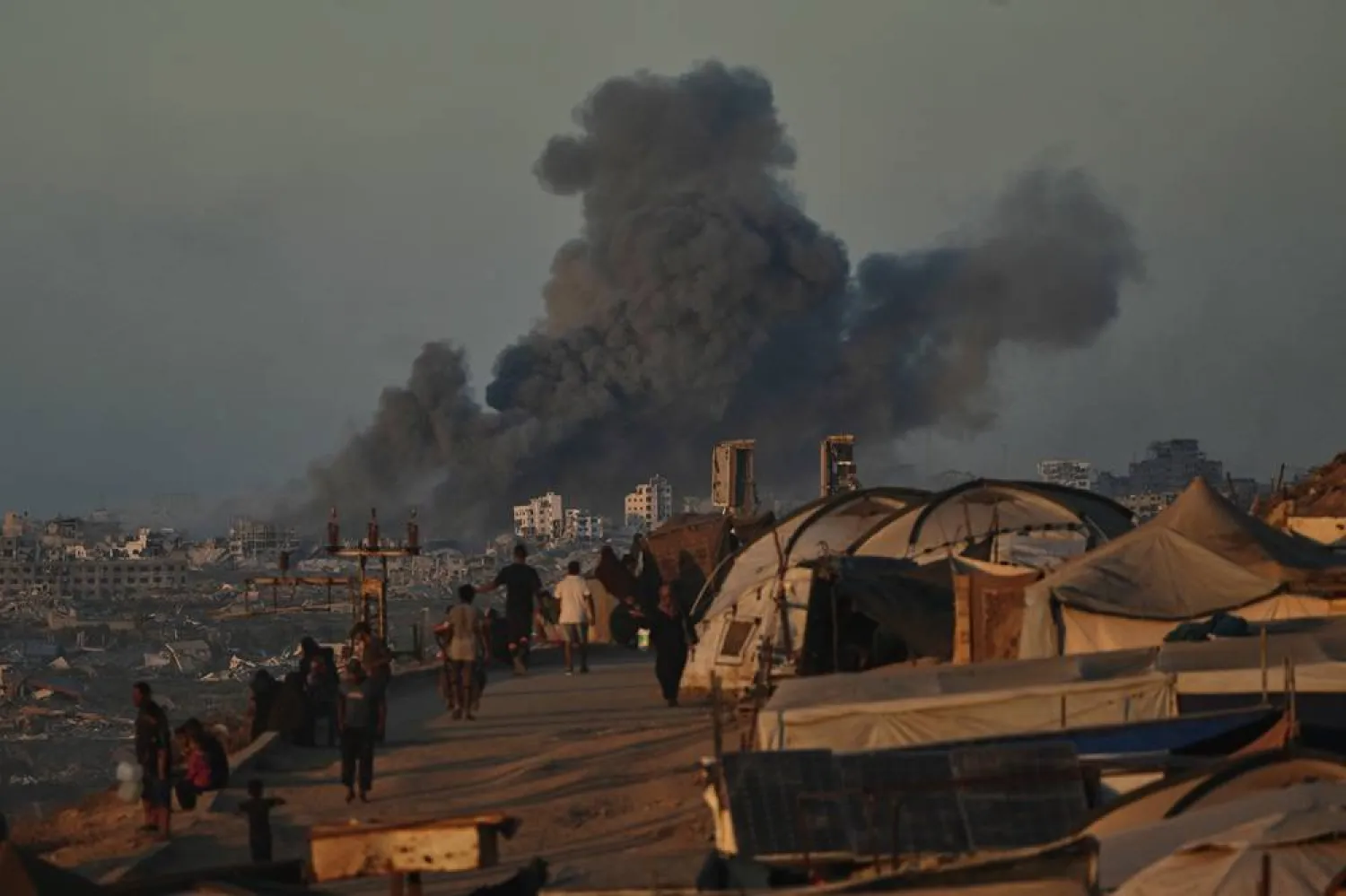
 Smoke rises following an Israeli military strike in Gaza City, as seen from the central Gaza Strip, Wednesday, Oct, 1, 2025. (AP)
Smoke rises following an Israeli military strike in Gaza City, as seen from the central Gaza Strip, Wednesday, Oct, 1, 2025. (AP)
TT

Report: Hamas Has Reservations over Some Clauses in Trump’s Gaza Plan, Wants them Changed

 Smoke rises following an Israeli military strike in Gaza City, as seen from the central Gaza Strip, Wednesday, Oct, 1, 2025. (AP)
Smoke rises following an Israeli military strike in Gaza City, as seen from the central Gaza Strip, Wednesday, Oct, 1, 2025. (AP)

Hamas is holding intensive talks with regional mediators over a US proposal to end the war in Gaza, but the group has raised objections to several clauses and is pressing for changes, sources familiar with the discussions said.

The plan was unveiled by US President Donald and endorsed by Israeli Prime Minister Benjamin Netanyahu after they met at the White House on Monday. Trump gave Hamas “three to four days” to respond.

Senior Hamas leaders met officials from Qatar, Egypt and Türkiye in Doha on Tuesday to discuss the plan and possible modifications.

The sources told Asharq Al-Awsat that the Hamas delegation objected to provisions on Israel’s withdrawal from Gaza, citing a lack of binding guarantees or a timetable. They also flagged the requirement to hand over Israeli hostages – alive or dead – within 72 hours as unrealistic given conditions on the ground.

Hamas negotiators also demanded clarity on issues of governance and weapons in Gaza. During the talks, they voiced opposition to the involvement of former British Prime Minister Tony Blair, whom they said was not a neutral figure.

One clause in the 20-point plan calls for an interim technocratic Palestinian administration overseen by an international “Board of Peace” chaired by Trump and including Blair.

Mediators told Hamas that the council would monitor governance remotely and that Palestinians themselves would run Gaza.

Diplomatic sources said envoys from the three Arab states urged Hamas to treat the plan as a real chance to end the conflict, stressing that Washington had offered guarantees to Arab and Muslim governments over Israel’s compliance, including withdrawal commitments.

“Hamas’ leadership has promised to study the proposal with seriousness, responsibility and positivity,” sources told Asharq Al-Awsat.

Parallel consultations are underway within Hamas and with other Palestinian factions to try to produce a “unified Palestinian response.”

But direct meetings with some factions remain unlikely due to security concerns following assassination attempt by Israel on Hamas leaders in Doha last month, the sources said.

Islamic Jihad may send one or two officials to the Qatari capital for joint talks.

Scope for amendments

For now, Hamas is expected to respond positively but with reservations aimed at securing amendments, sources said. How Washington and Israel react remains unclear, though Arab and Muslim governments could press them to accommodate Hamas’ remarks if they do not fundamentally alter the plan.

US officials have signaled openness to limited changes but not wholesale revisions.

Hamas sources described the proposal as “unjust and biased towards Israel,” arguing it offers little to Palestinians beyond symbolic concessions. Still, they said the group will approach it constructively, noting many clauses are “vague” and lack enforceable guarantees, especially on Israel’s phased withdrawal.

The group may seek longer deadlines for hostage releases and transfers, citing difficulties in locating remains under Gaza’s rubble and coordinating movements amid Israeli bombardment. They also deemed the 72-hour timeframe “illogical” under current conditions.

At the same time, Hamas is prepared to accept Israel's release of 250 Palestinian prisoners serving life terms, which it views as a reasonable trade-off, the sources added.
Lebanon's Government Approves a Deal to Transfer Syrian Prisoners Back to Syria

The main Homs prison was emptied when Assad fell in December 2024. But a year on, its wards are among those in Syria's prisons and lockups that are filling again with security detainees. REUTERS/John Davison
TT

Lebanon's Government Approves a Deal to Transfer Syrian Prisoners Back to Syria

The main Homs prison was emptied when Assad fell in December 2024. But a year on, its wards are among those in Syria's prisons and lockups that are filling again with security detainees. REUTERS/John Davison

Lebanon’s Cabinet approved an agreement to transfer Syrian prisoners serving their sentences in Lebanon back to their home country.

The issue of prisoners has been a sore point as the neighboring countries seek to recalibrate their relations following the ouster of former Syrian President Bashar Assad.

Lebanon and Syria have a complicated history with grievances on both sides. Many Lebanese resent the decades-long occupation of their country by Syrian forces that ended in 2005. Many Syrians resent the role played by the Lebanese militant group Hezbollah when it entered Syria’s civil war in defense of Assad’s government.

A key obstacle to warming relations has been the fate of about 2,000 Syrians in Lebanese prisons, including some 800 held over attacks and shootings, many without trial. Damascus had asked Beirut to hand them over to continue their prison terms in Syria, but Lebanese judicial officials said Beirut would not release any attackers and that each must be studied and resolved separately.

The deal approved late Friday appeared to resolve that tension. Lebanese Information Minister Paul Morcos said other issues remain to be resolved between the two countries, including the fate of Lebanese believed to have been disappeared into Syrian prisons during Assad’s rule and the demarcation of the border between the two countries.

Lebanon’s Deputy Prime Minister Tarek Mitri told reporters after the Cabinet meeting that about 300 prisoners would be transferred as a result of the agreement.

Protesters gathered in a square below the government palace in downtown Beirut ahead of the Cabinet vote to call for amnesty for Lebanese prisoners, including some who joined militant groups fighting against Assad in Syria. Some of the protesters called for the release of cleric Ahmad al-Assir, imprisoned for his role in 2013 clashes that killed 18 Lebanese army soldiers.

“The state found solutions for the Syrian youth who are heroes and belong to the Syrian revolution who have been imprisoned for 12 years,” said protester Khaled Al- Bobbo. “But in the same files there are also Lebanese detainees. ... We demand that just as they found solutions for the Syrians, they must also find solutions for the people of this country.”


Supplies Running Out at Syria's al-Hol Camp as Clashes Block Aid Deliveries

An aerial view shows the al-Hol camp in northeastern Syria’s Hasakeh province, Syria, Wednesday, Jan. 21, 2026, after the withdrawal of the Syrian Democratic Forces (SDF). (AP Photo/Ghaith Alsayed)
TT

Supplies Running Out at Syria's al-Hol Camp as Clashes Block Aid Deliveries

An aerial view shows the al-Hol camp in northeastern Syria’s Hasakeh province, Syria, Wednesday, Jan. 21, 2026, after the withdrawal of the Syrian Democratic Forces (SDF). (AP Photo/Ghaith Alsayed)

An international humanitarian organization has warned that supplies are running out at a camp in northeast Syria housing thousands of people linked to the ISIS group, as the country's government fights to establish control over an area formerly controlled by Kurdish fighters.

The statement by Save the Children came a week after government forces captured al-Hol camp, which is home to more than 24,000 people, mostly children and women, including many wives or widows of ISIS members.

The capture of the camp came after intense fighting earlier this month between government forces and members of the Kurdish-led and US-backed Syrian Democratic Forces during which forces loyal to interim President Ahmad al-Sharaa captured wide areas in eastern and northeastern Syria.

The SDF signed a deal to end the fighting after suffering major defeats, but sporadic clashes between it and the government have continued, The AP news reported.

Save the Children said that “critical supplies in al-Hol camp are running dangerously low” as clashes are blocking the safe delivery of humanitarian aid.

It added that last week’s clashes around the camp forced aid agencies to temporarily suspend regular operations at al-Hol. It added that the main road leading to the camp remains unsafe, which is preventing humanitarian workers from delivering food and water or running basic services for children and families.

“The situation in al-Hol camp is rapidly deteriorating as food, water and medicines run dangerously low,” said Rasha Muhrez, Save the Children Syria country director. “If humanitarian organizations are unable to resume work, children will face still more risks in the camp, which was already extremely dangerous for them before this latest escalation.”

Muhrez added that all parties to the conflict must ensure a safe humanitarian corridor to al-Hol so basic services can resume and children can be protected. “Lives depend on it,” she said.

The SDF announced a new agreement with the central government on Friday, aiming to stabilize a ceasefire that ended weeks of fighting and lay out steps toward integrating the US-backed force into the army and police forces.


Gaza Awaits Arrival of Technocratic Committee

A truck carrying food aid at the Rafah crossing, Jan. 28, 2026 (EPA)
TT

Gaza Awaits Arrival of Technocratic Committee

A truck carrying food aid at the Rafah crossing, Jan. 28, 2026 (EPA)

Gaza residents are waiting for the arrival of a technocratic committee tasked with administering the territory, after Israel announced a partial reopening of the Rafah land crossing with Egypt on Sunday, allowing limited daily movement of travelers in and out of Gaza.

The 15-member National Committee for the Administration of Gaza (NCAG) is a team of Palestinian technocrats created as part of the US-sponsored ceasefire agreement which came into effect on October 10.

The head of the committee, Ali Shaath, said in a post on X that once logistical arrangements among the relevant parties are finalized, the reopening of Rafah would be officially announced starting Monday.

He said Sunday would be used as a trial day to test operational procedures at the crossing.

Sources told Asharq Al-Awsat that members of the committee are expected to enter Gaza on Sunday or Monday, provided Israel grants approval, adding that Israeli foot-dragging on the issue continues.

COGAT, the Israeli military body in charge of coordinating aid to Gaza, said on Friday that the Rafah crossing would reopen starting Sunday, under strict restrictions on passenger movement, particularly for those permitted to return to Gaza.

In a statement, the office said the crossing would operate in both directions, but with limited passenger numbers.

Travel would take place in coordination with Egypt, subject to prior Israeli security approval and under the supervision of a European Union mission, following the same mechanism activated in January 2025.

It said returning from Egypt to Gaza would be permitted only for residents who left the territory during the war, and only after obtaining prior Israeli security clearance. After an initial screening at Rafah by the EU mission, travelers would undergo a second identification check at an Israeli army checkpoint.

Israel’s Channel 12 reported that only 150 travelers per day would be allowed to enter Gaza from the Egyptian side, adding that Israeli efforts to impose a direct military presence at the crossing had failed.

Israeli army radio said the country’s security system would monitor the crossing remotely using sensors, metal detectors, cameras, and facial recognition technology to identify approved departures and arrivals.

Any attempt to smuggle an individual using a forged identity would result in denial of entry or exit and detention, without clarifying the mechanism or the responsible authority.

Israeli Prime Minister Benjamin Netanyahu said on Tuesday that Israel would maintain security control over the Rafah crossing.

Yedioth Ahronoth reported that Israel would allow lower-ranking Palestinian fighters, but not senior officials, wounded during the war, to leave Gaza via Rafah if they wished, noting that, in principle, all those who depart would be allowed to return.

On the Palestinian side, sources told Asharq Al-Awsat that preparations to compile lists of patients initially approved to travel through Rafah began on Sunday.

The sources said members of the Palestinian technocratic committee are expected to arrive in Gaza on Sunday or Monday, if Israel permits, noting continued Israeli stalling on the issue.

If the committee members arrive, they will hold meetings with Hamas-run government bodies in Gaza to agree on mechanisms for transferring authority in the territory.

Additional meetings are planned with Palestinian factions, civil society activists, and others to coordinate efforts related to Gaza’s current situation and future governance.