


Egypt Working to Convince Hamas to Accept Trump Plan, Says Foreign Minister

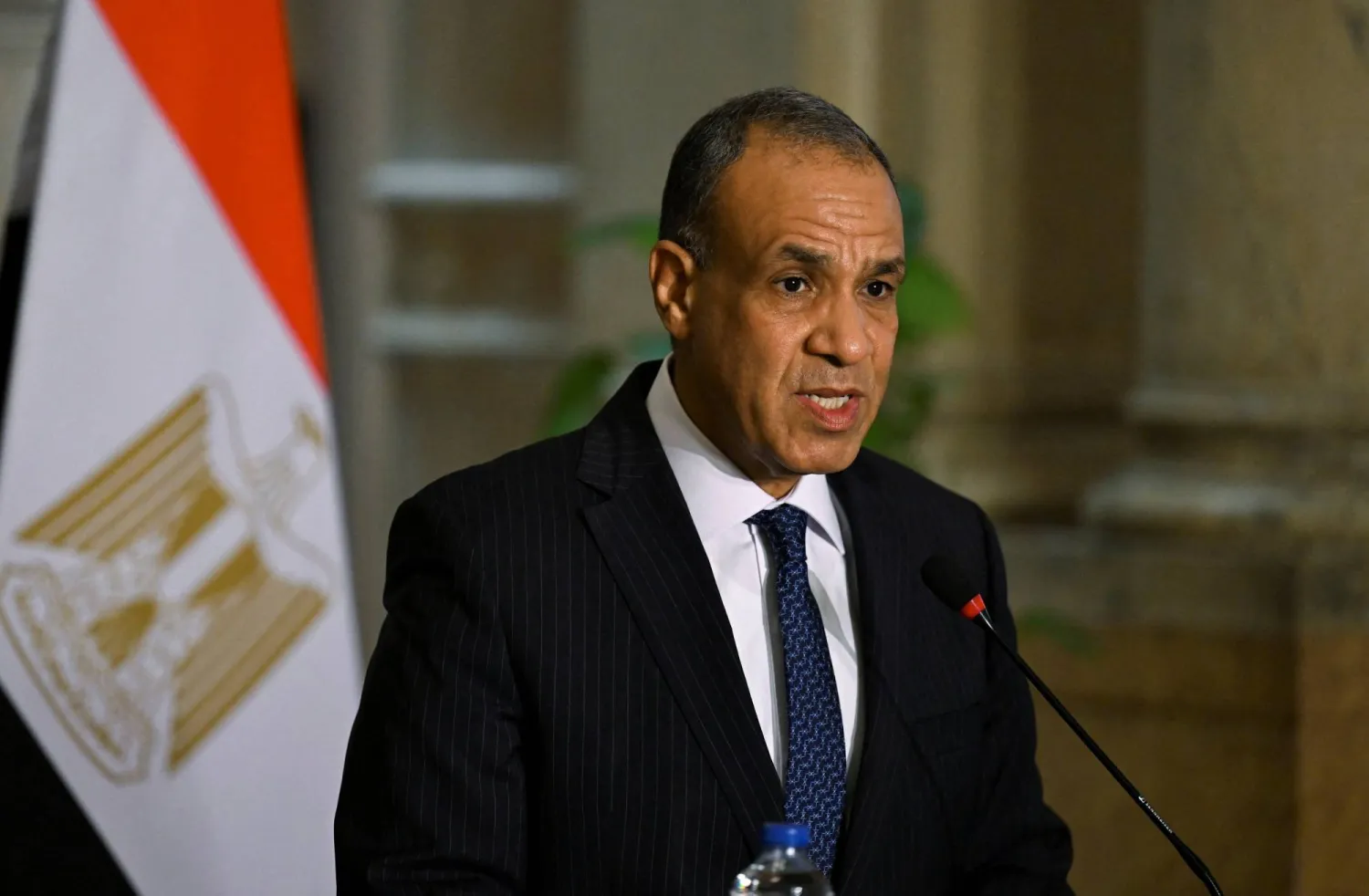
Egyptian Foreign Minister Badr Abdelatty speaks during a press conference with Philippe Lazzarini, Commissioner-General of the United Nations Relief and Works Agency for Palestine Refugees in the Near East (UNRWA) (not pictured), in Cairo, Egypt September 6, 2025. REUTERS/Mohamed Abd El Ghany
TT

Egypt Working to Convince Hamas to Accept Trump Plan, Says Foreign Minister

Egyptian Foreign Minister Badr Abdelatty speaks during a press conference with Philippe Lazzarini, Commissioner-General of the United Nations Relief and Works Agency for Palestine Refugees in the Near East (UNRWA) (not pictured), in Cairo, Egypt September 6, 2025. REUTERS/Mohamed Abd El Ghany

Egypt's foreign minister said on Thursday that Cairo was working with Qatar and Türkiye to convince Hamas to accept US President Donald Trump's plan to end a nearly two-year-old war in Gaza, and warned the conflict would escalate if the militant group refused.

Speaking at the French Institute of International Relations in Paris, Badr Abdelatty said it was clear that Hamas had to disarm and that Israel should not be given an excuse to carry on with its offensive in Gaza.

"Let's not give any excuse for one party to use Hamas as a pretext for this mad daily killings of civilians. What's happening is far beyond the seventh of October," he said, referring to the group's 2023 attack on Israel, in which 1,200 people were killed and more than 200 people taken hostage, according to Israeli tallies.

Israel's offensive has killed over 66,000 people in Gaza, Palestinian health authorities say.

"It is beyond revenge. This is ethnic cleansing and genocide in motion. So enough is enough," Abdelatty said.

The White House unveiled earlier this week a 20-point document that called for an immediate ceasefire, an exchange of hostages held by Hamas for Palestinian prisoners held by Israel, a staged Israeli withdrawal from Gaza, Hamas disarmament and a transitional government led by an international body.

On Tuesday, Trump gave Hamas three to four days to agree to the plan.

Egypt is a key mediator in efforts to end the Gaza war and Abdelatty said Cairo was coordinating with Qatar and Türkiye to convince Hamas to respond positively to the plan, but he remained very cautious.

"If Hamas refuse, you know, then it would be very difficult. And of course, we will have more escalation. So that's why we are exerting our intensive efforts in order to make this plan applicable and to get the approval of Hamas,” he said. Abdelatty said while he was broadly supportive of Trump's proposal for Gaza, more talks were needed on it.

"There are a lot of holes that need to be filled, we need more discussions on how to implement it, especially on two important issues - governance and security arrangements," he said. "We are supportive of the Trump plan and the vision to end war and need to move forward."

When asked whether he feared the Trump plan could lead to forced displacement of Palestinians, he said Egypt would not accept that.

"Displacement will not happen, it will not happen because displacement means the end of the Palestinian cause," he said. "We will not allow this to happen under any circumstances."


Ali Shaath Appointed Head of Gaza Administration Committee: What Do We Know About Him?

Palestinian Ali Shaath, the leading candidate for the chairmanship of the Gaza Administration Committee (photo released by his family). 
TT

Ali Shaath Appointed Head of Gaza Administration Committee: What Do We Know About Him?

Palestinian Ali Shaath, the leading candidate for the chairmanship of the Gaza Administration Committee (photo released by his family). 

Mediators from Egypt, Qatar, and Türkiye announced on Wednesday the formation of a Palestinian technocratic committee to administer the Gaza Strip, headed by Ali Shaath. The move follows changes to the committee’s membership and broader political maneuvering that point to an imminent transfer of governance from Hamas.

Earlier on Wednesday, US Special Envoy Steve Witkoff announced the launch of “Phase Two of President Donald Trump’s 20-point plan to end the conflict in Gaza,” saying it marks a shift “from a ceasefire to disarmament, technocratic governance, and reconstruction.”

The plan calls for the establishment of a technocratic body to oversee governmental and civilian affairs in Gaza as an alternative to Hamas rule.

While several well-known figures had previously been mentioned as potential leaders, Gaza residents and observers were surprised by the emergence of new names. Among those reported by Asharq Al-Awsat on Tuesday evening was Ali Shaath, who has since emerged as the leading candidate to chair the committee.

Who Is Ali Shaath?

Ali Shaath was born in 1958 in Khan Younis, southern Gaza, into a prominent Palestinian family and large clan with a long record of national and political engagement. Many members of his family are affiliated with Fatah.

He earned a bachelor’s degree in civil engineering from Ain Shams University in Cairo in 1982, a master’s degree in 1986, and a PhD in civil engineering from Queen’s University in the United Kingdom in 1989, specializing in infrastructure planning and urban development.

Shaath has held several senior posts within the Palestinian Authority and is widely regarded as a technical expert rather than a political figure. Early in the Authority’s formation, he served as deputy to then–Minister of Planning and International Cooperation Nabil Shaath, helping draft strategic development plans for a future Palestinian state.

He later served as undersecretary at the Ministry of Transport, overseeing major infrastructure and road projects. He went on to lead the Palestinian Industrial Estates and Free Zones Authority, chair the Palestinian Housing Council, head the Palestinian Ports Authority, and advise the Palestinian Economic Council for Development and Reconstruction (PECDAR). Most recently, despite retirement, he served as an adviser to the Ministry of Housing and Public Works.

Politically, Shaath participated in final-status negotiation committees in 2005 and contributed as a technical expert on border and maritime access issues. His background in economic development and postwar reconstruction appears to have positioned him to lead the technocratic committee.

Sources close to the Shaath family told Asharq Al-Awsat that he has lived in the West Bank for years, including before the Gaza war, and has consistently avoided factional politics, focusing instead on technical and professional roles.


Israel Seeks to Cement Status Quo of Its New Occupation in Syria

Members of Israel’s special reserve unit “Alpine Mountains” during training on Mount Hermon in Syria (Israeli army) 
TT

Israel Seeks to Cement Status Quo of Its New Occupation in Syria

Members of Israel’s special reserve unit “Alpine Mountains” during training on Mount Hermon in Syria (Israeli army) 

A senior Israeli official has acknowledged that disagreements with Syria remain “very deep,” dismissing what the United States has described as a positive atmosphere surrounding negotiations. “The reality is quite different,” the official said.

The remarks indicate that Israel intends to preserve the current situation created by its recent occupation of Syrian territory and rejects any withdrawal, not only from Mount Hermon but also from the nine positions it established following the collapse of Bashar al-Assad’s regime.

Israel has reportedly set far-reaching conditions in return, including barring Syria from deploying anti-aircraft missiles.

According to a report by Maariv political correspondent Anna Barsky, intensive talks held in Paris over two days last week, involving representatives from Israel, Syria, and the United States, produced only a limited outcome.

The discussions resulted in an agreement to establish a coordination mechanism aimed at preventing field-level friction, to be managed with active US involvement, but fell short of any broader political or security breakthrough.

Barsky wrote that there is currently no possibility of reaching a security agreement between Israel and Syria. While she cited Syria’s demand for an Israeli withdrawal from Syrian Mount Hermon as the main obstacle, the report suggests that Israel’s own demands are the primary factor blocking progress.

According to the senior official, Israel’s conditions include maintaining the new reality that emerged after Assad’s downfall in December 2024. This includes areas formerly designated as a UN-monitored buffer zone, an additional strip deeper along the border covering about 450 square kilometers, and all the peaks of Mount Hermon.

Israel is also seeking to strip the Syrian army of what it defines as strategic weapons, including advanced anti-aircraft systems or any arms that could disrupt the existing military balance. In addition, it demands that no foreign forces be present in Syria if they could restrict the Israeli army’s freedom of movement, specifically Russian or Turkish forces.

The report noted that the US administration, while pressing both sides to advance toward security understandings, supports Israeli demands it considers essential to Israel’s security, particularly remaining on Mount Hermon, though Washington is expected to propose compromise arrangements.

At the same time, Barsky reported growing concern in Tel Aviv over a parallel Syrian track: efforts by Damascus to coordinate with Moscow to redeploy Russian military forces in Syria, especially in the south.

Israel views such a move as a direct threat to its operational freedom and has worked to thwart initiatives aimed at restoring a Russian presence there. According to Maariv, Israel has conveyed a firm message to Damascus, Moscow, and Washington that it will not tolerate Russian forces in southern Syria.

The newspaper linked this stance to past experience, noting that while Russia maintained two main bases in Syria - Hmeimim Air Base and the naval facility in Tartus - it also deployed military police and observation posts near the disengagement zone in the south. Israel believes a return to that model would impose new operational constraints and alter the rules of engagement.

Although Russia’s footprint in Syria shrank after Assad’s fall, Israeli assessments suggest Moscow is seeking, in coordination with Syria’s new authorities, to rebuild its influence despite its preoccupation with the war in Ukraine.

The report said that both Moscow and Damascus view a Russian presence in southern Syria as strategically valuable, particularly as a means of constraining Israel.


Hezbollah Raises Civil War Threat Over Disarmament Plan

Hezbollah members take an oath in front of a monument to Iranian General Qassem Soleimani in Beirut in 2022 (AP file photo)
TT

Hezbollah Raises Civil War Threat Over Disarmament Plan

Hezbollah members take an oath in front of a monument to Iranian General Qassem Soleimani in Beirut in 2022 (AP file photo)

Hezbollah escalated its response to Lebanese President Joseph Aoun and Prime Minister Nawaf Salam over plans to press ahead with restricting weapons to the state and extending the move to areas north of the Litani River, raising the specter of civil war as tensions over the issue intensify.

Mahmoud Qamati, vice president of Hezbollah’s political council, said in a televised interview that statements by the president and prime minister on confining weapons north of the Litani meant the government was heading toward chaos and instability, and toward an internal situation that no one would accept, possibly even a civil war.

The government last week tasked the Lebanese army commander, during a cabinet session, with preparing a plan to restrict weapons north of the Litani, after announcing that the objectives of the first phase of the plan to confine arms to the state south of the river had been achieved.

Qamati’s Position

Hezbollah says that before any discussion begins on the fate of its weapons outside the area south of the river, Israel must stop violating Lebanese sovereignty, withdraw from points it occupies, and release prisoners.

Qamati said on Tuesday that some parties were insisting on implementing foreign dictates and offering concessions to Israel for free and without any return.

He added that the army’s role was not to protect Israel from any military action from Lebanon, but to confront Israel, which he said occupies Lebanese territory.

Accusing some members of the government of collusion to implement a US-Israeli plan for personal calculations, Qamati called for a return to reason, wisdom, and “Lebanese-Lebanese dialogue”.

War Against Whom?

Lebanese Industry Minister Joe Issa El-Khoury expressed surprise at Hezbollah’s threat of a civil war, asking between whom such a war would take place, between an illegitimate armed group and the legitimate army.

Civil wars, he said, usually erupt between illegitimate armed groups, warning that if Hezbollah did not hand over its weapons, other unarmed groups might rearm on the grounds that the army was unable to protect them.

Speaking to Asharq Al-Awsat, El-Khoury said it was unacceptable for one group alone to be armed to fight Israel, adding that Lebanon either builds a state together or looks for other projects. While the region was moving forward with strong momentum, he said, Lebanon was moving backward.

El-Khoury said the army’s forthcoming plan to restrict weapons north of the Litani should not include multiple phases, but rather a single phase running until the end of March.

He stressed that linking implementation to the army’s capabilities and resources was misplaced.

He recalled that the strongest militia after the civil war was the Lebanese Forces, which later committed to building the state and handed over its weapons to the army, thereby eliminating the need for army deployment in areas where the group had been present.

That, he said, was what should happen today with Hezbollah.

Party Warning

Sources familiar with Hezbollah’s internal thinking told Asharq Al-Awsat that the group did not want a clash with the army, and that the army did not intend to seize weapons by force.

The warning issued by Qamati, they said, was directed at political forces pushing for disarmament by force. The sources added that the current moves were an attempt to create the right conditions to reach a consensus solution to the issue.

Remarks by Rajji

Hezbollah’s veiled threats of civil war coincided with a fierce campaign by lawmakers from the Shiite duo, Amal and Hezbollah, against Lebanese Foreign Minister Youssef Rajji.

In a televised interview, Rajji said that the ceasefire declaration approved by the government provided for Hezbollah’s weapons to be confined in return for a halt to Israeli attacks, and that as long as the weapons were not fully confined, Israel, unfortunately, had the right to continue its attacks.

Hezbollah lawmaker Ali Ammar described the remarks as dangerous, saying they required a clear and firm stance from the president and prime minister, as well as a halt to such statements, which he said inflamed internal divisions and served only to benefit the enemy.

Qassem Hashem, a member of the Development and Liberation bloc, said Rajji’s comments went beyond impropriety to justifying Israeli aggression against Lebanon, calling it a violation of sovereignty and a blow to national dignity.

He said the remarks should not pass without accountability in cabinet, and that in a fully sovereign state, the minister would be dismissed.

Another lawmaker from the bloc, Mohammed Khawaja, asked the president and prime minister whether Rajji was truly Lebanon’s foreign minister, accusing him of focusing on finding justifications for Israel.

In response, El-Khoury told Asharq Al-Awsat that Rajji’s remarks reflected the government’s position, not a personal view.

He said the agreement approved by Hezbollah listed the parties authorized to carry weapons and did not include Hezbollah, meaning that the group’s insistence on keeping its arms constituted a breach of the agreement and provided Israel with a pretext to refuse to implement its provisions.
