


Hundreds of Thousands of Palestinians Return to Gaza City as Hamas Deploys Forces

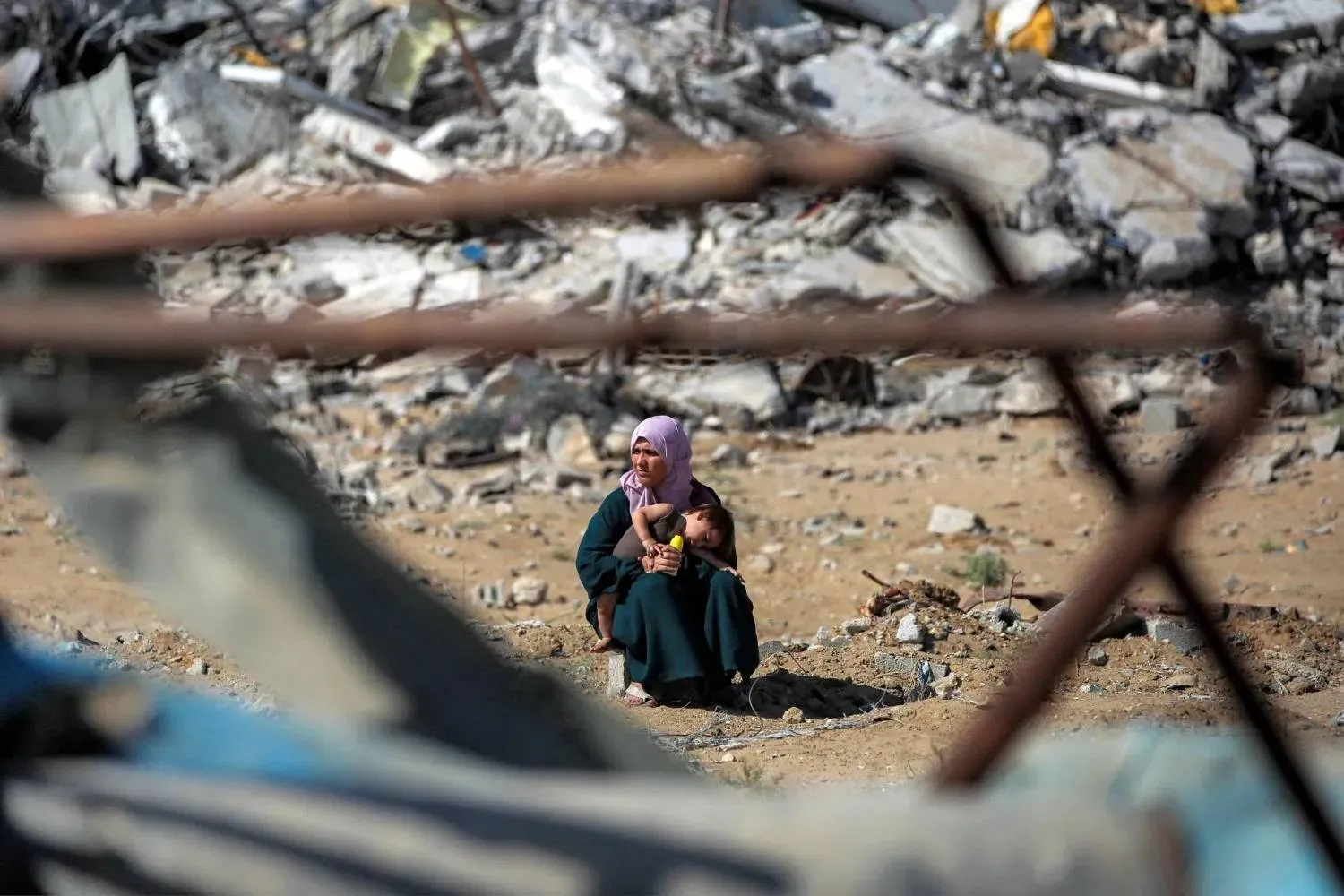
A Palestinian woman holds her child beside piles of rubble while heading toward Gaza City on Friday. (AFP)
TT

Hundreds of Thousands of Palestinians Return to Gaza City as Hamas Deploys Forces

A Palestinian woman holds her child beside piles of rubble while heading toward Gaza City on Friday. (AFP)

As dawn broke Friday, thousands of residents from Gaza City and the northern Strip streamed toward the Nuwairi area and the coastal al-Rashid Street, hoping to return to their homes after nearly a month of displacement.

Israeli forces initially blocked their passage before withdrawing around noon, clearing the way for hundreds of thousands to pour northward on foot and in vehicles.

The Israeli army announced that the ceasefire had taken effect at 12 p.m. local time in both Palestine and Saudi Arabia, though the truce was meant to begin earlier after Israel’s government voted overnight to approve the agreement.

Joy and ruin

Videos posted by journalists, activists, and remaining residents showed scenes of jubilation as Gazans made their way back through shattered neighborhoods. Despite the devastation, many said they were overjoyed simply to return.

Safaa al-Hannawi, 41, from Shati refugee camp west of Gaza City, said she had been waiting since early morning in Nuwairi near the Netzarim axis, hoping to reach her home, uncertain whether it was completely destroyed or partially damaged as she had left it a month ago.

“I can’t describe how happy I am to be back in the spirit of my life,” she said, referring to Gaza City and her neighborhood. Al-Hannawi said she planned to bring her tent from Mawasi Khan Younis and live in it if her home was gone. “But I won’t leave the area again,” she added.

Elsewhere, Yassine al-Barawi, a resident of Al-Nasr district in Gaza City, loaded his belongings into his car and immediately headed north as soon as Israeli forces announced civilians could return. His house was still standing, though damaged.

“I’d rather live in what’s left of my home than in a tent on barren farmland with nothing to sustain life,” he told Asharq Al-Awsat. “When they said we could go back, I rushed to leave. I couldn’t believe it would actually happen, not after our first displacement that lasted more than a year and a half.”

Hours earlier, the roughly 130,000 people who remained in Gaza City had ventured out to survey what was left of their homes and neighborhoods, many reduced to rubble by Israeli operations in recent weeks.

Widespread destruction

Nour Yaghi, 37, from the Sheikh Radwan neighborhood in northern Gaza City, said he reached his area early Friday after sheltering near Gaza’s port in recent weeks only to find it obliterated.

“The devastation is beyond description,” Yaghi said. “Our house and the neighboring ones are just piles of rubble. Seventy percent of Sheikh Radwan is gone, destroyed by booby-trapped military vehicles and airstrikes.”

Mousa al-Najjar from al-Shati camp said entire housing blocks had been flattened. “It will take months just to clear the main roads,” he said. “Anyone returning from the south won’t even recognize where their house once stood.”

According to Gaza’s municipality, more than 85 percent of the city has been destroyed. Medical sources said over 73 bodies were recovered from streets and homes in Gaza City after Israeli troops withdrew, while at least 20 more were found in Khan Younis.

Hamas forces reemerge

Hamas security forces were seen redeploying in parts of central and southern Gaza, as well as on the outskirts of Gaza City. The Interior Ministry in Gaza said its security services would begin restoring order in areas vacated by the Israeli army and “address the chaos the occupation sought to spread over the past two years.”

The Israeli military, meanwhile, warned residents to avoid several “highly dangerous” areas, including Beit Hanoun, Beit Lahia, Shujaiyya, and parts of Khan Younis near the Philadelphi corridor and Rafah crossing.

Military spokesperson Brig. Gen. Effi Defrin said Hamas “is no longer what it was when the war began two years ago. It has been defeated everywhere we fought it.” He urged civilians to stay away from Israeli-controlled zones to ensure their safety.

Gaza’s toll

In a statement marking the ceasefire, the Hamas-run Government Media Office accused Israel of committing “a full-scale genocide” in Gaza, using food, water, and medicine as weapons of war. It said Israel had destroyed 90 percent of the enclave’s civilian infrastructure and seized more than 80 percent of its territory through invasion and forced displacement.

The office estimated that Israel dropped more than 200,000 tons of explosives on Gaza and bombed the Mawasi area over 150 times despite designating it a “safe humanitarian zone.”

According to its figures, some 77,000 Palestinians were killed or remain missing, including more than 20,000 children and 12,500 women. About 67,000 bodies have been recovered, while 9,500 people remain unaccounted for. Over 1,000 infants under one year old were among the dead, including 450 newborns killed during the war, it said.

The report said more than 39,000 families were wiped out in airstrikes, and that women, children, and the elderly made up over half of all victims.

At least 1,670 medical workers, 140 civil defense members, 254 journalists, and more than 1,000 police and emergency responders were killed. Injuries totaled around 170,000, including thousands with amputations, paralysis, or blindness. Over 6,700 detainees, including medical and media staff, remain in Israeli custody under harsh conditions.

Gaza’s health system has “completely collapsed,” the office said, with 38 hospitals destroyed, hundreds of attacks on health facilities, and more than 788 assaults on medical services. Israel also destroyed 670 schools, 165 universities and educational institutions, killing 13,500 students, 830 teachers, and nearly 200 academics.

The statement added that 835 mosques were completely destroyed, several churches were damaged, and 40 cemeteries were razed. Israeli forces allegedly exhumed more than 2,450 bodies and established seven mass graves inside hospitals.

Nearly 300,000 housing units were demolished and 200,000 others heavily damaged, displacing about two million people. Many remain in tattered tents under dire humanitarian conditions.

The office accused Israel of using starvation as a weapon, keeping Gaza’s crossings closed for over 600 days and blocking thousands of aid trucks, resulting in more than 460 deaths from hunger and malnutrition. It estimated Gaza’s direct economic losses at over $70 billion after two years of war.


Arab Parliament Backs UNRWA Mandate Renewal, Reaffirms Support for Palestinian Rights

Arab Parliament Backs UNRWA Mandate Renewal, Reaffirms Support for Palestinian Rights
TT

Arab Parliament Backs UNRWA Mandate Renewal, Reaffirms Support for Palestinian Rights

Arab Parliament Backs UNRWA Mandate Renewal, Reaffirms Support for Palestinian Rights

Speaker of the Arab Parliament Mohamed Alyammahi welcomed the UN General Assembly’s decision to renew the mandate of the United Nations Relief and Works Agency for Palestine Refugees in the Near East (UNRWA) for another three years, saying the vote reflects broad international support for Palestinian rights and a clear rejection of efforts to undermine their cause.

Alyammahi stressed that the mandate’s renewal is particularly critical amid the continued aggression and blockade facing Palestinians, ensuring the agency can maintain its essential services. He noted the strong backing for related resolutions calling for an end to the occupation and the establishment of an independent Palestinian state with Jerusalem as its capital.

The speaker urged leveraging this growing international consensus to halt the assault on Gaza, facilitate the entry of humanitarian aid, intensify legal and diplomatic action against the occupation, and advance a credible political process that can help ease the suffering of the Palestinian people.


Israeli Soldiers Kill 55-Year-Old Palestinian and Teenager in West Bank

28 November 2025, Palestinian Territories, Hebron: Israeli forces block Palestinian farmers trying to access to their agricultural fields in the town of Tarqumiyah. (dpa)
TT

Israeli Soldiers Kill 55-Year-Old Palestinian and Teenager in West Bank

28 November 2025, Palestinian Territories, Hebron: Israeli forces block Palestinian farmers trying to access to their agricultural fields in the town of Tarqumiyah. (dpa)

Israeli soldiers killed a Palestinian teenager who was driving a car towards them as well as a Palestinian bystander in the West Bank on Saturday, according to an Israeli security official.

The military said that an "uninvolved person" was hit in addition to the driver of the car who had "accelerated" towards soldiers at a checkpoint in West Bank city of Hebron.

In an earlier statement, the military said two "terrorists" were killed, before later clarifying that only one person was involved.

An Israeli security official, speaking on condition of anonymity, said a 17-year-old was driving the car and a 55-year-old was the bystander.

Palestinian state news agency WAFA reported that 55-year-old Ziad Naim Abu Dawood, a municipal street cleaner, was killed while working. It said another Palestinian was killed but did not report the circumstances that led the soldiers to open fire.

The Palestinian health ministry identified the second Palestinian as 17-year-old Ahmed Khalil Al-Rajabi.

The military did not report any injuries to the soldiers.

The motive for the 17-year-old's actions was not immediately clear, and no armed group claimed responsibility.

Since January, 51 Palestinian minors, aged under 18, have been killed in the West Bank by Israeli forces, according to the Palestinian health ministry.

Violence has surged this year in the Israeli-occupied West Bank. Israeli settler attacks on Palestinians have risen sharply, while the military has tightened movement restrictions and carried out sweeping raids in several cities.

Palestinians have also carried out attacks on Israeli soldiers and civilians, some of them deadly.


Reconstruction Delays in South Lebanon Fuel Anger against the State, Hezbollah

Lebanese soldiers stand in front of a building targeted by an Israeli airstrike in the village of Deir Kifa in south Lebanon last month. (AFP file)
TT

Reconstruction Delays in South Lebanon Fuel Anger against the State, Hezbollah

Lebanese soldiers stand in front of a building targeted by an Israeli airstrike in the village of Deir Kifa in south Lebanon last month. (AFP file)

Mounting protests across frontline villages in south Lebanon are exposing deep frustration over stalled reconstruction efforts and long-delayed compensation for war damage, delays that have pushed many families to abandon their homes and rebuild their lives elsewhere.

In Taybeh, a resident recently blocked the road outside his damaged house, which had been struck by an Israeli raid. Earlier, villagers in Deir Siryan blocked a main road and burned tires to protest the lack of compensation for destroyed vehicles. In Houla, a local man appeared in a video claiming losses exceeding six million dollars and demanding equal treatment for border communities compared with other regions that previously received compensation.

These demonstrations come more than two years after border residents were first displaced by recurring Israeli strikes during its conflict with Hezbollah that turned into a full blown war in October 2024. Many residents continue to live away from their homes, with no clear timetable for reconstruction support.

The almost daily Israeli bombardments since a November 2024 ceasefire have increased the scale of destruction, intensifying the sense of abandonment.

For many villagers, the central question is not which authority - Hezbollah or the Lebanese state - should assume responsibility. Instead, they want whichever side can deliver funds that would allow them to rebuild shattered neighborhoods. Their protests increasingly target both the government and Hezbollah, which has a strong presence in the South.

Tarek Mazraani, coordinator of the Coalition of Southern Border Villages, said these “relatively modest” protests will continue as residents seek to make their voices heard.

He told Asharq Al-Awsat that demands are directed at the state and political parties alike: “People don’t care who pays. What matters is that compensation arrives.”

While the state remains largely absent from reconstruction efforts, Mazraani noted slight improvements in services such as electricity and water.

He added that protesters are also calling for urgent support for displaced families. Many have lost businesses, savings, and all sources of income, leaving them unable to cover rent, medical expenses, or basic living costs in their temporary housing.

Although residents recognize that reconstruction funding may be difficult to secure under current conditions, Mazraani said they still expect the government and influential parties to help ease their burden.

Since the coalition’s founding six months ago, he said, its advocacy has had an impact, “but we have yet to see any concrete decisions on the ground.”

Last month, the Development and Liberation Bloc of Parliament Speaker Nabih Berri, hosted a coordination meeting in Msayleh village to outline a reconstruction strategy with government and civil society representatives.

Yet southerners still await parliamentary approval of a $250 million World Bank loan to rebuild damaged infrastructure. The relevant legislation stalled because several political blocs are boycotting parliamentary sessions over electoral law disputes.

Political analyst Ali Al-Amin said the growing protests are an unsurprising reaction from communities that feel “virtually abandoned.”

He argued that residents blame Hezbollah for policies they believe have closed off political options for a national solution, noting that reconstruction cannot proceed without addressing the issue of weapons outside state control.

Israel’s continued strikes, alongside talk of imposing a buffer zone in the South under direct or indirect Israeli oversight, further obstruct recovery.

Under such conditions, “reconstruction is simply not possible now,” added Al-Amin.