



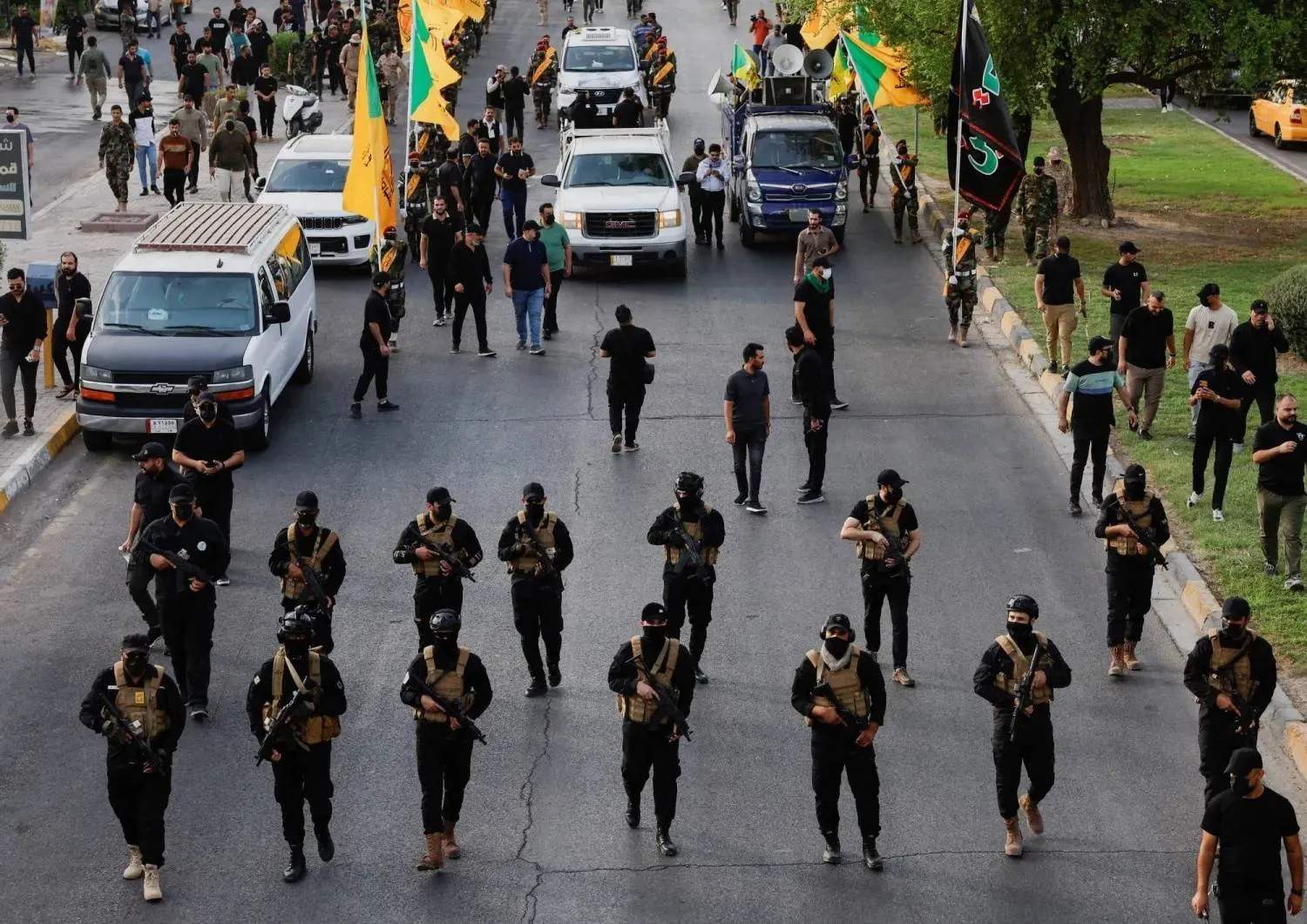

As Iraq’s government led by Prime Minister Mohammed Shia al-Sudani works to deepen economic and investment cooperation with the United States, including opening the country’s market to major American firms, Washington announced a new round of sanctions targeting Iraqi officials, businessmen, and companies linked to the Popular Mobilization Forces (PMF).
An Iraqi politician described the move as “a negative shift and a strong point of pressure” in the US position toward Baghdad.
The US State Department said Thursday that Washington is sanctioning Kataib Hezbollah and Asaib Ahl al-Haq for assisting the Iranian regime in “evading US sanctions, smuggling weapons, and engaging in widespread corruption in Iraq.”
An Iraqi official told Asharq Al-Awsat that the sanctions “likely mark the beginning of a wider wave that may include additional figures and entities in the coming phase.”
The official, who requested anonymity, said the measures imposed by the US Treasury “clearly indicate a negative turn in the relationship between the Trump administration and the Iraqi government.”
He noted that this comes just as a new phase of cooperation has begun between Baghdad and Washington, following a US-backed oil and political agreement between Baghdad and Erbil.
“Through these sanctions, Washington is putting pressure on Baghdad to move against groups it sees as threats, which it continues to link to Iran,” the official added.
“What’s notable here is that Washington has started to differentiate between the Iraqi state and the parallel actors within its political and security landscape.”
He warned that “the timing of this escalation is particularly sensitive, as Iraqi political factions are busy preparing for next year’s parliamentary elections, where Shiite blocs are vying for the premiership.”
Sanctions Linked to Iran
In a statement Thursday, the US Treasury Department said: “Today, the US Department of the Treasury’s Office of Foreign Assets Control (OFAC) is taking action against individuals and companies that assist the Iranian regime in evading US sanctions, smuggling weapons, and engaging in widespread corruption in Iraq.”
“The Iranian regime relies on various Iraqi militia proxies, including US-sanctioned foreign terrorist organization Kataib Hezbollah, to penetrate Iraq’s security forces and economy.”
“These Iran-backed groups are not only responsible for the deaths of US personnel but also conduct attacks against US interests and those of our allies across the Middle East.”
“The militias actively undermine the Iraqi economy, monopolizing resources through graft and corruption, and hinder the formation of a functioning Iraqi government that would make the region safer.”
“The targets today include bankers abusing the Iraqi economy to launder money for Iran and a terrorist front company that provides support and services to Iraqi militia groups.”
The Treasury is also taking action against Iraq-based Iranian Revolutionary Guard Corps (IRGC) assets that operate a source network that gathers information, including on US forces, it said.
Among those sanctioned were Iraqi Olympic Committee President Aqeel Meften and his brother, the first time a senior Iraqi government official of ministerial rank has been targeted.
The Treasury said they “own and manage an IRGC-QF-associated Iraqi commercial bank,” accusing it of laundering proceeds of corruption for political parties.
“For decades, the Meften brothers have laundered tens of millions of dollars for Iran, and smuggled oil and drugs and abused Aqeel Meften’s position as president of Iraq’s National Olympic Committee to engage in corruption,” the statement said.
Front Companies
The Treasury said Kataib Hezbollah, one of the most powerful PMF factions, established Muhandis General Company for Construction, Engineering, Mechanical, Agricultural, and Industrial Contracting as an economic front for its operations.
The company, led by Kataib Hezbollah commander Abd al-Aziz Malluh Mirjirash al Muhammadawi (Abu Fadak), allegedly used government contracts to transfer funds from state institutions to shell companies, including Baladna Agricultural Investments, to finance militia activity and weapons smuggling in coordination with the IRGC.
The sanctions also hit security figures running espionage networks for the IRGC inside Iraq. According to the statement, commanders from Kataib Hezbollah and the IRGC coordinated operations targeting US interests in Iraq earlier this year.
Those named included Kataib Hezbollah commander in Baghdad Hasan Qahtan Al-Sa’idi, accused of managing a network collecting intelligence on US troops in cooperation with IRGC officers. The network allegedly also involved his son, Muhammad Qahtan Al-Sa’idi, and Haytham Sabih Sa’id, both accused of gathering intelligence for Iran.
“The United States is pursuing maximum pressure on Iran. We are targeting the IRGC-Qods Force, which supports Iran’s regional terrorist partners and proxies, and two Iraq-based groups, Kataib Hezbollah and Asaib Ahl al-Haq. These militias actively undermine Iraq’s sovereignty, weaken Iraq’s economy, and conduct attacks against US personnel and interests across the Middle East,” Deputy State Department spokesman Tommy Pigott wrote on X.
In a related post on X, Republican Congressman Joe Wilson urged the Trump administration to also sanction the Badr Organization, its leader Hadi al-Amiri, and Iraq’s state-run Rafidain Bank, saying Iraq must be freed from Iran’s grip.
Mounting Pressure
The Iraqi Olympic Committee downplayed the sanctions, saying in a statement that “some television channels and social media platforms circulated false and fabricated reports about the committee’s president, Aqeel Meften, in an attempt to sow confusion and discredit the committee’s financial and sporting integrity.”
It said the allegations “have no basis in fact” and were part of “malicious campaigns aimed at undermining the committee’s transparent and balanced institutional work.”
Dr. Ihsan al-Shammari, head of the Iraqi Political Thinking Center in Baghdad, told Asharq Al-Awsat that “these sanctions reflect a policy adopted by the Trump administration to first weaken the financial networks of armed groups, and second, to send a clear message that Washington will not tolerate their growing influence within Iraq’s state institutions.”
He said the measures are based on an executive order issued by Trump reinstating the “maximum pressure” campaign against Iran, adding: “Iraq has effectively become part of that campaign.”
“What we’re seeing is a new approach in US-Iraq relations that may not stop at economic pressure, but could eventually include military options against armed factions,” al-Shammari warned. “The danger here lies in the fact that, for the first time, these sanctions have targeted government officials and state-linked companies, including the Muhandis Company affiliated with the Popular Mobilization Forces.”


