

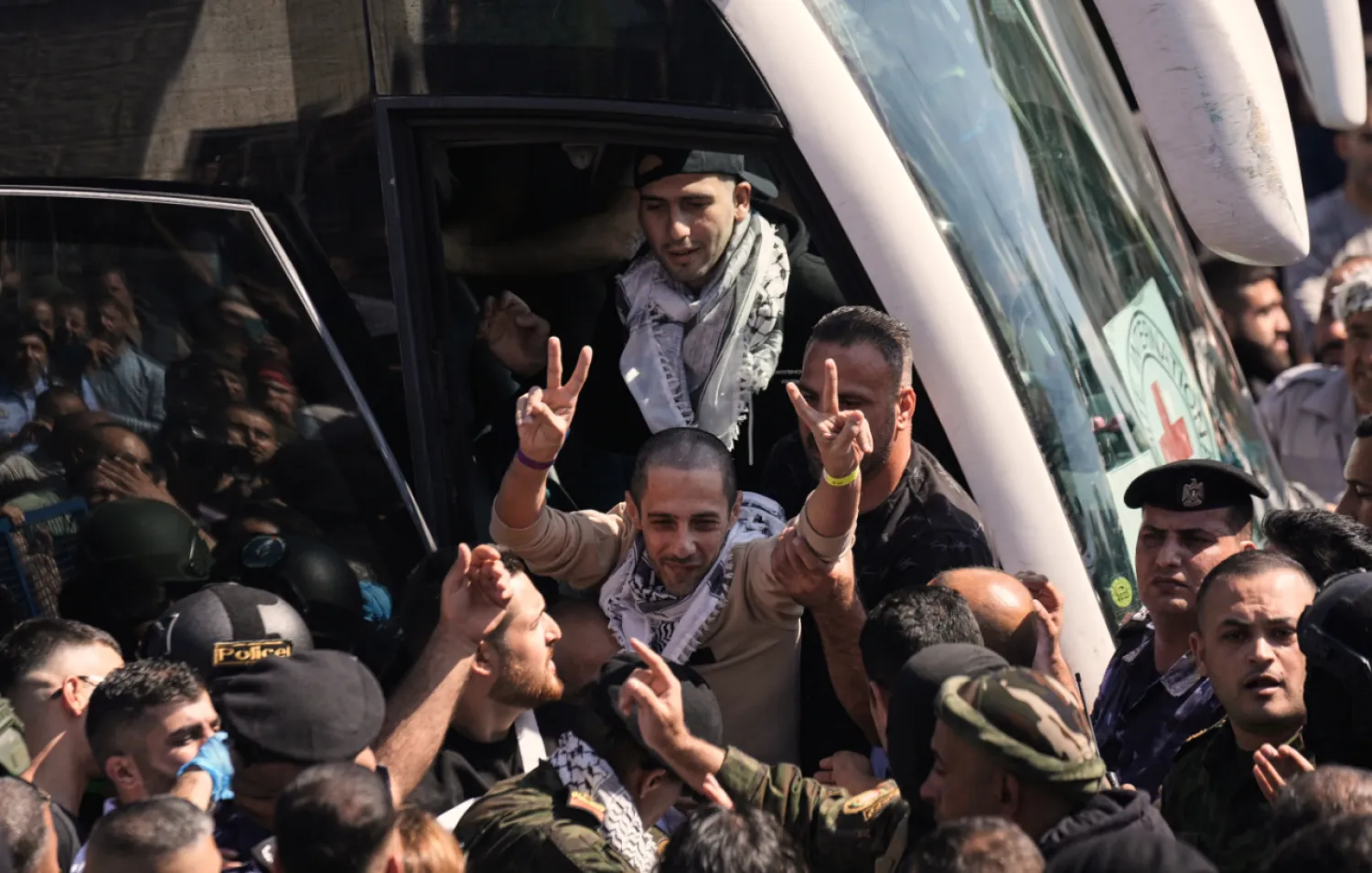

Palestinians Celebrate as Prisoners are Released by Israel

A Palestinian prisoner makes the victory sign after being released from an Israeli prison as part of a ceasefire deal between Israel and Hamas, upon his arrival in the West Bank city of Ramallah, Monday, Oct. 13, 2025. (AP Photo/Majdi Mohammed)
TT

Palestinians Celebrate as Prisoners are Released by Israel

A Palestinian prisoner makes the victory sign after being released from an Israeli prison as part of a ceasefire deal between Israel and Hamas, upon his arrival in the West Bank city of Ramallah, Monday, Oct. 13, 2025. (AP Photo/Majdi Mohammed)

Cheers erupted among Palestinians on Monday as Israel released nearly 2,000 prisoners under a Gaza ceasefire agreement that saw them exchanged for Israeli hostages freed by Hamas.

Large crowds greeted the freed prisoners in Beitunia in the Israeli-occupied West Bank and in Khan Younis in Gaza, flashing V-for-victory signs as they descended from International Committee of the Red Cross buses. In Beitunia, they were given traditional keffiyeh scarves as a show of nationalist pride. Some were lifted onto people's shoulders. Others sank into chairs, exhausted, The AP news reported.

“It was an indescribable journey of suffering — hunger, unfair treatment, oppression, torture and curses — more than anything you could imagine,” said Kamal Abu Shanab, a 51-year-old Fatah member from the West Bank town of Tulkarem.

His face was gaunt. He said he lost 139 pounds (59 kilograms) in prison.

“We don’t recognize him. He’s not the person we knew. Our uncle doesn’t look like our uncle,” said his niece, Farah Abu Shanab.

Those freed include around 1,700 of the several thousand Palestinians that Israeli troops seized from Gaza during the 2-year war and have held without charge.

Also among those released were 250 Palestinians sentenced to prison terms, most of them convicted for deadly attacks on Israelis dating back decades as well as others convicted on lesser charges, according to Israel’s Justice Ministry. Of those, Israel exiled 154, sending them to neighboring Egypt, where officials said they will be sent to third countries.

The rest were returning to homes in East Jerusalem, the West Bank and Gaza.
Nearly everyone has a friend or family member who has been jailed by Israel, particularly young men.

While Israel views the prisoners as terrorists, many Palestinians consider them as freedom fighters resisting a decades-long Israeli military occupation. Reports from rights groups detailing conditions while held — including isolation, abuse and illness — have made prisoners prominent symbols of their people’s political struggle.

In Khan Younis, thousands of people cheered and celebratory gunfire rang in the air. The freed Palestinians filed out wearing gray jumpsuits and entered the hospital for medical examinations.

Israeli forces detained thousands of Palestinians during the war in raids on shelters and hospitals and at checkpoints stopping families as they fled their homes amid military operations.

Families often had no idea their relatives had been detained, and it often took months to determine if they were in Israeli custody, if confirmation came at all. Most were held under laws passed in Israel at the start of the war that allowed Palestinians to be detained for months as “unlawful combatants” without judicial review or access to lawyers.

Rights groups, the UN and detainees have reported routine abuse in the detention facilities, including beatings and insufficient food.

Israel says it adheres to its prison standards under law and investigates any reports of violations.

Monday’s release still leaves about 1,300 Palestinians from Gaza in Israeli custody, according to a count of detainees in September by the Israeli human rights group Hamoked.

Warnings not to celebrate Celebrations in the West Bank occurred despite Israeli warnings against doing so. A flier circulated saying anyone supporting what it called “terrorist organizations” risked arrest.

Palestinians had gathered on hills overlooking Ofer Prison. An armored Israeli vehicle drove up and fired tear gas and rubber bullets. As drones buzzed overhead, the crowd scattered.

Israel’s military did not respond to questions.

Who is on the list According to a list issued by Hamas, the Gaza detainees freed include two women, six teenagers under 18 and around 30 men over 60.

The list of 250 convicted prisoners freed, ranging in age from 19 to 64, includes 159 affiliated with Fatah, the political party that runs the Palestinian Authority in the West Bank, and 63 associated with Hamas. The remainder are unaffiliated or belong to other groups.

Many were arrested in the early 2000s, which saw the eruption of the Second Intifada, a Palestinian uprising fueled by anger over continued Israeli occupation despite years of peace talks. Palestinian armed groups carried out attacks that killed hundreds of Israelis, and the Israeli military killed several thousand Palestinians.

Some were convicted in military trials that rights advocates say often lack due process. Others have been incarcerated for months or years without trial in what is known as administrative detention. Israel says the practice, widely criticized by Palestinians and human rights groups, is needed to prevent attacks and avoid sharing sensitive intelligence.

The Hamas list did not include roughly half a dozen highest-profile prisoners, including Marwan Barghouti, Hassan Salameh, Ahmed Saadat and Abbas Al-Sayyed. Barghouti is widely seen as a potential successor to Palestinian President Mahmoud Abbas.

A list of released prisoners issued by Israel includes the following:

Raed Sheikh A 51-year-old Palestinian police officer and Fatah member, Sheikh was sentenced to multiple life terms in 2000 for his role in the killing of two Israeli soldiers who were attacked by a mob at a West Bank police station, including one thrown from the station's window.

Mahmoud Issa A 57-year-old Hamas commander imprisoned for life in 1993 — before the Oslo interim peace accords — Issa was among those convicted of kidnapping and killing a 29-year-old Israeli border police officer that year. Much of his more than three decades behind bars were spent in solitary confinement, conditions that have made him a symbol among prisoners’ rights advocates.

Shamasneh brothers The two brothers — 56-year-old Mohammed and 62-year-old Abdel Jawad Shamasneh — were in 1993 sentenced to multiple life terms for their role in a stabbing attack that killed Israeli hitchhikers whose bodies were later found in a Jerusalem riverbed in 1990 during the first Palestinian intifada.

Iyad Fatafta A 47-year-old Fatah member serving a life sentence, Fatafta was one of two men convicted of murder for stabbing American tourist Kristine Luken and a friend who was hiking with her and survived.



Israeli Forces Kill Two West Bank Teenagers

Israeli soldiers ride in the Merkava main battle tank at a position in northern Israel along the border with southern Lebanon on November 6, 2025. (Photo by Jalaa MAREY / AFP)
TT

Israeli Forces Kill Two West Bank Teenagers

Israeli soldiers ride in the Merkava main battle tank at a position in northern Israel along the border with southern Lebanon on November 6, 2025. (Photo by Jalaa MAREY / AFP)

The Israeli military said Friday it had killed two suspects it said threw Molotov cocktails in the occupied West Bank village of Judeira overnight.

The Palestinian health ministry identified the dead as two 16-year-old boys.

The military said in a statement that a unit deployed in the area "eliminated" the individuals, a word Israeli officials generally use when suspects are killed.

The army published a surveillance camera video in which two individuals are seen throwing a burning object over a wall matching the appearance of the one separating the area near Judeira from a road used by Israelis.

Though located in the West Bank, which Israel has occupied since 1967, Judeira is surrounded by roads and lands that are effectively annexed by Israel.

The Ramallah-based Palestinian health ministry identified the two individuals as Mohammed Ateem and Mohammed Qasim, both 16.

In a statement, the ministry added that the Israeli army had retrieved the two teenagers' bodies.

On Wednesday, the military killed another teenager who it said had thrown an explosive device at Israeli troops.

In a statement Friday, the military said it had killed three militants and arrested 60 "wanted individuals" this week in the occupied West Bank.

Violence in the West Bank has soared since the war in Gaza broke out in October 2023.


Piles of Garbage and Seeping Sewage Pollute Devastated Gaza

Displaced Palestinians sit next to their destroyed homes in Khan Yunis camp in the southern Gaza Strip, 05 November 2025. EPA/HAITHAM IMAD
TT

Piles of Garbage and Seeping Sewage Pollute Devastated Gaza

Displaced Palestinians sit next to their destroyed homes in Khan Yunis camp in the southern Gaza Strip, 05 November 2025. EPA/HAITHAM IMAD

Stinking mounds of fly-covered garbage lie strewn throughout Gaza amid the rubble from Israel's devastating military campaign, spilling out along roadsides and between the tents where most of the shattered enclave's people live. Government services such as rubbish collection ceased as soon as the war began and although they are partially returning since the truce last month, the massive extent of destruction means any more thorough cleanup lies far in the future, said Reuters.

"I don't smell any fresh air. I smell a foul odor in my tent. I can't sleep. My children wake up in the morning coughing," said Mahmoud Abu Reida, gesturing at the dumpster by the tent he shares with his wife and four children in Khan Younis.

Rotting garbage, sewage-filled pools, hazardous waste from bomb sites and noxious smoke from burning cloth and plastic have birthed a fetid environment for Gazans.

"The scale of the waste problem in Gaza is huge," said Alessandro Mrakic, head of the Gaza office of the UN development agency UNDP.

Waste landfill sites were already full before the start of the war and three major dump sites were located along the border with Israel in areas that are now off limits to Palestinians, he said. "We're talking about 2 million tons of waste - untreated - all across Gaza," Mrakic said, adding that the risks to the environment, to the aquifer that much of Gaza's water comes from, and to the population's health were "immense".

Many people complain of gastric diseases and skin complaints from diarrhea to rashes, sores, lice and scabies, and doctors in the tiny, crowded Palestinian territory say pollution is to blame.

"Skin diseases have spread a lot because of overcrowding in tents and the tents are next to garbage dumps," said Sami Abu Taha, a dermatologist at the Kuwaiti field hospital in Khan Younis, lamenting the lack of medicine to treat such ailments.

One of Abu Reida's children has been repeatedly to the hospital, he said, where doctors had told him the boy was suffering from a bacterial infection that likely came from the rubbish container by the tent.

BOMBARDMENTS SMASH INFRASTRUCTURE

In another part of Khan Younis, Mahmoud Helles was sitting in his tent with his children - a sewage-filled pond standing nearby.

"We find nowhere to stay but in such places," he said, showing a rash of red spots on his arm and hand.

"This place is very, very difficult - it is full of diseases and epidemics because of war remnants, piles of garbage, and the lack of sewage treatment," he said.

Much of Gaza's wastewater and sewage infrastructure was badly damaged by Israel's bombardment and ground operations, leaving people to use open latrines that flood when it rains.

The United Nations is developing plans to deal with the waste problem, including considering options for processing plants that can generate electricity from waste, Mrakic said.

"Immediate action is needed, mainly through access of machinery, equipment, that will allow us to properly perform the job on the ground," he added.


Britain Removes Sanctions on Syria’s President, Interior Minister 

29 March 2025, Syria, Damascus: Syria's President Ahmed al-Sharaa speaks during the ceremony announcing the new Syrian government at the People's Palace. (dpa)
TT

Britain Removes Sanctions on Syria’s President, Interior Minister 

29 March 2025, Syria, Damascus: Syria's President Ahmed al-Sharaa speaks during the ceremony announcing the new Syrian government at the People's Palace. (dpa)

Britain removed sanctions on Syrian interim President Ahmed al-Sharaa on Friday, after the United Nations Security Council did the same ahead of his meeting with US President Donald Trump on Monday.

Britain said in the same statement that it was also lifting sanctions on Syria's interior minister Anas Khattab.

Both men had formerly been subject to financial sanctions targeted at ISIS and al-Qaeda.

"I think he's doing a very good job," Trump said on Thursday of Sharaa. "It's a tough neighborhood, and he's a tough guy, but I got along with him very well. And a lot of progress has been made with Syria."

"We did take the sanctions off Syria in order to give them a fighting shot," he told reporters in Washington.