


Lebanon's Economy Minister Expects Cabinet to Sign Fiscal Gap Law Soon

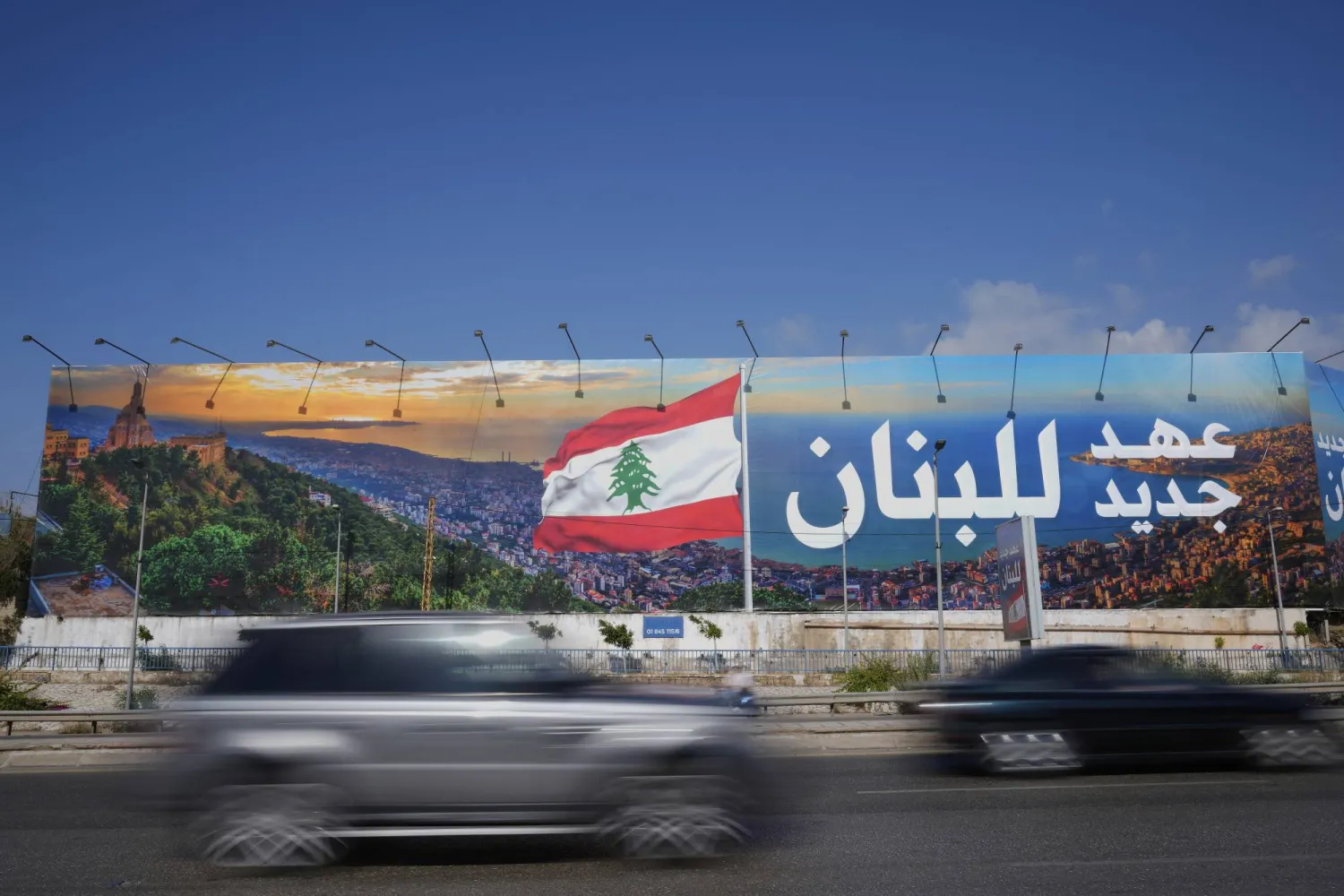
Cars pass in front of a billboard that reads, in Arabic, "A new era for Lebanon," in Beirut, Lebanon, May 28, 2025. (AP Photo/Hussein Malla)
TT

Lebanon's Economy Minister Expects Cabinet to Sign Fiscal Gap Law Soon

Cars pass in front of a billboard that reads, in Arabic, "A new era for Lebanon," in Beirut, Lebanon, May 28, 2025. (AP Photo/Hussein Malla)

Lebanon's cabinet is soon expected to approve and send to parliament a long-awaited law needed to restructure its debt burden, the country's economy minister said, adding that policymakers are in touch daily with the International Monetary Fund.

Lebanon is struggling to emerge from a severe economic crisis following decades of profligate spending by ruling elites that sent the economy into a tailspin in late 2019, with depositors locked out of accounts as debt-laden banks shut down.

Key to the fiscal and economic overhaul is a law on the distribution of financial losses between the state, the central bank, commercial banks and depositors - dubbed the "fiscal gap" law.

Asked about progress on the law, Amer Bisat said the government's emphasis was on good legislation rather than speedy progress.

"The idea is to present it, discuss in the cabinet, approve in the cabinet, and then send it over to the parliament," Bisat told Reuters on Tuesday on the sidelines of the annual meetings of the IMF and World Bank. He added that he expected these things to happen "soon."

"It's more important that we get something right than we get something fast," he said.

RELATIONS WITH BONDHOLDERS POSITIVE, MINISTER SAYS

Declining to give details on the numbers being discussed, Bisat said the draft would follow three principles - depositors would get back their money over time with no haircut and that any solution would ensure the banking sector back to health. Furthermore, smaller deposits would get their money back faster than larger depositors, he added.

Bisat also said he was meeting with the IMF every day. Asked whether he would also meet bondholders on the sidelines of the meetings in Washington, Bisat declined to comment but said relations between authorities and those investors were "good, cordial and positive."

Recent events in the region could bring big positive change for Lebanon, said Bisat, who previously was BlackRock's global head of emerging markets.

"That change could potentially be very good, very positive for Lebanon," he said. "Let's not forget, we're in the middle of a war still ... but there's a possibility that the kind of changes that are happening, if stability, if security, comes back to the region, Lebanon could benefit enormously."

The government is also expecting hundreds of investors to head to Beirut in November for a conference dubbed Beirut One, that Bisat hopes would help rekindle private investor engagement in the country.

"There is a strong interest in imagining the day after," he said. "We know people are very realistic ... everybody knows that challenges are enormous, and the journey is still very, very long, but I really think people are saying it's okay to start imagining how things will be after."




Asian Shares Advance as Markets Await Signals on When the War with Iran May End

 South Korean dealers work in front of monitors at the Hana Bank in Seoul, South Korea, 09 March 2026. (EPA)
South Korean dealers work in front of monitors at the Hana Bank in Seoul, South Korea, 09 March 2026. (EPA)
TT

Asian Shares Advance as Markets Await Signals on When the War with Iran May End

 South Korean dealers work in front of monitors at the Hana Bank in Seoul, South Korea, 09 March 2026. (EPA)
South Korean dealers work in front of monitors at the Hana Bank in Seoul, South Korea, 09 March 2026. (EPA)

Asian shares were mostly higher Wednesday with several benchmarks giving up much of their early gains as investors awaited signals on when the war with Iran may end.

US futures rose and oil prices were mixed.

Tokyo's Nikkei 225 gained 1.3% to 54,926.50 and South Korea's Kospi picked up 0.6% to 5,562.40 after gaining more than 3% earlier in the day.

In Hong Kong, the Hang Seng fell back, slipping 0.2% to 25,921.02, while the Shanghai Composite index edged 0.2% higher to 4,131.39.

Australia's S&P/ASX 200 rose 0.6% to $8,743.50.

Taiwan's benchmark climbed 4.1% and the Sensex in India fell 1.1%. In Bangkok, the SET gained 1.3%.

Oil prices have remained sharply below their peaks hit on Monday. Such spikes have been rocking financial markets worldwide because of worries that the war could block the global flow of oil and natural gas for a long time.

“Asian equities and global futures managed to steady the ship today, helped by crude holding just below the psychologically charged $90 line. In the current regime, that single number functions less like a price and more like a pressure valve,” Stephen Innes of SPI Asset Management said in a commentary.

Early Wednesday, the price for a barrel of Brent crude, the international standard, was down 2 cents at $87.78. That’s about 10% below its settlement price the day before.

US benchmark crude oil gained 53 cents to $83.98 per barrel.

Oil prices plunged Monday afternoon from a high of nearly $120 per barrel, its most expensive level since 2022, after President Donald Trump told CBS News he thinks “the war is very complete, pretty much.” That raised hopes that the war may end relatively soon, which could allow oil to flow freely again from the Middle East to customers around the world.

However, both sides have sharpened their rhetoric as the war enters its 11th day. US Defense Secretary Pete Hegseth promised the most intense strikes yet while the Pentagon detailed the broader toll of injuries sustained by US troops.

The US said it took out more than a dozen minelaying Iranian vessels Tuesday, and Tehran vowed to block the region’s oil exports, saying it would not allow “even a single liter” to be shipped to its enemies.

One point where Trump has remained clear was his desire to keep the Strait of Hormuz open. The war has effectively blocked the waterway off Iran’s coast, where a fifth of the world’s oil sails on a typical day.

“If Iran does anything that stops the flow of Oil within the Strait of Hormuz, they will be hit by the United States of America TWENTY TIMES HARDER than they have been hit thus far,” Trump said in a posting on his social media network late Monday.

On Tuesday, the S&P 500 dipped 0.2% to 6,781.48, a day after its latest wild swings caused by extreme moves in the oil market. The Dow Jones Industrial Average fell 34 points, or 0.1% to 47,706.51 and the Nasdaq composite edged higher by less than 0.1% to 22,697.10.

Oracle's shares on the Nasdaq surged 12% in premarket trading early Wednesday after the company reported its earnings and revenue jumped 20% in the last quarter, much better than analysts had forecast.

Stock markets have a history of bouncing back relatively quickly from military conflicts, as long as oil prices don’t stay too high for too long. Uncertainty about whether that may happen this time around has led to stunning swings up and down for markets worldwide, often hour-to-hour.

If oil prices do stay high for long, household budgets already stretched by high inflation could snap under the pressure. Companies would see their own bills jump for fuel and to stock items on their store shelves or in their data warehouses. It all raises the possibility of a worst-case scenario for the global economy, “stagflation,” where growth stagnates and inflation remains high.

In other dealings early Wednesday, the dollar rose to 158.08 Japanese yen from 158.05 yen. The euro rose to $1.1638 from $1.1610.


Report: IEA Proposes Largest Ever Oil Release from Strategic Reserves

A display shows fuel prices at a petrol station in Munich, Germany, 10 March 2026. Fuel prices have risen since the start of US and Israeli military strikes on Iran and retaliatory attacks by Iran. (EPA)
TT

Report: IEA Proposes Largest Ever Oil Release from Strategic Reserves

A display shows fuel prices at a petrol station in Munich, Germany, 10 March 2026. Fuel prices have risen since the start of US and Israeli military strikes on Iran and retaliatory attacks by Iran. (EPA)

The International Energy Agency has proposed the largest release of oil reserves in its history to restrain soaring crude prices amid the US-Israel war with Iran, the Wall Street Journal reported, citing officials familiar with the matter.

The release would exceed the 182 million barrels of oil that IEA member nations put on the market in two releases in 2022 when Russia launched its full-scale invasion of Ukraine, the newspaper said.

The IEA called an extraordinary meeting of members on Tuesday, with nations expected to decide ‌on the proposal ‌the following day, the paper said.

The plan ‌would ⁠be adopted if ⁠there were no objections, it said, but protests by even one country could delay the effort.

G7 energy ministers stopped short of agreeing on a release of strategic oil reserves but in a statement on Wednesday said they supported the idea in principle.

French President Emmanuel Macron is due to chair a meeting of G7 leaders ⁠later on Wednesday.

"In principle, we support the implementation ‌of proactive measures to address the ‌situation, including the use of strategic reserves," the G7 energy ministers said. "G7 ‌members will carefully consider the recommendations."

One G7 source told Reuters ‌that although no country currently faced a physical shortage of crude, prices were rising sharply, and leaving the situation unattended was not an option.

However, any actual release cannot start immediately because decisions on aspects such as ‌total volume, country allocations, and timing require further discussion, the source said.

"The IEA secretariat is expected ⁠to propose ⁠scenarios, based on expected market impact, and outreach may extend to non-IEA members like China and India," the source said.

The IEA and the White House did not immediately respond to Reuters' requests for comment.

IEA member South Korea is participating in the discussion "and reviewing its position," a spokesperson for the country's industry ministry said on Wednesday.

Oil prices see-sawed on Wednesday as markets doubted whether the IEA's reported plan for a record release of oil reserves could offset potential supply shocks from the conflict in the Middle East.


G7 Energy Ministers Confirm Readiness to Release Oil Stockpiles

Out of service signs are pictured on unleaded petrol and diesel fuel pumps at a petrol service station in Cambridge, eastern England on March 09, 2026. (Photo by Paul ELLIS / AFP)
TT

G7 Energy Ministers Confirm Readiness to Release Oil Stockpiles

Out of service signs are pictured on unleaded petrol and diesel fuel pumps at a petrol service station in Cambridge, eastern England on March 09, 2026. (Photo by Paul ELLIS / AFP)

Energy ministers from the Group of Seven nations confirmed readiness to ⁠take necessary steps to support ⁠global energy supplies, ⁠including possible joint release of strategic oil stockpiles, Japan's Industry Minister Ryosei Akazawa told a ⁠briefing on ⁠Tuesday.

The International Energy Agency (IEA) hosted a meeting of G7 energy ministers at its headquarters in Paris, chaired by Minister Roland Lescure of France, which holds the G7 presidency.

At the virtual meeting, the agency provided an update on its view of the situation in global oil and gas markets, which have been significantly affected by the conflict in the Middle East.

Lescure said the group is prepared to release emergency stockpiles if required.

“We are ready to take the necessary measures, including drawing on strategic reserves to stabilize the market,” Lescure said.

“We are not there yet,” he told reporters in Brussels, after hosting a meeting of G7 finance ministers.

“We are monitoring the markets, the impact on the macroeconomy but also on our citizens,” he said, adding that coordination among major economies remains central to the response.

“Everyone is willing to take measures to stabilize the market, including the US,” Lescure said.

“We have asked the IEA to elaborate scenarios for a potential oil stock release, we need to be ready to act at any moment,” he added.

For its part, the agency said in a statement, “We discussed all the available options, including making IEA emergency oil stocks available to the market. IEA Member countries currently hold over 1.2 billion barrels of public emergency oil stocks, with a further 600 million barrels of industry stocks held under government obligation.”

European governments are on edge about the prospect of a repeat of the energy crisis they faced in 2022 after Russia ⁠invaded Ukraine, when prices surged to record peaks, forcing some industries to shut down operations.

The EU imports more than 90% of its oil and around 80% of its gas, making European countries highly ⁠exposed to fluctuations in global oil and gas prices.

European Commission chief Ursula von der Leyen is due to propose measures to tackle the politically sensitive issue at an EU summit next week.

Being “completely dependent on expensive and volatile imports” of fossil fuels puts Europe at a disadvantage to other regions, von der Leyen said in a speech.

“Developments in the Middle East remind us once again of the risks of relying still too much on fossil fuels,” von der Leyen said, adding that reducing Europe's nuclear energy sector was a “strategic mistake.”

On Tuesday, the EU called on member states to help consumers and businesses by lowering taxes on energy where possible, as war in the Middle East saw oil and gas prices surge.

“If you are at all able to lower taxes on energy, especially on electricity, there is a huge potential” to reduce consumer bills, EU's energy chief Dan Jorgensen said at Parliament in Strasbourg on Tuesday.

Jorgensen said cutting taxes could help ease the financial burden on households as rising energy costs continue to affect consumers across the union.

According to the European Commission Joint Research Center, around 48 million people in Europe, roughly one in ten, cannot afford to heat their homes adequately.