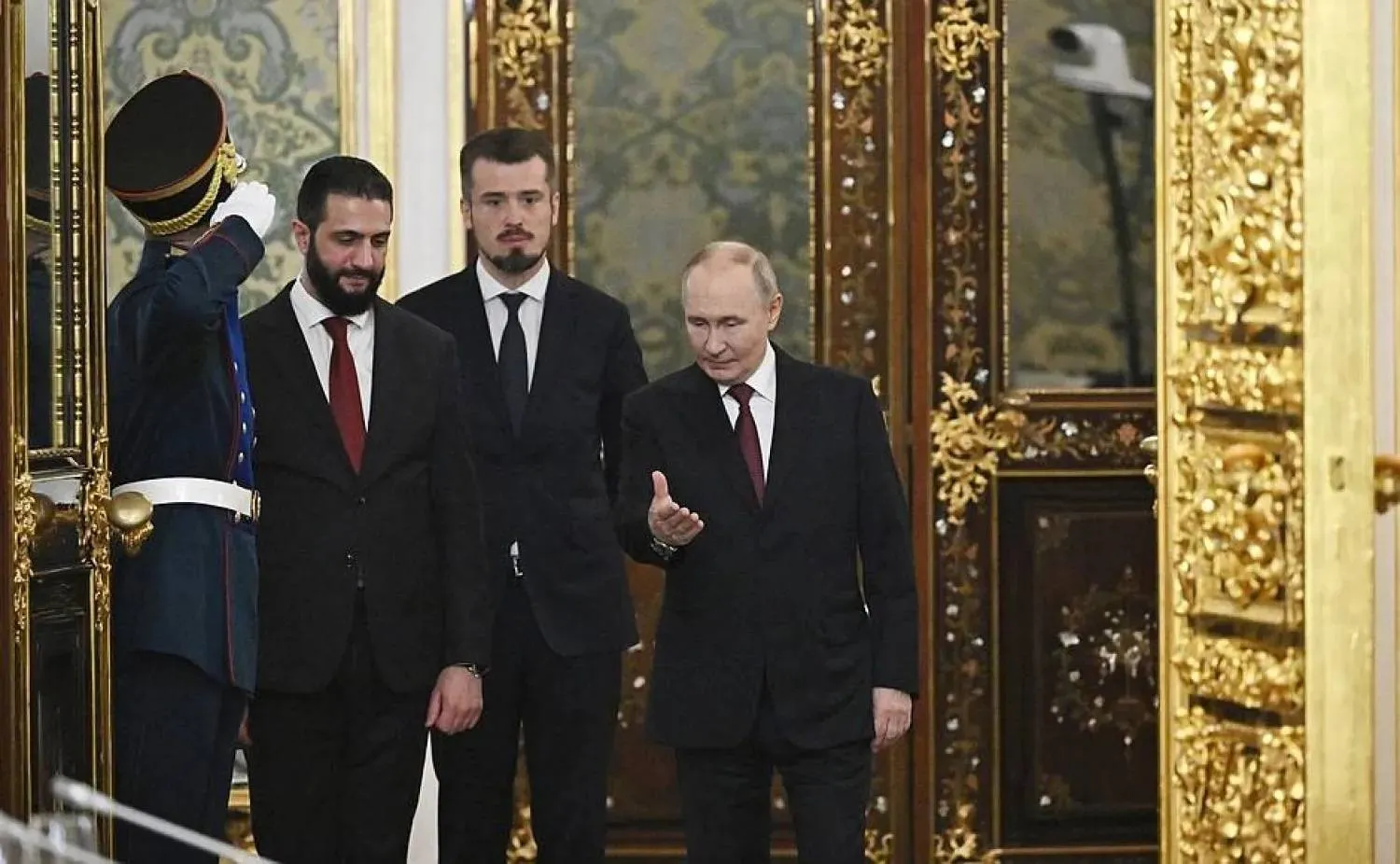

A year ago, few would have imagined this scene: Syrian President Ahmed al-Sharaa sitting in one of the Kremlin’s grandest halls, warmly received, while opposite him, President Vladimir Putin was flanked by Russia’s top decision-makers.
Just a few kilometers away, the ousted Syrian leader, once a close Kremlin ally, likely watched the encounter with a mix of nostalgia and regret. The “humanitarian refugee,” as he is sometimes described, may have followed the public portion of the meeting on screens from afar, in the Kremlin’s Green Reception Hall—reserved for receptions of prominent world leaders.
The scene, unimaginable a year ago, reflected the Kremlin’s pragmatic approach and swift adaptation to Syria’s new political reality.
Putin and al-Sharaa Meeting in Moscow
Putin appeared at ease discussing relationships spanning eight decades, avoiding mention of the lean years, and emphasizing that Russia’s ties are built on long-term national interests, not fleeting political moments.
Al-Sharaa, fully aware of the historical significance, echoed his counterpart’s earlier calls—a man who, until last year, had demanded his head “dead or alive”—and calmly noted Syria’s internal changes without using terms that might irritate Moscow, such as “liberation of Syria.”
Russian Military Bases
Behind the public optics lay meticulously orchestrated protocols, a hallmark of Kremlin diplomacy. From al-Sharaa’s entrance, greeted by the presidential guard, to the exit of cameras before closed-door discussions, every detail followed strict procedure.
As expected, sensitive topics were omitted from the open session. There was no mention of Russia’s military bases—a top Kremlin priority—or of Syria’s transitional justice demands, including the extradition of former President Bashar al-Assad.
Yet these issues were present in the discussions, as later remarks by Kremlin spokesperson Dmitry Peskov and Foreign Minister Sergey Lavrov partially indicated, though without any sign of formal agreement.
Regarding the bases, Moscow confirmed that both presidents had discussed their future, but details remained sparse, suggesting further technical, political, and military deliberations are needed. Leaks hint at a shared interest in creating a new legal framework governing Russian forces in Syria, defining their roles, size, and authority on the ground.
Al-Sharaa’s vague reference to “respecting all previously signed agreements” could be misinterpreted. Observers note that Syria honoring commitments does not necessarily imply continued adherence to outdated documents, with reports pointing to a potential review announced during the recent Moscow visits by Syrian foreign and defense ministers.
Preliminary indications from Syrian sources suggest a possible agreement on joint management at the Hmeimim airbase and reopening Latakia Airport, though Russian confirmation has not emerged.
Assad and Transitional Justice
The question of Assad’s fate was apparently addressed only tangentially, not as an official demand. When asked, Peskov declined to comment, saying: “We have nothing to say on this matter.” Syrian sources in Moscow, however, suggested that transitional justice and the handover of Assad and other former regime figures were briefly mentioned in general terms.
Another ambiguous point concerned Moscow’s potential domestic role, whether in stabilizing certain regions or supporting Syrian authorities. Before the meeting, speculation abounded about Russia mediating with northeastern Kurdish groups, southern Druze factions, or even Israel, to curb ongoing Israeli incursions.
Experts cited by Asharq Al-Awsat confirmed Russia’s capability, noting prior experience in southern Syria and along the Golan demarcation, though the Kremlin denied that Russian patrols in Syrian territories were discussed at the meeting.
The issue is tied to Russia’s “capacity” should future agreements be reached. Experts also stress its strategic importance if Moscow and Damascus coordinate on restructuring and training the Syrian army, potentially including the provision of air and ground defenses—a topic raised during the Syrian chief of staff’s recent Moscow visit.
Regional coordination and diplomatic channels with Israel would be essential to prevent further attacks, suggesting Russia could resume a guarantor role for both Damascus and Jerusalem, particularly in contested zones and army rehabilitation.
Russian Debt and Reconstruction
A key aspect of the new relationship involves Syrian debts to Russia and potential compensation claims. While detailed discussions have yet to take place, early signs indicate Moscow’s willingness to approach the matter on two fronts:
A preliminary readiness to forgive Syrian debts as part of broader Russian support to alleviate economic pressure, contingent on clear reciprocal steps, including granting Russian companies stakes in reconstruction and key sectors.
An alternative Russian approach favoring direct involvement in rebuilding critical infrastructure—energy, transport, and other strategic facilities originally developed with Russian assistance.
This aligns with publicly announced post-meeting intentions for Russian participation in reconstructing Syria’s infrastructure, arguably the easiest initiative to implement immediately.
Energy, Transport, and Humanitarian Support
Accompanying al-Sharaa in Moscow were Foreign Minister Asaad Hassan al-Shaibani, Defense Minister Major General Murhaf Abu Qasra, General Intelligence Director Hussein Al-Salama, and Secretary General of the Presidency of Syria Maher al-Sharaa.
Immediately after the presidential meeting, Deputy Prime Minister Alexander Novak, Russia’s energy minister, told reporters that Russian companies were eager to return to Syria, offering robust support for energy projects and major oil and gas initiatives, alongside infrastructure and humanitarian aid—especially urgent food and medical supplies.
Novak said: “Today we discussed specific projects in energy, transport, tourism, healthcare, and cultural and humanitarian sectors.”
He added that Syria urgently needs reconstruction across energy, railway, and transport infrastructure, and that Russian firms are prepared to assist, drawing on Soviet-era experience.
Syrian Finance Minister Mohammed Yisr Barniyeh echoed this at the IMF and World Bank annual meetings, highlighting Syria’s willingness to offer Russia “huge opportunities to support the country’s reconstruction.”
Moving Forward
The Kremlin meeting established a broad framework for moving past Syria’s recent turbulent chapter, partially transcending the Assad era. While explicit or covert Russian support for remnants of the former regime is no longer on the table, finalizing agreements on all pending issues remains a complex task. Experts stress the need to operationalize joint government mechanisms and continue detailed discussions on each file.
The presidents reportedly agreed to resume flights between Moscow and Damascus—a small but symbolic step in normalizing ties. The Syrian foreign and defense ministers remained in Moscow after al-Sharaa’s departure, with reports suggesting upcoming agreements with Russia, though details have yet to be disclosed.