


Political Division Deepens Rift Over Libya’s Constitutional Court

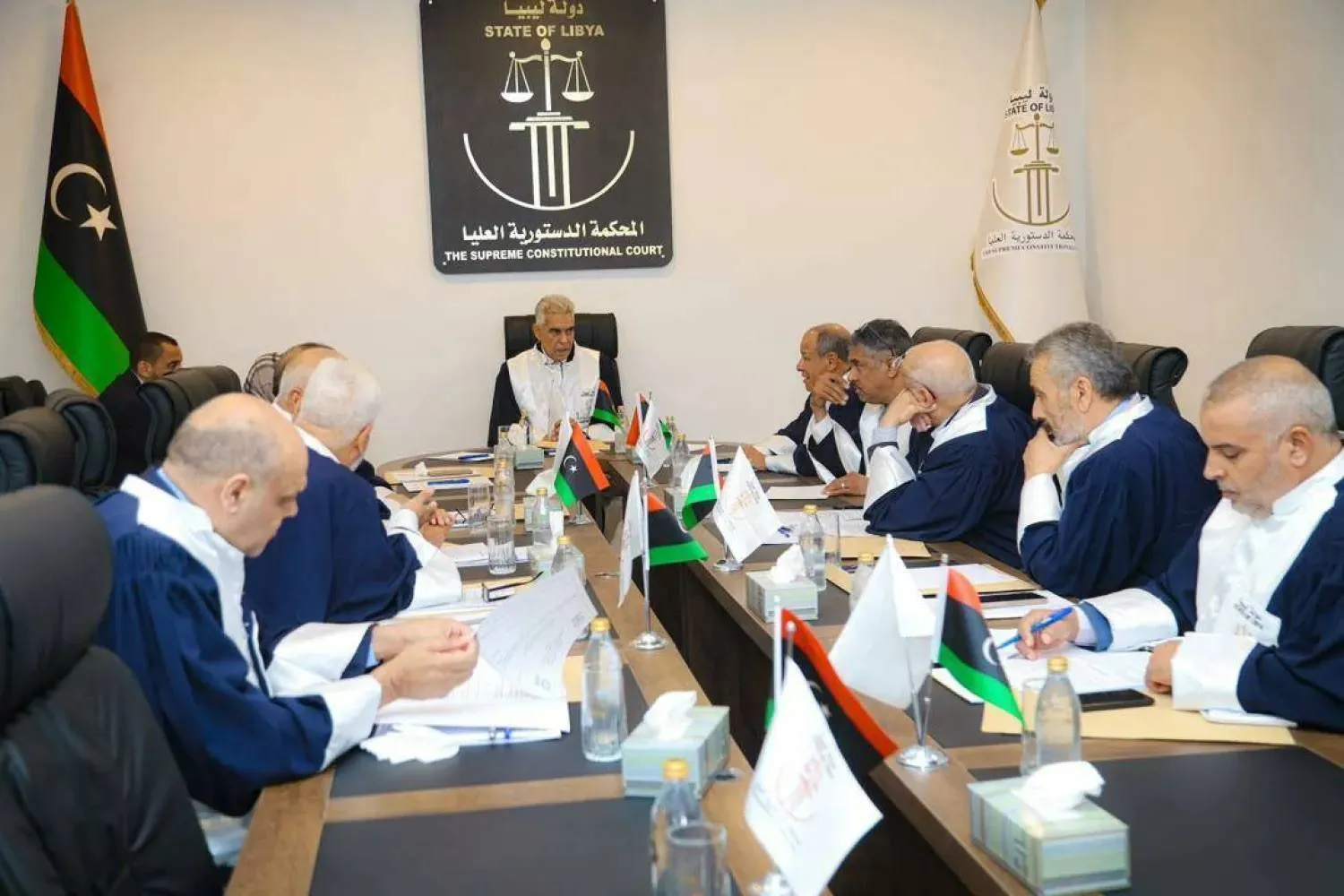
A meeting of the Constitutional Court in Benghazi earlier this month (Official Court Page)
TT

Political Division Deepens Rift Over Libya’s Constitutional Court

A meeting of the Constitutional Court in Benghazi earlier this month (Official Court Page)

Libya’s political divisions have intensified the dispute over the newly established Constitutional Court in Benghazi. Tensions escalated after the court issued a ruling abolishing the constitutional chamber of the Supreme Court in Tripoli, sparking questions about the legality of the move and fears over its impact on the unity of the judiciary.

This is the second major controversy involving the Benghazi court in a month. Earlier, its decision to shield the House of Representatives’ approval of military promotions issued by Libyan National Army leader Field Marshal Khalifa Haftar, including promotions involving his sons Saddam and Khaled, triggered strong objections from the High Council of State in Tripoli, which described the ruling as “an assault on judicial independence.”

Khalifa Al-Daghari, a member of parliament, said the controversy over the court’s decisions “will continue as long as the constitutional chamber in Tripoli remains in place.”

He argued that the court’s establishment came at “an ill-suited time for a country operating under a temporary constitutional declaration and divided between two rival authorities.”

Al-Daghari, who previously expressed reservations in parliament about setting up the court in Benghazi, warned that such a move “could deepen political division and entrench institutional fragmentation,” a situation Libya has faced for more than a decade.

The Benghazi court’s ruling transfers all cases from Tripoli’s constitutional chamber to the new court “without fees,” giving parties three months to refile their cases, after which they will be dismissed.

Legal experts have questioned the legality of the decision. Al-Koni Abouda argued that the court was established by a transitional authority - the House of Representatives - and that its president “exceeded his powers by dissolving a chamber not under his administrative authority.”

For his part, Hisham Al-Harati warned that creating a constitutional court in the absence of a functioning constitution “sets a dangerous precedent” that threatens judicial unity and independence, turning the judiciary into “a new arena for political conflict.”

The court’s establishment followed a bitter standoff between parliament and the Presidential Council. Although the council suspended the law in April, parliament pressed ahead with appointments in June, and the court was officially inaugurated on August 19.

Supporters of the court, including MP Mohamed Amer Al-Abani, argue that it draws legitimacy from legislation passed by an elected legislature, which can only be overturned by a similar law. He dismissed claims that the House of Representatives, as a transitional body, lacks authority, pointing to existing legal frameworks that preserve its powers.

The court issued its statement in response to remarks by UN Envoy Hanna Tetteh, who expressed concern over the existence of “two constitutional institutions.”

In a letter, the court urged her to withdraw what it called “personal opinions,” affirming its commitment to judicial independence.

Many Libyan legal and political figures warn that these developments could further fragment the judiciary, already under strain from years of political division.

The constitutional chamber, established in 1982 and suspended in 2016, had long been the country’s highest judicial authority. Its revival now faces a new challenge following the creation of the Benghazi court in 2023.



Israel Military Says Soldier Killed in Gaza 

A drone view shows the destruction in a residential neighborhood, after the withdrawal of the Israeli forces from the area, amid a ceasefire between Israel and Hamas in Gaza, in Gaza City, October 21, 2025. (Reuters)
TT

Israel Military Says Soldier Killed in Gaza 

A drone view shows the destruction in a residential neighborhood, after the withdrawal of the Israeli forces from the area, amid a ceasefire between Israel and Hamas in Gaza, in Gaza City, October 21, 2025. (Reuters)

The Israeli military announced that one of its soldiers had been killed in combat in southern Gaza on Wednesday, but a security source said the death appeared to have been caused by "friendly fire".

"Staff Sergeant Ofri Yafe, aged 21, from HaYogev, a soldier in the Paratroopers Reconnaissance Unit, fell during combat in the southern Gaza Strip," the military said in a statement.

A security source, however, told AFP that the soldier appeared to have been "killed by friendly fire", without providing further details.

"The incident is still under investigation," the source added.

The death brings to five the number of Israeli soldiers killed in Gaza since a ceasefire took effect on October 10.


Syria: SDF’s Mazloum Abdi Says Implementation of Integration Deal May Take Time

People sit outdoors surrounded by nature, with the Tigris river flowing in the background, following a long atmospheric depression, near the Syrian-Turkish border in Derik, Syria, February 16, 2026 REUTERS/Orhan Qereman
TT

Syria: SDF’s Mazloum Abdi Says Implementation of Integration Deal May Take Time

People sit outdoors surrounded by nature, with the Tigris river flowing in the background, following a long atmospheric depression, near the Syrian-Turkish border in Derik, Syria, February 16, 2026 REUTERS/Orhan Qereman

Mazloum Abdi, commander of the Syrian Democratic Forces, said the process of merging the SDF with Syrian government forces “may take some time,” despite expressing confidence in the eventual success of the agreement.

His remarks came after earlier comments in which he acknowledged differences with Damascus over the concept of “decentralization.”

Speaking at a tribal conference in the northeastern city of Hasakah on Tuesday, Abdi said the issue of integration would not be resolved quickly, but stressed that the agreement remains on track.

He said the deal reached last month stipulates that three Syrian army brigades will be created out of the SDF.

Abdi added that all SDF military units have withdrawn to their barracks in an effort to preserve stability and continue implementing the announced integration agreement with the Syrian state.

He also emphasized the need for armed forces to withdraw from the vicinity of the city of Ayn al-Arab (Kobani), to be replaced by security forces tasked with maintaining order.


Israeli Far-Right Minister to Push for ‘Migration’ of West Bank, Gaza Palestinians 

A Palestinian man checks leather belts as people prepare for Ramadan, in the old city of Hebron in the Israeli-occupied West Bank, February 17,2026. (Reuters)
TT

Israeli Far-Right Minister to Push for ‘Migration’ of West Bank, Gaza Palestinians 

A Palestinian man checks leather belts as people prepare for Ramadan, in the old city of Hebron in the Israeli-occupied West Bank, February 17,2026. (Reuters)

Israel's far-right Finance Minister Bezalel Smotrich said he would pursue a policy of "encouraging the migration" of Palestinians from the occupied West Bank and Gaza Strip, Israeli media reported Wednesday.

"We will eliminate the idea of an Arab terror state," said Smotrich, speaking at an event organized by his Religious Zionism Party late on Tuesday.

"We will finally, formally, and in practical terms nullify the cursed Oslo Accords and embark on a path toward sovereignty, while encouraging emigration from both Gaza and Judea and Samaria.

"There is no other long-term solution," added Smotrich, who himself lives in a settlement in the West Bank.

Since last week, Israel has approved a series of measures backed by far-right ministers to tighten control over the West Bank, including in areas administered by the Palestinian Authority under the Oslo Accords, in place since the 1990s.

The measures include a process to register land in the West Bank as "state property" and facilitate direct purchases of land by Jewish Israelis.

The measures have triggered widespread international outrage.

On Tuesday, the UN missions of 85 countries condemned the measures, which critics say amount to de facto annexation of the Palestinian territory.

"We strongly condemn unilateral Israeli decisions and measures aimed at expanding Israel's unlawful presence in the West Bank," they said in a statement.

"Such decisions are contrary to Israel's obligations under international law and must be immediately reversed.

"We underline in this regard our strong opposition to any form of annexation."

UN Secretary-General Antonio Guterres on Monday called on Israel to reverse its land registration policy, calling it "destabilizing" and "unlawful".

The West Bank would form the largest part of any future Palestinian state. Many on Israel's religious right view it as Israeli land.

Israeli NGOs have also raised the alarm over a settlement plan signed by the government which they say would mark the first expansion of Jerusalem's borders into the occupied West Bank since 1967.

The planned development, announced by Israel's Ministry of Construction and Housing, is formally a westward expansion of the Geva Binyamin, or Adam, settlement situated northeast of Jerusalem in the West Bank.

The current Israeli government has fast-tracked settlement expansion, approving a record 52 settlements in 2025.

Excluding Israeli-annexed east Jerusalem, more than 500,000 Israelis live in West Bank settlements and outposts, which are illegal under international law.