


Mediators Push to Uphold Gaza Deal, Speed Up Stabilization Force

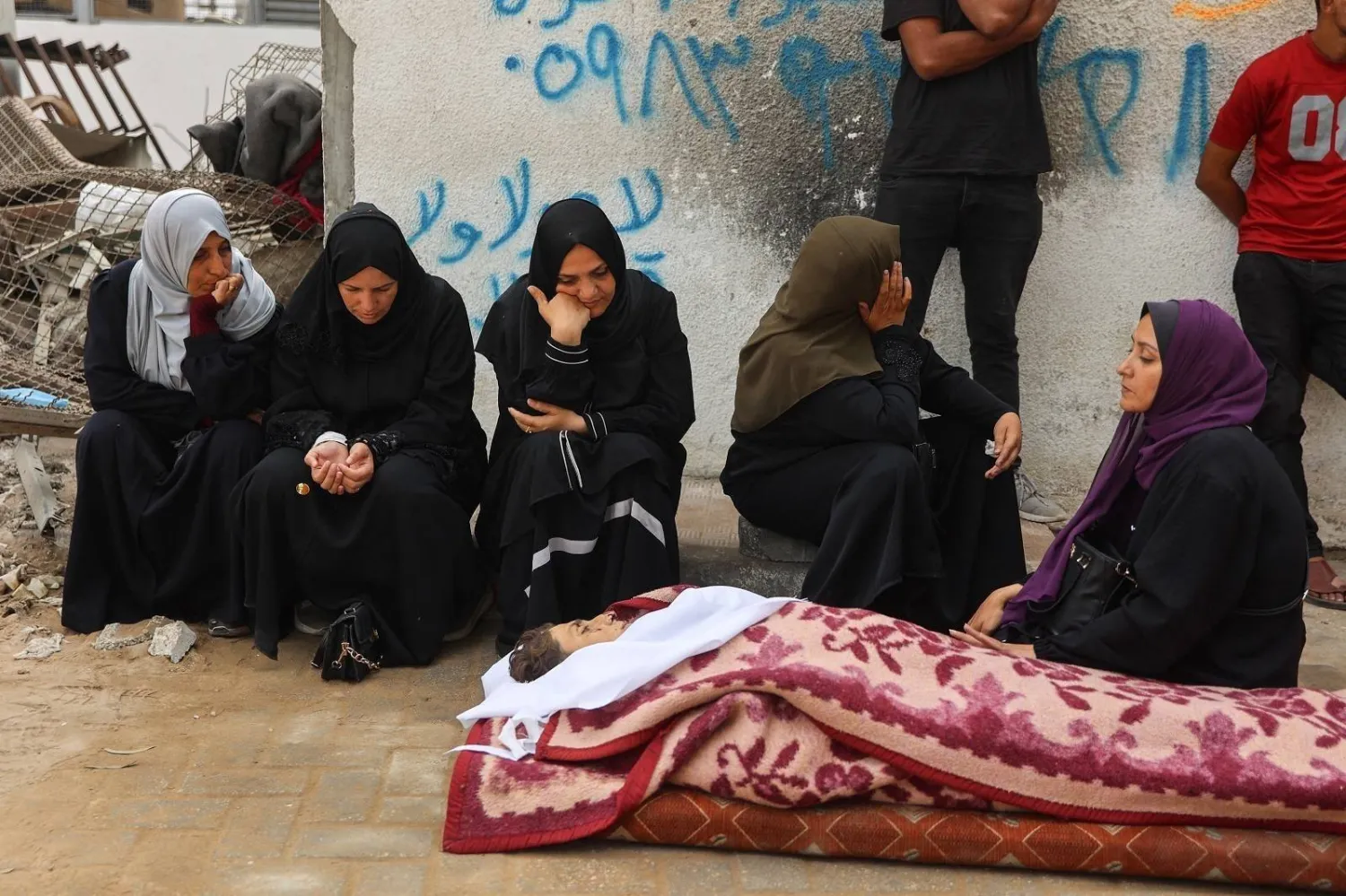
Palestinians mourn a relative killed in Israeli airstrikes in Gaza City (AFP)
TT

Mediators Push to Uphold Gaza Deal, Speed Up Stabilization Force

Palestinians mourn a relative killed in Israeli airstrikes in Gaza City (AFP)

Mediators are pressing ahead with efforts to uphold a ceasefire agreement in the Gaza Strip despite continued Israeli violations, as attention turns to a meeting scheduled in Istanbul on Monday.

The meeting, announced by Türkiye, one of the guarantors of the deal reached in Sharm el-Sheikh last month, is expected to carry several messages, according to Palestinian and Turkish analysts who spoke to Asharq Al-Awsat.

Chief among them is a call to Israel to maintain the ceasefire and expedite approval for the deployment of an international stabilization force in Gaza.

The gathering will also urge Washington to sustain pressure on Prime Minister Benjamin Netanyahu’s government to remove any obstacles to the agreement’s implementation.

As the Israeli army confirmed on Saturday that the crisis over the bodies of hostages remains unresolved, and continued its strikes for a fourth consecutive day across Gaza, mediation efforts have intensified.

Turkish Foreign Minister Hakan Fidan said at a press conference on Friday that the foreign ministers of the Arab-Islamic Contact Group, who met US President Donald Trump in New York in September, will convene in Istanbul on Monday.

“The meeting will discuss the ceasefire in Gaza and how to move to the second phase, which is the stabilization force,” Fidan said, adding that Ankara was concerned about the fragility of the truce, according to Reuters.

Palestinian political analyst Abdel Mahdi Mutawe said the Istanbul meeting would serve as “a platform for influential countries to help consolidate the Gaza ceasefire after repeated Israeli violations,” noting that Türkiye seeks to play a more active role in this phase.

Turkish political analyst Taha Odeh Oglu said the upcoming meeting carries significant implications amid the complex situation caused by Israeli breaches and delays in advancing to the next stage.

“It will be a real test for forging a unified stance to confront Israeli challenges, a message to Washington, which continues to back Israel, and a signal that the Arab and Islamic coalition remains engaged,” he said.

Hours after the process of returning hostages’ bodies faltered again, when Israel announced that three bodies handed over by Hamas were not those of the captives, Israeli forces carried out new airstrikes on Gaza on Saturday, a security source in the enclave told Agence France Presse.

The official Palestinian news agency WAFA reported on Friday that Israeli forces had bombed the Gaza Strip for the third straight day, killing two people.

On Tuesday and Wednesday, Israel responded to the killing of one of its soldiers with airstrikes that Gaza’s Health Ministry said left 104 people dead. Israel said on Wednesday it “remains committed to the ceasefire agreement despite its military response.”

Qatari Prime Minister and Foreign Minister Sheikh Mohammed bin Abdulrahman Al Thani said on Wednesday that mediators were in contact with both sides to preserve the ceasefire.

“We are closely following the challenges the Gaza ceasefire faced on Tuesday. Our focus is to ensure the truce holds, and intensive communication has taken place with both parties to maintain it,” he said.

In a televised interview on Thursday, Diaa Rashwan, head of Egypt’s State Information Service, said Netanyahu “does not want to move to the second phase of the Gaza agreement,” which includes forming a Palestinian administration to govern the enclave.

He added that the Gaza agreement remains intact despite Israeli violations, which he described as “not surprising from an occupying power responsible for killing 70,000 Palestinians over the past two years.”

Rashwan said Netanyahu aims to create tension for both the Palestinians and mediators, particularly Egypt and Qatar, and is seeking to reshape Israel’s domestic political scene by calling early elections.

The Istanbul meeting comes as Netanyahu last week hinted at his opposition to any role for Turkish security forces in Gaza as part of a US-backed mission to monitor the ceasefire with Hamas. On Saturday, Israeli officials again cited the unresolved issue of the hostages’ bodies.

Mutawe said Egypt’s role remains crucial, especially as it hosted the signing of the Gaza deal last month, which is expected to continue under US guarantees.

He added that the Istanbul meeting is unlikely to overcome major obstacles, particularly those related to the stabilization force.

“Israel is exerting heavy pressure to exclude any Turkish involvement in Gaza, whether in reconstruction or through international forces, and it has explicit US backing for that position,” he said, adding that the Istanbul talks are unlikely to pressure Washington to dissuade Israel from its veto.

However, Oglu said the meeting could still succeed in forming a unified bloc to counter Israeli efforts to sway Washington over the agreement’s terms.

He noted that Ankara’s role in the international forces remains complicated, given the personal rivalry between Netanyahu and Turkish President Recep Tayyip Erdogan.



Lebanon Says Israeli Strikes on Beirut Area Kill 7

Rescue workers inspect the scene of Israeli airstrikes, in Beirut, Lebanon, Wednesday, April 1, 2026. (AP Photo/Hussein Malla)
TT

Lebanon Says Israeli Strikes on Beirut Area Kill 7

Rescue workers inspect the scene of Israeli airstrikes, in Beirut, Lebanon, Wednesday, April 1, 2026. (AP Photo/Hussein Malla)

The Lebanese health ministry said Wednesday that Israeli strikes on Beirut's southern suburbs and a nearby town killed at least seven people, as Israel's military said it had targeted senior Hezbollah members.

The health ministry said an Israeli air raid on south Beirut's Jnah area killed at least five people and wounded 21 others. A Lebanese security source said four parked cars were hit.

Another strike that hit a vehicle in Khaldeh, just south of the capital, killed two people and wounded three, the health ministry said in a separate statement.

Israel's military said it had struck a "senior Hezbollah commander" and another member of the group in two separate strikes "in the Beirut area,” without naming the targets or giving detail on the exact locations.

Hezbollah has claimed dozens of attacks across the border and against Israeli forces inside Lebanon.

The group also said its fighters were engaged in "fierce clashes" with Israeli troops near the border early Wednesday, and claimed rocket fire targeting a group of soldiers in another area.

Israel's military has reported several casualties among its ranks in recent days in south Lebanon, including four soldiers who were killed.


US Journalist Kidnapped in Baghdad, Search Underway

American freelancer Shelly Kittleson. (Facebook)
TT

US Journalist Kidnapped in Baghdad, Search Underway

American freelancer Shelly Kittleson. (Facebook)

An American journalist was kidnapped Tuesday in Baghdad and Iraqi security forces are pursuing her captors, Iraqi officials said. The journalist was identified as freelancer Shelly Kittleson by one of the outlets she worked for.

A US official blamed the Iran-backed Iraqi militia Kataib Hezbollah.

The Iraqi interior ministry confirmed a foreign journalist had been kidnapped but didn't give more details. Two Iraqi security officials, who spoke on condition of anonymity because they were not authorized to speak publicly about the case, said the kidnapped journalist is a woman and a US citizen.

They said that two cars were involved in the kidnapping, one of which crashed while being pursued near the town of Al-Haswa in Babil province southwest of Baghdad. The journalist was then transferred to a second car that fled the scene.

The interior ministry said security forces had launched an operation to track down the kidnappers, and intercepted a vehicle belonging to the kidnappers that overturned as they tried to flee. One suspect was arrested and one of the vehicles used in the kidnapping was seized, but others remain on the loose, the statement said.

The two Iraqi security officials said the journalist was abducted in central Baghdad's Saadoun Street, and that an alert was sent to all checkpoints, leading to the pursuit of the kidnappers as they headed toward Babil province.

Al-Monitor, a regional news site covering the Middle East, said it was "deeply alarmed" and identified the journalist as Kittleson, a freelancer who contributed to the publication.

"We call for her safe and immediate release," the statement said. "We stand by her vital reporting from the region and call for her swift return to continue her important work."

Kittleson has been a longtime freelancer in the region, reporting extensively from Syria and Iraq.

The US Embassy in Baghdad declined to comment. The US State Department issued a statement, saying the Trump administration "has no higher priority than the safety and security of Americans" and that it is "tracking these reports."

Dylan Johnson, US assistant secretary of state for public affairs, said on X that the "State Department previously fulfilled our duty to warn this individual of threats against them."

"An individual with ties to the Iranian-aligned militia group Kataib Hezbollah believed to be involved in the kidnapping has been taken into custody by Iraqi authorities," Johnson added.

A second US official, who spoke on condition of anonymity due to privacy concerns, said the abducted journalist had been warned multiple times, including as late as Monday night, that she was in danger and should leave Iraq immediately.

Iraqi officials have not publicly said anything about the kidnappers' affiliation.

Iran-backed militias in Iraq have launched regular attacks on US facilities in the country since the beginning of the US-Israeli war on Iran. Since the war began on Feb. 28, the US Embassy has warned of kidnapping risks and urged citizens in Iraq to leave.

Iraqi militias have also kidnapped foreigners in the past.

Elizabeth Tsurkov, a Princeton graduate student with Israeli and Russian citizenship, disappeared in Baghdad in 2023. After she was freed and handed over to US authorities in September 2025, she said that she had been held by Kataib Hezbollah.

The group never officially claimed responsibility for kidnapping her.


Hamas Sources Acknowledge Differences with Mediators on Disarmament Plan

Gunmen from Hamas’ Izz ad-Din al-Qassam Brigades in Nuseirat refugee camp, central Gaza, February 2025 (EPA)
TT

Hamas Sources Acknowledge Differences with Mediators on Disarmament Plan

Gunmen from Hamas’ Izz ad-Din al-Qassam Brigades in Nuseirat refugee camp, central Gaza, February 2025 (EPA)

At a time when Palestinian sources told Asharq Al-Awsat that Egypt, Qatar, and Türkiye helped draft a plan submitted by the Board of Peace to disarm factions in Gaza, Hamas sources acknowledged “differences” with mediators over the proposal.

Sources familiar with the Gaza Administration Committee said mediators involved in ceasefire talks had been fully briefed on the Board of Peace plan before it was presented to Hamas and other factions.

A document published by Reuters and other media outlets last week showed that the Board of Peace, formed by US President Donald Trump, had proposed that Hamas dismantle its tunnel network in the Gaza Strip and give up weapons in stages over eight months.

The plan lays out a timeline starting with a national committee taking over security in Gaza and ending with a full Israeli withdrawal once “final verification” that the enclave is free of weapons is achieved.

Sources close to the Gaza Committee said the three mediating countries, working with the United States, helped shape the proposal, introducing amendments and comments during drafting.

After confirming receipt of the proposal last week, Hamas officials voiced anger at the Board of Peace’s High Representative for Gaza, Nickolay Mladenov, after he told the Security Council that reconstruction could not begin until disarmament phases were verified.

Mediator backing

Two Hamas sources in Gaza said they were unaware of any direct involvement by mediators in drafting the plan, but suggested that the mediators likely knew its details before it was presented.

A senior Hamas source outside Gaza said the group had not received clear confirmation of such involvement, but that the proposal’s language and mediator support indicated prior knowledge.

The senior source said the plan had been discussed internally and that some provisions were reviewed with mediators during meetings in Egypt and Türkiye in recent days.

They said a unified Palestinian position would be presented within a clear framework aimed at amending key clauses, rejecting any link between disarmament and progress on other steps.

They stressed “the need to obligate Israel to fulfill its commitments,” saying the current plan allows it to maneuver and pressure what he described as the “resistance” to achieve its core aim of keeping Gaza demilitarized while retaining security control.

“Differences are normal”

Asked about gaps between Hamas and mediators, the three sources agreed there were “differences,” one describing them as “normal.”

The senior source said the proposal does not fully meet Palestinian demands and requires factions to surrender weapons without a meaningful return from Israel.

They pointed to earlier ceasefire talks, when mediators showed responsiveness to faction demands, prompting them and the United States to engage positively with proposals, an approach factions hope will be repeated.

Hamas is likely to struggle to reject the plan outright and may instead seek amendments to secure what it sees as Palestinian gains. Israel has clearly rejected such changes and has signaled a possible return to war.

The plan calls for full disarmament, light and heavy weapons, factional, tribal, and personal, under a framework of “one law and one weapon,” while ensuring Hamas has no role in governing Gaza, either civilly or in security.

An Egyptian source told Asharq Al-Awsat about a week ago that Egypt’s Interior Ministry will receive thousands of candidates for a Palestinian police force tasked with maintaining security in Gaza under a ceasefire deal.

Recruits will undergo six weeks of training, with others set to train in Jordan.

The Gaza Administration Committee has recently opened applications for security roles in the new force, drawing tens of thousands of applicants, although the initial target is about 5,000 officers.

The United States, working with Israel, aims to start reconstruction in southern Gaza, particularly in Rafah, areas under Israeli control, before moving to Hamas-held areas.

Under the plan, reconstruction is tied to disarmament, a condition Hamas has consistently rejected.