


Israel Returns 15 Palestinian Bodies to Gaza, Where Displaced Families Endure Winter Rains

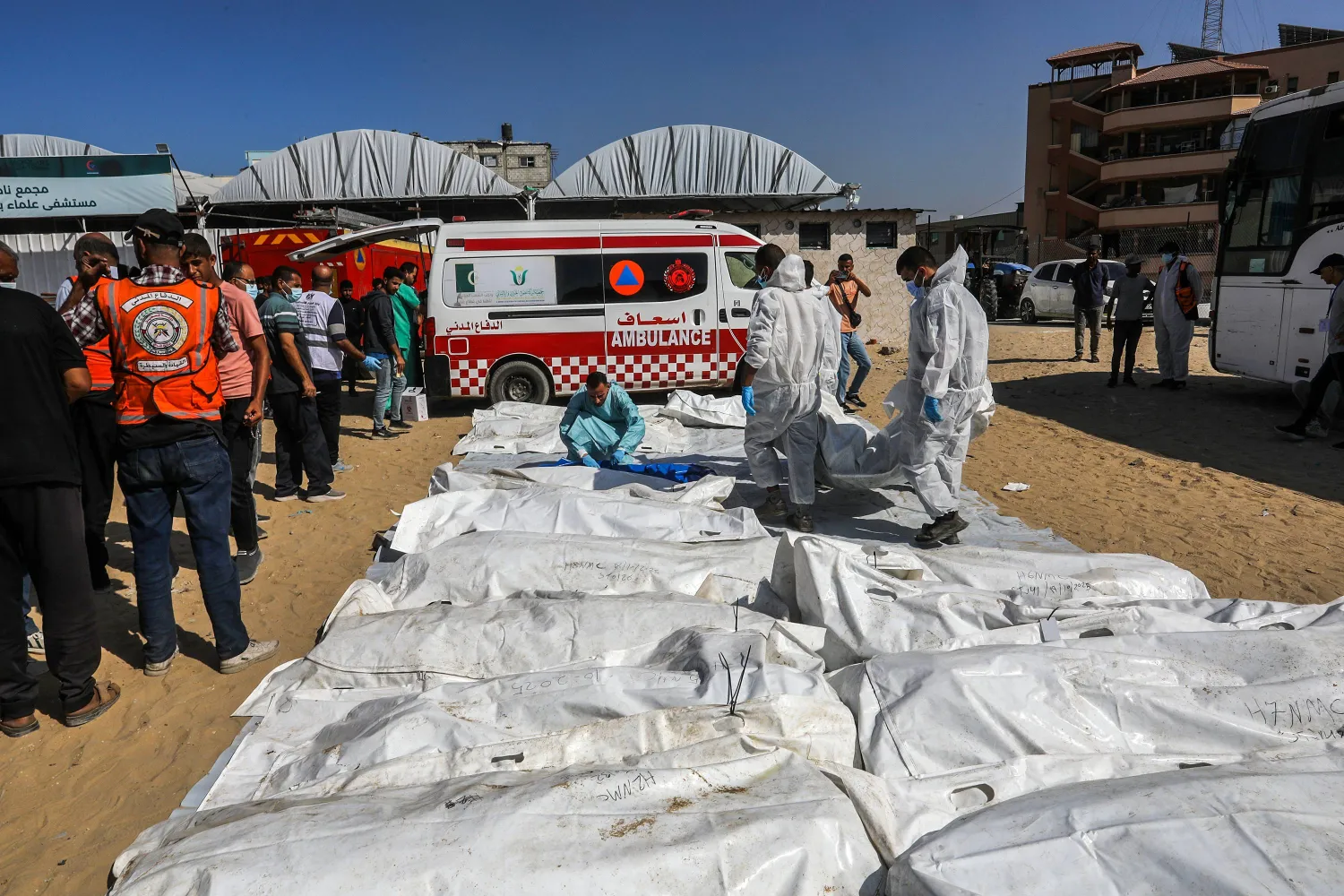
27 October 2025, Palestinian Territories, Khan Younis: The bodies of 40 palestinians, killed by the Israeli army, placed in front of Nasser Hospital, ahead of their burial, in Khan Younis, south of the Gaza Strip, with the participation of the Civil Defense and some workers from the Ministry of Health. Photo: Abed Rahim Khatib/dpa
TT

Israel Returns 15 Palestinian Bodies to Gaza, Where Displaced Families Endure Winter Rains

27 October 2025, Palestinian Territories, Khan Younis: The bodies of 40 palestinians, killed by the Israeli army, placed in front of Nasser Hospital, ahead of their burial, in Khan Younis, south of the Gaza Strip, with the participation of the Civil Defense and some workers from the Ministry of Health. Photo: Abed Rahim Khatib/dpa

Israel returned the bodies of 15 Palestinians to Gaza on Friday, officials at Nasser hospital in Khan Younis said, in the latest step to fulfilling the terms of the fragile US-brokered ceasefire agreement. 

The bodies were returned after fighters late Thursday handed over the body of one of the last four remaining Israeli hostages taken during the Oct. 7, 2023, attack that launched the war in Gaza. 

Israel identified the returned body as that of Meny Godard, who was abducted from Kibbutz Be’eri in southern Israel. His wife, Ayelet, was killed during the attack. 

The armed wings of Hamas and the Palestinian Islamic Jihad said Godard’s body was recovered in southern Gaza. 

The remains of 25 hostages have been returned to Israel since the ceasefire between Israel and Hamas began on Oct. 10. There are still three more in Gaza that need to be recovered and handed over. Hamas returned 20 living hostages to Israel on Oct. 13. 

For each hostage returned, Israel has released the remains of 15 Palestinians, an exchange central to the ceasefire’s first phase. Overall, the number of bodies of Palestinians received so far is 330, of which only 95 have been formally identified, according to Gaza Health Ministry officials. 

Health officials in Gaza have said identifying the remains handed over by Israel is complicated by a lack of DNA testing kits. 

The bodies of 27 unidentified Palestinians were interred in Gaza on Friday. 

Displaced families endure wet, wintry conditions 

As winter settles over Gaza and the first rains begin, displaced families are struggling to keep their makeshift shelters from collapsing under the weather. 

As cloudy skies Friday threatened another downpour in Gaza City, Abdel Rahim Halawa, a father of seven children, worked to fasten a tarp over his tent made of wood, blankets and sheets of plastic. 

“All of the mattresses and blankets got drenched this evening. If more rain comes on us, we don’t know how we can live anymore,” he said. 

Some families have taken shelter in what remains of destroyed buildings. One family lives inside a section of concrete held up by a single crooked column, its open side covered with a piece of tarp. 

“Yes, it might collapse. Some committees came and told us it’s forbidden to live inside of it, but we have no alternative, especially in the winter with the severe cold,” said Saed Salhi, who is living in the structure with four members of his family, all displaced from their home in Jabaliya in northern Gaza. 

UN human rights chief says settler violence must end  

The UN's human rights chief, Volker Türk, on Friday joined a chorus of condemnation over a recent string of attacks by Israeli settlers against Palestinians in the West Bank, urging an end to the violence and for Israel to hold the perpetrators accountable. 

UN Human Rights Commissioner spokesperson Thameen Al-Kheetan said more than 260 attacks by Israeli settlers against Palestinians and their property in the West Bank were recorded in October, more than in any month since 2006. 

“We reiterate that the Israeli government’s assertion of sovereignty over the occupied West Bank and its annexation of parts of it are in breach of international law, as the International Court of Justice has confirmed,” said Al-Kheetan. 

Israeli settlers on Thursday torched and defaced a mosque in a Palestinian village in the central West Bank. That followed violence two days earlier during which dozens of masked Israeli settlers set fire to vehicles and other property in the Palestinian villages of Beit Lid and Deir Sharaf. 

The attacks on the two Palestinian villages prompted Israeli President Isaac Herzog to denounce them as “shocking and serious.” The Israeli army’s chief of staff, Lt. Gen. Eyal Zamir, said the military “will not tolerate the phenomena of a minority of criminals who tarnish a law-abiding public.” 

US Secretary of State Marco Rubio said Wednesday that there's concern that the events in the West Bank “could undermine what we’re doing in Gaza.” 

Israeli officials have sought to cast settler violence as the work of a few extremists. But Palestinians and rights groups say that the violence is widespread and carried out by settlers across the territory, with impunity from Israel’s far-right government. Israeli Prime Minister Benjamin Netanyahu hasn’t commented on the surge in violence. 

The Palestinian Health Ministry in the West Bank said six teenagers — aged 15 to 17 — were shot and killed by Israeli fire in four separate incidents over the last two weeks. In the most recent incident Thursday, two 15-year-old boys were killed near the village of Beit Ummar. 

The Israeli military said that in three of the incidents its soldiers were responding to “terrorists” hurling either Molotov cocktails or explosives or carrying out a “terror attack.” In the other, the military said troops acted according to “standard operating procedures” and opened fire against Palestinians throwing rocks to “remove the threat.” 

What's next for Gaza  

The next parts of the 20-point ceasefire plan call for creating an international stabilization force, forming a technocratic Palestinian government and disarming Hamas. 

The fragile agreement aims to wind down the war that was triggered by the Hamas-led attack on southern Israel that killed about 1,200 people and saw 251 taken hostage. 

Israel responded with a sweeping military offensive that has killed more than 69,100 Palestinians in Gaza, according to Gaza’s Health Ministry. The ministry, part of the Hamas-run government and staffed by medical professionals, maintains detailed records viewed as generally reliable by independent experts. 


Will Lebanon Be the Biggest Loser After the Ceasefire?

Smoke rises after an Iranian missile is intercepted over the Sahel Alma area in Mount Lebanon. (Reuters)
TT

Will Lebanon Be the Biggest Loser After the Ceasefire?

Smoke rises after an Iranian missile is intercepted over the Sahel Alma area in Mount Lebanon. (Reuters)

Political sources in Beirut warned Lebanon could emerge as the biggest loser when the current regional war ends, outlining their concerns to Asharq Al-Awsat.

Lebanon is heading toward a severe internal crisis, the sharpest in its modern history with the dispute centering on Hezbollah’s weapons.

The majority of Shiites in the country insists on keeping them, while most other segments say Lebanon’s survival depends on implementing government decisions to limit arms to the state, in line with Lebanese, Arab, and international positions.

The sources noted that Hezbollah has again entered a regional war it cannot influence, risking burdens Lebanon cannot bear.

Hefty price

The war is proving costly for those involved and for countries hit by its spillover.

A ceasefire would likely show Iran suffered heavy damage to its defense, industrial sectors, and infrastructure, potentially setting it back decades. But its size, energy resources, and experience with economic hardship may help it manage the aftermath, unless losses destabilize the system.

Iranian missiles are expected to have caused damage to Israeli institutions and infrastructure, despite a high interception rate. The cost of interception is steep, but Israel appears ready to absorb it, calling the conflict an existential war and relying on strong US support.

Lebanon will struggle the most. Its economy is already near collapse. The country faces a catastrophic situation, with about one million displaced and heavy destruction along the border with Israel.

Israel has said it intends to establish a “buffer zone” inside Lebanese territory, signaling a return of occupation to parts of the country “pending guarantees for the safety of Galilee residents.”

The most dangerous scenario is that Israel’s campaign on the Lebanese front continues even if a ceasefire is reached between the US and Israel on one side and Iran on the other.

The fallout is worsened by a deepening rift among Lebanon’s components, raising the risk of internal conflict.

The role of parliament Speaker Nabih Berri appears diminished as the conflict widens. The current crisis over the expulsion of the Iranian ambassador reflects a deeper divide between the Shiite camp and others over weapons, the war, and Lebanon’s regional role.

Hezbollah described the expulsion as a “sin”, demanding that the government reverse it.

‘Impossible to coexist’

Voices are rising in Lebanon, warning that it was “impossible to coexist” between a “quasi-state” and a “Hezbollah’s statelet.”

Countries that once backed Lebanon’s reconstruction, especially in the Gulf, are now focused on their own losses from Iranian attacks. They have also made clear that they will not help unless the Lebanese state takes full control over decisions of war and peace.

The sources reiterated their warning that Lebanon risks being the biggest loser, especially if Israel expands its ground offensive and internal divisions deepen to the point of questioning the country’s very formula of coexistence.


Netanyahu Says Israel Is Expanding ‘Buffer Zone’ in Lebanon

Smoke billows from an Israeli strike on Marjeyoun in southern Lebanon on Wednesday. (AFP)
TT

Netanyahu Says Israel Is Expanding ‘Buffer Zone’ in Lebanon

Smoke billows from an Israeli strike on Marjeyoun in southern Lebanon on Wednesday. (AFP)

Israeli Prime Minister Benjamin Netanyahu said on Wednesday that his country's forces were expanding a "buffer zone" in southern Lebanon as the military pressed ahead with its campaign against Hezbollah.

"We have created a genuine security zone preventing any infiltration toward the Galilee and the northern border," Netanyahu said in a video statement.

"We are expanding this zone to push the threat from anti-tank missiles further away and to establish a broader buffer zone."

Netanyahu said that dismantling Hezbollah "remains central" to Israel's objectives in Lebanon.

"It is connected to the broader confrontation with Iran," he said.

"We are determined to profoundly transform the situation in Lebanon," he added.

Lebanon was pulled into the Middle East war when Iran-backed Hezbollah began firing rockets into Israel on March 2 to avenge the killing of Iran's supreme leader Ali Khamenei.


Strike on Western Iraq Kills Seven Security Personnel

Members of Iraq's PMF carry the coffin of the PMF operations commander for Al-Anbar, Saad Dawai alongside others during a mass funeral in Baghdad on March 24, 2026. (AFP)
TT

Strike on Western Iraq Kills Seven Security Personnel

Members of Iraq's PMF carry the coffin of the PMF operations commander for Al-Anbar, Saad Dawai alongside others during a mass funeral in Baghdad on March 24, 2026. (AFP)

A strike on a base in western Iraq killed seven security personnel, the defense ministry said Wednesday, a day after an attack on the same base targeted the Popular Mobilization Forces.

"This resulted in the death of seven of our heroic fighters and the injury of 13 others," the ministry said of the strike in Anbar province, saying it specifically targeted the base's military healthcare clinic.

Rescue operations were ongoing, it added.

The base hosts Iraqi police, soldiers from the regular army and PMF, a security official told AFP.

It was hit by a deadly strike on Tuesday that the former paramilitaries blamed on the United States.

Iraq said late on Tuesday it would summon the US charge d'affaires and the Iranian ambassador after deadly strikes blamed on their countries, as Iraqi authorities granted the targeted groups the "right to respond".

Iraq has been pulled into the war sparked by US and Israeli strikes on Iran on February 28, and which has since engulfed much of the region.

Iraq has long been a proxy battleground for the United States and Iran, and has struggled to balance diplomatic ties with both countries.

Since the war began, pro-Iran armed groups have claimed responsibility for attacks on US interests in Iraq and across the region, while strikes have also targeted these groups, including state-linked positions.

In the statement from the prime minister's office, however, Iraq granted former paramilitaries within the official armed forces the right to "respond to military attacks" by drones and aircraft that targeted their headquarters.
