


First Major Winter Rains Pummel Gaza and Destroy Makeshift Shelters

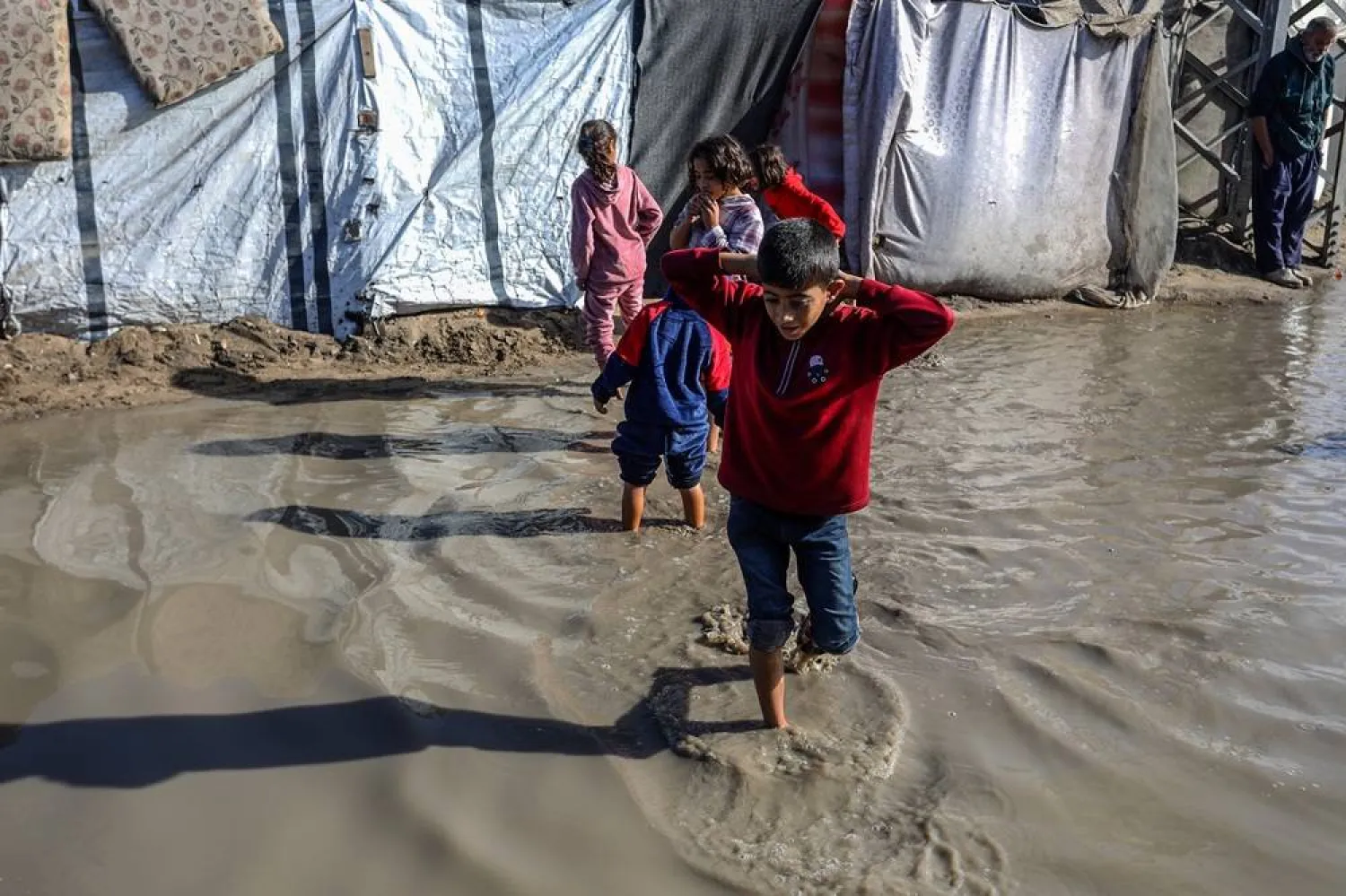
15 November 2025, Palestinian Territories, Khan Yunis: Children walk through the rainwater between their tents, as Palestinians suffer from the bitter cold and heavy rains that inundate their tents in the Al-Attar area of Mawasi, west of Khan Younis in the southern Gaza Strip. (dpa)
TT

First Major Winter Rains Pummel Gaza and Destroy Makeshift Shelters

15 November 2025, Palestinian Territories, Khan Yunis: Children walk through the rainwater between their tents, as Palestinians suffer from the bitter cold and heavy rains that inundate their tents in the Al-Attar area of Mawasi, west of Khan Younis in the southern Gaza Strip. (dpa)

Winter's first heavy rainfall sent water cascading through Gaza's sprawling Muwasi tent camp on Saturday, as the territory struggles to cope with flooding and devastated infrastructure after two years of war.

Residents attempted to dig trenches to keep the water from flooding their tents, as rain dripped through tears in tarpaulins and makeshift shelters. The intermittent bursts soaked families' scant belongings. Strong winds can also topple tents and hamper attempts to gather scarce food and supplies.

Two weeks ago, Bassil Naggar bought a new tent on the black market for the equivalent of about $712, because the summer sun had worn his old tent thin. Still, rainwater was leaking through.

“I spent all (Friday) pushing water out of my tent,” Naggar said, adding that his neighbors’ tents and belongings were wrecked. “Water puddles are inches high, and there is no proper drainage.”

Barefoot children splashed in puddles as women made tea outside under dark clouds. Some people tried to shelter in destroyed buildings, even those at risk of collapse, with gaping holes covered by pieces of plastic.

According to the United Nations, Muwasi was sheltering up to 425,000 displaced Palestinians earlier this year, the vast majority in makeshift temporary tents, after Israel's war with Hamas displaced most of Gaza's population of over 2 million people.

Muwasi had largely been undeveloped sand dunes before the Israeli military designated it a humanitarian zone early in the war.

The Israeli defense body in charge of humanitarian aid in Gaza has said it is allowing in winterization materials including blankets and heavy tarps, but aid organizations warn the efforts are far from sufficient when winter temperatures plummet and the wind whips off the Mediterranean.

UN vote expected Monday

The first stage of the ceasefire agreement is nearing its end. The next and even more challenging stage calls for the implementation of a governing body for Gaza and the deployment of an international stabilization force. It is not clear where either stands. Another looming question is the proposed disarming of Hamas.

The UN Security Council on Monday is expected to vote on a US proposal for a UN mandate for a stabilization force in Gaza despite opposition from Russia, China and some Arab countries.

The war broke out on Oct. 7, 2023, when Hamas-led fighters attacked southern Israel, killing some 1,200 people, mostly civilians, and abducting 251 hostages. They still hold the remains of three hostages, which Israel is demanding before progressing to the second stage of the current ceasefire that took effect on Oct. 10.

Hamas has said the territory's devastation is complicating efforts to find the remains, but Israel has accused the group of dragging its feet.

Israel has been returning the remains of 15 Palestinians for the remains of each Israeli hostage. Gaza's Health Ministry on Saturday said Israel had returned 330 remains, and only 97 had been identified upon their return. Health officials in Gaza say identifications are complicated by a lack of DNA testing kits.

Israel’s military campaign in Gaza has killed 69,100 Palestinians, including many women and children, according to the Gaza Health Ministry, which does not distinguish between civilians and combatants in its figures. The ministry, part of the Hamas-run government and staffed by medical professionals, maintains detailed records viewed as generally reliable by independent experts.



Israel Military Says Soldier Killed in Gaza 

A drone view shows the destruction in a residential neighborhood, after the withdrawal of the Israeli forces from the area, amid a ceasefire between Israel and Hamas in Gaza, in Gaza City, October 21, 2025. (Reuters)
TT

Israel Military Says Soldier Killed in Gaza 

A drone view shows the destruction in a residential neighborhood, after the withdrawal of the Israeli forces from the area, amid a ceasefire between Israel and Hamas in Gaza, in Gaza City, October 21, 2025. (Reuters)

The Israeli military announced that one of its soldiers had been killed in combat in southern Gaza on Wednesday, but a security source said the death appeared to have been caused by "friendly fire".

"Staff Sergeant Ofri Yafe, aged 21, from HaYogev, a soldier in the Paratroopers Reconnaissance Unit, fell during combat in the southern Gaza Strip," the military said in a statement.

A security source, however, told AFP that the soldier appeared to have been "killed by friendly fire", without providing further details.

"The incident is still under investigation," the source added.

The death brings to five the number of Israeli soldiers killed in Gaza since a ceasefire took effect on October 10.


Syria: SDF’s Mazloum Abdi Says Implementation of Integration Deal May Take Time

People sit outdoors surrounded by nature, with the Tigris river flowing in the background, following a long atmospheric depression, near the Syrian-Turkish border in Derik, Syria, February 16, 2026 REUTERS/Orhan Qereman
TT

Syria: SDF’s Mazloum Abdi Says Implementation of Integration Deal May Take Time

People sit outdoors surrounded by nature, with the Tigris river flowing in the background, following a long atmospheric depression, near the Syrian-Turkish border in Derik, Syria, February 16, 2026 REUTERS/Orhan Qereman

Mazloum Abdi, commander of the Syrian Democratic Forces, said the process of merging the SDF with Syrian government forces “may take some time,” despite expressing confidence in the eventual success of the agreement.

His remarks came after earlier comments in which he acknowledged differences with Damascus over the concept of “decentralization.”

Speaking at a tribal conference in the northeastern city of Hasakah on Tuesday, Abdi said the issue of integration would not be resolved quickly, but stressed that the agreement remains on track.

He said the deal reached last month stipulates that three Syrian army brigades will be created out of the SDF.

Abdi added that all SDF military units have withdrawn to their barracks in an effort to preserve stability and continue implementing the announced integration agreement with the Syrian state.

He also emphasized the need for armed forces to withdraw from the vicinity of the city of Ayn al-Arab (Kobani), to be replaced by security forces tasked with maintaining order.


Israeli Far-Right Minister to Push for ‘Migration’ of West Bank, Gaza Palestinians 

A Palestinian man checks leather belts as people prepare for Ramadan, in the old city of Hebron in the Israeli-occupied West Bank, February 17,2026. (Reuters)
TT

Israeli Far-Right Minister to Push for ‘Migration’ of West Bank, Gaza Palestinians 

A Palestinian man checks leather belts as people prepare for Ramadan, in the old city of Hebron in the Israeli-occupied West Bank, February 17,2026. (Reuters)

Israel's far-right Finance Minister Bezalel Smotrich said he would pursue a policy of "encouraging the migration" of Palestinians from the occupied West Bank and Gaza Strip, Israeli media reported Wednesday.

"We will eliminate the idea of an Arab terror state," said Smotrich, speaking at an event organized by his Religious Zionism Party late on Tuesday.

"We will finally, formally, and in practical terms nullify the cursed Oslo Accords and embark on a path toward sovereignty, while encouraging emigration from both Gaza and Judea and Samaria.

"There is no other long-term solution," added Smotrich, who himself lives in a settlement in the West Bank.

Since last week, Israel has approved a series of measures backed by far-right ministers to tighten control over the West Bank, including in areas administered by the Palestinian Authority under the Oslo Accords, in place since the 1990s.

The measures include a process to register land in the West Bank as "state property" and facilitate direct purchases of land by Jewish Israelis.

The measures have triggered widespread international outrage.

On Tuesday, the UN missions of 85 countries condemned the measures, which critics say amount to de facto annexation of the Palestinian territory.

"We strongly condemn unilateral Israeli decisions and measures aimed at expanding Israel's unlawful presence in the West Bank," they said in a statement.

"Such decisions are contrary to Israel's obligations under international law and must be immediately reversed.

"We underline in this regard our strong opposition to any form of annexation."

UN Secretary-General Antonio Guterres on Monday called on Israel to reverse its land registration policy, calling it "destabilizing" and "unlawful".

The West Bank would form the largest part of any future Palestinian state. Many on Israel's religious right view it as Israeli land.

Israeli NGOs have also raised the alarm over a settlement plan signed by the government which they say would mark the first expansion of Jerusalem's borders into the occupied West Bank since 1967.

The planned development, announced by Israel's Ministry of Construction and Housing, is formally a westward expansion of the Geva Binyamin, or Adam, settlement situated northeast of Jerusalem in the West Bank.

The current Israeli government has fast-tracked settlement expansion, approving a record 52 settlements in 2025.

Excluding Israeli-annexed east Jerusalem, more than 500,000 Israelis live in West Bank settlements and outposts, which are illegal under international law.