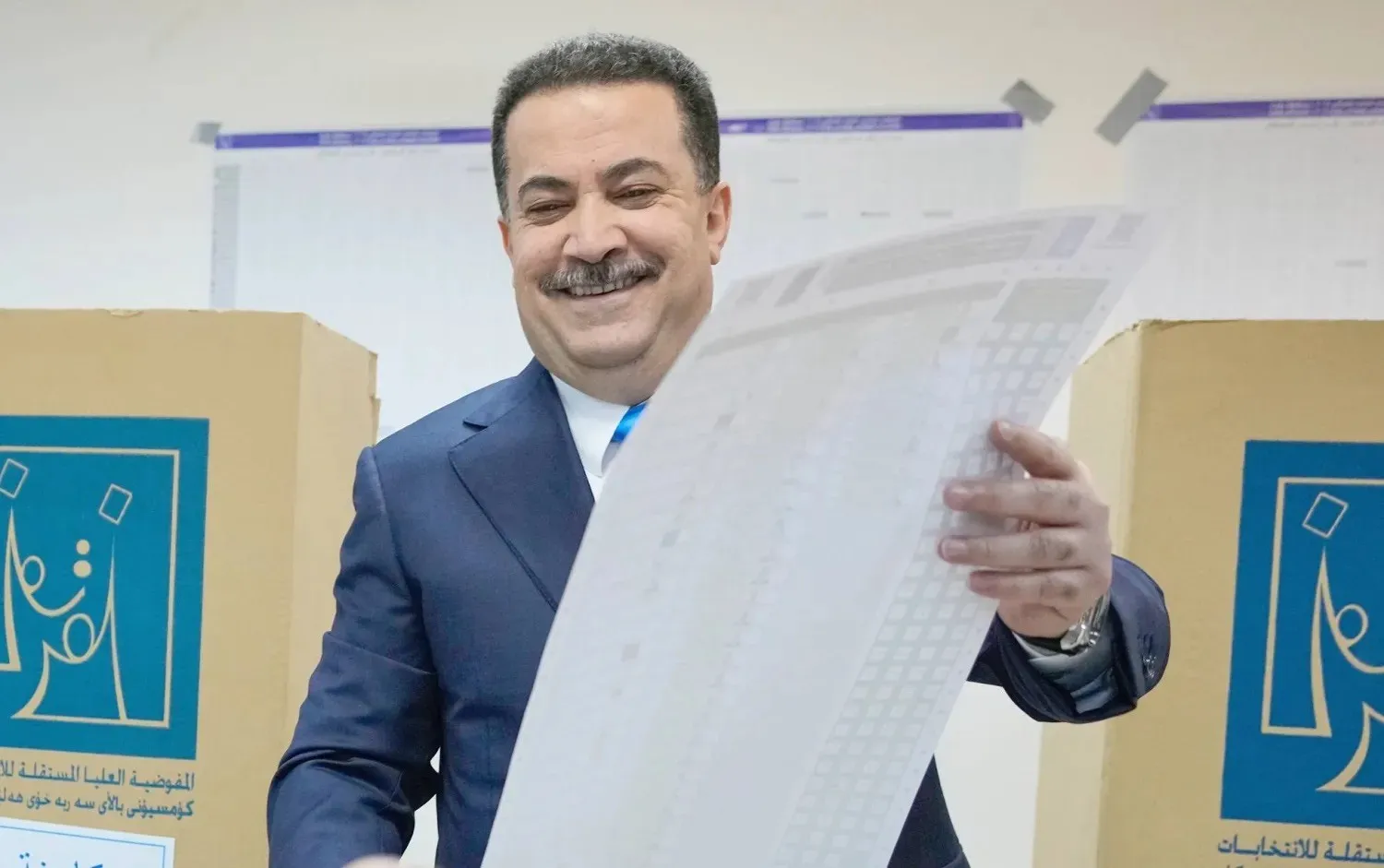

Iraqi political forces that have won seats in the recent parliamentary elections are moving to lay the groundwork for forming the next federal government.
These preparations come as parties continue to negotiate the shape of parliamentary blocs and the potential distribution of ministerial portfolios, all against the backdrop of widening divisions over whether to grant Prime Minister Mohammed Shia al-Sudani a second term.
The political scene is marked by notable tensions within the Coordination Framework - a coalition of major Shiite parties and parliamentary blocs - over defining the largest bloc in parliament and determining al-Sudani’s place in any future cabinet.
Although allies close to the premier say he remains committed to the Framework’s overarching policies, he continues to insist on seeking another term. Yet several political figures argue that some of the coalition’s components may need to reassess their positions following the election results, particularly as certain groups secured more seats than expected, prompting a re-evaluation of alliances.
A senior Iraqi political source told Asharq Al-Awsat that internal disagreements revolve primarily around the need for coordinated action to ensure the formation of the largest bloc.
He stressed that member parties differ markedly in their stance toward al-Sudani, and that the shape of the next government will depend not only on intra-Framework negotiations but also on discussions with Sunni and Kurdish parties, which are expected to introduce their own conditions.
Within this context, the prime minister is preparing to visit Erbil, the capital of the Kurdistan Region, in the coming two days.
He is scheduled to meet with key Kurdish leaders, including Kurdistan Democratic Party (KDP) president Masoud Barzani, Kurdistan Region President Nechirvan Barzani, and Regional Prime Minister Masrour Barzani. Talks are expected to focus on post-election alliances and key issues that are set to shape the next phase.
Al-Sudani will wrap up his visit by attending a ceremony at the American University of Duhok and meeting with local officials.
Although al-Sudani’s Reconstruction and Development coalition won the highest number of seats, securing around 46 with more than 1.3 million votes, the results have not brought him closer to a renewed mandate.
Several influential Coordination Framework leaders, including State of Law Coalition head Nouri al-Maliki, who won roughly 29 seats, strongly oppose his return. Other figures such as Qais al-Khazali and Ammar al-Hakim have also expressed reservations.
According to political sources, the four largest factions within the Framework have agreed to block al-Sudani from securing a second term. Together with allied Shiite groups, these forces command more than 100 seats, placing them in a strong position to form the “largest parliamentary bloc” authorized by Iraq’s political system to nominate a prime minister.
Article 76 of the constitution stipulates that the president must task the nominee of the largest bloc with forming a government within 15 days.
However, the definition of “largest bloc” has remained contentious since 2010, when the Federal Supreme Court ruled that it may refer either to the list winning the most seats or to a post-election coalition able to assemble a majority.
The US State Department has congratulated Iraqis on the peaceful vote and affirmed that the winning parties may now proceed with government formation, stressing Washington’s commitment to strengthening ties based on mutual respect and shared interests.
Earlier, US Special Presidential Envoy Mark Savaya reaffirmed American support for Iraqi sovereignty, reform efforts, and initiatives to curb external interference and the activities of armed groups, alongside cooperation in security, energy, and development.