
A joint military convoy of Syrian, Russian, and Turkish officers toured southwestern Syria on Monday, highlighting the changes the country has undergone less than a year after the fall of Moscow’s former ally.
The delegation, comprising around 15 SUVs escorted by 10 Syrian public security and military police vehicles, inspected sites that had once hosted Russian forces, before Moscow was compelled to actively reposition its troops across Syrian territory.
The convoy moved from Saasaa in the Damascus countryside toward Beit Jen, at the far southwestern edge of the Damascus countryside bordering Quneitra province, then proceeded to the area west of Beit Jen town, before heading to central Quneitra countryside.
According to sources, the delegation, whose mission was not publicly announced, inspected military sites that had previously served as Russian headquarters during the former regime.
The route taken by the convoy saw a heavy deployment of Syrian public security forces. The unprecedented tour, amid ongoing Israeli violations in the region, carried multiple messages.
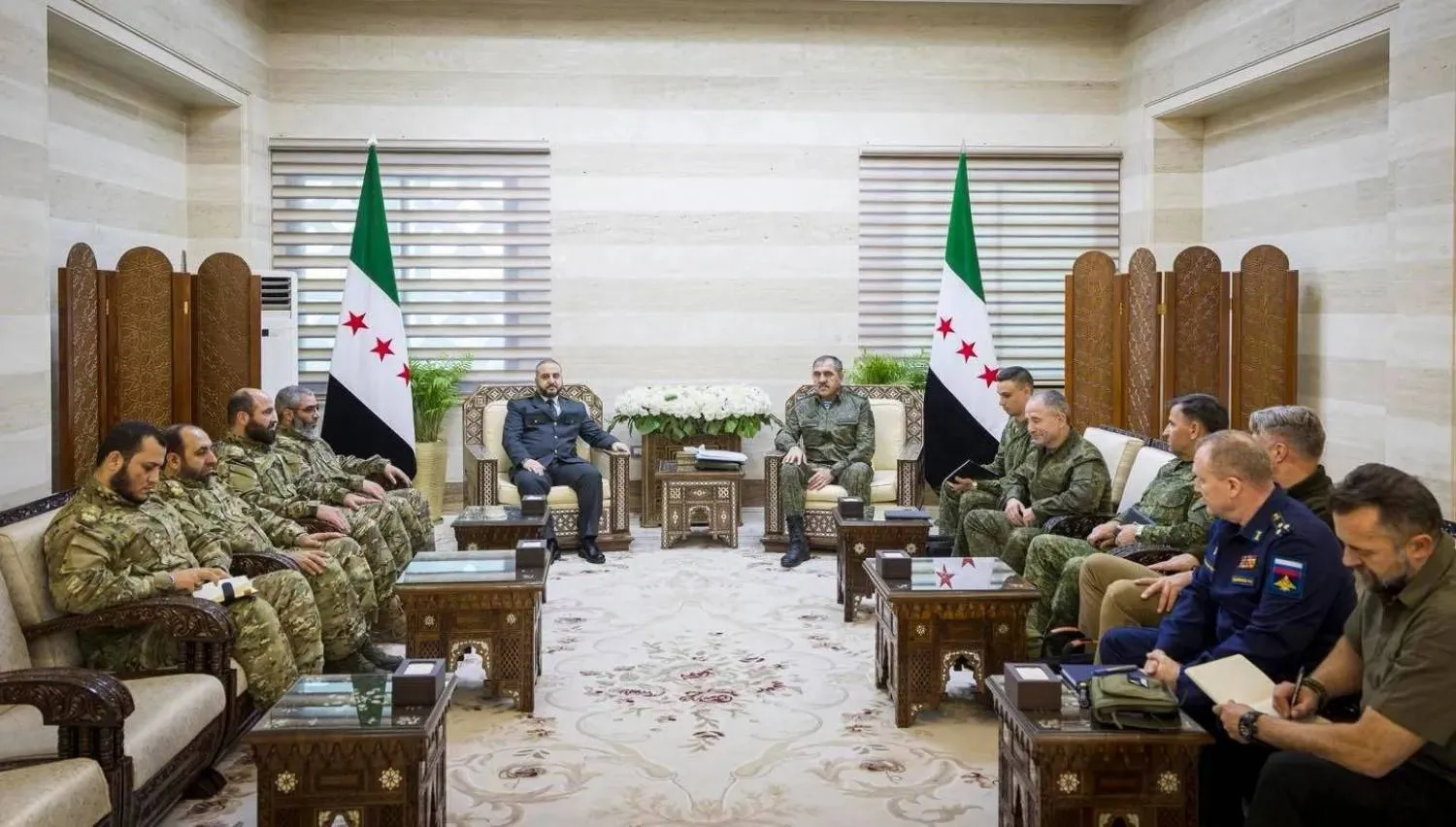
It followed two significant developments: first, a visit to Damascus by Syrian Defense Minister Major General Murhaf Abu Qasra for talks with Russian Deputy Defense Minister Yunus-Bek Yevkurov, the highest-ranking Russian official to visit Syria since the fall of Bashar al-Assad.
Second, the visit came shortly after a phone call between Russian President Vladimir Putin and Israeli Prime Minister Benjamin Netanyahu.
The Kremlin said the call covered the situation in Gaza, Iran’s nuclear file, and ways to ensure stability in Syria. Analysts suggest that Moscow and Damascus are now coordinating efforts to curb Israeli overreach and establish guarantees to restore calm in southern Syria.
Countering Israeli Pretexts
The visit builds on the outcomes of Syrian President Ahmed al-Sharaa’s trip to Moscow a month ago, where he reportedly discussed resuming Russian patrols in coordination with Damascus and efforts to pressure Israel to halt ongoing violations.
Russian sources indicate discussions on redeploying Russian military police units in southern Syria to remove Israeli pretexts. Israel controls extensive areas in Damascus countryside, Quneitra, and Daraa, posing a threat to civilians, with dozens reportedly detained by Israeli forces.
Moscow’s role, in this context, is to reassure Israel that Syrian territory will not be used for attacks threatening Israeli security, while Syrian-Russian cooperation will prevent Iranian-backed militias and extremist groups from consolidating in the region.
Strategic Russian Repositioning
The visit by Yevkurov, according to Russian sources, addresses broader issues beyond southern security arrangements. It signals a comprehensive reconfiguration of Russia’s military presence in Syria, reflecting a pragmatic new framework that protects the interests of both countries. Following the meetings, Moscow and Damascus announced discussions on strengthening military coordination and cooperation.
Leaks suggested potential Russian support for modernizing the Syrian army and providing advanced defensive technologies, although such plans are closely linked to Russian-Israeli understandings to avoid new attacks on Syrian military sites.
The broader Syrian-Russian dialogue, spanning military and political levels, appears focused on redefining bilateral priorities. The Russian outlet Tsargrad, close to the military establishment, noted that Yevkurov’s visit is particularly significant for shaping the new military relationship.
Yevkurov, a senior general in the Russian Ministry of Defense responsible for the “African sector,” oversees Russia’s growing military operations in Africa and has been under sanctions from Britain, Canada, the European Union, and the United States since 2022. His African portfolio is relevant in Syria, as the country serves as a key logistical hub for supplies sent to the continent.
Previously, Moscow proposed adjusting its Syrian bases to function as “humanitarian supply stations” for Africa and other regions. Russian sources say this explains Yevkurov’s Damascus visit, aimed at securing logistical support for Russia’s military and economic operations in Africa via Syria’s Hmeimim airbase and Tartus naval facility.
According to the same source, Syria is also crucial for Russia to maintain influence in the Middle East and as a traditional market for Russian military industrial products. Moscow sees Syria as part of a broader economic, humanitarian, and cultural network that it considers valuable and difficult to abandon.
Damascus’ Interests
For Damascus, Russian support is seen as vital to counterbalance growing Turkish influence, provide maneuvering space for potential alignment with the United States, gain backing at the United Nations and Security Council, and facilitate mutual guarantees with Israel. Russia is also expected to play a moderating role with Syrian minorities, including Kurds, Druze, and Alawites, given its reputation as a trusted mediator.
Russian Foreign Minister Sergei Lavrov recently highlighted this approach, noting that Moscow has contributed significantly to Syria’s economy, social sector, national cadre training, and defense capabilities.
He added that these contributions must be adapted to new circumstances, including the functioning of Russian military bases. Lavrov said Syrian leadership and several regional countries are keen to maintain Russia’s presence under a framework that serves both parties’ interests.