Israeli Forces Kill 2 Palestinian Teens in Escalating West Bank Violencehttps://english.aawsat.com/arab-world/5211202-israeli-forces-kill-2-palestinian-teens-escalating-west-bank-violence
Israeli Forces Kill 2 Palestinian Teens in Escalating West Bank Violence
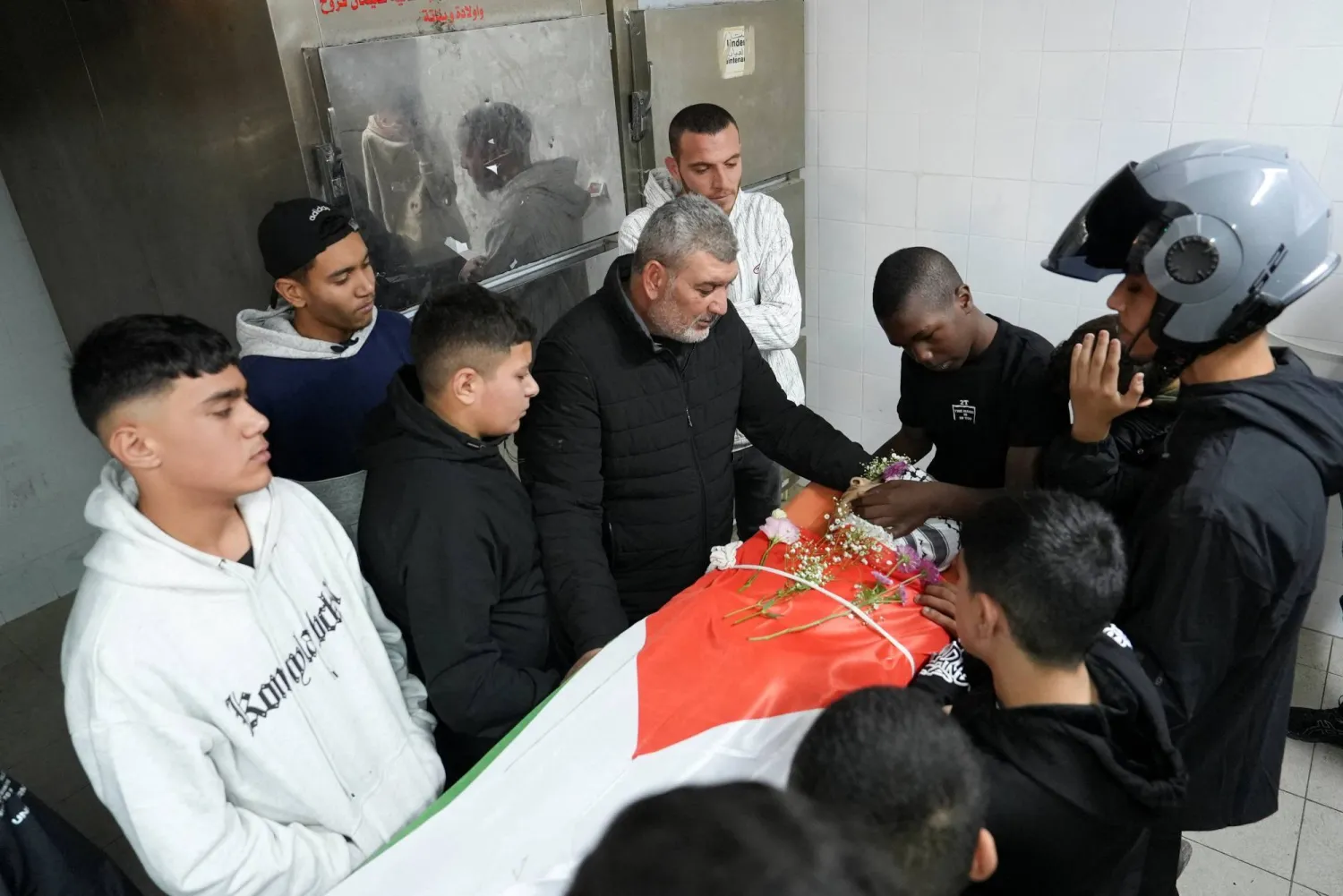
Relatives of one of two Palestinians, who were killed in an Israeli raid, react near their body ahead of their funeral, at a hospital in Ramallah, in the Israeli-occupied West Bank November 21, 2025. REUTERS/Ismael Khader
Israeli Forces Kill 2 Palestinian Teens in Escalating West Bank Violence
Relatives of one of two Palestinians, who were killed in an Israeli raid, react near their body ahead of their funeral, at a hospital in Ramallah, in the Israeli-occupied West Bank November 21, 2025. REUTERS/Ismael Khader
Israeli forces killed two Palestinian teenagers during an overnight raid on a town near Ramallah in the Israeli-occupied West Bank, residents said, as violence surges in the territory with a growing number of dead.
Forces shot Sami Ibrahim Mashaikha, 16, and Amr Khaled Al-Marboua, 18, in Kfar Aqab and both later died of their wounds, according to the health ministry in the Palestinian Authority.
The Palestinian WAFA news agency reported that Israeli forces had raided Kfar Aqab overnight, deploying forces to the streets and on top of the town's buildings before opening fire.
Asked for comment, the Israeli military deferred to the Israel Border Police, a unit of Israel's national police, which did not immediately respond to a Reuters request for comment.
While an October 10 ceasefire has largely ended the war in Gaza between Israel and Palestinian Hamas militants, the West Bank is experiencing increasing violence.
Palestinians have faced tightening military restrictions over the past two years, curbing their freedom of movement. Attacks on Palestinians by Israeli settlers have also escalated.
Prime Minister Benjamin Netanyahu said on Monday he would meet with cabinet ministers to ensure that Israelis involved in attacks on Palestinians are brought to justice.
Italy Calls for Release of Five Activists Held by Israel in West Bankhttps://english.aawsat.com/arab-world/5332821-italy-calls-release-five-activists-held-israel-west-bank
Italy's Foreign Minister Antonio Tajani (R) speaks to media after the meeting of the top diplomats of the R4 mechanism and the European E3 mechanism, in Istanbul on October 23, 2026. (AFP)
TT
TT
Italy Calls for Release of Five Activists Held by Israel in West Bank
Italy's Foreign Minister Antonio Tajani (R) speaks to media after the meeting of the top diplomats of the R4 mechanism and the European E3 mechanism, in Istanbul on October 23, 2026. (AFP)
Italy has called for the immediate release of five Italian activists, all women, held by Israeli forces in the West Bank, Foreign Minister Antonio Tajani said on Friday.
Italian foreign ministry sources said the women were detained on Thursday by Israeli police in Kiryat Arba along with other international activists, while seeking to protect Palestinian farmers during the olive harvest.
"What happened is unacceptable, they were not committing any crime," Tajani told reporters on the sidelines of an international summit in Istanbul, adding he hoped they would be released in a matter of hours.
The women were expected to be transferred to Israel's immigration authority on Friday pending expulsion and repatriation procedures, Israeli authorities told Italian diplomats earlier in the day, according to the sources.
Middle East, European FMs Hold Talks on Regional Developments in Istanbulhttps://english.aawsat.com/arab-world/5332818-middle-east-european-fms-hold-talks-regional-developments-istanbul
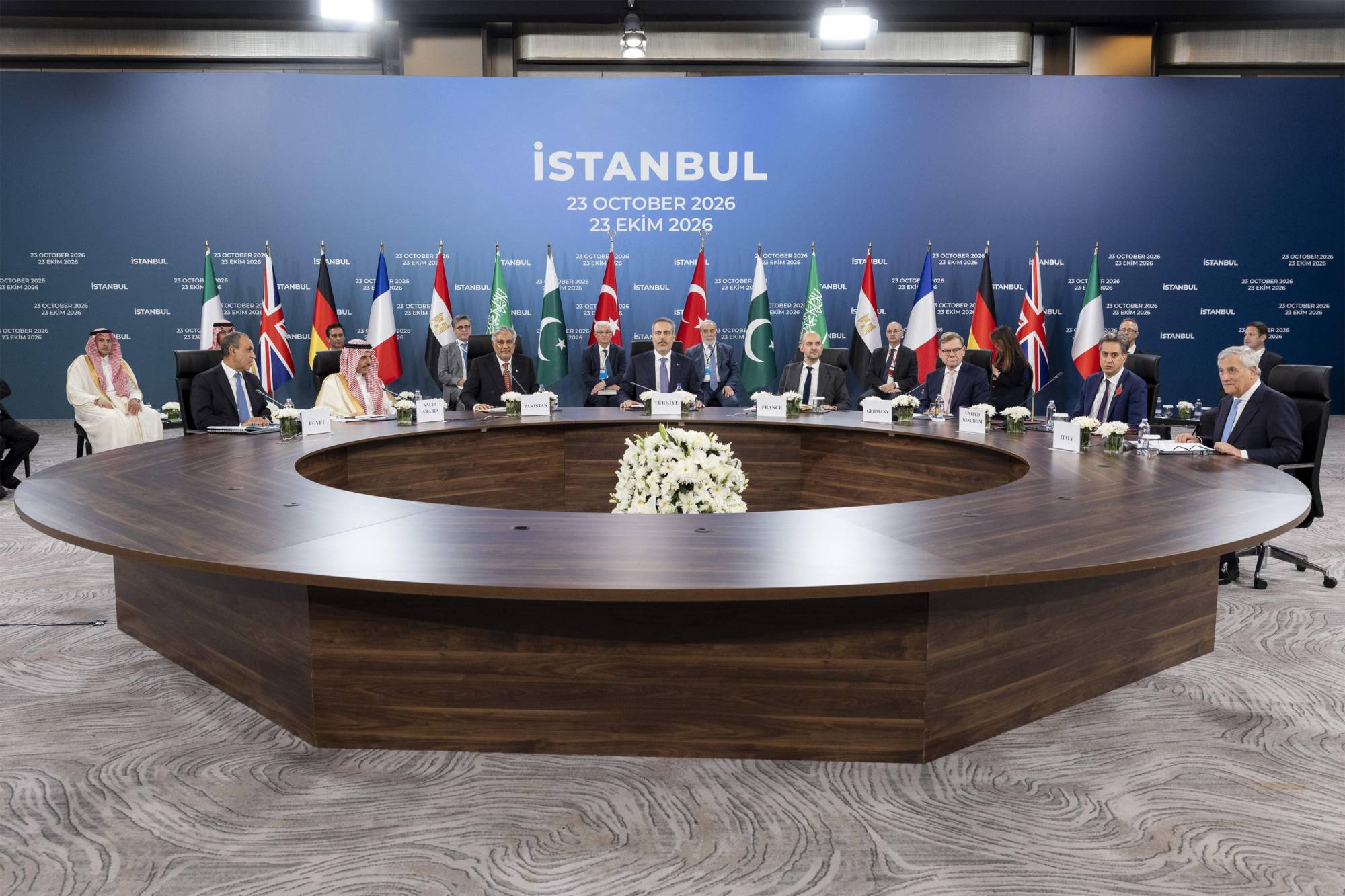
Italian Foreign Minister Antonio Tajani (L), Saudi Foreign Minister Prince Faisal bin Farhan bin Abdullah (2-L), French Foreign Minister Jean-Noel Barrot (3-L), German Foreign Minister Johann Wadephul (4-L), Turkish Foreign Minister Hakan Fidan (4-R), British Foreign Minister Edward Miliband (3-R), Pakistani Foreign Minister Ishaq Dar (2-R) and Egyptian Foreign Minister Badr Abdelatty (R) pose for a group photograph during the R4 and E3 foreign ministers' meeting in Istanbul, Türkiye , 23 October 2026. (EPA)
TT
TT
Middle East, European FMs Hold Talks on Regional Developments in Istanbul
Italian Foreign Minister Antonio Tajani (L), Saudi Foreign Minister Prince Faisal bin Farhan bin Abdullah (2-L), French Foreign Minister Jean-Noel Barrot (3-L), German Foreign Minister Johann Wadephul (4-L), Turkish Foreign Minister Hakan Fidan (4-R), British Foreign Minister Edward Miliband (3-R), Pakistani Foreign Minister Ishaq Dar (2-R) and Egyptian Foreign Minister Badr Abdelatty (R) pose for a group photograph during the R4 and E3 foreign ministers' meeting in Istanbul, Türkiye , 23 October 2026. (EPA)
Foreign ministers from eight European and Middle Eastern countries met in Istanbul on Friday in an unprecedented format for talks on reopening the Strait of Hormuz and crises across the Middle East.
Ministers from Britain, France and Germany -- the so-called E3 -- as well as Italy met counterparts from Saudi Arabia, Egypt, Pakistan and Türkiye to discuss the Palestinian-Israeli conflict, Yemen, Hormuz -- a crucial trade route blocked in the Iran war -- and ways to end the Russia-Ukraine conflict.
The talks began at an Istanbul hotel overlooking the Bosphorus, after separate meetings of top European diplomats and diplomats from regional countries.
French Foreign Minister Jean-Noel Barrot said a new escalation between Iran and the United States "would create nothing but losers and would undoubtedly have very serious consequences for hydrocarbon prices".
"And so the first thing this group of eight countries ... will do is call on both sides to exercise the utmost restraint, because we cannot afford another escalation in the region," he told journalists on the sidelines of the talks in Istanbul.
Italy's Antonio Tajani said the aim was to work for "de-escalation to guarantee freedom of navigation".
"I do not believe the problem can be solved from a purely military standpoint," he said.
"If we want to reopen Hormuz, which is vital for our economies, we must promote dialogue and make Iran understand that this attitude cannot continue."
Egyptian Foreign Minister Badr Abdelatty (L), Saudi Foreign Prince Faisal bin Farhan bin Abdullah (2-L), Pakistani Foreign Minister Ishaq Dar (3-L), Turkish Foreign Minister Hakan Fidan (4-L), French Foreign Minister Jean-Noel Barrot (4-R), German Foreign Minister Johann Wadephul (3-R), British Foreign Secretary Edward Miliband (2-R) and Italian Foreign Minister Antonio Tajani (R) pose for a group photograph during the R4 and E3 foreign ministers' meeting in Istanbul, Türkiye, 23 October 2026. (EPA)
- 'Iranian tactics' -
Turkish Foreign Minister Hakan Fidan hosted the meeting as Türkiye stepped up efforts to strengthen its regional role, including through the Makkah Defense Alliance, a defense pact launched with Saudi Arabia and Pakistan in August.
Türkiye has said the pact is not aimed at any specific country and remains open to others, including Egypt.
"Our platform has several advantages, particularly because it is informal and flexible and focuses specifically on the issues we face. It allows us to exchange information and coordinate our positions more effectively," Fidan told reporters.
"We are not aware of any other platform that brings together countries with such different geographical and political backgrounds. Türkiye, in particular, is well placed to play a constructive role in this process."
Cairo has yet to decide whether to join the alliance. On Wednesday, President Abdel Fattah al-Sisi said Egypt would "defend Saudi territory" and would not take part in any attack on Yemen.
Iran-backed Houthis are battling Yemen's legitimate government and have launched attacks on Saudi Arabia.
British foreign minister Ed Miliband's office said ahead of the talks they would essentially revolve around "the Strait of Hormuz and the situation in Saudi Arabia".
It said Miliband would "advocate for a diplomatic solution to the (Hormuz) crisis that restores full navigational rights and freedoms".
He was also to stress "how Iranian tactics are being replicated across the region, with attacks on Saudi Arabia further destabilizing the region and increasing pressure on vital waterways and global chokepoints, such as Bab al-Mandeb and the Suez Canal".
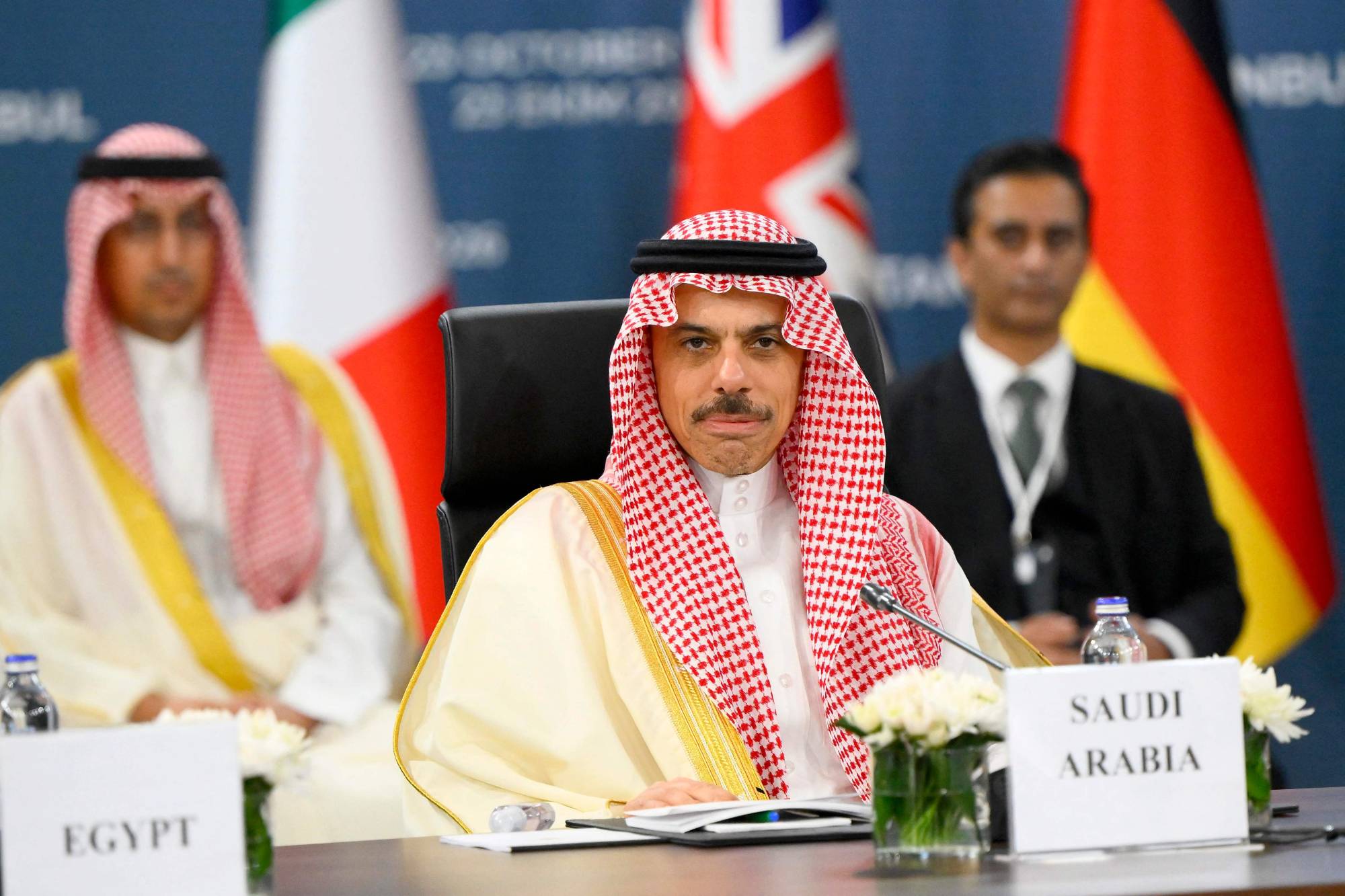
Saudi Arabia's Foreign Minister Prince Faisal bin Farhan bin Abdullah attends the meeting of the top diplomats of the R4 mechanism and the European E3 mechanism in Istanbul on October 23, 2026. (AFP)
- 'De-escalation' -
Fidan stressed that regional security required countries in the region to assume responsibility and that Ankara prioritized cooperation mechanisms based on "regional ownership".
"Regional frameworks turn into credible platforms for action and cooperation", he said ahead of the talks.
"Stability cannot simply be imported, and lasting solutions cannot be imposed from outside. Those who live with conflict must play a central role in resolving it," he added.
The eight countries "decided, after very constructive discussions, to continue the work by meeting at regular intervals", Barrot said.
Hundreds of Syrians Protest Repeated Israeli Incursionshttps://english.aawsat.com/arab-world/5332814-hundreds-syrians-protest-repeated-israeli-incursions
Syrians wave flags and hold portraits of people who were arrested during Israeli military incursions in southern Syria, as they protest near the United Nations building in Damascus, on October 23, 2026. (AFP)
TT
TT
Hundreds of Syrians Protest Repeated Israeli Incursions
Syrians wave flags and hold portraits of people who were arrested during Israeli military incursions in southern Syria, as they protest near the United Nations building in Damascus, on October 23, 2026. (AFP)
Hundreds rallied across Syria on Friday condemning Israeli incursions in the country's south including one this week that killed a man with a disability, AFP correspondents and state media reported.
The Israeli military has carried out hundreds of strikes in Syria and conducted frequent incursions into its territory since Islamist authorities took power after toppling longtime ruler Bashar al-Assad in December 2024.
It also sent troops into a UN-patrolled buffer zone that had separated Israeli and Syrian forces on the mainly Israeli-occupied Golan Heights since 1974.
Protesters rallied in several locations including Damascus and central Syria's Homs, decrying Israeli incursions and attacks in the southern Quneitra and Daraa provinces, state media reported.
An AFP correspondent in Daraa city saw hundreds rallying, some waving Syrian flags.
Protester Taysir al-Hariri told AFP that demonstrators had gathered to "send a message to the world" that Syria stands united "against Israeli incursions and against anyone who is tempted to tamper... with national security".
State television footage of other rallies showed protesters carrying posters reading "We are all Moaz", referring to the man with special needs who Syria said was killed by Israeli fire a day earlier during an incursion in Daraa province.
Syria accuses Israel of violating a 1974 disengagement agreement through repeated incursions in the south, the raiding of homes there and the seizing of dozens of residents, in conjunction with other military activity including shelling.
In Damascus, outside a United Nations building, the family of a Syrian man seized by Israel called for his release, with children holding posters reading "I want my dad".
State media on Friday also reported that Israeli forces advanced in part of Quneitra province and blocked several roads.
Israel has vowed to keep troops in a so-called "security zone" in southern Syria, where it seeks a broader demilitarized area.
Syria and Israel have held negotiations as they seek to reach a security agreement, but Israel remains distrustful of Syria's new authorities.
لم تشترك بعد
انشئ حساباً خاصاً بك لتحصل على أخبار مخصصة لك ولتتمتع بخاصية حفظ المقالات وتتلقى نشراتنا البريدية المتنوعة