
Assad’s Chemical Weapons Remnants Threaten Civilians at Over 100 Sites in Syria

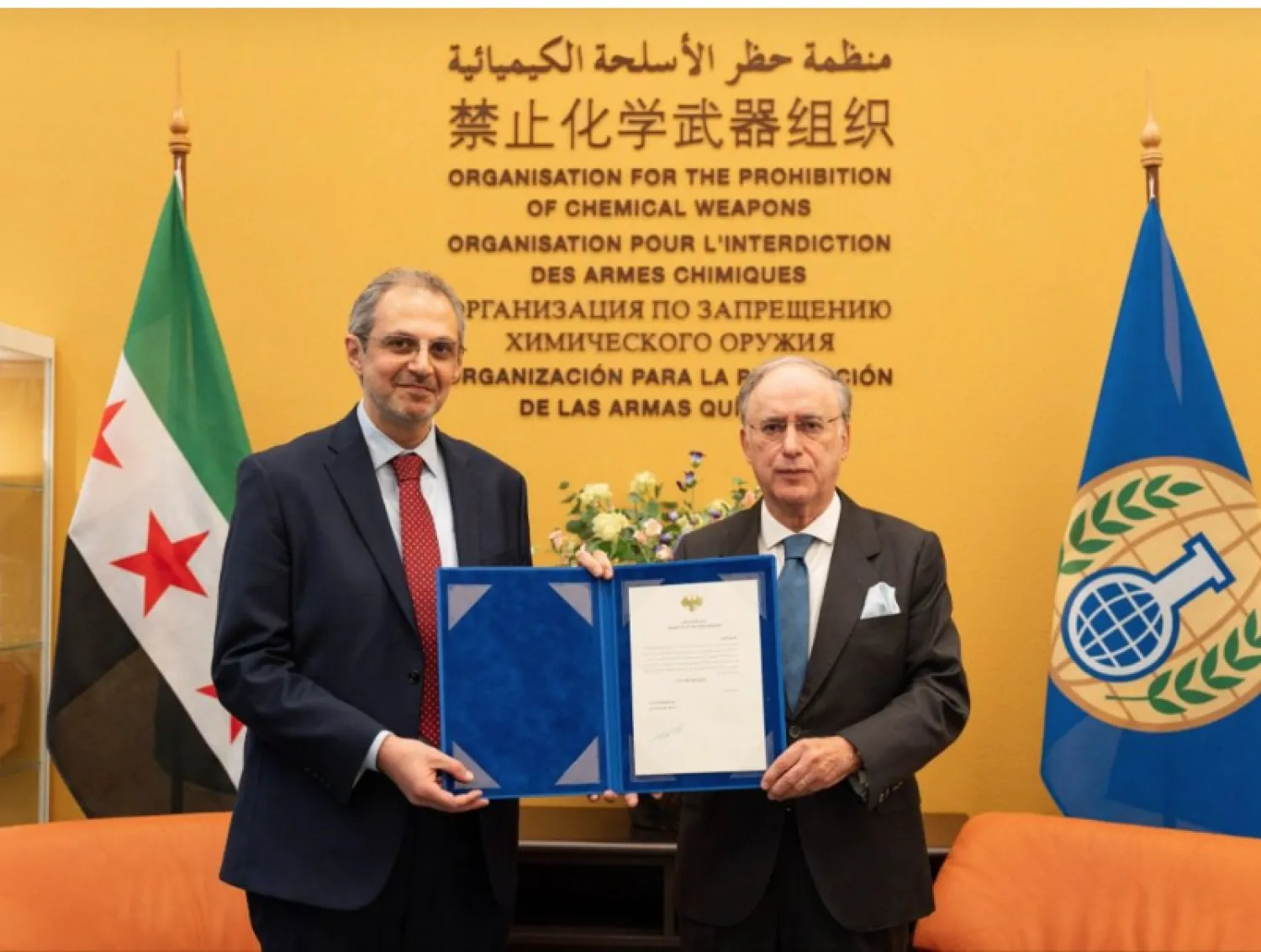
Mohammad Katoub (left) assumes his duties as Syria’s representative to the Organization for the Prohibition of Chemical Weapons (Al-Ikhbariyah Syria). 
TT

Assad’s Chemical Weapons Remnants Threaten Civilians at Over 100 Sites in Syria

Mohammad Katoub (left) assumes his duties as Syria’s representative to the Organization for the Prohibition of Chemical Weapons (Al-Ikhbariyah Syria). 

Syria’s newly reactivated mission to the Organization for the Prohibition of Chemical Weapons (OPCW) has warned that remnants of chemical weapons left across the country pose a direct threat to civilians in more than 100 suspected locations.

The warning came from Syria’s permanent representative to the OPCW, Dr. Mohammad Katoub, who said that toxic remnants remain in areas previously struck or used for weapons production. He noted that many of these locations are close to population centers, raising fears of accidental exposure.

Speaking on the first working day of the restored Syrian mission in The Hague, Katoub told the state-run channel Al-Ikhbariyah that the Assad regime continued to use chemical weapons for 12 years. He said the most recent documented incident occurred on December 5, 2024, in the village of Khattab, in Hama countryside.

Damascus announced Katoub’s appointment late Friday, reactivating its mission to the OPCW after nearly a year of suspension. However, Katoub said that Syria has not yet recovered its full privileges and remains without voting rights, though there is a pending recommendation for review by member states.

A physician by training, Katoub worked in Eastern Ghouta during the years of siege imposed by Bashar al-Assad’s forces. Known then as “Majid Abu Ali,” he was one of the key witnesses to the 2013 sarin massacre in Ghouta, which killed nearly 1,400 people.

Appearing Saturday from the OPCW office in The Hague, Katoub revealed that the portrait of Bashar al-Assad that once hung in the mission’s office has been replaced with a page listing some of the Ghouta victims. “The wall is not big enough to hold the names of all the chemical-weapons victims in Syria,” he said.

One survivor, Majid Haiba, who was present during the 2013 attacks in Moadamiya al-Sham and Darayya, told Asharq Al-Awsat that he, his wife and daughter inhaled a toxic gas and continue to suffer from respiratory and neurological illnesses to this day.

A former conscript in the Syrian military’s chemical-warfare unit, Haiba said hospitals in Damascus refused to treat them, forcing them to flee illegally to Daraa and then to Zaatari camp in Jordan, where they met a French medical team. The team took clothing, hair and blood samples, he said, in hopes of preserving evidence.

According to Haiba, his testimony did not stop further attacks. He added that several chemical-research facilities he had identified were later struck by Israel, including sites in Barzeh, Jmeiraya, a Fourth Division facility near Damascus, and a facility in Masyaf, in Hama countryside.

Katoub said Syria has begun seeking technical cooperation from OPCW member states to safely remove toxic remnants. He confirmed that national teams have gathered information on around 100 suspected sites and have already inspected 23 of them, although more likely exist. He added that multiple ministries — including Defense, Emergency Services, Health, Justice and a transitional justice authority — are now working to secure contaminated areas, including some damaged by Israeli strikes.

Chemical Weapons Use in Syria: Key Incidents

Human Rights Watch says the Assad regime used chemical weapons on a wide scale throughout the conflict that began in 2011. Documented attacks include the first suspected nerve-agent use in Khan al-Assal in 2012; the large-scale sarin attack on Eastern Ghouta in 2013; a nerve agent strike in Homs the same year; sarin use in Saraqib and Kafr Zita in 2014; multiple chlorine attacks in Idlib in 2015; toxic strikes in Arbin, Saraqib and Aleppo’s al-Zahra district in 2016; the sarin attack on Khan Sheikhoun in 2017; and the Douma chlorine and suspected sarin attack in 2018.


Israel Clears Final Hurdle to Start Settlement Construction That Would Cut West Bank in Two

Construction cranes tower above a construction site in Givat HaMatos, an Israeli settlement suburb of Israeli-annexed east Jerusalem on January 2, 2026. (AFP)
TT

Israel Clears Final Hurdle to Start Settlement Construction That Would Cut West Bank in Two

Construction cranes tower above a construction site in Givat HaMatos, an Israeli settlement suburb of Israeli-annexed east Jerusalem on January 2, 2026. (AFP)

Israel has cleared the final hurdle before starting construction on a controversial settlement project near Jerusalem that would effectively cut the West Bank into two, according to a government tender. 

The tender, seeking bids from developers, would clear the way to begin construction of the E1 project. 

The anti-settlement monitoring group Peace Now first reported the tender. Yoni Mizrahi, who runs the group’s settlement watch division, said initial work could begin within the month. 

Settlement development in E1, an open tract of land east of Jerusalem, has been under consideration for more than two decades, but was frozen due to US pressure during previous administrations. 

The international community overwhelmingly considers Israeli settlement construction in the West Bank to be illegal and an obstacle to peace. 

The E1 project is especially contentious because it runs from the outskirts of Jerusalem deep into the occupied West Bank. Critics say it would prevent the establishment of a contiguous Palestinian state in the territory. 

Israeli Finance Minister Bezalel Smotrich, a far-right politician who oversees settlement policy, has long pushed for the plan to become a reality. 

“The Palestinian state is being erased from the table not with slogans but with actions,” he said in August, when Israel gave final approval to the plan. “Every settlement, every neighborhood, every housing unit is another nail in the coffin of this dangerous idea.” 

The tender, publicly accessible on the website for Israel’s Land Authority, calls for proposals to develop 3,401 housing units. Peace Now says the publication of the tender “reflects an accelerated effort to advance construction in E1.” 


Three Killed in Aleppo Attacks, Syrian Government, SDF Trade Blame

Syrian forces are seen during a military parade in Aleppo marking a year since the ouster of the Assad regime in December 2025. (Syrian Defense Ministry)
TT

Three Killed in Aleppo Attacks, Syrian Government, SDF Trade Blame

Syrian forces are seen during a military parade in Aleppo marking a year since the ouster of the Assad regime in December 2025. (Syrian Defense Ministry)

At least three people were killed and several others wounded in Syria's northern city of Aleppo, state news agency SANA said on Tuesday, citing Aleppo's health director, after deadly attacks for which Syrian government forces and the Kurdish-led Syrian Democratic Forces traded blame.

Syria's defense ministry said in a statement that the SDF had continued its "escalation" by targeting army positions and residential areas in Aleppo. The SDF denied its responsibility, saying that the ‌casualties were caused by "indiscriminate" ‌artillery and missile shelling by ‌factions ⁠aligned with ‌the Damascus government.

The violence came days after a meeting between senior officials from the SDF and the Damascus government on implementing a deal agreed nearly 10 months ago that aimed to fully integrate the semi-autonomous Kurdish region into the central Syrian government.

The agreement was ⁠meant to be implemented by the end of 2025, but ‌the two sides have made ‍little progress, each accusing ‍the other of stalling or acting in bad ‍faith.

The SDF is reluctant to give up autonomy it won as the main US ally during the war, which left it with control of ISIS prisons and rich oil resources.

Integrating the SDF into Syria's army would mend Syria's deepest remaining fracture, ⁠but failing to do so risks an armed clash that could derail the country's emergence from 14 years of war and potentially draw in Türkiye, which has threatened an incursion against Kurdish fighters it views as terrorists.

As progress falters, several rounds of fighting have broken out. On December 22, Syrian government forces and SDF agreed to de-escalate in the northern city of Aleppo, after a wave ‌of attacks that left at least two civilians dead and several wounded.


African Union Calls for Immediate Revocation of Somaliland’s Recognition by Israel

Somalis burn the Israel flag and an image depicting Israeli Prime Minister Benjamin Netanyahu during a demonstration, after Israel became the first country to formally recognize the self-declared Republic of Somaliland, at the Mogadishu Stadium in Warta Nabada district of Mogadishu, Somalia December 30, 2025. (Reuters)
TT

African Union Calls for Immediate Revocation of Somaliland’s Recognition by Israel

Somalis burn the Israel flag and an image depicting Israeli Prime Minister Benjamin Netanyahu during a demonstration, after Israel became the first country to formally recognize the self-declared Republic of Somaliland, at the Mogadishu Stadium in Warta Nabada district of Mogadishu, Somalia December 30, 2025. (Reuters)

The African Union's Political Affairs Peace and Security council called on Tuesday for the "immediate revocation" of Israel's recognition ‌of Somaliland.

Israeli ‌Foreign ‌Minister ⁠Gideon Sara ‌visited Somaliland on Tuesday on a trip that was denounced by Somalia, 10 ⁠days after Israel ‌formally recognized the ‍self-declared ‍republic as ‍an independent and sovereign state.

"The (AU) Council strongly condemns, in the strongest terms, the unilateral recognition of ⁠the so-called 'Republic of Somaliland' by Israel," it said in a post on X after a ministerial meeting.