Hamas Says Discussed Second Phase of Gaza Truce in Cairo

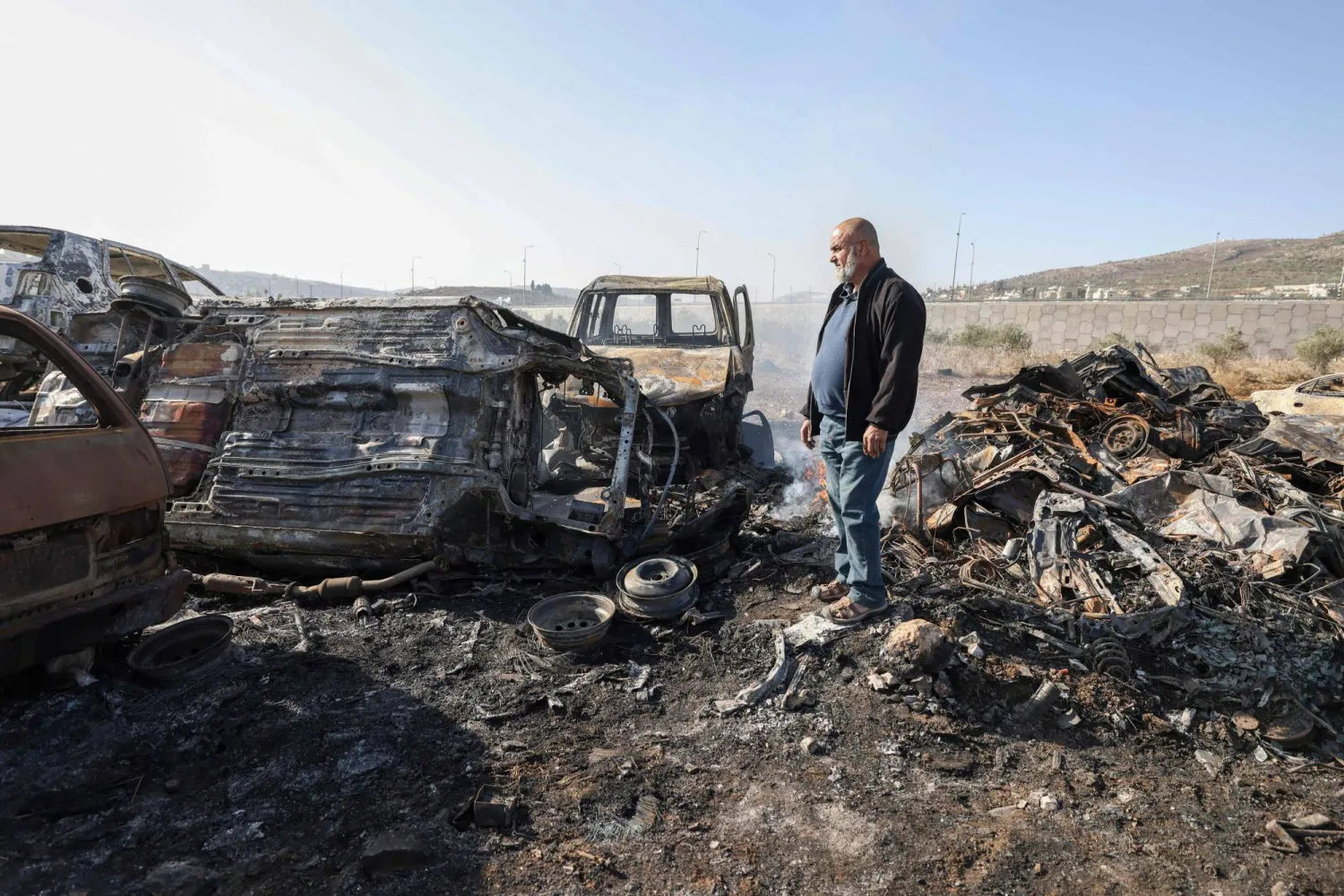
A Palestinian man Ahmad Dalal, 57, inspects scrap cars burnt in an attack by Israeli settlers, in Huwara in the Israeli-occupied West Bank, November 21, 2025.  (Photo by JAAFAR ASHTIYEH / AFP)
A Palestinian man Ahmad Dalal, 57, inspects scrap cars burnt in an attack by Israeli settlers, in Huwara in the Israeli-occupied West Bank, November 21, 2025. (Photo by JAAFAR ASHTIYEH / AFP)
TT

Hamas Says Discussed Second Phase of Gaza Truce in Cairo

A Palestinian man Ahmad Dalal, 57, inspects scrap cars burnt in an attack by Israeli settlers, in Huwara in the Israeli-occupied West Bank, November 21, 2025.  (Photo by JAAFAR ASHTIYEH / AFP)
A Palestinian man Ahmad Dalal, 57, inspects scrap cars burnt in an attack by Israeli settlers, in Huwara in the Israeli-occupied West Bank, November 21, 2025. (Photo by JAAFAR ASHTIYEH / AFP)

A delegation of senior Hamas leaders discussed the second phase of the Gaza ceasefire agreement on Sunday with the head of Egyptian intelligence, the Palestinian group said.  

Led by Hamas chief negotiator Khalil al-Hayya, the delegation arrived in the Egyptian capital on Saturday for talks on Sunday with Egyptian intelligence chief Hassan Rashad, two officials from the movement told AFP.  

Hamas said in a statement that it "reaffirmed its commitment to implementing the first phase of the (ceasefire) agreement, stressing the importance of putting an end to Israeli violations".  

"The nature of the second phase of the agreement" was also discussed in Cairo, Hamas added, without giving further details. 

The second stage of the Gaza ceasefire plan concerns disarming Hamas, establishing a transitional authority and deploying an international stabilization force.  

Hamas, excluded from any role in the future governance of the territory under the Trump plan adopted by the UN Security Council, is refusing to disarm.  

Over the past few days, Israel and Hamas have accused each other of violating the US-brokered truce that came into effect on October 10 after two years of war. 

Gaza's civil defense agency said 21 people were killed and dozens more wounded in multiple Israeli air strikes on Saturday.  

The Israeli military said an "armed terrorist" had crossed the so-called Yellow Line within the Gaza Strip, behind which Israeli forces have withdrawn, and fired at Israeli soldiers.  

In response to the incident in southern Gaza, the Israeli military said it "began striking terror targets in the Gaza Strip".  

Hamas said on Sunday it had also raised the fate of fighters in Gaza's southern area of Rafah with whom it had lost contact.  

According to various media reports, up to 200 Hamas fighters are believed to be trapped in tunnels in Gaza beneath part of the territory where the Israeli army has redeployed under phase one of the agreement. 


Trump Warns Iraq Against Returning Former PM Maliki to Power Amid Worries about Iran Influence

A general view shows al-Firdous Square in Baghdad, Iraq July 27, 2022. (Reuters)
TT

Trump Warns Iraq Against Returning Former PM Maliki to Power Amid Worries about Iran Influence

A general view shows al-Firdous Square in Baghdad, Iraq July 27, 2022. (Reuters)

President Donald Trump warned Iraq on Tuesday that the US would no longer support the country if its former prime minister, Nouri al-Maliki, returns to power.

Trump made the threat days after the dominant political bloc known as the Coordination Framework, a collection of Shiite parties, announced it was backing the nomination of Maliki, who the US administration views as too close to Iran.

"Last time Maliki was in power, the Country descended into poverty and total chaos. That should not be allowed to happen again,” Trump said in a social media post announcing his opposition to Maliki.

“Because of his insane policies and ideologies, if elected, the United States of America will no longer help Iraq and, if we are not there to help, Iraq has ZERO chance of Success, Prosperity, or Freedom," he warned.

Trump's intervention into Iraqi politics comes at a fraught moment for Trump in the Middle East as he weighs carrying out new strikes on Iraq's neighbor Iran, which has maintained deep influence in Iraq's government since the US ouster of Saddam Hussein in 2003.

Trump has left open the possibility of military action in response to Tehran's deadly crackdown on recent protests against the government.

Maliki's troubled relationship with Washington

Caretaker Prime Minister Mohammed Shia al-Sudani 's bloc won the largest share of seats in November’s parliamentary elections. But he stepped aside earlier this month after he was unable to form a government. That cleared the field for Maliki after the two had competed for the backing of the Coordination Framework.

Maliki, who first served as prime minister in 2006, is the only Iraqi prime minister to serve two terms since the US toppled Saddam in 2003. Maliki's bid for a third term failed after he was accused of monopolizing power and alienating the country's sizable Sunni and Kurdish populations.

When he came to power in May 2006, Maliki was initially embraced by President George W. Bush. Maliki took over as prime minister months after the bombing of the al-Askari shrine, a significant Shiite mosque. It was a moment that deepened sectarian tension in Iraq and sparked a period of intense violence in the country.

But within months, US officials soured on Maliki. They saw his government as too often favoring Shiite factions and alienating Sunni populations, which exacerbated the security crisis.

For years, concerns were frequently raised in Washington about Maliki’s closeness to Iran and his ability to govern independently of Tehran’s influence.

By 2014, the Obama administration had lost confidence in Maliki’s ability to manage the security situation, particularly the rise of the ISIS group, which had seized large swaths of the country.

‘This is Iraq, so never say never’

The Trump administration began publicly signaling its concerns about the political situation in Iraq in recent days, with Secretary of State Marco Rubio telling caretaker PM Sudani in a phone call Sunday that the US was concerned about a pro-Iran government taking root in Iraq.

“The Secretary emphasized that a government controlled by Iran cannot successfully put Iraq’s own interests first, keep Iraq out of regional conflicts, or advance the mutually beneficial partnership between the United States and Iraq,” said State Department principal deputy spokesperson Tommy Pigott in a statement.

Hussain Abdul-Hussain, a research fellow focused on the Middle East at the Foundation for Defense of Democracies, a hawkish Washington think tank, said that Trump's public opposition creates a difficult hurdle for Maliki to overcome.

“But this is Iraq, so never say never,” said Abdul-Hussein. “And this was a guy whose political life was supposed to have expired many, many years ago, and yet Maliki is still here.”

The US also has been pushing Baghdad to disarm Iran-backed groups operating inside Iraq — a difficult proposition, given the political power that many of them hold.

Fraught moment with Iran

It's not the first time that Trump has intervened in another country's politics since returning to office. He also offered strong backing last year for right-wing candidates in Argentina, Honduras, and Poland.

The long-frayed relationship between the US and Iran remains tense after Trump earlier this month repeatedly threatened Tehran with military action if his administration found the authorities were using deadly force against anti-government protesters.

He then said he was holding off on strikes after claiming that Iran had halted the execution of some 800 people detained in the protests — something Iran’s top prosecutor, Mohammad Movahedi, has strongly denied.

Trump may have been at least temporarily dissuaded from carrying out a strike because of a shift in the US naval presence from the Middle East to South America.

The aircraft carrier USS Gerald Ford was redirected from the Mediterranean Sea in November to support operations targeting drug smugglers in the Caribbean Sea and eastern Pacific as well as this month's capture of former Venezuelan president Nicolás Maduro.

But the aircraft carrier USS Abraham Lincoln and three accompanying warships have arrived in the Middle East, US Central Command confirmed Monday. That's raised anew speculation that Trump could soon opt to order airstrikes on Iran for its crackdown on protesters.


Netanyahu Says Israel Focusing on Disarming Hamas, Vows to Block Establishment of Palestinian State 

Israel's Prime Minister Benjamin Netanyahu speaks during the second "International Conference on Combating Antisemitism - Generation of Truth" in Jerusalem, 26 January 2026. (EPA)
TT

Netanyahu Says Israel Focusing on Disarming Hamas, Vows to Block Establishment of Palestinian State 

Israel's Prime Minister Benjamin Netanyahu speaks during the second "International Conference on Combating Antisemitism - Generation of Truth" in Jerusalem, 26 January 2026. (EPA)

Prime Minister Benjamin Netanyahu said on Tuesday that Israel would shift its focus to disarming Hamas and demilitarizing Gaza following the return of the last hostage from the Palestinian territory.

He further said that no reconstruction work would take place in Gaza until those two missions were accomplished.

Netanyahu also vowed to block the establishment of a Palestinian state in Gaza, insisting Israel would maintain security control over both it and the occupied West Bank, despite widening international recognition of Palestinian statehood.

The US-sponsored Gaza ceasefire plan, in effect since October 10, stipulated the return of all the hostages held in the territory under its first phase, and Hamas's disarmament under the second.

"Now we are focused on completing the two remaining tasks: disarming Hamas and demilitarizing Gaza of weapons and tunnels," Netanyahu said during a televised press conference.

"It will be done the easy way or it will be done the hard way. But in any case it will happen.

"I'm hearing even now claims that Gaza's reconstruction will be allowed before demilitarization -- this will not happen," Netanyahu said.

Fighters took 251 hostages during the October 7, 2023 attack on Israel that sparked the Gaza war. Israeli forces on Monday brought home the remains of the last captive, Ran Gvili.

Though Hamas said the return of Gvili's body showed its commitment to the ceasefire deal, it has so far not surrendered its weapons.

The group has repeatedly said disarmament is a red line, but it has also suggested it would be open to handing over its weapons to a Palestinian governing authority.

In his remarks Tuesday, Netanyahu said that the establishment of a Palestinian state in Gaza "hasn't happened and it will not happen", claiming credit for having "repeatedly blocked" the implementation of a two-state paradigm.

The war in Gaza, which has left much of the territory in ruins, accelerated international calls for Palestinian statehood, with several Western countries last year taking the step of formally recognizing a Palestinian state.

But Netanyahu insisted that Israel would continue to "exercise security control from the Jordan (River) to the sea, and that applies to the Gaza Strip as well".

- 'Grave mistake' -

The premier also alluded to US President Donald Trump's recent remarks on Iran, which he has previously threatened to attack over its deadly crackdown on anti-government protests.

The US has deployed an aircraft carrier strike group to the region, prompting warnings from Iran that it would not hesitate to defend itself.

"President Trump will decide what he decides; the State of Israel will decide what it decides," Netanyahu said.

But, he added, "if Iran makes the grave mistake of attacking Israel, we will respond with a force that Iran has never seen".

Trump told the Axios news site on Monday that the US had "a big armada next to Iran", but that he believed talks were still an option.

"They want to make a deal. I know so. They called on numerous occasions," he said.

Iranian President Masoud Pezeshkian hit out at US "threats" on Tuesday, saying they were "aimed at disrupting the security of the region".

Israel fought a 12-day war with Iran last June that saw it strike military targets across the country and kill a number of the country's senior military leaders and nuclear scientists.

Iran responded with ballistic missile attacks targeting Israeli cities.

The US briefly joined in with strikes on key nuclear facilities before declaring a ceasefire.


Armed Gaza Gangs Shift Tactics, Straining Hamas Security

Fighters from Hamas’s armed wing, Al-Qassam Brigades, in Khan Younis, Feb. 20, 2025. (dpa)
TT

Armed Gaza Gangs Shift Tactics, Straining Hamas Security

Fighters from Hamas’s armed wing, Al-Qassam Brigades, in Khan Younis, Feb. 20, 2025. (dpa)

For months, a proliferation of armed gangs in Gaza was widely seen as a looming threat to Hamas, which has ruled the enclave since 2007 after seizing it by force following a bitter split with Fatah in the wake of Hamas’s victory in the 2006 legislative elections.

As time passed, however, those expectations faded, as the gangs proved disorganized, fragmented, and incapable of mounting a sustained challenge.

Abu Shabab gang

The most prominent armed gang was led by Yasser Abu Shabab, a Palestinian whom the Hamas-run authorities had previously detained on criminal charges.

After his release from prison at the start of the war in October 2023, he became free to operate. He gradually gained notoriety for seizing and looting humanitarian aid, working with relatives and friends. He later formed an armed group that spread in areas under Israeli control east of Rafah in southern Gaza.

Israel, over time, placed hopes on Abu Shabab’s gang as the first group to emerge and expand, eventually attracting dozens and then a limited number of hundreds of fighters, in what was seen as a potential challenge to Hamas.

Efforts were made not only through the looting of aid arriving via the Kerem Shalom crossing, but also through skirmishes carried out by the gang against gunmen from families opposed to Hamas. These included gunfire and attacks on public and other facilities aimed at asserting the group’s presence.

Hamas confronted these practices on each occasion, with fatalities reported on both sides. The biggest losers, however, were members of families that aligned themselves with the gang and were targeted by Hamas fire as a deterrent.

This approach succeeded in several cases before the most recent ceasefire. It intensified afterward, when Hamas attacked other clans and families, killing, wounding, and arresting dozens, in what it described as a deterrent message to anyone attempting to cooperate with Israel.

For short periods, Abu Shabab’s gang was accused of taking part in the abduction of Palestinians by Israel, including Hamas activists, but this was not proven.

In some cases, it later emerged that Israeli special forces had carried out those operations. The gang was also accused of responsibility for killing Palestinians heading to US-run aid distribution centers, though accounts of those incidents were contradictory.

Other gangs

During the same period, other armed gangs emerged in different areas, including the group led by Hossam Al-Asatal south of Khan Younis, Rami Helles’s gang east of Gaza City, Ashraf Al-Mansi’s group in the north of the strip, and, most recently, the gang led by Shawqi Abu Nseira northeast of Khan Younis.

These groups adopted various names such as “Counterterrorism” and “Popular Forces.”

Abu Shabab was later killed unexpectedly while attempting to mediate a family dispute east of Rafah. Leadership of his group subsequently passed to his deputy, Ghassan Al-Dahini, described as the “mastermind, organizer, and de facto leader” of the Abu Shabab gang.

Following Abu Shabab’s killing, his group lost much of its already limited influence and carried out no significant new activities or skirmishes, particularly after the ceasefire. Some of its members fell into Hamas ambushes and were killed or arrested.

Hamas also struck the gangs led by Helles and Al-Mansi and attempted to target Al-Asatal’s group, while no action was taken against the most recently formed gang led by Abu Nseira.

The Helles and Al-Mansi gangs, operating east of Gaza City and in the north, respectively, tried to assert themselves through minimal clashes.

More recently, however, the Helles gang adopted a new tactic, killing several Gazans who approached the so-called yellow line in the Shujaiya and Tuffah neighborhoods, and forcing residents of a residential block in Tuffah to evacuate at Israel’s request. This marked a new development in the group’s methods.

These moves appear to have prompted Hamas, late Sunday into Monday, to set an ambush for members of that gang on the outskirts of Gaza City.

Details remain unclear, but the “Radea (Deterrence)” force of Gaza’s armed factions’ security apparatus said it had thwarted a “hostile security operation” and inflicted casualties.

Rami Helles, the gang’s leader, confirmed in a Facebook post that one of his fighters, Raad Al-Jamal, had been killed, without providing details. Some sources said Al-Jamal was among the earliest gunmen to join the group.

The gang appears to have attempted to prove itself by assassinating a Hamas activist, as other gangs had done, but its members were caught in the ambush.

All of the gangs, since their formation, have operated on the ground in the service of Israel by entering booby-trapped houses and tunnels to detect explosives.

This has led to the killing and wounding of some of their members, a practice later confirmed by Israeli media, which reported that the Israeli army relied on them because of the frequency of ambushes faced by its forces.

More dangerous tactics

Within the span of a month, the armed gangs shifted to what Palestinians described as “dangerous” tactics after carrying out two assassinations targeting officers in the Hamas-run security services and prominent activists in the movement’s armed wing, the Qassam Brigades, near their homes.

An investigation by Asharq Al-Awsat found that the first assassination, on Dec. 14, 2025, targeted Ahmed Zamzam, an officer in the Internal Security Service, in the Maghazi refugee camp in central Gaza.

It was carried out by gunmen belonging to Shawqi Abu Nseira’s gang. The second, on Jan. 12, targeted Mahmoud Al-Asatal, the head of investigations in the Hamas-run administration in Khan Younis.

That attack was carried out by gunmen linked to Hossam Al-Asatal’s gang. Al-Asatal was a relative of the victim, though his clan had disowned him since he formed his gang in September. Field sources said both operations followed prolonged surveillance of the targets.

The change in tactics raised questions about its rationale. Field sources told Asharq Al-Awsat that, unlike older gangs, Abu Nseira and Hossam Al-Asatal displayed greater loyalty to Israel, operated more boldly, spoke fluent Hebrew with Israeli media, and presented themselves as potential alternatives to Hamas’s rule in Gaza.

According to the sources, the gunmen who carried out the two assassinations were equipped with small body-mounted cameras to document the operations, and some of the weapons used were pistols fitted with silencers.

This pointed clearly to Israeli support, which other gangs did not receive due to their failure to demonstrate real impact.

Multiple field sources also said members of these gangs had obtained new Israeli weapons, including anti-armor munitions, for the first time since Israel began providing them with support, food, and some light arms.

Shifting factors

The ability of these gangs to carry out two assassinations within a month prompted further scrutiny. Asharq Al-Awsat verified through several sources that both Abu Nseira and Al-Asatal had been senior officers in the Palestinian Authority’s security services and possessed significant experience.

The sources said Al-Asatal had received specialized training for years with Israel’s Mossad after being recruited by the Shin Bet, and had been assigned to work outside Palestine. He later took part in the assassination of Qassam Brigades leader Fadi Al-Batsh, an engineer who was not widely known within the group and had been receiving specialized training in Malaysia to develop drones and rockets.

Al-Batsh was killed in April 2018 in an operation in which Al-Asatal participated alongside local agents working for the Mossad. Hamas later succeeded in luring Al-Asatal through one of his brothers, an officer in the Internal Security Service, arresting him and issuing a death sentence against him.

Sources said Al-Asatal and Abu Nseira possessed broader military thinking than others. Al-Asatal had held the rank of major in the Preventive Security Service, while Abu Nseira served as a major general in the Palestinian police.

By contrast, Rami Helles held the rank of junior officer in the Presidential Guard, as did Ashraf Al-Mansi, who served as a conscript in the same force. Abu Shabab had not belonged to any Palestinian security service, while his deputy, Ghassan Al-Dahini, had served in the National Security Forces.

The experience of Al-Asatal and Abu Nseira, including the former’s recruitment and extensive training by Israeli intelligence and the latter’s past imprisonment by Israel, enabled them to target active Hamas members, particularly newly recruited Qassam Brigades fighters, and recruit them to their side.

Al-Asatal recently announced that a member of the Qassam Brigades’ elite unit in Jabalia had joined his forces, prompting the man’s family to deny he had been part of the elite unit.

Hamas sources told Asharq Al-Awsat that he had been recently recruited and worked as a courier between some leaders, transporting funds, and collecting donations from abroad for charitable projects for displaced people. He was the grandson of one of Hamas’s founders in Jabalia.

The activities of these two gangs have increasingly troubled Hamas from a security standpoint, as Israel continues to intensify its intelligence efforts to carry out assassinations whenever conditions allow.

This has prompted Hamas to raise its alert level and strengthen personal security for its officers and leaders to guard against further assassination attempts, Asharq Al-Awsat has learned.

Hamas and its security services have issued internal security directives urging leaders and members to remain vigilant, vary their routes, carry appropriate weapons to repel any attack, and abandon mobile phones to reduce tracking amid Israeli assistance to the gangs.

They were also instructed to monitor any suspicious movements by individuals believed to be surveilling them and to take countermeasures accordingly.