


Western Advice Urges Lebanon, Iraq to Shift from Factions to State

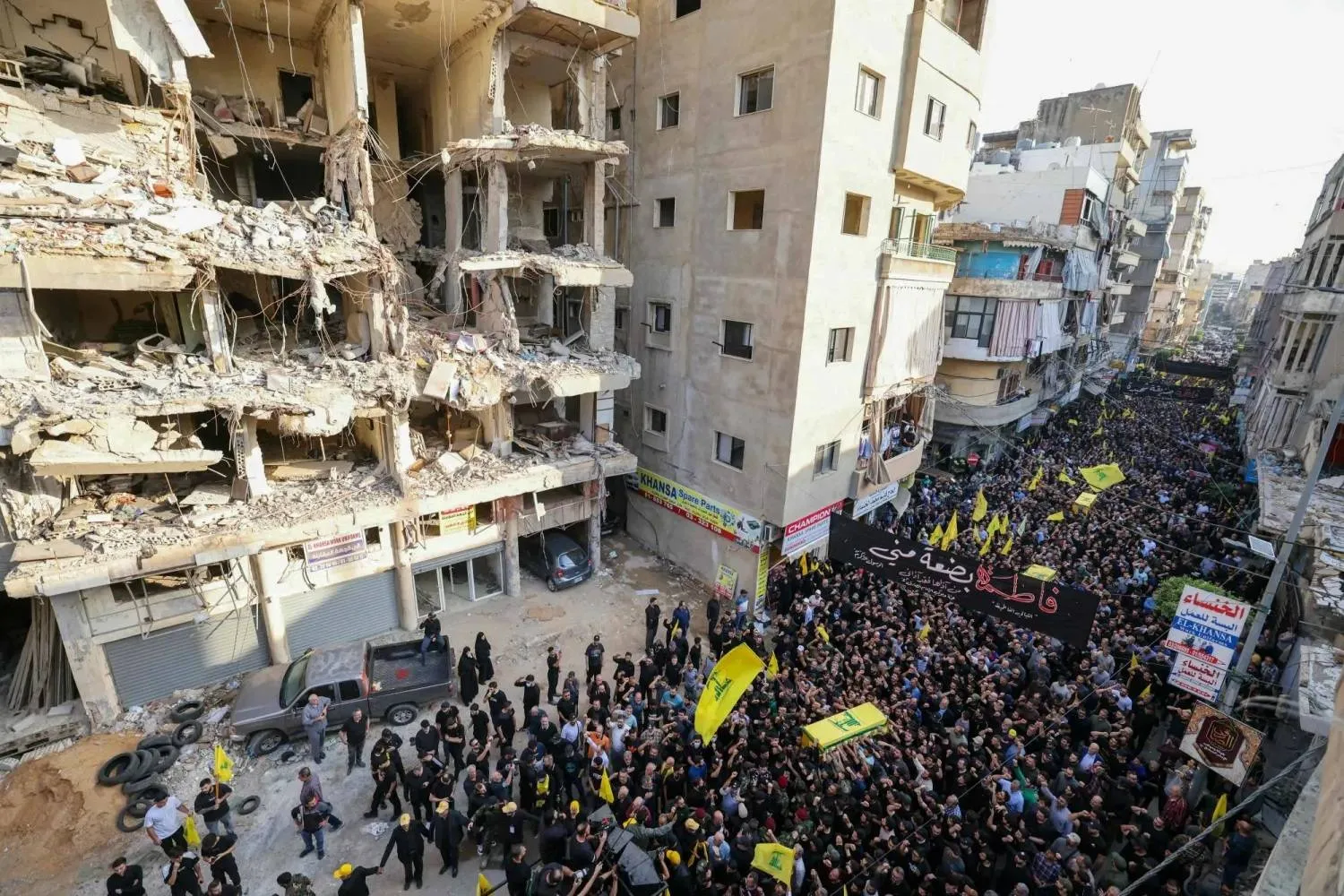
Funeral of Hezbollah chief of staff Haitham Tabtabai and others killed in an Israeli strike in Beirut’s southern suburbs (AFP)
TT

Western Advice Urges Lebanon, Iraq to Shift from Factions to State

Funeral of Hezbollah chief of staff Haitham Tabtabai and others killed in an Israeli strike in Beirut’s southern suburbs (AFP)

A senior Western diplomat in Beirut urged regional states to recognize the gravity of the moment the Middle East is navigating in order to prevent the continuation of the wars that erupted after the October 7 attacks in Gaza.

The diplomat, who is closely involved in Western contacts with Lebanon, told Asharq Al-Awsat that the region should “take advantage of President Donald Trump’s desire to play the role of peacemaker, even if moving forward with the American proposals appears difficult at times.”

The envoy pointed to what they described as “the disastrous outcome of allowing armed factions to control the decisions of capitals.”

He listed them as follows:

Hamas acted alone in launching the Al-Aqsa Flood operation, and the outcome was catastrophic, not only for Gaza but also for the West Bank, which is facing constant Israeli attempts to undermine its stability.

Hezbollah in Lebanon acted unilaterally and joined the flood. The result is what we see today.

Israel has seized positions inside Lebanon and has effectively established a security belt inside Lebanese territory, something it would not have been able to do if decisions were in the hands of the country’s legitimate authorities.

The Bashar al-Assad government paid the price for allowing Iran backed factions to operate on its soil, and the result was its collapse.

Syria’s new president, Ahmed al Sharaa, has learned the lesson that the world has grown weary of the era of factions and wants to deal only with states capable of making their decisions within their institutions.

The diplomat said the coming weeks “could be decisive for Lebanon,” noting that “the world’s ability to spare Lebanon a new Israeli attack depends on the ability of the Lebanese authorities to prove they are the sole decision maker in matters of war and peace, without any faction holding decision making power or veto power.”

They expressed hope that “the moderate current within Lebanon’s Shia community will prevail so that Parliament Speaker Nabih Berri can play a rescue role for his community and for Lebanon as a whole.”

They warned that “keeping the Lebanese state without a clear and firm decision regarding the monopoly of weapons could expose Lebanon to serious dangers.”

They noted that “the shift from the era of factions to the era of states is a task facing not only Lebanon but also Baghdad, especially given the continuing deep rift between Iran and the West.”

They said Tehran “must conclude that a new phase has begun in the region, one defined by states rather than factions, and that clinging to the old policy will only lead to more confrontations that Iran itself will not be spared.”

Iraq, which is now seeking a new government, “needs to thoroughly examine the shifts that have taken place in the region and absorb what happened in Gaza, Lebanon and Syria. Syria is without the Assad government, Lebanese Hezbollah is without Hassan Nasrallah, and Iran itself has lost many of its generals and scientists after already losing Qassem Soleimani,” the commander of the Quds Force, the external operations arm of the Revolutionary Guard.

The diplomat said that in the coming phase Iraq must “prioritize state logic over factional logic and adopt rational choices in both domestic and foreign relations.”

They said that strengthening moderation and state institutions within the Coordination Framework would spare Iraq crises it does not need, especially if predictions prove true that the region is moving toward a new military round between Israel and Iran, one the Trump administration will find difficult to stay out of.

They added that “Iraq would be fortunate if the government formation process results in sending a message to the world that Iraq will focus on rebuilding itself and will not be drawn into bloc politics or confrontational rhetoric regionally or internationally.”

They called on political leaders in Baghdad and Beirut to “look to the experience of President al-Sharaa, who managed quickly to bring his country out of isolation after realizing that Syria had no path except the path of the state, even though he himself came from the world of factions.”



Libya Says UK to Analyze Black Box from Crash That Killed General

Military personnel carry portraits of the Libyan chief of staff, General Mohamed al-Haddad (2-R), and his four advisers, who were killed in a plane crash in Türkiye, during an official repatriation ceremony at the Ministry of Defense headquarters in Tripoli, Libya, 27 December 2025. (EPA)
TT

Libya Says UK to Analyze Black Box from Crash That Killed General

Military personnel carry portraits of the Libyan chief of staff, General Mohamed al-Haddad (2-R), and his four advisers, who were killed in a plane crash in Türkiye, during an official repatriation ceremony at the Ministry of Defense headquarters in Tripoli, Libya, 27 December 2025. (EPA)

Libya said on Thursday that Britain had agreed to analyze the black box from a plane crash in Türkiye on December 23 that killed a Libyan military delegation, including the head of its army.

General Mohammed al-Haddad and four aides died after a visit to Ankara, with Turkish officials saying an electrical failure caused their Falcon 50 jet to crash shortly after takeoff.

Three crew members, two of them French, were also killed.

The aircraft's black box flight recorder was found on farmland near the crash site.

"We coordinated directly with Britain for the analysis" of the black box, Mohamed al-Chahoubi, transport minister in the Government of National Unity (GNU), said at a press conference in Tripoli.

Haddad was very popular in Libya despite deep divisions between west and east.

Haddad was chief of staff for the Tripoli-based GNU.

Chahoubi told AFP a request for the analysis was "made to Germany, which demanded France's assistance" to examine the aircraft's flight recorders.

"However, the Chicago Convention stipulates that the country analyzing the black box must be neutral," he said.

"Since France is a manufacturer of the aircraft and the crew was French, it is not qualified to participate. The United Kingdom, on the other hand, was accepted by Libya and Turkey."

After meeting the British ambassador to Tripoli on Tuesday, Foreign Minister Taher al-Baour said a joint request had been submitted by Libya and Türkiye to Britain "to obtain technical and legal support for the analysis of the black box".

Chahoubi told Thursday's press briefing that Britain "announced its agreement, in coordination with the Libyan Ministry of Transport and the Turkish authorities".

He said it was not yet possible to say how long it would take to retrieve the flight data, as this depended on the state of the black box.

"The findings will be made public once they are known," Chahoubi said, warning against "false information" and urging the public not to pay attention to rumors.


STC Says Handing over Positions to National Shield Forces in Yemen's Hadhramaut, Mahra

National Shield forces in Hadhramaut. (National Shield forces)
TT

STC Says Handing over Positions to National Shield Forces in Yemen's Hadhramaut, Mahra

National Shield forces in Hadhramaut. (National Shield forces)

Southern Transitional Council (STC) forces in Yemen began on Thursday handing over military positions to the government’s National Shield forces in the Hadhramaut and al-Mahra provinces in eastern Yemen.

Local sources in Hadhramaut confirmed to Asharq Al-Awsat that the handover kicked off after meetings were held between the two sides.

Speaking on condition of anonymity, the sources said the National Shield commanders met with STC leaderships to discuss future arrangements. The sourced did not elaborate, but they confirmed that Emirati armored vehicles, which had entered Balhaf port in Shabwah were seen departing on a UAE vessel, in line with a Yemeni government request.

The National Shield is overseen by Presidential Leadership Council (PLC) Chairman Dr. Rashad al-Alimi.

A Yemeni official described Thursday’s developments as “positive” step towards uniting ranks and legitimacy against a common enemy – the Houthi groups.

The official, also speaking on condition of anonymity, underscored to Asharq Al-Awsat the importance of “partnership between components of the legitimacy and of dialogue to resolve any future differences.”

Meanwhile, on the ground, Yemeni military sources revealed that some STC forces had refused to quit their positions, prompting the forces to dispatch an official to Hadhramaut’s Seiyun city to negotiate the situation.


One Dead as Israeli Forces Open Fire on West Bank Stone-Throwers

Israeli troops during a military operation in the Palestinian village of Qabatiya, near the West Bank city of Jenin, 27 December 2025. (EPA)
TT

One Dead as Israeli Forces Open Fire on West Bank Stone-Throwers

Israeli troops during a military operation in the Palestinian village of Qabatiya, near the West Bank city of Jenin, 27 December 2025. (EPA)

The Israeli military said its forces killed a Palestinian in the occupied West Bank in the early hours on Thursday as they opened fire on people who were throwing stones at soldiers.

Two other people were hit on a main ‌road near the ‌village of Luban ‌al-Sharqiya ⁠in Nablus, ‌the military statement added. It described the people as militants and said the stone-throwing was part of an ambush.

Palestinian authorities in the West Bank said ⁠a 26-year-old man they named as ‌Khattab Al Sarhan was ‍killed and ‍another person wounded.

Israeli forces had ‍closed the main entrance to the village of Luban al-Sharqiya, in Nablus, and blocked several secondary roads on Wednesday, the Palestinian Authority's official news agency WAFA reported.

More ⁠than a thousand Palestinians were killed in the West Bank between October 2023 and October 2025, mostly in operations by security forces and some by settler violence, the UN has said.

Over the same period, 57 Israelis were killed ‌in Palestinian attacks.