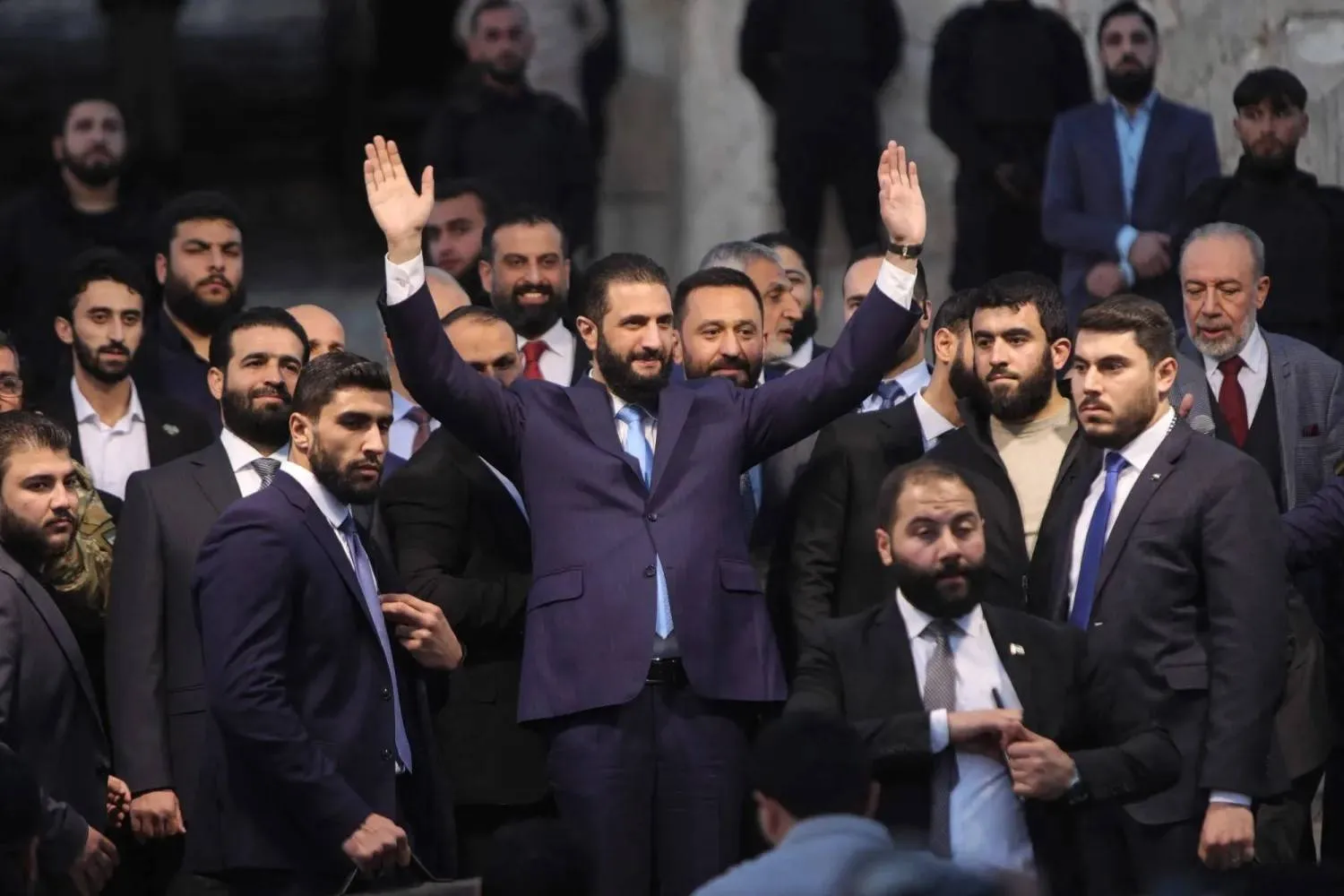

Syrian President Ahmed al-Sharaa vowed on Saturday to marshal every possible effort to rebuild the country, declaring from the city of Aleppo that Syria stands at the threshold of a long and demanding recovery.
During a visit to the northern metropolis, he described Aleppo’s reconstruction as a cornerstone of the broader national effort, saying its ancient walls had witnessed both the city’s liberation and the advance toward Damascus.
What began as a celebration of Aleppo, he added, marks the opening chapter of a new era for Syria and the wider region.
Al-Sharaa told Aleppo residents that the authorities would not stop at the city’s liberation, saying the effort had begun from the first moment it was retaken.
He pledged collective work to rebuild Syria. It is widely known that the opposition assault that toppled Bashar al-Assad a year ago began in the western countryside of Aleppo before reaching Damascus.
His statements came as the authorities confront complex challenges at home and abroad ahead of the first anniversary of Assad’s overthrow. Domestically, the country faces security fragility and divisions across several layers of society. Externally, Israeli incursions and attacks continue inside Syrian territory.
The Interior Ministry on Saturday displayed its vehicles carrying a new visual identity, moving in a convoy from the Mezzeh highway to Umayyad Square and then to the Carlton roundabout in Damascus amid popular celebrations.
Interior Minister Anas Khattab said the new identity was not a cosmetic change but a reaffirmation of state authority, describing it as part of a broader national project.
As retaliatory killings continue in different parts of the country, Syrians are demanding that the authorities impose state control, enforce the law and speed up transitional justice procedures to curb security breakdowns and improve economic conditions, according to sources close to the government who spoke to Asharq Al-Awsat.
The sources said Damascus faces security challenges of high complexity and sensitivity, beginning with groups linked to remnants of the former regime and members of minority communities who fear the Islamic background of the current authorities, and extending to advocates of decentralization in Sweida in the south and in areas controlled by the Syrian Democratic Forces, SDF, in the northeast.
The sources stressed that the difficulties are not limited to demands for partition or calls for international protection, which Israel uses to justify continued attacks.
They said these pressures are affecting the government’s support base and sharpen its internal sensitivities to a degree that could threaten national stability and push the country toward chaos.
According to the sources, the support base and its loyalists are divided into several layers.
The first includes hardline supporters who say the only reason they do not go after the remnants of the former regime or opponents from minority groups is their commitment to state orders and specifically to the instructions of al-Sharaa, who insists that no component of Syrian society be targeted.
The second layer includes some of the former “comrades in jihad,” among them several foreign fighters, who question the authorities’ stance toward them and claim they have been sidelined in response to international pressure.
The third layer consists of civilian revolutionaries and the traditional opposition to the Assad regime. Segments of these groups feel that the current authorities exclude them from meaningful participation in rebuilding the state and treat them as individuals rather than as political entities that contributed to the uprising against the former government.
The sources also pointed to a paradox visible in the recent anniversary celebrations marking one year since the start of the campaign to topple Assad, which took place in response to a call from al-Sharaa.
They said the demonstration in Damascus’s Umayyad Square on Friday appeared spontaneous and lacked organization, with chants ranging from sectarian slogans to calls for national unity and rejection of sectarianism, all under the banner of support for the new authorities and condemnation of the Israeli strike on the town of Beit Jinn in southern Syria.
The Interior Ministry’s celebration of the new visual identity coincided with the first anniversary of the “Repelling the Aggression” battle that ended Assad’s rule.
It came amid mass public gatherings, some of which appeared driven by momentum to counter demonstrations in Alawite areas of Homs, Latakia, Tartus and the countryside of Hama, where protesters called for decentralization and the release of detainees from the former regime.
The authorities are attempting to contain rising tensions through countermeasures. In this context, a Christmas tree lighting ceremony was held at the Mar Mikhael Church in Latakia in the presence of the city’s governor, Mohammad Othman.
In a parallel move, Hama Governor Abdulrahman al-Sahyan issued a decision banning the posting of any religious or legal announcements inside government or service institutions or public facilities without prior approval from the Directorate of Religious Endowments in Hama.