
Pope Leo, in Crisis-Hit Lebanon, Urges Faith Leaders to Unite for Peace

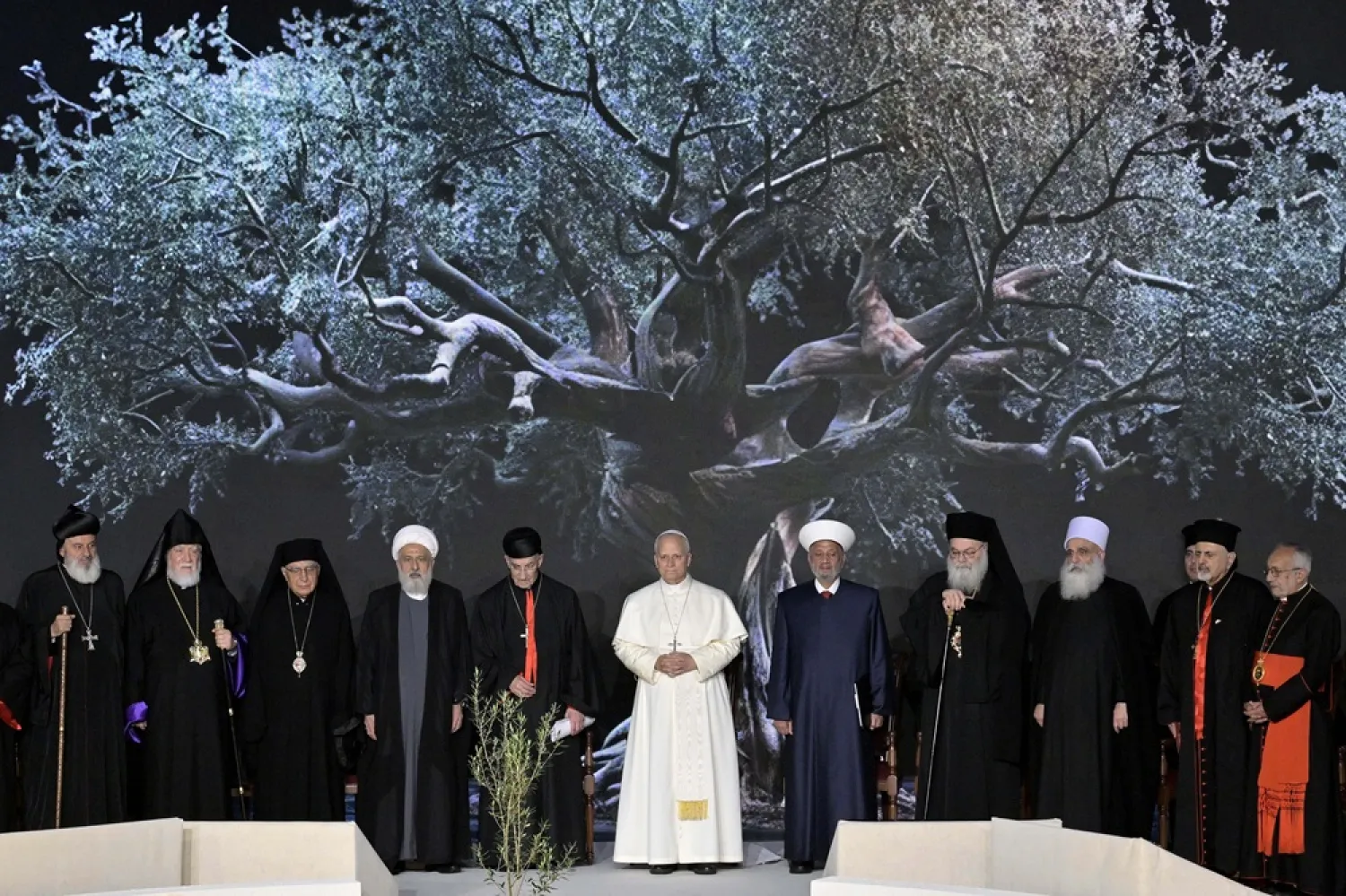
01 December 2025, Lebanon, Beirut: Pope Leo XIV (C) poses for a picture with various Lebanese religious leaders during an interfaith and ecumenical meeting at the Martyrs' Square in Beirut, on the second day of his apostolic visit to Lebanon. (dpa)
TT

Pope Leo, in Crisis-Hit Lebanon, Urges Faith Leaders to Unite for Peace

01 December 2025, Lebanon, Beirut: Pope Leo XIV (C) poses for a picture with various Lebanese religious leaders during an interfaith and ecumenical meeting at the Martyrs' Square in Beirut, on the second day of his apostolic visit to Lebanon. (dpa)

Pope Leo gathered leaders of Lebanon's religious communities next to the old frontline of the country's sectarian civil war on Monday and urged peaceful coexistence in a region beset by bloodshed and tumult. 

"May every bell toll, every adhan, every call to prayer blend into a single, soaring hymn," he said, using the Arabic term for the Muslim call to prayer. 

Leo is near the end of his first overseas trip as pope, a visit to Türkiye and Lebanon, ancient biblical lands where he has championed the advancement of Christian and wider religious unity, and the cause of peace. 

HOPE AND PEACE 

On Tuesday, in the final appearances of his trip, he will pray at the site of a deadly 2020 port blast that shredded swathes of Beirut, then lead a Mass on the city's historic waterfront with an expected 100,000 people. 

Leo has described his trip to Lebanon, racked by years of conflict, political paralysis and economic misery, as a mission of peace, and in Türkiye he warned that humanity's future was at risk due to the world's ongoing bloody conflicts. 

The pope met faith leaders on Monday in the central Martyrs' Square, situated on the "green line" that divided Muslim west and Christian east Beirut during the 1975-90 civil war, and urged them to be "builders of peace". 

Lebanese representatives of the Alawite and Druze communities, which have suffered through bouts of sectarian violence in neighboring Syria this year, spoke at the event. 

Later on Monday about 15,000 young people gathered for an event with the 70-year-old pontiff outside the Maronite Catholic headquarters. 

"There is hope within you, a gift that we adults seem to have lost. ... You have more time to dream, to plan and to do good," he said. 

VISIT TO CATHOLIC SHRINE 

Leo also visited the tomb of St. Charbel, a Catholic saint revered across the region, before heading to Harissa, a Catholic shrine on a mountaintop overlooking the Mediterranean just north of Beirut. 

People at the shrine, known for its towering statue of the Virgin Mary looking out towards Beirut, ululated as the pope arrived, pressing in to greet him with shouts of "Viva il Papa" (Long live the pope). 

"We have really been waiting for the pope's visit because it is raising our hope now," said Rev. Toni Elias, a Maronite priest from Rmeich, a Christian town close to the Israeli border. The Maronites are an eastern-rite Catholic community and the largest Christian sect in Lebanon. 

"We believe that he brings with him the message of peace, which we really need." 

Before speaking at the shrine, Leo heard testimonies from people living in Lebanon. Loren Capobres, a Filipina migrant in the country for 17 years, told Leo about her experience living through war. 

The pope said stories like hers show the need to "take a stand to ensure that no one else will have to flee from his or her country due to senseless and cruel conflicts". 

CONFLICT 

Lebanon, which has the largest share of Christians in the Middle East, has been rocked by the spillover of the Gaza conflict, as Israel and the Lebanese group Hezbollah went to war, culminating in a devastating Israeli offensive. 

The country, which hosts 1 million Syrian and Palestinian refugees, is also struggling to emerge from a severe economic crisis following decades of profligate spending that sent the economy into a tailspin in late 2019. 

The deputy head of the Supreme Shiite Islamic Council, Sheikh Ali al-Khatib, thanked Leo for his visit during the interfaith meeting and said the country was riddled with wounds "as a result of Israel's continued attacks". 

Israel says its continued strikes since last year's ceasefire agreement are to prevent Hezbollah from re-establishing military capabilities and posing a renewed threat to communities in northern Israel. 

Leo's schedule on Tuesday includes a prayer at the site of the 2020 chemical explosion at the Beirut port that killed 200 people, an outdoor Mass on the Beirut waterfront and a visit to one of Lebanon's few mental health facilities.  


EU Warns Israel Suspending Gaza NGOs Would Block 'Life-Saving Aid'

Palestinians walk along streets past tent camps for displaced people in Gaza City, Wednesday, Dec. 31, 2025. (AP)
TT

EU Warns Israel Suspending Gaza NGOs Would Block 'Life-Saving Aid'

Palestinians walk along streets past tent camps for displaced people in Gaza City, Wednesday, Dec. 31, 2025. (AP)

The EU warned Wednesday that Israel's threat to suspend several aid groups in Gaza under new registration rules would block "life-saving" assistance from reaching the population.

"The EU has been clear: the NGO registration law can not be implemented in its current form," EU humanitarian chief Hadja Lahbib posted on X, after Israel said several groups would be barred from January 1 for failing to comply with rules concerning the listing of their Palestinian employees.

"IHL (international humanitarian law) leaves no room for doubt: aid must reach those in need," Lahbib wrote.


Hadhramaut Governor to Asharq Al-Awsat: UAE Has Started Withdrawing its Forces, Door Still Open to STC

Hadhramaut Governor Salem Ahmed al-Khanbashi. (Asharq Al-Awsat)
TT

Hadhramaut Governor to Asharq Al-Awsat: UAE Has Started Withdrawing its Forces, Door Still Open to STC

Hadhramaut Governor Salem Ahmed al-Khanbashi. (Asharq Al-Awsat)

Hadhramaut Governor Salem Ahmed al-Khanbashi called on Wednesday inhabitants of the governorate who are involved with the Southern Transitional Council to "return home" and join their "brothers in the National Shield Forces".

In remarks to Asharq Al-Awsat, he pledged that they will be welcomed in the ranks and that their "affairs will be arranged."

He also confirmed that the United Arab Emirates has started withdrawing its forces from all positions they were stationed at, including Hadhramaut and al-Shabwah.

He said they pulled out from the al-Rayan airport and Balhaf in Shabwah.

The forces had a limited presence in the al-Rabwa and al-Dabba areas in Hadhramaut . Their role was limited to supervising the STC's security support forces, he explained.

Sources confirmed that the UAE started pulling out its forces from Shabwah on Tuesday at the request of Presidential Leadership Council (PLC) Chairman Dr. Rashad al-Alimi.

Al-Khanbashi stressed that the only way to resolve the current crisis lies in the withdrawal of the STC from Hadhramaut and Mahra.

"The door is still open and we hope our brothers in the STC will seize the opportunity to avert the eruption of any fighting in Hadhramaut and the rest of the country," he added.

"They should return to where they came from and then we can kick of political dialogue about any future formations without resorting to imposing a status quo by force," he stressed.

Moreover, he underlined the readiness of the National Shield Forces, which are overseen by al-Alimi, to deploy in Hadhramaut and Mahra, in line with the state of emergency that he declared on Tuesday.

An additional 3,000 Hadhramaut residents, who have military experience, are also prepared to support their brothers in the National Shield Forces, al-Khanbashi revealed.

He said that coordination with Saudi Arabia was at its highest levels.

The Kingdom views Hadhramaut and Mahra as part of its "strategic security depth," he went on to say. "Our shared borders stretch over 700 kms, so the security and stability of the two provinces are part of the Kingdom's strategic security."

Saudi Arabia does not want Hadhramaut and Mahra to turn into dangerous hubs that can threaten it, he continued.

Al-Khanbashi added that al-Alimi's orders on Tuesday came at the right time to prevent saboteurs from trying to undermine the situation.


Nearly 25 ISIS Fighters Killed or Captured in Syria, US Military Says

A US military patrol is seen in northeastern Syria. (Reuters file)
TT

Nearly 25 ISIS Fighters Killed or Captured in Syria, US Military Says

A US military patrol is seen in northeastern Syria. (Reuters file)

The US military said Tuesday that nearly 25 operatives of the ISIS group were killed or captured in Syria this month following an ambush that killed two US troops and an American civilian interpreter.

The US Central Command, which oversees the Middle East, said in a statement on X that 11 missions were carried out over the past 10 days and followed initial strikes against ISIS weapons sites and infrastructure on Dec. 19, which hit 70 targets across central Syria.

In the operations since, the US military and other forces from the region, including Syria, killed at least seven ISIS members, captured others and eliminated four weapons caches, US Central Command said.

“We will not relent,” Adm. Brad Cooper, who leads the command, said in the statement. “We are steadfast in commitment to working with regional partners to root out the ISIS threat posed to US and regional security.”

Targets ranged from senior ISIS members who were being closely monitored by military officials to lower-level foot soldiers, according to a US official who spoke on the condition of anonymity to discuss sensitive military operations.

The official said a growing collaboration between the United States and Syria's relatively new government meant that US forces were able to attack ISIS in areas of the country where they previously did not operate. Syrian forces were the driving force behind some of the missions against the militant group this year, the official added.

The official compared the growing cooperation to that between the US and Iraq in fighting ISIS a decade ago and said the goal, like in Iraq, is to ultimately hand over the effort fully to the Syrians.

The latest operations followed a Dec. 13 ambush that occurred near the ancient city of Palmyra while American and Syrian security officials had gathered for a meeting over lunch. Two members of the Iowa National Guard and a civilian interpreter from Michigan were killed, while three other US troops and members of Syria’s security forces were wounded.

The gunman, who was killed, had joined Syria’s internal security forces as a base security guard and recently had been reassigned because of suspicions he might be affiliated with ISIS, Syrian officials said.

The initial retaliatory strike on ISIS targets in Syria, which included fighter jets from Jordan, was a major test for the warming ties between the US and Syria since last year's ouster of autocratic leader Bashar al-Assad.

President Donald Trump said Syria's new president, Ahmed al-Sharaa, was “extremely angry and disturbed by this attack."