

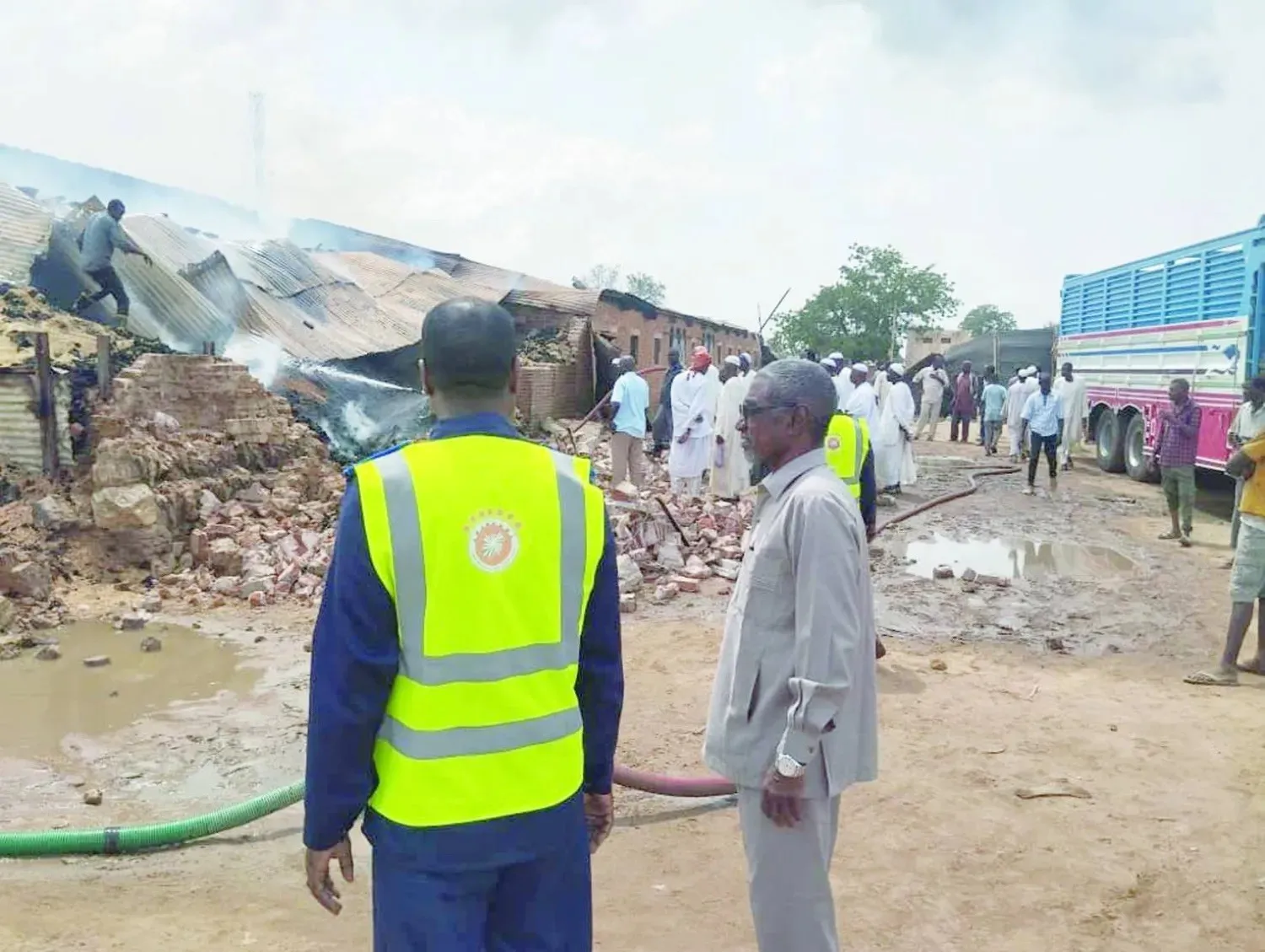

After Oil-Rich Babanusa, What Will the Rapid Support Forces Target Next?

A circulated photo shows part of the destruction caused by Rapid Support Forces (RSF) drones in the city of El-Obeid in the Kordofan region. 
TT

After Oil-Rich Babanusa, What Will the Rapid Support Forces Target Next?

A circulated photo shows part of the destruction caused by Rapid Support Forces (RSF) drones in the city of El-Obeid in the Kordofan region. 

After more than two years of intense fighting, the Rapid Support Forces (RSF) announced on Monday that they had seized full control of the Sudanese Army’s 22nd Infantry Division, the military’s last remaining stronghold in Babanusa, the capital of West Kordofan.

Analysts say the fall of the strategically located, oil-producing city, which is also known for its dairy industry, could serve as a launchpad for further RSF advances into northern and southern parts of the state.

The Sudanese Army has issued no official statement more than 48 hours after the RSF announcement. However, pro-army social media pages reported that the military had withdrawn substantial forces from the city to Heglig, another key location in West Kordofan.

Pressure from the RSF has left major cities across the three Kordofan states increasingly vulnerable. The army now holds only El-Obeid and Um Rawaba in North Kordofan, and Heglig in West Kordofan, following the fall of Al-Nuhud and Babanusa.

In South Kordofan, the army retains control of Kadugli and Dilling, while the RSF holds Al-Dibabat. Their ally, the Sudan People’s Liberation Movement–North (SPLM-N) led by Abdelaziz Adam al-Hilu, controls Kauda in the Nuba Mountains.

Babanusa lies about 600 kilometers southwest of Khartoum, near the East Darfur border. It is one of Sudan’s most important railway junctions, linking the west to the east and north, and is regarded as an economic hub due to its livestock industry and significant oil reserves.

Although the RSF has not publicly outlined its next objectives, former Sudanese officers say the city’s fall creates multiple avenues for further advances. A retired army officer, speaking anonymously, said Babanusa’s military and geographic significance could mark a turning point in the conflict, potentially opening the path to RSF attempts on major cities in South Kordofan, including Kadugli and Dilling.

He noted that the RSF has long listed El-Obeid as a priority target and has repeatedly attacked it; with RSF positions now nearby, a large-scale assault “is possible at any moment.”

The officer added that although the RSF declared a unilateral ceasefire, it did not adhere to it, continuing its assault on the 22nd Division until it captured the base – is an indication, he said, that the group’s military objectives remain far from exhausted.

Military experts say the RSF’s presence in Babanusa provides a strong platform for further operations, including support for its ally al-Hilu’s SPLM-N faction to push toward Kadugli, especially after recent army gains in several strategic towns in the state.

Mohamed Bashir Suleiman, former Deputy Chief of Staff and former army spokesman, told Asharq Al-Awsat that Babanusa’s fall was predictable. He said controlling the city grants the RSF “a wide operational maneuvering space.” Its economic value, particularly its oil, along with its social environment, which includes communities sympathetic to the RSF, also give the group political advantages as it expands its territorial hold in both Kordofan and Darfur.

Suleiman said RSF control of Babanusa places it in a stronger position to counter the army’s gains in North Kordofan, despite the military’s recent advances around El-Obeid and in the Nuba Mountains.

According to Suleiman, the Sudanese Army must adopt sound operational planning across all fronts in North and West Kordofan. This will require significant troop reinforcements, logistical support, and reserve forces to avoid costly setbacks. The army’s broader strategic goal, he said, remains the recovery of Darfur.

He added that the RSF’s seizure of Babanusa serves several aims, foremost among them driving the army out of areas where it traditionally enjoys social support in West Kordofan.

He noted that holding the city allows the RSF to maintain secure supply routes for fighters and weapons, expand its territorial control, and continue positioning itself for a future assault on strategically and symbolically important El-Obeid.

Suleiman said the RSF’s timing reflects an effort to strengthen its military and political leverage ahead of any renewed negotiations, particularly as the Quad, which comprises the United States, Saudi Arabia, the UAE, and Egypt, continues discussions over a proposed three-month humanitarian ceasefire.


Video Shows Fires in Palestinian Village in West Bank During Israeli Settler Attack

 People stand in an area with destroyed vehicles and a structure, which Palestinians say were burned by Israeli settlers on Saturday, in the Palestinian town of Mikhmas, near Ramallah in the Israeli-occupied West Bank, January 18, 2026. (Reuters)
People stand in an area with destroyed vehicles and a structure, which Palestinians say were burned by Israeli settlers on Saturday, in the Palestinian town of Mikhmas, near Ramallah in the Israeli-occupied West Bank, January 18, 2026. (Reuters)
TT

Video Shows Fires in Palestinian Village in West Bank During Israeli Settler Attack

 People stand in an area with destroyed vehicles and a structure, which Palestinians say were burned by Israeli settlers on Saturday, in the Palestinian town of Mikhmas, near Ramallah in the Israeli-occupied West Bank, January 18, 2026. (Reuters)
People stand in an area with destroyed vehicles and a structure, which Palestinians say were burned by Israeli settlers on Saturday, in the Palestinian town of Mikhmas, near Ramallah in the Israeli-occupied West Bank, January 18, 2026. (Reuters)

Israeli settlers rampaged through a Palestinian village in the West Bank, setting fire to a series of structures, according to security camera footage obtained by The Associated Press on Sunday, in an overnight onslaught that has become a common phenomenon in the occupied territory.

In the video, time-stamped at around 10 p.m. Saturday, several structures in the village go up in flames as the sound of gunfire, screaming and barking echoes in the background. At one point in the video, the fires grow so large that they illuminate the bands of settlers, dressed in black, pacing freely through the village.

Also Sunday, at least four more countries said they had been invited to join US President Donald Trump’s Board of Peace, the international body expected to oversee his Gaza ceasefire plan and perhaps other conflict resolutions.

Meanwhile, an Israeli Cabinet minister said that he'd ordered officials to disconnect the water and electricity for facilities of the UN Relief and Works Agency for Palestinian Refugees, or UNRWA. It's the latest action in Israel’s long-running campaign to shut down the agency. UNRWA fears the shutdown could hamper its work in east Jerusalem.

Settler attack video

The footage obtained by the AP showed the moment dozens of settlers descended on the small Bedouin hamlet of Khirbet al-Sidra, north of Jerusalem, attacking Palestinians and international activists and burning cars and homes, according to the Palestinian Authority's Jerusalem governate, which monitors Palestinian affairs in the area.

In a statement, it said that eight homes and at least two cars were burned in the attack.

Israel’s military said that soldiers dispatched to the village found an Israeli vehicle with clubs inside. It said that Palestinians, Israelis and foreign nationals were injured, and troops were searching the area to make arrests. As of Sunday afternoon, no arrests had been reported.

It marked the latest assault in the tense territory as settler violence spikes in recent months.

Around 500,000 Israelis have settled in the West Bank since Israel captured the territory, along with east Jerusalem and the Gaza Strip, in the 1967 Mideast war. Their presence is viewed by most of the international community as illegal and a major obstacle to peace.

The Palestinians seek all three areas for a future state. Israel has sought to play down the violence as the work of a small, radical minority. But Israel's far-right government, dominated by settlers and their supporters, has done little to stop the attacks.

Board of Peace invites

Jordan, Greece, Cyprus and Pakistan on Sunday announced that they had received invitations to Trump's Board of Peace. Albania, Egypt, Paraguay, Argentina and Türkiye have already said they were invited.

The board, made up of world leaders, was initially seen as a mechanism focused on ending the Israel-Hamas war in Gaza. It's now taking shape with ambitions to have a far broader mandate to address other global crises, potentially rivaling the United Nations.

The US hasn't yet announced the official list of members. In letters sent Friday to various world leaders inviting them to be “founding members” of the board, Trump says the body would “embark on a bold new approach to resolving global conflict.”

Israel moves against UNRWA

Israeli Energy Minister Eli Cohen said on X Sunday he'd issued formal notices to disconnect water and electricity from facilities belonging to UNRWA.

The UN agency said on X that the shutdown could take effect within two weeks. It comes after Israel's parliament in December passed a bill to cut the supply of electricity and water to the facilities.

The earlier ban already closed many of UNRWA’s services in east Jerusalem, though it continues to operate a vocational training center in east Jerusalem.

The agency provides aid and services, including health and education, to around 2.5 million Palestinian refugees in Gaza and the occupied West Bank and east Jerusalem, as well as 3 million more in Syria, Jordan and Lebanon.

Earlier last year, Israel banned the agency from operating on its territory. The ban followed months of attacks on the agency by Israel, which says it's deeply infiltrated by Hamas. UNRWA rejects that accusation.


Iraq Announces Complete Withdrawal of US-Led Coalition from Federal Territory

 US forces at the Taji camp, north of Baghdad. (AFP file)
US forces at the Taji camp, north of Baghdad. (AFP file)
TT

Iraq Announces Complete Withdrawal of US-Led Coalition from Federal Territory

 US forces at the Taji camp, north of Baghdad. (AFP file)
US forces at the Taji camp, north of Baghdad. (AFP file)

Iraq said on Sunday US-led coalition forces had finished withdrawing from bases within the country's federal territory, which excludes the autonomous northern Kurdistan region.

"We announce today... the completion of the evacuation of all military bases and leadership headquarters in the official federal areas of Iraq of advisers" of the US-led coalition, the military committee tasked with overseeing the end of the coalition's mission said.

With the withdrawal, "these sites come under the full control of Iraqi security forces", it said in the statement, adding that they would transition to "the stage of bilateral security relations with the United States".

The vast majority of coalition forces had withdrawn from Iraqi bases under a 2024 deal between Baghdad and Washington outlining the end of the mission in Iraq by the end of 2025 and by September 2026 in the Kurdistan region.

US and allied troops had been deployed to Iraq and Syria since 2014 to fight the ISIS group, which had seized large swathes of both countries.

The group was territorially defeated in Iraq in 2017 and in Syria in 2019, but continues to operate sleeper cells.

The vast majority of coalition troops withdrew from Iraq over previous stages, with only advisers remaining in the country.

The military committee on Sunday said Iraqi forces were now "fully capable of preventing the reappearance of ISIS in Iraq and its infiltration across borders".

"Coordination with the international coalition will continue with regards to completely eliminating ISIS's presence in Syria," it added.

It pointed to "the coalition's role in Iraq offering cross-border logistical support for operations in Syria, through their presence at an airbase in Erbil", the capital of Iraq's Kurdistan region.

In December, two US soldiers and a civilian interpreter were killed in Syria in an attack blamed on ISIS, sparking fears of a resurgence in the country.

The statement added that anti-ISIS operations would be coordinated with the coalition through the Ain al-Assad base in Anbar province in western Iraq.

ISIS attacks in Iraq have massively declined in recent years, but the group maintains a presence in the country's mountainous areas.

A UN Security Council report in August said: "In Iraq, the group has focused on rebuilding networks along the Syrian border and restoring capacity in the Badia region."


Jordan Says King Abdullah Received Invitation to Join Gaza Peace Board

Palestinian girls walk past the rubble of residential buildings destroyed during the war, in Gaza City, January 16, 2026. REUTERS/Dawoud Abu Alkas
TT

Jordan Says King Abdullah Received Invitation to Join Gaza Peace Board

Palestinian girls walk past the rubble of residential buildings destroyed during the war, in Gaza City, January 16, 2026. REUTERS/Dawoud Abu Alkas

Jordan's foreign ministry said on Sunday that King Abdullah received an invitation from ‌US President ‌Donald ‌Trump ⁠to join ‌the so-called "Board of Peace" for Gaza.

The foreign ministry said it was ⁠currently reviewing ‌related documents ‍within ‍the country's ‍internal legal procedures.

The board is set to supervise the temporary governance of Gaza, ⁠which has been under a shaky ceasefire since October.

On Friday, the White House announced some members of a so-called "Board of Peace" that is to supervise the temporary governance of Gaza, which has been under a fragile ceasefire since October.

The names include US Secretary of State Marco Rubio, President Donald Trump's special envoy Steve Witkoff, former British Prime Minister Tony Blair and Trump's son-in-law, Jared Kushner. Trump is the chair of the board, according to a plan his White House unveiled in October.

The White House did not detail the responsibilities of each member of the "founding Executive board." The names do not include any Palestinians. The White House said ⁠more members will be announced over the coming weeks.

The board will also include private equity executive and billionaire ‌Marc Rowan, World Bank President Ajay Banga and Robert Gabriel, ‍a Trump adviser, the White House ‍said, adding that Nickolay Mladenov, a former UN Middle East envoy, will be the ‍high representative for Gaza.

Army Major General Jasper Jeffers, a US special operations commander, was appointed commander of the International Stabilization Force, the White House said. A UN Security Council resolution, adopted in mid-November, authorized the board and countries working with it to establish that force in Gaza.

The White House also named an 11-member "Gaza Executive Board" that will include Turkish Foreign Minister Hakan Fidan, the UN special coordinator for the Middle East ⁠peace process, Sigrid Kaag, the United Arab Emirates minister for international cooperation, Reem Al-Hashimy, and Israeli-Cypriot billionaire Yakir Gabay, along with some members of the executive board.

This additional board will support Mladenov's office and the Palestinian technocratic body, whose details were announced this week, the White House said.
