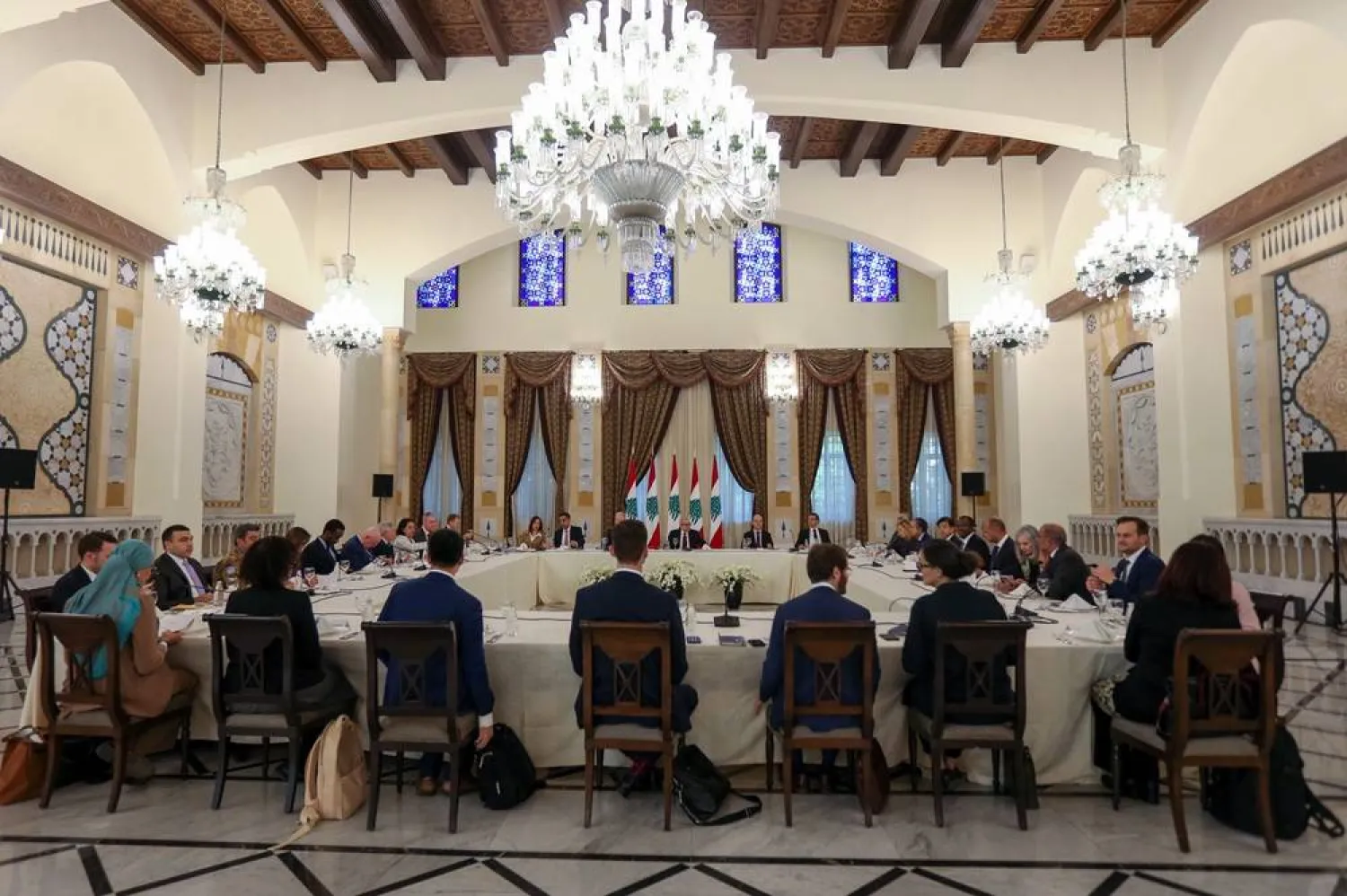

The Lebanese prime minister on Friday told a visiting UN delegation that his country will need a follow-up force in southern Lebanon along the border with Israel to fill the vacuum once the UN peacekeepers' term expires by the end of next year.
The UN Security Council voted unanimously in August to terminate the UN Interim Force in Lebanon (UNIFIL) at the end of 2026 — nearly five decades after the force was deployed. The multinational force has played a significant role in monitoring the security situation in the region, including during the Israel-Hezbollah war last year.
But it has drawn criticism from officials in President Donald Trump’s administration, which has moved to slash US funding for the operation as Trump remakes America’s approach to foreign policy.
Lebanese Prime Minister Nawaf Salam held talks with the team representing the 15 members of the UN Security Council, saying he believes another, follow-up force would help Lebanese troops along the border where they have intensified efforts in the volatile area that witnessed the 14-month war between Israel and the Iran-backed Hezbollah group.
Salam proposed that a small follow-up force could work much like the UN observers force that has been deployed along Syria’s border with Israel since 1974.
There was no immediate response from the UN delegation, which arrived in Lebanon after a visit to Syria. Earlier Friday, the delegation also met with Lebanese President Joseph Aoun, who said Lebanon would welcome any country's decision to keep its forces in southern Lebanon after UNIFIL's term expires.
Aoun also touted Lebanon’s appointment of former ambassador to Washington, Simon Karam, to head the Lebanese delegation to a previously military-only committee that monitors the US-brokered ceasefire that halted the latest Israel-Hezbollah war.
The appointment has angered Hezbollah, whose leader Sheikh Naim Qassem said in a televised speech later Friday that the appointment of the ex-ambassador was allegedly a “concession" to Israel.
Qassem said it would not change "the enemy’s stance and its aggression,” referring to Israel’s almost daily airstrikes on what the Israeli military says are Hezbollah targets in Lebanon since the ceasefire went into effect in November last year. The UN says that the Israeli strikes since the ceasefire have killed 127 civilians.
Israel’s air force carried out a series of airstrikes on Thursday in south Lebanon, saying it struck Hezbollah’s infrastructure. Warnings were issued in advance to evacuate the area.
The latest Israel-Hezbollah war began a day after Hamas attacked southern Israel on Oct. 7, 2023, with Hezbollah firing rockets into Israel in solidarity with the Palestinian Hamas group. Israel's response operation that included bombardment and a ground operation last year has severely weakened Hezbollah.