


Lebanon’s Leaders Unite on Technical, Security Track in Talks with Israel

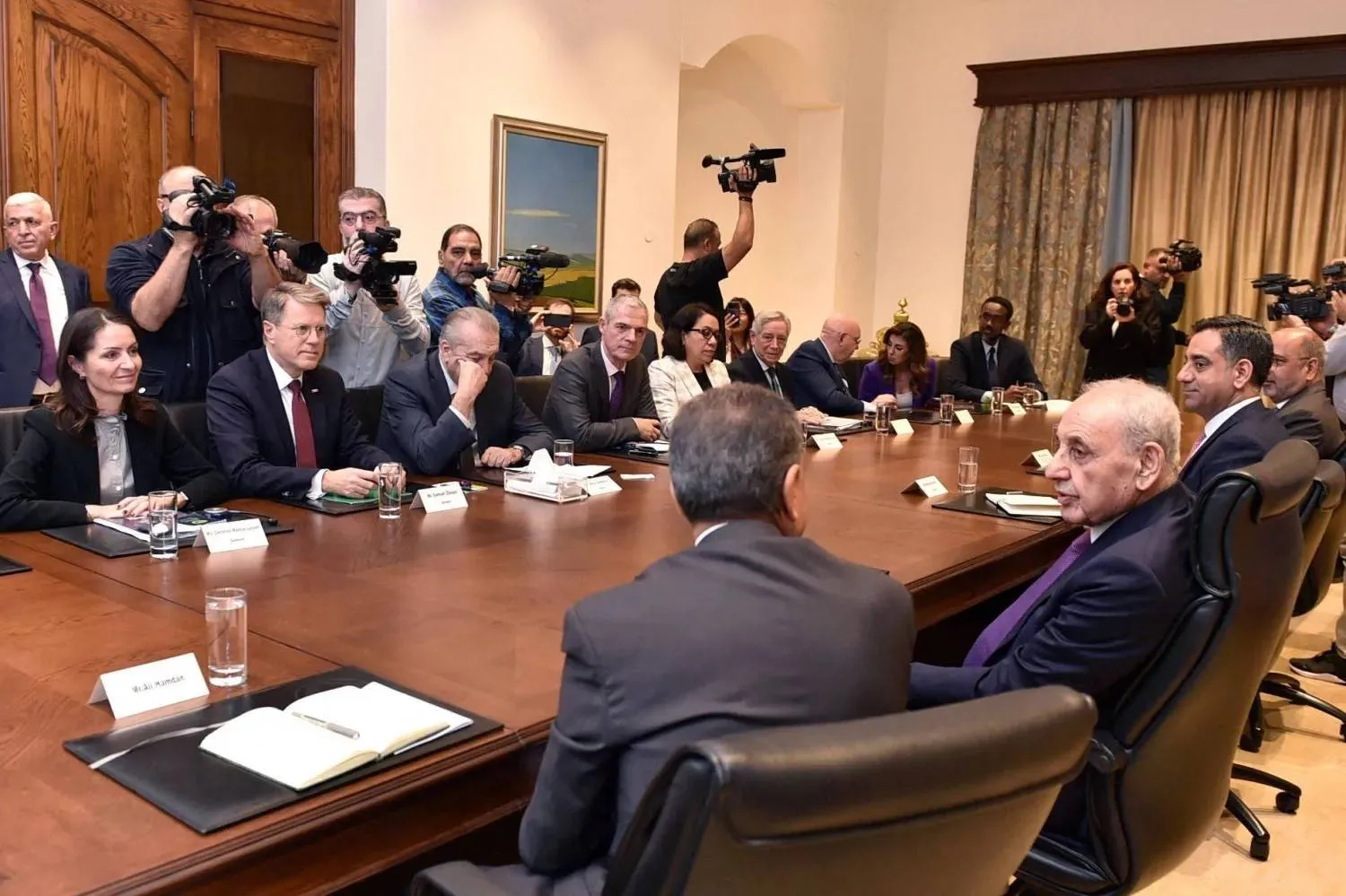
Parliament Speaker Nabih Berri meets with UN Security Council Delegation in Beirut (Lebanese Parliament)
TT

Lebanon’s Leaders Unite on Technical, Security Track in Talks with Israel

Parliament Speaker Nabih Berri meets with UN Security Council Delegation in Beirut (Lebanese Parliament)

Cabinet sources said Lebanon’s three top leaders remain aligned as negotiations with Israel move into a new phase, marked by the appointment of a civilian envoy, former ambassador to Washington and lawyer Simon Karam, to lead Lebanon’s delegation to the Mechanism Committee.

The move is intended to jolt the committee out of months of stagnation and push it toward a security agreement anchored in enforcing a cessation of hostilities, after earlier rounds were dominated by routine tallies of Israeli violations conducted with United Nations peacekeepers.

The sources said the leaders’ agreement to pull the Mechanism out of its deadlock coincided with drawing political boundaries for the talks.

These boundaries are strictly limited to ending Israeli violations and attacks, securing a withdrawal from the south, releasing Lebanese detainees, and revisiting and correcting border demarcation in response to Lebanon’s reservations over disputed points along the Blue Line that it considers part of its sovereign territory.

The sources told Asharq Al-Awsat that Lebanon insists on restricting the negotiations to non-negotiable security issues. It will not allow the talks to drift into discussions on normalizing relations with Israel or striking a peace agreement.

This position is shared by President Joseph Aoun, Prime Minister Nawaf Salam, and Parliament Speaker Nabih Berri, who was the first to propose adding civilians to the Mechanism.

The three leaders reiterated their stance ahead of the first round of talks, attended by US envoy Morgan Ortagus and joined by Karam, in defiance of the agenda set by Israeli Prime Minister Benjamin Netanyahu.

They said Netanyahu is trying to raise the stakes to provoke Hezbollah against the state and sow confusion, even as the Israeli army continues its violations to turn the group’s base against it.

This became evident in the targeting of several homes between the banks of the Litani River, despite containing no weapons depots.

The sources said Netanyahu is escalating militarily to force Lebanon to accept Israeli terms, although he knows the negotiations will not deviate from their technical and security framework.

Lebanon, they said, remains committed to ensuring that only the state holds weapons.

The sources noted Berri’s insistence that he was the first to propose adding civilians to the Mechanism and asked where Hezbollah Secretary-General Sheikh Naim Qassem stands on this proposal.

They asked whether he ever objected to his “older brother’s” suggestion, given that Qassem had declared in an open letter to the three leaders that he rejects negotiations with Israel.

Qassem later walked back parts of that letter by having a senior Hezbollah official convey a message that Berri was not its intended target, in an effort to prevent a rupture within the Shiite political camp.

The sources also questioned why Hezbollah objects to the talks if its “older brother” is the one negotiating on its behalf and was behind the United States mediated ceasefire agreement brokered by Amos Hochstein.

They said the only card Hezbollah has left is raising the ceiling of its objections, since it no longer has the ability to reset the negotiating table at a time when the balance of power has tilted in Israel’s favor, particularly after the group’s unilateral support for Gaza cost it its previous deterrence and rules of engagement.

The sources said Hezbollah lacks alternatives that would allow it to reverse the balance of power and is limiting itself to loud political objections that it cannot translate into military action.

This comes despite its insistence on keeping its weapons and its accusation that the Salam government committed a mistake by agreeing to the principle that arms must be exclusively in the hands of the state, beginning from north of the Litani to Lebanon’s international border with Syria, in parallel with progress in the negotiations.

They said Hezbollah is forced to calibrate its position, since it cannot afford to break with Aoun or jeopardize its alliance with Berri, a rupture that would leave the group exposed at a moment when it seeks internal protection.

Any strain in these relationships would also create negative repercussions for the Shiite community. The sources asked why the group does not place its cards in Berri’s hands, as he is better positioned to navigate Shiite public sentiment that seeks the liberation of the south and the return of its residents to their villages.

Berri is viewed, even by rivals, as the essential gatekeeper to any settlement that could restore international attention to Lebanon and open a path for reconstruction. He enjoys Arab and international ties that Hezbollah lacks, as the group remains reliant solely on Iran.

The sources said the negotiations’ entry into a new phase prompted United States pressure on Israel to prevent the war from expanding, after Lebanon agreed to Washington’s request to add a civilian to the Mechanism and task him with leading the delegation.

They urged Hezbollah to stand behind the state’s diplomatic choice and said the group’s fears that the talks could lead to a peace treaty with Israel are unfounded.

They noted that Berri himself was the first to support bringing civilians into the process, which should reassure Hezbollah and encourage it to give diplomacy a chance.

They added that Salam is not acting unilaterally and is coordinating with Aoun. Both leaders are working together to implement the government’s commitment to ensuring that only the state holds weapons.

They also revealed that communication between Aoun and Berri has not stopped. The two men reviewed the atmosphere surrounding the Mechanism’s meeting in Naqoura before the latest cabinet session.

According to the sources, Berri instructed his parliamentary bloc and senior Amal Movement members not to comment on the negotiations, positively or negatively.

The directive came because he wants to centralize the political message and avoid dragging party members on both sides into disputes that could spill into the streets.

Hezbollah, they said, also wants to protect its relationship with its sole remaining ally in Lebanon after its former partners in the so-called Axis of Resistance endorsed the principle of exclusive state authority over weapons.

The sources said Hezbollah knows that avenues for repairing its Arab and international relations remain closed, unlike Berri who maintains wide ties.

They questioned what Hezbollah is counting on after its leadership rejected Egypt’s initiative, insisting, according to Western diplomatic sources cited by Asharq Al-Awsat, on linking its position to US-Iran negotiations in hopes of safeguarding Iran’s leverage in Lebanon after regional setbacks for the Axis.

They said the government will take note of Hezbollah’s objection, although it will have no impact on the course of the talks.

Hezbollah will not mobilize its supporters in the streets to avoid friction with Amal, particularly since Berri does not oppose the launch of negotiations, which remain tied to liberating the south and implementing Resolution 1701.

Any attempt by Hezbollah to outbid Berri for populist gain would backfire and weaken the group’s standing within its own community.



Sudan Urges US to Designate RSF a Terrorist Group

RSF commander Mohamed Hamdan Daglo speaks during a press conference at RSF headquarters in Khartoum, Sudan February 19, 2023. (Reuters)
TT

Sudan Urges US to Designate RSF a Terrorist Group

RSF commander Mohamed Hamdan Daglo speaks during a press conference at RSF headquarters in Khartoum, Sudan February 19, 2023. (Reuters)

Sudan's foreign ministry said Tuesday that the United States should designate the paramilitary Rapid Support Forces a "terrorist organization", a day after Washington slapped the same designation on the local branch of the Muslim Brotherhood.

The US designation for the Brotherhood, which will come into effect next week, accused the Islamist group of receiving support from Iran.

Noting that decision, while stopping short of criticizing it, Sudan's foreign ministry said "all groups that violate international humanitarian law and commit terrorism, crimes against humanity, and war crimes in Sudan should be designated as terrorist groups".

The US, it added, should therefore "designate the RSF militia as a terrorist group, given its proven crimes and documented violations of international humanitarian law, including war crimes, crimes against humanity, genocide, and terrorism".

Since 2023, the RSF -- under paramilitary commander Mohamed Hamdan Daglo -- has been at war with the regular army, under Sudan's de facto leader Abdel Fattah al-Burhan.

Burhan has a complex relationship with Islamists, relying on them for political support and fighters, but facing pressure from the US and his allies to distance himself from them.

He has denied having Brotherhood members in his government.

The RSF has been widely accused of mass atrocities, and last month was found by a UN inquiry to have committed "acts of genocide" in Darfur.

Last year, the US issued a similar genocide determination.

The RSF has repeatedly characterized the war as a fight against Sudan's Islamists and the remnants of the ruling system of Islamist-military president Omar al-Bashir, whom Daglo and Burhan helped oust in 2019.


Israeli Strikes Hit Near Beirut as Envoy Says Disarming Hezbollah Could End War

Smoke billows following an Israeli airstrike on Dahieh, in the southern suburbs of Beirut, Lebanon, 10 March 2026. (EPA)
TT

Israeli Strikes Hit Near Beirut as Envoy Says Disarming Hezbollah Could End War

Smoke billows following an Israeli airstrike on Dahieh, in the southern suburbs of Beirut, Lebanon, 10 March 2026. (EPA)

Israel's military pounded the Lebanese capital's southern suburbs with air strikes on Tuesday and its troops pushed deeper into the country's south, as an Israeli envoy said the key to ending the war was disarming Lebanese group Hezbollah.

Lebanon was pulled deep into the war in the Middle East last week, when Iran-backed Hezbollah opened fire on Israel to avenge the killing of Iran's supreme leader.

Israel has since launched air strikes across Lebanon's south, east and Beirut's suburbs, killing nearly 500 people including more than 80 children, according to Lebanon's health ministry.

Strikes on Beirut's southern suburbs on Tuesday afternoon sent thick columns of smoke over the ‌city. Two hours ‌before they began, an Israeli military spokesperson ordered residents to leave ‌immediately, ⁠specifying three new ⁠districts that should be evacuated.

A member of the municipal council for the area told Reuters families there were fleeing, adding to the nearly 700,000 that Lebanese authorities say have already been displaced by the war.

Lebanon's Minister of Social Affairs Haneen Sayed said on Tuesday that the state was bracing itself for higher displacement figures than in 2024, when the last war between Israel and Hezbollah pushed more than a million people out of their homes.

"So we expect that ⁠the needs, the numbers of displacement, will be higher than in ‌2024. Now on the other side in terms ‌of resources, there's far less resources this year given the global situation, the regional war that's ‌happening," she said.

DISARMING HEZBOLLAH COULD END WAR, ISRAELI ENVOY SAYS

Sayed spoke to Reuters ‌at Beirut's airport, where the European Union was delivering 45 tons of emergency supplies including medical kits and blankets.

"Our traditional partners and friends in the Gulf are of course under stress themselves. So we're appealing to the international community to be with us at this moment to help stabilize the ‌situation in terms of humanitarian needs," Sayed said.

Israeli troops made advances on Tuesday in additional towns in southeastern Lebanon, including with ⁠armored columns, Lebanese security ⁠sources told Reuters.

Lebanese President Joseph Aoun on Monday had signaled his openness to enter direct negotiations with Israel to end the war.

But Israel's ambassador to France Joshua Zarka said on Tuesday that words were not enough.

"At this stage, I’m not aware of any decision to enter negotiations to end this war," Zarka said.

"What would end it is the disarmament of Hezbollah — and that is a choice for the Lebanese government," he said.

Zarka said Lebanon's government was "making very good statements, but to these comments they need to add actions."

Lebanon's government last year vowed to establish a state monopoly on arms and confiscated part of Hezbollah's arsenal in the country's south, without objections from the group.

But Hezbollah has refused to disarm in full, and Lebanese authorities were fearful that taking its arms by force could ignite a civil conflict.


Lebanese, Syrian Presidents Agree on Tightening Border Control

This handout photograph released by the Lebanese Presidency Press Office shows Lebanon's President Joseph Aoun giving a joint-press conference with Germany's president at the Presidential Palace in Baabda, east of Beirut, on February 16, 2026. (Lebanese Presidency Press Office / AFP)
TT

Lebanese, Syrian Presidents Agree on Tightening Border Control

This handout photograph released by the Lebanese Presidency Press Office shows Lebanon's President Joseph Aoun giving a joint-press conference with Germany's president at the Presidential Palace in Baabda, east of Beirut, on February 16, 2026. (Lebanese Presidency Press Office / AFP)

The Lebanese and Syrian presidents agreed Tuesday on the need to step up control over their shared frontier following a pair of incidents involving cross-border fire.

Lebanon's Joseph Aoun and Syria's Ahmed al-Sharaa agreed during a phone call that "the current sensitive situation requires enhancing coordination and consultation... especially with regard to the necessity of controlling the border", a Lebanese presidency statement said.

Sharaa also "expressed his support for the Lebanese president's efforts to disarm Hezbollah and spare the region the repercussions of the current conflict", according to a statement from the Syrian presidency.

The phone call between the leaders came hours after Syria accused pro-Iran Hezbollah of firing artillery shells into its territory.

Syrian army officials said shells fired from Lebanon landed near the town of Serghaya, west of Damascus, the state news agency SANA reported on Tuesday.

"The Syrian Arab Army will not tolerate any aggression targeting Syria," the army said in a statement to official media.

Earlier, a Lebanese soldier was moderately wounded on Friday by "gunfire from the Syrian side targeting a Lebanese army post in the Qasr-Hermel area", Lebanon's army said.

"An investigation is underway to determine the circumstances of the incident in coordination with the relevant Syrian authorities."

Lebanon was drawn into the Middle East war last week when Hezbollah attacked Israel in response to the killing of Iranian supreme leader Ali Khamenei during US-Israeli strikes. Syria has so far remained on the sidelines.

In recent days, areas adjacent to Syria and controlled by Hezbollah in eastern Lebanon have witnessed fierce clashes between the group and Israeli commando forces.

Syria responded to the outbreak of the regional war last week by stationing additional troops on its borders with Lebanon and Iraq.

Hezbollah had been a key ally of Damascus during the rule of former president Bashar al-Assad, and it intervened militarily in support of him in 2013, remaining in Syria for years in a number of border towns and crossings.