


Islamic Jihad Denies Withholding Body of Last Israeli Hostage

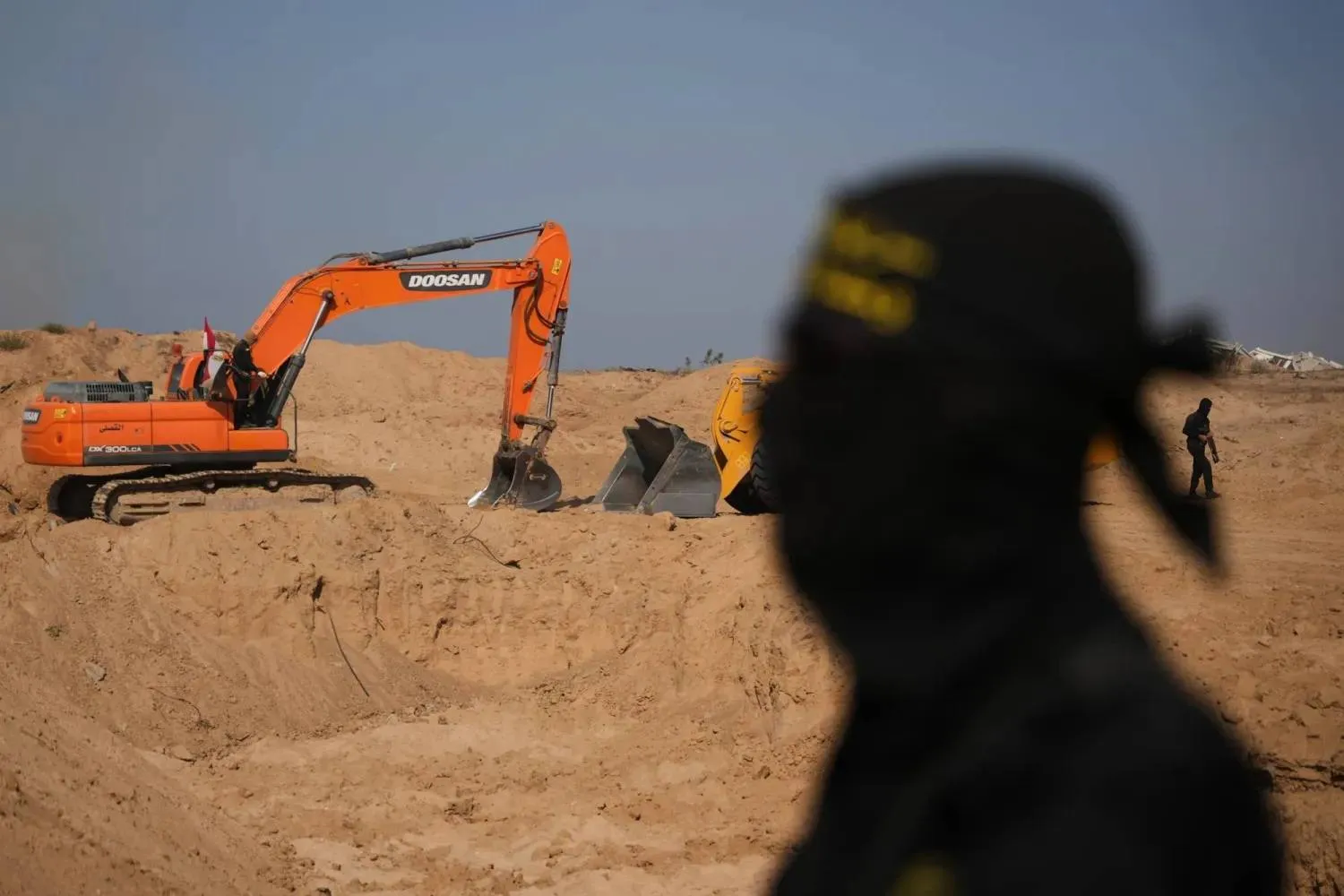
An Islamic Jihad member looks on as workers dig in search of the corpses of hostages in northern Gaza. (AP file)
TT

Islamic Jihad Denies Withholding Body of Last Israeli Hostage

An Islamic Jihad member looks on as workers dig in search of the corpses of hostages in northern Gaza. (AP file)

Palestinian sources dismissed Israeli claims circulating over the past two days that the Islamic Jihad movement is refusing to cooperate with Hamas by handing over what Israel says is the last body of an Israeli hostage in Gaza, a step Israel has linked to moving into the second phase of the ceasefire.

Israel’s Maariv newspaper reported on Friday, citing Israeli security sources, that tensions had emerged between Hamas and Islamic Jihad over the latter’s alleged refusal to hand over the body of the last hostage, Ran Gvili.

Israel believes Islamic Jihad fighters were directly involved in abducting Gvili and holding him in Gaza.

The Al-Quds Brigades, the armed wing of Islamic Jihad, said days ago it had handed over all hostages in its possession and had fully complied with the ceasefire agreement, a claim confirmed by sources in the movement speaking to Asharq Al-Awsat.

According to those sources, Gvili’s body was not among the Israeli hostages held by Islamic Jihad and was instead in Hamas’ custody. They said coordination with Hamas was excellent and denied any disagreements or tensions, dismissing Israeli media reports as unfounded.

Sources from Hamas told Asharq Al-Awsat the body was believed to be located in three or four sites in the Shujaiya and Zeitoun neighborhoods east of Gaza City. Search operations were carried out at those locations but failed to locate it.

They said all field commanders and activists involved in the abduction and in guarding the body had been killed in a series of airstrikes and other operations, making it difficult to determine the exact location with certainty.

They added that the difficulty was compounded by heavy bombardment, widespread destruction and land leveling in those areas during Israeli ground incursions.

According to Israel’s Yedioth Ahronoth newspaper, Israel provided Hamas, via mediators, with information about individuals who might help identify the body’s location, as well as details on potential sites, accompanied by aerial photographs.

Hamas sources said there was ongoing communication with mediators on this issue and others.

New video raises doubts

These developments coincided with the Israeli Hostages and Missing Families Forum publishing video footage of six hostages whose bodies were found inside a tunnel in Rafah in August 2024.

The footage shows them sharing daily life, marking the Jewish holiday of Hanukkah, celebrating the start of 2024, talking among themselves, shaving and moving from one place to another inside the tunnel.

The videos raised questions about the Israeli army’s claim that they were killed two days before being found, allegedly shot by Hamas fighters. Hamas has denied that account, saying they were killed in an Israeli strike that hit the site.

Israeli journalist Miki Levin wrote in a report on Maariv’s website that the six could have returned home alive had an agreement been reached earlier, in April last year, as senior members of the negotiating team had said.

She criticized Israeli Prime Minister Benjamin Netanyahu and ministers Bezalel Smotrich and Itamar Ben-Gvir for insisting on the notion of “total victory,” which she described as empty and unattainable.

She said the six would have been freed under a deal rejected by the Israeli government, which ignored warnings that an incursion into Rafah would lead to the hostages’ deaths.

According to the Israeli Public Broadcasting Corporation, negotiations with mediators days before their deaths were on the verge of collapse due to the Israeli government’s insistence on controlling the Philadelphi corridor. Five of the hostages were due to be released had an agreement been signed at that time.

These circumstances, Hamas sources said, likely prompted Israel to claim they were killed by Hamas gunfire.

The sources again denied that version, saying the hostages were killed in artillery and air strikes that hit the area and also killed several of their captors. They noted that captors had instructions at the time to kill any hostage if Israeli forces approached and posed a direct threat.

The tunnel was located in the Tel al-Sultan neighborhood west of Rafah in southern Gaza. The Israeli army later acknowledged that investigations indicated the hostages were killed as a result of military pressure in the area.

In October 2024, Israel killed Yahya Sinwar, the former head of Hamas’ political bureau, in a house near the tunnel site in Tel al-Sultan, in what Israeli accounts described as a surprise encounter while he was with an armed group spotted moving inside the building.

Asharq Al-Awsat reported in November 2024, citing Hamas sources, that Ibrahim Sinwar, the son of Qassam Brigades commander Mohammed Sinwar, who was later killed in an Israeli strike, had been killed alongside his uncle in one of the Rafah tunnels.

The sources said Ibrahim Mohammed Sinwar was killed in an Israeli strike as he emerged from a tunnel opening to monitor Israeli troop movements, while accompanied by his uncle, in August that year in Rafah.

Assessments cited by Asharq Al-Awsat suggest the tunnel in question was the same one where the six hostages were held. Subsequent Israeli investigations said DNA evidence indicated Sinwar had been present there.

The hostages may in fact have been killed in the same strike that killed Ibrahim Sinwar, who had accompanied his uncle Yahya throughout the war, along with other armed fighters.

Hamas sources stressed that strict instructions had been in place regarding the treatment of Israeli hostages, including providing all necessary means to keep them alive and safeguard their lives.



Cairo to Host Hamas Delegation Next Week to Advance Gaza Ceasefire Deal

Palestinians walk through the ruins of destroyed buildings in Gaza City, Sunday, Jan. 4, 2026. (AP)
TT

Cairo to Host Hamas Delegation Next Week to Advance Gaza Ceasefire Deal

Palestinians walk through the ruins of destroyed buildings in Gaza City, Sunday, Jan. 4, 2026. (AP)

A Palestinian source told Asharq Al-Awsat on Tuesday that Cairo will host a delegation from Hamas next week for talks aimed at advancing a ceasefire agreement in Gaza.

The source, who is close to Hamas, said the visit is expected to focus on the provisions of the second phase of the ceasefire deal, most notably finalizing the names of a technocratic committee to administer Gaza, in an effort to move forward with implementation of the agreement.

The talks will be led by senior Hamas figure and chief negotiator Khalil al-Hayya, though no exact date for the meeting has been announced.

Two Palestinian sources close to Fatah also stressed the importance of Egypt’s role in shaping arrangements for the second phase of the deal, particularly in the face of obstacles posed by Israeli Prime Minister Benjamin Netanyahu.

On Tuesday, Netanyahu said the Rafah border crossing would not be reopened until the return of the last remaining body.

Israel’s public broadcaster reported that the Israeli premier is insisting the crossing between Gaza and Egypt remain closed until the body of the final Israeli captive held in the enclave, Ran Gvili, is returned.

He was quoted as saying that agreements with the US administration underpin this position.

The move marks a reversal from earlier expectations that the crossing would reopen at the start of the first phase of the Gaza agreement on Oct. 10.

It follows a report published Sunday by the Israeli daily Haaretz, which cited informed sources as saying the Rafah crossing was set to reopen soon in both directions, with European forces playing a main role in running it.

Those forces had already arrived in Israel and were ready to deploy in the area, it revealed.


Report: Iran’s Foreign Minister to Visit Lebanon on Thursday

16 March 2018, Austria, Vienna: Abbas Araqchi, then Deputy Foreign Minister of Iran, gives an interview in Vienna. (dpa)
TT

Report: Iran’s Foreign Minister to Visit Lebanon on Thursday

16 March 2018, Austria, Vienna: Abbas Araqchi, then Deputy Foreign Minister of Iran, gives an interview in Vienna. (dpa)

Iran's Foreign Minister Abbas Araqchi told the Mehr news ​agency he will visit Lebanon on Thursday with an economic delegation.

A US-backed ceasefire agreed in November 2024 ended more than ‌a year ‌of ‌fighting ⁠between ​Israel ‌and Lebanon's Hezbollah, but it also required the disarmament of the Iran-aligned group.

Lebanon has sought to distance itself ⁠from Iran, with its Foreign ‌Minister Youssef Raji ‍last ‍month declining an ‍invitation to visit Tehran citing "current conditions" as not permitting the visit, and he instead ​invited Araqchi to visit Beirut for talks.


Latest Israeli Escalation in Lebanon Raises Questions about All-out War

Rescue workers search for possible victims in a building destroyed by an Israeli strike in the southern port city of Sidon, Lebanon, early Tuesday, Jan. 6, 2026. (AP)
TT

Latest Israeli Escalation in Lebanon Raises Questions about All-out War

Rescue workers search for possible victims in a building destroyed by an Israeli strike in the southern port city of Sidon, Lebanon, early Tuesday, Jan. 6, 2026. (AP)

The Israeli airstrike that struck a three-storey building on Tuesday in the industrial zone of Sainiq, in the Sidon district in southern Lebanon, was part of a broader wave of attacks that on Monday targeted the western Bekaa Valley, Jezzine, and areas around Sidon.

With intensive drone flights over Baalbek and its outskirts, followed by surveillance over Tyre and Zahrani, the picture pointed to a new wave of escalation extending beyond the South that stretches from north of the Litani River to the Awali basin and parts of the Bekaa.

Timing

The escalation raises serious questions, Lebanese President Joseph Aoun said, particularly as the “Mechanism” committee is set to meet on Wednesday.

The committee is tasked with halting hostilities and identifying practical steps to restore security and stability in the South, including Israel’s withdrawal to the international border, the release of Lebanese detainees, and the completion of the Lebanese Army’s deployment in line with UN Security Council Resolution 1701.

In a statement, Aoun stressed that Israel’s continued attacks aim to derail local, regional, and international efforts to contain the escalation, despite Lebanon’s cooperation and the measures adopted by the government to extend state authority south of the Litani.

He added that these steps were implemented by the Lebanese Army “with professionalism, discipline, and precision.”

He renewed his call for effective international intervention to curb Israel’s actions and to enable the Mechanism committee to fulfill its mandate with the consensus of the parties concerned and sustained international support.

On Monday, Israel launched a series of strikes across eastern and southern Lebanon after issuing evacuation warnings to residents. Overnight, it continued air raids without warning on Zahrani and Sarafand.

At dawn on Tuesday, it struck a three-storey building in an industrial area in Ghazieh, near the coastal city of Sidon — about 40 kilometres south of Beirut — wounding one person, levelling the building, damaging nearby structures, and sparking a fire.

Later on Tuesday, an Israeli drone struck an area near a house in the village of Kfardounine, followed by another strike on a home in Khirbet Selm that killed two people, according to Lebanon’s National News Agency.

The Israeli army said it had targeted “multiple military infrastructures” belonging to Hezbollah and Hamas, including weapons depots and military facilities above and below ground.

The statement said Hezbollah used these sites to advance “terrorist plans” and rebuild its capabilities. It also cited strikes on Hamas weapons-production sites in southern Lebanon allegedly used to arm the Palestinian group and plan attacks against Israeli forces and Israel.

Signals on the ground

The latest strikes carry several overlapping signals: a clear return to escalation; an expansion of operations to include areas north of the Litani, the Awali basin, and parts of the Bekaa; and a shift beyond targeting Hezbollah’s military infrastructure alone, with attacks on sites Israel says belong to Hamas.

This has brought strikes into predominantly Sunni areas, such as Manara in the western Bekaa.

Beyond the South

Retired Brigadier Khalil Helou told Asharq Al-Awsat that the recent developments reflect a broader Israeli strategy aimed at increasing pressure on the Lebanese government and state institutions, particularly the army, to accelerate implementation of the second phase of the plan to impose state monopoly over arms, especially north of the Litani, effectively across all of Lebanon.

He said Israel’s approach in Lebanon cannot be separated from the situation in Gaza and Iran, arguing that these arenas are interconnected within a single strategic vision that also intersects with US policy.

“What we are witnessing today is the outcome of wider political and security understandings that emerged after the meeting between Benjamin Netanyahu and Donald Trump, even if the details were never made public,” he said. The leaders met in late December.

Intelligence-driven operations

Helou described Israel’s recent strikes as “limited military operations with an intelligence-driven character rather than open political signaling.”

The absence of prior warnings in some cases, he added, points to targeted assassinations or precision strikes on sites believed to have particular military importance.

Dahiyeh a possible target, war unlikely

On potential escalation scenarios, Helou said strikes on Beirut’s southern suburb of Dahiyeh have become more conceivable than before within Israel’s margin of maneuver.

He nonetheless ruled out a full-scale war, arguing that Hezbollah is currently unable to mount a response even if the scope of attacks widens.

Iran

Turning to Iran, Helou said internal developments and debates within the Iranian regime play a decisive role in shaping Tehran’s regional behavior.

Any major decision by Hezbollah remains directly tied to Iranian guidance, he added.

“The Lebanese scene cannot be read in isolation from what is unfolding daily in Iran, where the broader strategic picture is being drawn,” he remarked.

Meanwhile, Israel’s Walla news site reported that there is no intention to scale back Israeli military presence along the Lebanese border and that operations will continue as required, even if this entails expanding their geographic scope to include areas north of the Litani, the Awali basin, parts of the Bekaa, and Beirut’s southern suburbs.

The escalation comes ahead of a military meeting of the Mechanism committee and before a Cabinet session Thursday devoted to reviewing the Lebanese Army’s final report on arms control south of the Litani and preparations for a second phase north of the river.

Haaretz, meanwhile, reported that Trump told Netanyahu he was granting him limited leeway for any military operation against Hezbollah.

Helou said the next phase is likely to see intensified strikes and mounting pressure aimed at enforcing the second phase of disarmament across Lebanon without sliding into a comprehensive war, describing the current trajectory as a “calculated escalation serving broader political and military objectives.”