


Israeli Military Raids in Syria Raise Tensions as They Carve Out a Buffer Zone

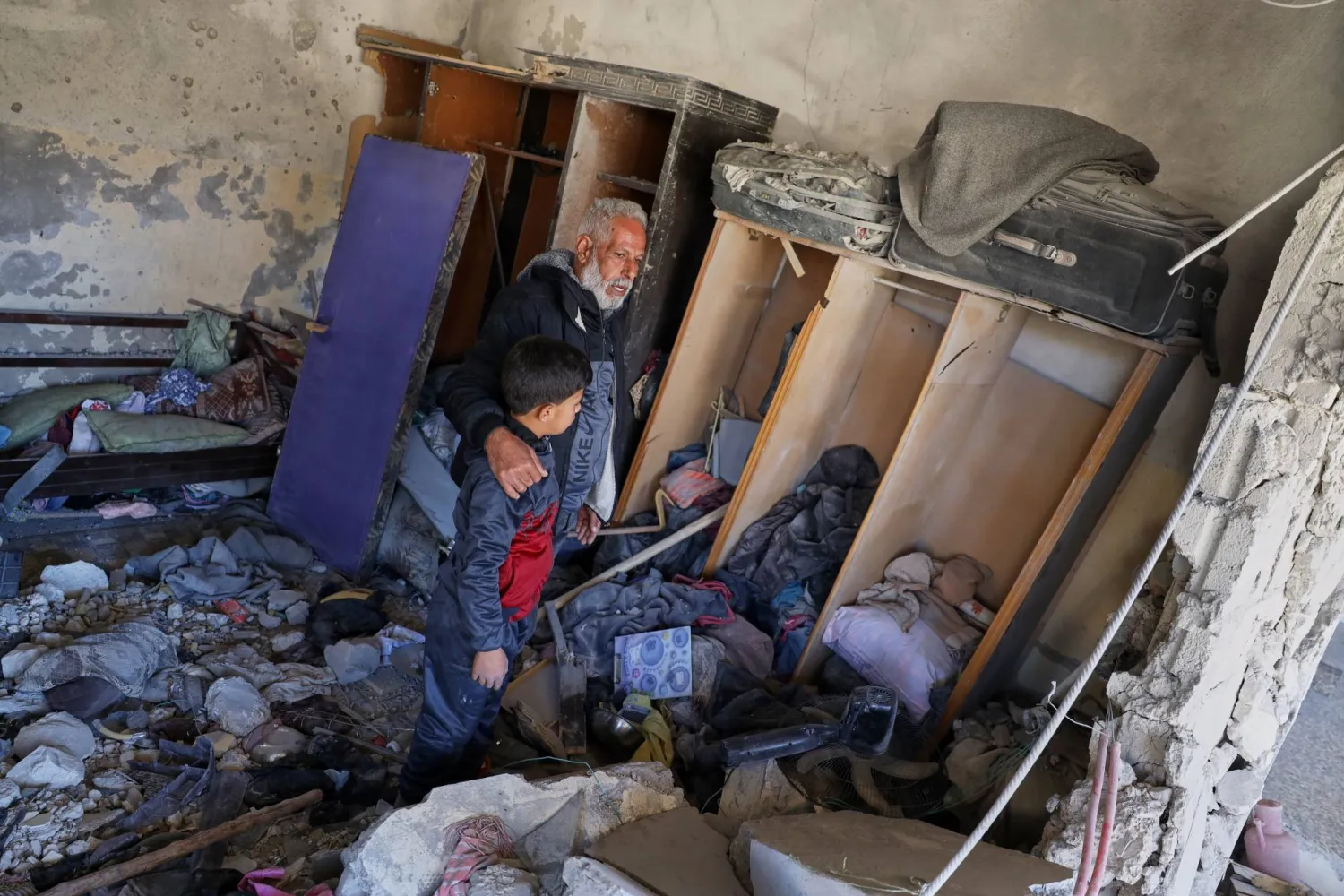
Qassim Hamadeh, who lost two sons, a daughter-in-law, and his 4- and 10-year-old grandsons, among 13 villagers killed when Israeli troops raided Beit Jin, southwestern Syria, on Nov. 2, looks at the damage from the raid alongside one surviving grandson, Dec. 1, 2025. (AP Photo/Omar Albam)
TT

Israeli Military Raids in Syria Raise Tensions as They Carve Out a Buffer Zone

Qassim Hamadeh, who lost two sons, a daughter-in-law, and his 4- and 10-year-old grandsons, among 13 villagers killed when Israeli troops raided Beit Jin, southwestern Syria, on Nov. 2, looks at the damage from the raid alongside one surviving grandson, Dec. 1, 2025. (AP Photo/Omar Albam)

Qassim Hamadeh woke to the sounds of gunfire and explosions in his village of Beit Jin in southwestern Syria last month. Within hours, he had lost two sons, a daughter-in-law and his 4-year-old and 10-year-old grandsons. The five were among 13 villagers killed that day by Israeli forces.

Israeli troops had raided the village — not for the first time — seeking to capture, as they said, members of a militant group planning attacks into Israel. Israel said militants opened fire at the troops, wounding six, and that troops returned fire and brought in air support.

Hamadeh, like others in Beit Jin, dismissed Israel’s claims of militants operating in the village. The residents said armed villagers confronted Israeli soldiers they saw as invaders, only to be met with Israeli tank and artillery fire, followed by a drone strike. The government in Damascus called it a “massacre.”

The raid and similar recent Israeli actions inside Syria have increased tensions, frustrated locals and also scuttled chances — despite US pressure — of any imminent thaw in relations between the two neighbors.

An expanding Israeli presence

An Israeli-Syria rapprochement seemed possible last December, after opposition factions overthrew autocratic Syrian President Bashar Assad, a close ally of Iran, Israel’s archenemy.

Syria’s interim president, Ahmad al-Sharaa, who led the opposition, said he has no desire for a conflict with Israel. But Israel was suspicious, mistrusting al-Sharaa.

Israeli forces quickly moved to impose a new reality on the ground. They mobilized into the UN-mandated buffer zone in southern Syria next to the Golan Heights, which Israel captured from Syria during the 1967 Mideast war and later annexed — a move not recognized by most of the international community.

Israeli forces erected checkpoints and military installations, including on a hilltop that overlooks wide swaths of Syria. They set up landing pads on strategic Mt. Hermon nearby. Israeli reconnaissance drones frequently fly over surrounding Syrian towns, with residents often sighting Israeli tanks and Humvee vehicles patrolling those areas.

Israel has said its presence is temporary to clear out pro-Assad remnants and militants — to protect Israel from attacks. But it has given no indication its forces would leave anytime soon. Talks between the two countries to reach a security agreement have so far yielded no result.

Ghosts of Lebanon and Gaza

The events in neighboring Lebanon, which shares a border with both Israel and Syria, and the two-year war in Gaza between Israel and the militant Palestinian group Hamas have also raised concerns among Syrians that Israel plans a permanent land grab in southern Syria.

Israeli forces still have a presence in southern Lebanon, over a year since a US-brokered ceasefire halted the latest Israel-Hezbollah war. That war began a day after Hamas attacked southern Israel on Oct. 7, 2023, with Hezbollah firing rockets into Israel in solidarity with its ally Hamas.

Israel’s operations in Lebanon, which included bombardment across the tiny country and a ground incursion last year, have severely weakened Hezbollah.

Today, Israel still controls five hilltop points in southern Lebanon, launches near-daily airstrikes against alleged Hezbollah targets and flies reconnaissance drones over the country, sometimes also carrying out overnight ground incursions.

In Gaza, where US President Donald Trump’s 20-point ceasefire deal has brought about a truce between Israel and Hamas, similar buffer zones under Israeli control are planned even after Israel eventually withdraws from the more than half of the territory it still controls.

At a meeting of regional leaders and international figures earlier this month in Doha, Qatar, al-Sharaa accused Israel of using imagined threats to justify aggressive actions.

“All countries support an Israeli withdrawal" from Syria to the lines prior to Assad's ouster, he said, adding that it was the only way for both Syria and Israel to "emerge in a state of safety.”

Syria's myriad problems

The new leadership in Damascus has had a multitude of challenges since ousting Assad.

Al-Sharaa's government has been unable to implement a deal with local Kurdish-led authorities in northeast Syria, and large areas of southern Sweida province are now under a de facto administration led by the Druze religious minority, following sectarian clashes there in mid-July with local Bedouin clans.

Syrian government forces intervened. Hundreds of civilians, mostly Druze, were killed. Over half of the roughly 1 million Druze worldwide live in Syria. Most other Druze live in Lebanon and Israel, including in the Golan Heights.

Israel, which has cast itself as a defender of the Druze, though many of them in Syria are critical of its intentions, has also made overtures to Kurds in Syria.

“The Israelis here are pursuing a very dangerous strategy,” said Michael Young, Senior Editor at the Beirut-based Malcolm H. Kerr Carnegie Middle East Center.

It contradicts, he added, the positions of Saudi Arabia, Türkiye, Egypt — and even the United States — which are "all in agreement that what has to come out of this today is a Syrian state that is unified and fairly strong,” he added.

Israel and the US at odds over Syria

In a video released from his office after visiting Israeli troops wounded in Beit Jin, barely 5 kilometers (3 miles) from the edge of the UN buffer zone, Israeli Prime Minister Benjamin Netanyahu said Israel seeks a “demilitarized buffer zone from Damascus to the (UN) buffer zone,” including Mt. Hermon.

“It is also possible to reach an agreement with the Syrians, but we will stand by our principles in any case,” Netanyahu said.

His strategy has proven to be largely unpopular with the international community, including with Washington, which has backed al-Sharaa’s efforts to consolidate his control across Syria.

Israel’s operations in southern Syria have drawn rare public criticism from Trump, who has taken al-Sharaa under his wing.

“It is very important that Israel maintain a strong and true dialogue with Syria, and that nothing takes place that will interfere with Syria’s evolution into a prosperous State,” Trump said in a post on Truth Social after the Beit Jin clashes.

Syria is also expected to be on the agenda when Netanyahu visits the US and meets with Trump later this month.

Experts doubt Israel will withdraw from Syria anytime soon — and the new government in Damascus has little leverage or power against Israel's much stronger military.

“If you set up landing pads, then you are not here for short-term,” Issam al-Reiss, a military adviser with the Syrian research group ETANA, said of Israeli actions.

Hamadeh, the laborer from Beit Jin, said he can “no longer bear the situation” after losing five of his family.

Israel, he said, “strikes wherever it wants, it destroys whatever it wants, and kills whoever it wants, and no one holds it accountable.”



Egypt Pushes for Deeper Economic Ties with Qatar

Photo from  the Egyptian–Qatari Business Forum in Cairo on Sunday (Egyptian Ministry of Investment) 
TT

Egypt Pushes for Deeper Economic Ties with Qatar

Photo from  the Egyptian–Qatari Business Forum in Cairo on Sunday (Egyptian Ministry of Investment) 

Egypt has signaled a new push to deepen economic cooperation with Qatar, announcing a set of investment facilitation measures aimed at boosting bilateral trade and attracting Qatari capital. The announcement came during the Egyptian–Qatari Business Forum held in Cairo on Sunday.

Egypt’s Minister of Investment and Foreign Trade, Hassan ElKhatib, said that a specialized committee would be established to streamline investment and trade procedures between the two countries. Experts view the move as a clear indication of the evolving economic partnership between Cairo and Doha.

ElKhatib inaugurated the forum alongside Ahmad bin Mohammed Al-Sayed, Qatar’s Minister of State for Foreign Trade, with wide participation from business leaders and private-sector representatives from both countries.

Bilateral relations have gained renewed strength following President Abdel Fattah Al-Sisi’s visit to Doha in April, during which Qatar announced a $7.5 billion package of direct investments to support its economic partnership with Egypt.

According to ElKhatib, Qatari investments in Egypt currently stand at around $3.2 billion, distributed across more than 266 companies operating in sectors including finance, industry, and tourism. He added that bilateral trade reached $143 million during the first ten months of the current year, up from $80 million in 2023 — an increase of nearly 80 percent.

The minister said relations with Qatar received a significant boost following Al-Sisi’s visit, which paved the way for new investment projects, led by developments on Egypt’s northwestern Mediterranean coast.

To further support Qatari investors, El-Khatib announced the creation of the specialized facilitation committee to help remove obstacles facing companies and enhance overall economic cooperation, underscoring Egypt’s intent to elevate ties with Qatar to a more strategic level.

Qatar’s Minister of State for Foreign Trade emphasized the importance of strengthening economic partnerships with Cairo, highlighting the private sector’s role in driving growth and creating new investment opportunities. He noted that sustained cooperation between companies in both countries enhances knowledge exchange and enables high-quality investments that support sustainable development.

Former Egyptian Assistant Foreign Minister Ambassador Youssef El-Sharkawy said Egyptian–Qatari relations have entered a new phase of political and economic cooperation. He told Asharq Al-Awsat that economic collaboration has become the main engine of strategic partnership, particularly through investments in the North Coast, the Suez Canal Economic Zone, and key sectors such as tourism, industry, and real estate.

Economist Walid Gaballah, a member of the Egyptian Association for Economy and Legislation, said the forum serves as a practical mechanism for activating Qatar’s investment commitments in Egypt, especially in tourism, agriculture, technology, and industry. He added that improved investment conditions have already contributed to rising trade volumes.

According to Egypt’s Central Agency for Public Mobilization and Statistics, bilateral trade between Egypt and Qatar totaled $128.4 million last year. Observers noted that the deepening economic relationship coincides with closer regional coordination between Cairo and Doha, including joint efforts to promote de-escalation and stability in the region.


Political Tensions between Lebanon and Iran Reach New Heights

Lebanese President Joseph Aoun (center), Foreign Minister Youssef Raggi (left) and Iranian FM Abbas Araqchi meet in Lebanon in June. (Lebanese Presidency)
TT

Political Tensions between Lebanon and Iran Reach New Heights

Lebanese President Joseph Aoun (center), Foreign Minister Youssef Raggi (left) and Iranian FM Abbas Araqchi meet in Lebanon in June. (Lebanese Presidency)

Tensions between Lebanon and Iran have reached unprecedented levels, reflecting a shift in how Beirut views its ties with Tehran, especially when it comes to Hezbollah’s arsenal and Iranian meddling in Lebanese internal affairs.

The tensions are not just playing out in the media, but in official positions taken by Lebanon’s top officials.

The latest example was Lebanese Foreign Minister Youssef Raggi’s announcement last week that he was declining an invitation by his Iranian counterpart Abbas Araqchi to visit Tehran. He instead proposed meeting in a neutral country.

An official Lebanese source told Asharq Al-Awsat that Raggi’s position does not stem from his personal views, but from a “clear political stance that Lebanese-Iranian relations cannot go back on track if they are not based on equality.

Iran must only limit its dealings in Lebanon to the state and no other party, namely Hezbollah, it added.

The root of the crisis lies in Iran’s absolute support for Hezbollah and how Tehran views it as an extension of its Revolutionary Guards Corps, an entity that exists parallel to the Lebanese state and even violates its jurisdiction in taking decisions of war and peace.

Speaking on condition of anonymity, the source warned that Iran maintaining this position towards Lebanon, “complicates the situation inside Lebanon and exposes the country to a new war with Israel.”

Lebanon cannot withstand such a new conflict, it added.

Araqchi on Thursday said he would visit Lebanon after Raggi issued a formal invitation.

Raggi was not the only senior Lebanese official to take issue with Iran. Earlier this year, President Joseph Aoun refused to meet with Secretary of Iran's Supreme National Security Council Ali Larijani while he was visiting Beirut.

The source said the refusal was a “direct message that the Lebanese state no longer tolerates parallel channels or relations that go beyond formal and constitutional levels.”

“This is the Lebanese state’s official position,” it stressed. “Iran will be welcomed if its changes the way it approaches Lebanon, whereby relations should be between official and constitutional institutions. Both countries should be equals, not with one being subordinate to the other.”

Earlier in 2025, Aoun received Iranian Speaker of the Shura Council Mohammad Bagher Qalibaf, informing him that Lebanon has “grown weary” of other countries “waging their wars on its territory.”

“It is about time that the Lebanese people are relieved of wars and tragedies,” he said, referring to the “support war” Hezbollah had launched in 2023 in solidarity with Hamas in Gaza with Iran’s backing.

On Sunday, Iranian foreign ministry spokesman Esmaeil Baghaei renewed Tehran’s call on Beirut to hold dialogue.

“Iran would rather avoid making statements that would distract Lebanon from focusing on its sovereignty and territorial integrity. The real danger against Lebanon’s sovereignty and dignity are Israel’s ambitions and hegemony,” he remarked.

Meanwhile, a senior adviser to Iran's supreme leader, Ali Akbar Velayati, declared that Tehran will continue to support Hezbollah.

Meeting with Hezbollah representative in Tehran, Abdullah Safieddine, he described the party as one of “the most important pillars of the Resistance Axis.”

Hezbollah is playing a “fundamental role in confronting Zionism,” he added.

Such statements demonstrate how Iran views Hezbollah’s arsenal as part of Tehran's regional security system, not as an issue related to Lebanon’s sovereignty.

The Lebanese government earlier this year took a landmark decision to impose state monopoly over arms, which effectively calls on Hezbollah to lay down its weapons.

Another adviser to Iran’s supreme leader, Ali Shamkhani, had previously openly declared that efforts to disarm Hezbollah “will fail.”

“These arms are those of the Lebanese people to defend their territory against Israel,” he added, rejecting any discussions about handing them over to the Lebanese state.

The official Lebanese source stressed that “there can be no going back” from the decision to impose state monopoly over arms.

“The internal and external objections will not change the state’s policy that has taken the decision to impose its authority throughout Lebanon,” it continued.


Seven Killed in Drone Strike on Hospital in Sudan's Restive Kordofan Region

The Sudanese flag flutters in Omdurman, part of greater Khartoum on December 13, 2025. Since April 2023 war has raged between the Sudanese regular army and the paramilitary Rapid Support Forces (RSF), killing tens of thousands of people and created one of the world's worst humanitarian crises. (Photo by Ebrahim Hamid / AFP)
TT

Seven Killed in Drone Strike on Hospital in Sudan's Restive Kordofan Region

The Sudanese flag flutters in Omdurman, part of greater Khartoum on December 13, 2025. Since April 2023 war has raged between the Sudanese regular army and the paramilitary Rapid Support Forces (RSF), killing tens of thousands of people and created one of the world's worst humanitarian crises. (Photo by Ebrahim Hamid / AFP)

A drone strike Sunday on an army hospital in the besieged southern Sudan city of Dilling left "seven civilians dead and 12 injured", a health worker at the facility told AFP.

The victims included patients and their companions, the medic said on condition of anonymity, explaining that the army hospital "serves the residents of the city and its surroundings, in addition to military personnel".

Dilling, in the flashpoint state of South Kordofan, is controlled by the Sudanese army but is besieged by rival paramilitary forces.

The greater Kordofan region is currently facing the fiercest fighting in Sudan's war between the army and the Rapid Support Forces (RSF), as both seek to wrest control of the massive southern region.

The RSF controls swathes of Kordofan along with their allies, the Sudan People's Liberation Movement-North (SPLM-N) faction led by Abdelaziz al-Hilu, which has a historic foothold in the region's Nuba Mountains.

Together, the forces have besieged the region's key cities with army divisions, including Dilling and South Kordofan state capital Kadugli, some 120 kilometers (75 miles) south.

Famine has gripped Kadugli since September, according to the UN, which estimates Dilling is suffering the same conditions, but a lack of access to data has prevented an official declaration.

Sunday's strike comes a day after a drone strike on a United Nations peacekeeping base killed six Bangladeshi troops in Kadugli.

- Wider attack -

Last week, SPLM-N said the capture of Dilling and Kadugli was "only a matter of time", urging the army and its allied militias to withdraw.

The RSF, emboldened by its seizure of the army's last holdout position in Darfur in October, has pushed through Kordofan in an attempt to capture the country's central corridor.

The UN has repeatedly warned the region is in danger of witnessing a repeat of the atrocities that unfolded in North Darfur state capital El-Fasher, including mass killing, abductions and sexual violence.

Paramilitaries have set their sights on Kadugli, Dilling and North Kordofan state capital El-Obeid, which lie on a north-south axis between the South Sudan border and the capital Khartoum.

El-Obeid also lies on a key highway that connects Darfur to Khartoum, which the army recaptured in March.

With the RSF in control of all of Darfur's major cities, Sudan is effectively split in two.

The army holds the center, east and north, while the RSF and its allies control the west and parts of the south.

Across the country, the war has killed tens of thousands of people, displaced 12 million and created the world's largest hunger and displacement crises.