


Sudan Once again Tops International Rescue Committee Crises Watchlist

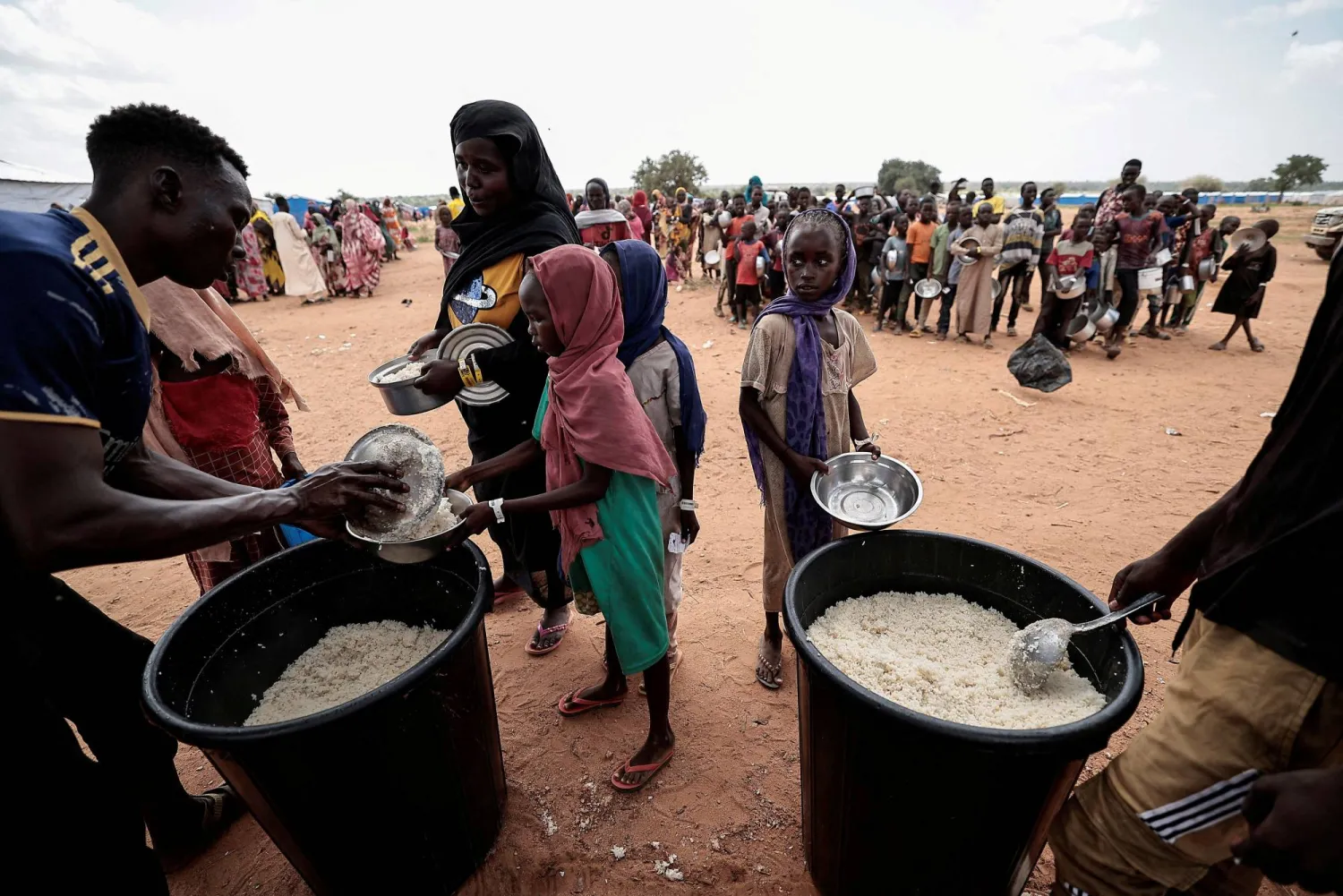
FILE PHOTO: Sudanese people, who fled the conflict in Geneina in Sudan's Darfur region, receive rice portions from Red Cross volunteers in Ourang on the outskirts of Adre, Chad July 25, 2023. REUTERS/Zohra Bensemra/File Photo
TT

Sudan Once again Tops International Rescue Committee Crises Watchlist

FILE PHOTO: Sudanese people, who fled the conflict in Geneina in Sudan's Darfur region, receive rice portions from Red Cross volunteers in Ourang on the outskirts of Adre, Chad July 25, 2023. REUTERS/Zohra Bensemra/File Photo

Sudan has once again topped a watchlist of global humanitarian crises released by the International Rescue Committee (IRC) aid organization, as warring sides press on with a conflict that has killed tens of thousands of people.

It is the third time in a row Sudan has headed the list, which was published on Tuesday. It highlights the 20 countries most at risk of new or worsened humanitarian emergencies.

"What the IRC is seeing on the ground is not a tragic accident. The world is not simply failing to respond to crisis; actions and words are producing, prolonging, and rewarding it," IRC CEO David Miliband said in a statement.

"The scale of the crisis in Sudan, ranking first on this year’s Watchlist for the third year in a row and now the largest humanitarian crisis ever recorded, is a signature of this disorder."

War erupted in April 2023 from a power struggle between the Sudanese army and the paramilitary Rapid Support Forces ahead of a planned transition to civilian rule, and triggered the world's largest displacement crisis. More than 12 million people have already been displaced by the ongoing war in Sudan, where humanitarian workers lack resources to help those fleeing, many of whom have been raped, robbed or bereaved by the violence.

Sudan is followed by the Palestinian territories, South Sudan, Ethiopia and Haiti, according to the list.

The IRC said although these countries are home to just 12% of the global population, they account for 89% of those in humanitarian need. It added that the countries are projected to host more than half of the world's extreme poor by 2029.

The remaining countries on the list are Myanmar, Democratic Republic of Congo, Mali, Burkina Faso, Lebanon, Afghanistan, Cameroon, Chad, Colombia, Niger, Nigeria, Somalia, Syria, Ukraine and Yemen.



Israeli Strike in Gaza Kills Family of Four

Smoke and flames rise from a house during an Israeli strike, carried out after the Israeli military warned residents to evacuate the area, in Khan Younis, in the southern Gaza Strip, September 9, 2026. REUTERS/Ramadan Abed
TT

Israeli Strike in Gaza Kills Family of Four

Smoke and flames rise from a house during an Israeli strike, carried out after the Israeli military warned residents to evacuate the area, in Khan Younis, in the southern Gaza Strip, September 9, 2026. REUTERS/Ramadan Abed

An Israeli strike in Gaza on Thursday killed a family of four including two children, Palestinian hospital and security sources said.

"The bodies of four members of the Ahmad family were recovered in pieces after an Israeli strike hit a house in the Beit Lahia Project area in the northern Gaza Strip," an official at Al-Shifa hospital in Gaza City said, identifying the children as aged 12 and eight.

The Israeli military, contacted by AFP, said it was checking.

A Palestinian security source in Gaza, which is under the control of Hamas, said that Israeli warplanes struck after midnight in Beit Lahia and separately in the heart of the Jabalia refugee camp, with Israeli forces also firing on tents of displaced people and ambulances.

"Israel continues its violations in the Gaza Strip," the security source said.

Israel in October last year agreed to a ceasefire brokered by the United States but since then has advanced further into Gaza.

Israeli Prime Minister Benjamin Netanyahu has vowed no let-up in strikes targeting Hamas, which led the unprecedented October 7, 2023 attack against Israel, and no pullout from Gaza until Hamas gives up all of its weapons.

Israel often identifies its targets afterwards. The Israeli military said that on Sunday it killed Sabhi Hadr Al-Atham al-Batrihi, claiming he was planting explosive devices against Israeli troops in the Gaza Strip.

Israeli strikes have killed more than 1,300 people since the ceasefire was announced, according to the Gaza health ministry, which operates under Hamas and whose figures are considered generally reliable by the United Nations.

The Israeli army has identified five deaths in its ranks over the same period, as well as the death of one civilian contractor.


Yemeni Tribal Affairs Chief to Houthis: ‘Your Time Is Near’

Sheikh Bakil Naji al-Soufi, head of the Tribal Affairs Authority at Yemen’s Interior Ministry. (Asharq Al-Awsat)
TT

Yemeni Tribal Affairs Chief to Houthis: ‘Your Time Is Near’

Sheikh Bakil Naji al-Soufi, head of the Tribal Affairs Authority at Yemen’s Interior Ministry. (Asharq Al-Awsat)

Sheikh Bakil Naji al-Soufi, head of the Tribal Affairs Authority at Yemen’s Interior Ministry, has warned the Houthis that “your time is near, and you will leave Yemen because of your actions.”

Al-Soufi believes mounting anger in Houthi-controlled areas has moved beyond frustration over economic and living conditions and is nearing a point of action, with tribes awaiting “zero hour” and what he described as a “glimmer of hope” or support from the Yemeni government.

In a new episode of the Asharq Al-Awsat Podcast, recorded in the newspaper’s Riyadh newsroom, al-Soufi discussed the tribal practice of “nakaf,” the Al-Rayyan tribal encampments in Al-Jawf province and relations between the tribes and the Houthis. He also recalled his experience mediating with Houthi leaders more than a decade ago and outlined his view of the future confrontation, pointing to expected military “surprises.”

In the interview, filmed Aug. 20, 2026, al-Soufi described “nakaf” as a tradition under which tribes gather at encampments known as “matarah” when faced with a grievance or a situation requiring mobilization. He said developments in Al-Jawf reflected what tribes had experienced from Houthi conduct and attempts to subjugate and humiliate them.

Al-Soufi explained that tribes had historically been “an integral part of the state” and its supporting “backbone.” Where official institutions are absent, tribal customs and ties play a role in maintaining security and stability.

Deceptive slogans

Al-Soufi noted that the Houthis initially succeeded in appealing to public sentiment when they entered Sanaa by invoking poverty, high prices and corruption. The tribes later discovered, he argued, that those slogans were a means of reaching power.

He accused the group of imposing levies and taxes on various activities and using talk of a “blockade” to justify deteriorating living conditions.

The more significant shift, in his view, is occurring inside Houthi-controlled areas themselves. He stressed that tribes were not merely waiting to join the encampments but that there was broader readiness to move against the Houthis.

“People are only waiting for zero hour,” he stated, adding that he is personally in contact with figures inside Houthi-held areas whose names he declined to disclose. He described the situation as being “on the rim of a volcano.”

Al-Soufi recalled heading a mediation committee between the Houthis and Salafists in Kitaf in 2011 and 2012, when he dealt with Mahdi al-Mashat and met Abu Ali al-Hakim, Youssef al-Fishi and Saleh al-Sammad.

He said that experience led him at the time to conclude that the group was implementing an Iranian project. He described Abu Ali al-Hakim as one of the most important Houthi figures he had encountered because of the security and military portfolios he oversaw.

Failed negotiations

Al-Soufi recounted that years of negotiations had failed to demonstrate an ability to end the crisis. He argued that the Houthis maneuver when under pressure and were more willing to make concessions when in a weaker position.

On the delay in reaching a military resolution, he said the government acts as a state with domestic and international obligations and must weigh the economic and military consequences before and after any battle, unlike armed groups.

The Yemeni official concluded by saying that “strong preparations” were underway and that Yemenis would soon hear of “surprises.”

Asked whether those surprises would be “in the air or on the ground,” he replied briefly: “In the air and on the ground.”


Disarmament Stalemate Casts Shadow Over Iraqi Government, Coordination Framework

Prime Minister Ali al-Zaidi (Reuters)
TT

Disarmament Stalemate Casts Shadow Over Iraqi Government, Coordination Framework

Prime Minister Ali al-Zaidi (Reuters)

Iraq’s ruling coalition has been forced to abandon plans to create deputy prime minister posts amid disputes over bringing weapons under state control, while sources say political factions are moving to recalculate their shares of the remaining vacant ministries.

Since parliament has approved Prime Minister Ali al-Zaidi’s government on May 15, 2026, giving the green light to 14 out of 23 ministers, political disputes have prevented appointments to nine portfolios, most notably the interior and defense ministries.

A more complicated dispute involved attempts by forces within the Coordination Framework to create four deputy prime minister posts. Asa’ib Ahl al-Haq was among the leading proponents, with its leader, Qais al-Khazali, putting forward his brother Laith al-Khazali for one of the positions.

Reliable sources told Asharq Al-Awsat that Asa’ib Ahl al-Haq had sought the post after formally agreeing to the plan to bring weapons under state control, but US objections blocked the appointment.

The sources described a “test of strength” between al-Zaidi and Coordination Framework forces because of the overlap between completing the Cabinet and the weapons issue. Scrapping the deputy prime minister posts, they said, opens the door to bargaining and forces all sides to recalculate the points assigned to ministries.

Observers believe efforts to complete the Cabinet began to falter as some political forces backed away from the weapons plan.

Al-Zaidi had made bringing arms under state control a key pillar of his government program. Asa’ib Ahl al-Haq and other factions later joined the proposed settlement in hopes of easing international pressure.

Sources said the Coordination Framework’s latest meeting exposed sharp divisions between leaders opposed to creating deputy PM posts and others insisting on them, preventing the coalition from issuing a statement afterward.

Al-Zaidi has held a series of meetings with Coordination Framework leaders in recent days in an effort to reach agreement on completing his Cabinet, particularly after his government marked its first 100 days.

Figures close to the prime minister’s office said he urged ruling coalition leaders to continue supporting the government in resolving outstanding issues, including bringing weapons under state control, combating corruption and filling Cabinet vacancies, regardless of disputes over deputy prime minister posts.

Under Iraq’s informal power-sharing system, ministries are distributed among election-winning political forces according to points based on each party’s number of parliamentary seats.

Legal and legislative affairs researcher Saif al-Saadi told Asharq Al-Awsat that scrapping the deputy PM posts would increase the value of the remaining portfolios, with sovereign ministries potentially worth 15 to 20 points and service ministries 10 to 12.

Al-Saadi expected two or three ministries to be filled, while the rest could remain under acting ministers because of domestic and external factors. He said the United States opposes militia-linked figures taking senior government posts, while competition among Shiite political forces is delaying agreement on candidates for the vacant portfolios.