


Sudan Named Most Neglected Crisis of 2025 in Aid Agency Poll 

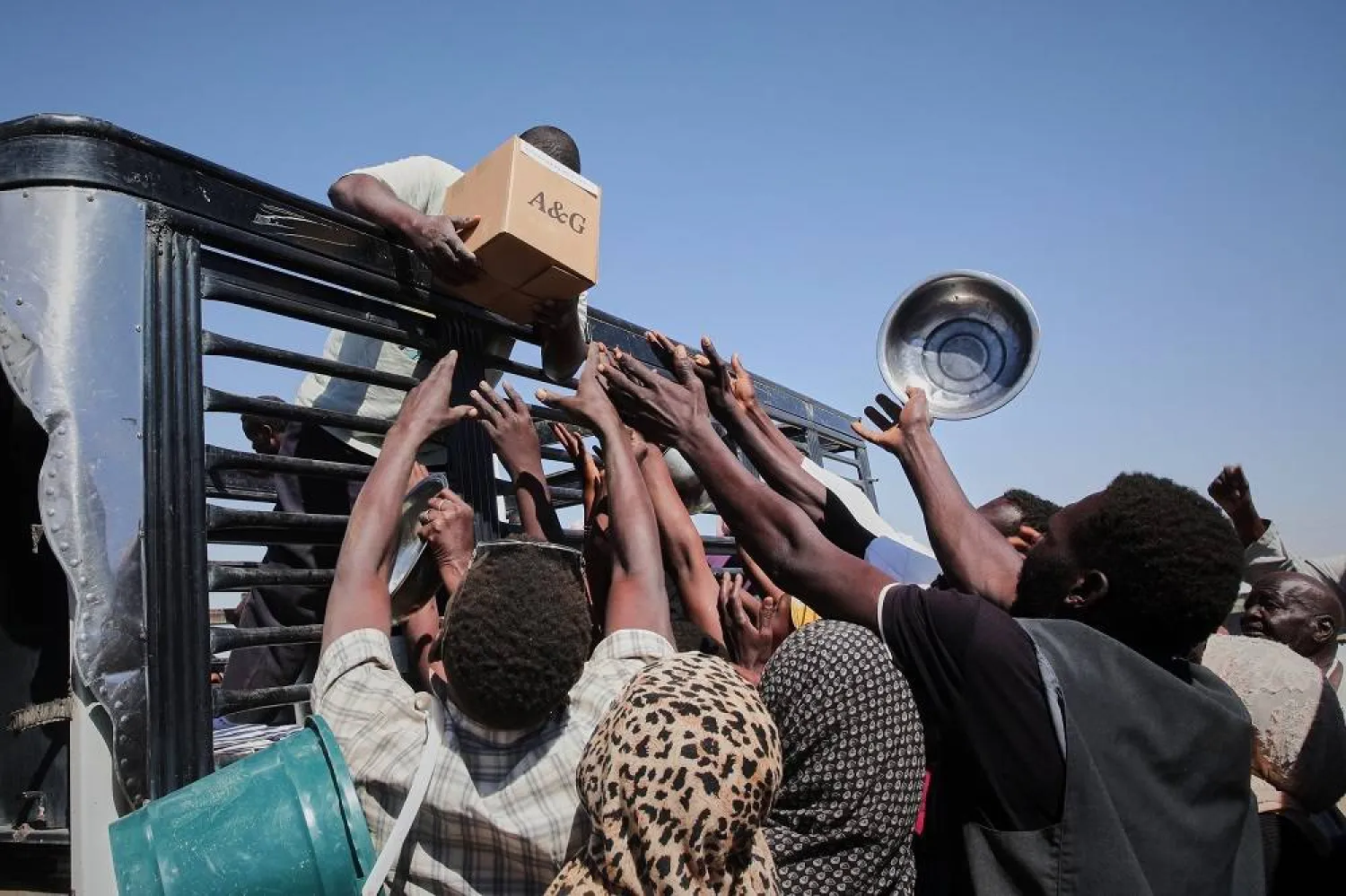
Sudanese families displaced from el-Fasher reach out as aid workers distribute food supplies at the newly established El-Afadh camp in Al Dabbah, in Sudan's Northern State, Sunday, Nov. 16, 2025. (AP)
TT

Sudan Named Most Neglected Crisis of 2025 in Aid Agency Poll 

Sudanese families displaced from el-Fasher reach out as aid workers distribute food supplies at the newly established El-Afadh camp in Al Dabbah, in Sudan's Northern State, Sunday, Nov. 16, 2025. (AP)

The humanitarian catastrophe engulfing Sudan, unleashing horrific violence on children and uprooting nearly a quarter of the population, is the world's most neglected crisis of 2025, according to a poll of aid agencies.

Some 30 million Sudanese people - roughly equivalent to Australia's population - need assistance, but experts warn that warehouses are nearly empty, aid operations face collapse and two cities have tipped into famine.

"The Sudan crisis should be front page news every single day," said Save the Children humanitarian director Abdurahman Sharif.

"Children are living a nightmare in plain sight, yet the world continues to shamefully look away."

Sudan was named by a third of respondents in a Thomson Reuters Foundation crisis poll of 22 leading aid organizations.

Democratic Republic of Congo (DRC), widely considered the deadliest conflict since World War Two, ranked second.

Although Sudan has received some media attention, Sharif said the true scale of the catastrophe remained "largely out of sight and out of mind."

The United Nations has called Sudan the world's biggest humanitarian crisis, but a $4.16 billion appeal is barely a third funded.

The poll's respondents highlighted a number of overlooked emergencies, including Myanmar, Afghanistan, Somalia, Africa's Sahel region and Mozambique.

Many agencies said they were reluctant to single out just one crisis in a year when the United States and other Western donors slashed aid despite soaring humanitarian needs.

"It feels as though the world is turning its back on humanity," said Oxfam's humanitarian director Marta Valdes Garcia.

'INDICTMENT OF HUMANITY'

The conflict between the Sudanese army and the paramilitary Rapid Support Forces, which erupted out of a power struggle in April 2023, has created the world's largest displacement crisis with 12 million people fleeing their homes.

Aid groups cited appalling human rights violations, including child cruelty, rape and conscription.

"What is being done to Sudan's children is unconscionable, occurring on a massive scale and with apparent impunity," said World Vision's humanitarian operations director Moussa Sangara.

Hospitals and schools have been destroyed or occupied, and 21 million people face acute hunger.

The UN World Food Program (WFP) has warned that without additional funds it will have to cut rations for communities in famine or at risk.

Aid organizations say violence, blockades and bureaucratic obstacles are making it hard to reach civilians in conflict zones.

"What we are witnessing in Sudan is nothing short of an indictment of humanity," said the UN refugee agency's regional director Mamadou Dian Balde.

"If the world does not urgently step up - diplomatically, financially, and morally - an already catastrophic situation will deteriorate further with millions of Sudanese and their neighbors paying the price."

'BREAKING POINT'

South Sudan and Chad, both hosting large numbers of Sudanese refugees, were also flagged in the survey.

Charlotte Slente, head of the Danish Refugee Council, said Chad - a country already dealing with deep poverty and hunger exacerbated by the climate crisis - was being pushed "to breaking point."

"Chad's solidarity with the refugees is a lesson for the world's wealthiest nations. That generosity is being met by global moral failure," Slente said.

In South Sudan, Oxfam said donors were pulling out, forcing aid agencies to cut crucial support for millions of people.

'HELLSCAPE FOR WOMEN'

Several organizations sounded the alarm over escalating conflict in DRC.

Around 7 million people are displaced and 27 million face hunger in the vast resource-rich country, where rape has been used as a weapon of war through decades of conflict.

"This is the biggest humanitarian emergency that the world isn't talking about," said Christian Aid's chief executive Patrick Watt.

On a recent visit, he said villagers told him how armed groups had stolen livestock, torched homes, recruited boys to fight and subjected women and girls to terrifying sexual violence.

Rwandan-backed M23 rebels seized a swathe of eastern Congo this year in their bid to topple the government in Kinshasa. Fighting has continued despite a US-led peace deal signed this month by DRC and Rwanda.

DRC's conflict has intensified amid soaring global demand for minerals needed for clean energy technologies, smartphones and more.

Watt said people now face economic disaster due to Kinshasa's blockade on M23-controlled areas and aid cuts that have hollowed out the humanitarian response.

ActionAid said the violence had "created a hellscape" for women, while the Norwegian Refugee Council (NRC) called Congo "a case study of global neglect."

"This neglect is not an accident: it is a choice," said NRC Secretary General Jan Egeland.

UN aid chief Tom Fletcher named Myanmar as the most neglected crisis, describing it as "a billion-dollar emergency running on fumes."

A $1.1 billion appeal for the southeast Asian country is only 17% funded despite mass displacement, rising hunger and rampant violence.

Although donors raced to help after Myanmar's massive earthquake in March, Fletcher said the world had turned away from the "grinding crisis" underneath.

"Myanmar is becoming invisible," he said.


Damascus, in Cooperation with Baghdad, Foils Plot to Smuggle Drugs Abroad

Quantities of Captagon prepared for smuggling abroad- SANA
TT

Damascus, in Cooperation with Baghdad, Foils Plot to Smuggle Drugs Abroad

Quantities of Captagon prepared for smuggling abroad- SANA

Syrian authorities said they have thwarted an attempt to smuggle a large shipment of drugs out of the country.

The Syrian Narcotics Directorate said on Wednesday it seized approximately 400,000 captagon pills, weighing about 65 kilograms, during an operation in Homs province in central Syria.

The drugs would have been smuggled to other countries, the Syrian Arab News Agency (SANA) reported. Two suspects were arrested on suspicion of managing a drug-trafficking network operating across borders.

The operation was carried out in coordination with Iraq’s General Directorate for Narcotics and Psychotropic Substances Control, SANA quoted a Syrian Interior Ministry statement as saying.

Earlier this month, the Syrian Narcotics Directorate conducted a joint security operation with the Iraqi authorities targeting an international drug-trafficking network, and seizing about 300,000 Captagon pills. Two people were also arrested.


How Gaza Armed Gangs Recruit New Members

Security personnel guard trucks carrying aid as they arrive in Rafah, amid the ongoing conflict between Israel and the Palestinian Islamist group Hamas, in the southern Gaza Strip January 17, 2024. (Reuters)
TT

How Gaza Armed Gangs Recruit New Members

Security personnel guard trucks carrying aid as they arrive in Rafah, amid the ongoing conflict between Israel and the Palestinian Islamist group Hamas, in the southern Gaza Strip January 17, 2024. (Reuters)

As Hamas moves to strike armed gangs operating in areas of the Gaza Strip under Israeli army control, the groups are responding with defiance, stepping up efforts to recruit young men and expand their ranks.

Videos posted on social media show training exercises and other activities, signaling that the gangs remain active despite pressure from Hamas security services.

Platforms affiliated with Hamas security say some members have recently turned themselves in following mediation by families, clans and community leaders. The gangs have not responded to those statements. Instead, they occasionally broadcast footage announcing new recruits.

Among the most prominent was Hamza Mahra, a Hamas activist who appeared weeks ago in a video released by the Shawqi Abu Nasira gang, which operates north of Khan Younis and east of Deir al-Balah.

Mahra’s appearance has raised questions about how these groups recruit members inside the enclave.

Field sources and others within the security apparatus of a Palestinian armed faction in Gaza told Asharq Al-Awsat that Mahra’s case may be an exception. They described him as a Hamas activist with no major role, despite his grandfather being among the founders of Hamas in Jabalia.

His decision to join the gang was driven by personal reasons linked to a family dispute, they said, not by organizational considerations.

The sources said the gangs exploit severe economic hardship, luring some young men with money, cigarettes and other incentives. Some recruits were heavily indebted and fled to gang-controlled areas to avoid repaying creditors.

Others joined in search of narcotic pills, the sources said, noting that some had previously been detained by Hamas-run security forces on similar charges. Economic hardship and the need for cigarettes and drugs were among the main drivers of recruitment, they added, saying the gangs, with Israeli backing, provide such supplies.

Resentment toward Hamas has also played a role, particularly among those previously arrested on criminal or security grounds and subjected to what the sources described as limited torture during interrogations under established procedures.

According to the sources, some founders or current leaders of the gangs previously served in the Palestinian Authority security services.

They cited Shawqi Abu Nasira, a senior police officer; Hussam al-Astal, an officer in the Preventive Security Service; and Rami Helles and Ashraf al-Mansi, both former officers in the Palestinian Presidential Guard.

These figures, the sources said, approach young men in need and at times succeed in recruiting them by promising help in settling debts and providing cigarettes. They also tell recruits that joining will secure them a future role in security forces that would later govern Gaza.

The sources described the case of a young man who surrendered to Gaza security services last week. He said he had been pressured after a phone call with a woman who threatened to publish the recording unless he joined one of the gangs.

He later received assurances from another contact that he would help repay some of his debts and ultimately agreed to enlist.

During questioning, he said the leader of the gang he joined east of Gaza City repeatedly assured recruits they would be “part of the structure of any Palestinian security force that will rule the sector.”

The young man told investigators he was unconvinced by those assurances, as were dozens of others in the same group.

Investigations of several individuals who surrendered, along with field data, indicate the gangs have carried out armed missions on behalf of the Israeli army, including locating tunnels. That has led to ambushes by Palestinian factions.

In the past week, clashes in the Zaytoun neighborhood south of Gaza City and near al-Masdar east of Deir al-Balah left gang members dead and wounded.

Some investigations also found that the gangs recruited young men previously involved in looting humanitarian aid.


Israel Permits 10,000 West Bank Palestinians for Friday Prayers at Al Aqsa

Palestinians attend Friday prayers in a mosque following an attack that local Palestinians said was carried out by Israeli settlers, in the village of Deir Istiya near Salfit in the Israeli-occupied West Bank November 14, 2025. REUTERS/Sinan Abu Mayzer
TT

Israel Permits 10,000 West Bank Palestinians for Friday Prayers at Al Aqsa

Palestinians attend Friday prayers in a mosque following an attack that local Palestinians said was carried out by Israeli settlers, in the village of Deir Istiya near Salfit in the Israeli-occupied West Bank November 14, 2025. REUTERS/Sinan Abu Mayzer

Israel announced that it will cap the number of Palestinian worshippers from the occupied West Bank attending weekly Friday prayers at the Al-Aqsa Mosque in east Jerusalem at 10,000 during the holy month of Ramadan, which began Wednesday.

Israeli authorities also imposed age restrictions on West Bank Palestinians, permitting entry only to men aged 55 and older, women aged 50 and older, and children up to age 12.

"Ten thousand Palestinian worshippers will be permitted to enter the Temple Mount for Friday prayers throughout the month of Ramadan, subject to obtaining a dedicated daily permit in advance," COGAT, the Israeli defense ministry agency in charge of civilian matters in the Palestinian territories, said in a statement, AFP reported.

"Entry for men will be permitted from age 55, for women from age 50, and for children up to age 12 when accompanied by a first-degree relative."

COGAT told AFP that the restrictions apply only to Palestinians travelling from the West Bank, which Israel has occupied since the 1967 Arab-Israeli war.

"It is emphasised that all permits are conditional upon prior security approval by the relevant security authorities," COGAT said.

"In addition, residents travelling to prayers at the Temple Mount will be required to undergo digital documentation at the crossings upon their return to the areas of Judea and Samaria at the conclusion of the prayer day," it said, using the Biblical term for the West Bank.

During Ramadan, hundreds of thousands of Palestinians traditionally attend prayers at Al-Aqsa, Islam's third holiest site, located in east Jerusalem, which Israel captured in 1967 and later annexed in a move that is not internationally recognized.

Since the war in Gaza broke out in October 2023, the attendance of worshippers has declined due to security concerns and Israeli restrictions.

The Palestinian Jerusalem Governorate said this week that Israeli authorities had prevented the Islamic Waqf -- the Jordanian-run body that administers the site -- from carrying out routine preparations ahead of Ramadan, including installing shade structures and setting up temporary medical clinics.

A senior imam of the Al-Aqsa Mosque, Sheikh Muhammad al-Abbasi, told AFP that he, too, had been barred from entering the compound.

"I have been barred from the mosque for a week, and the order can be renewed," he said.

Abbasi said he was not informed of the reason for the ban, which came into effect on Monday.

Under longstanding arrangements, Jews may visit the Al-Aqsa compound -- which they revere as the site of the first and second Jewish temples -- but they are not permitted to pray there.

Israel says it is committed to upholding this status quo, though Palestinians fear it is being eroded.

In recent years, a growing number of Jewish ultranationalists have challenged the prayer ban, including far-right politician Itamar Ben Gvir, who prayed at the site while serving as national security minister in 2024 and 2025.
