


Egypt Signals Possible Activation of Joint Defense Pact to Safeguard Sudan’s Unity

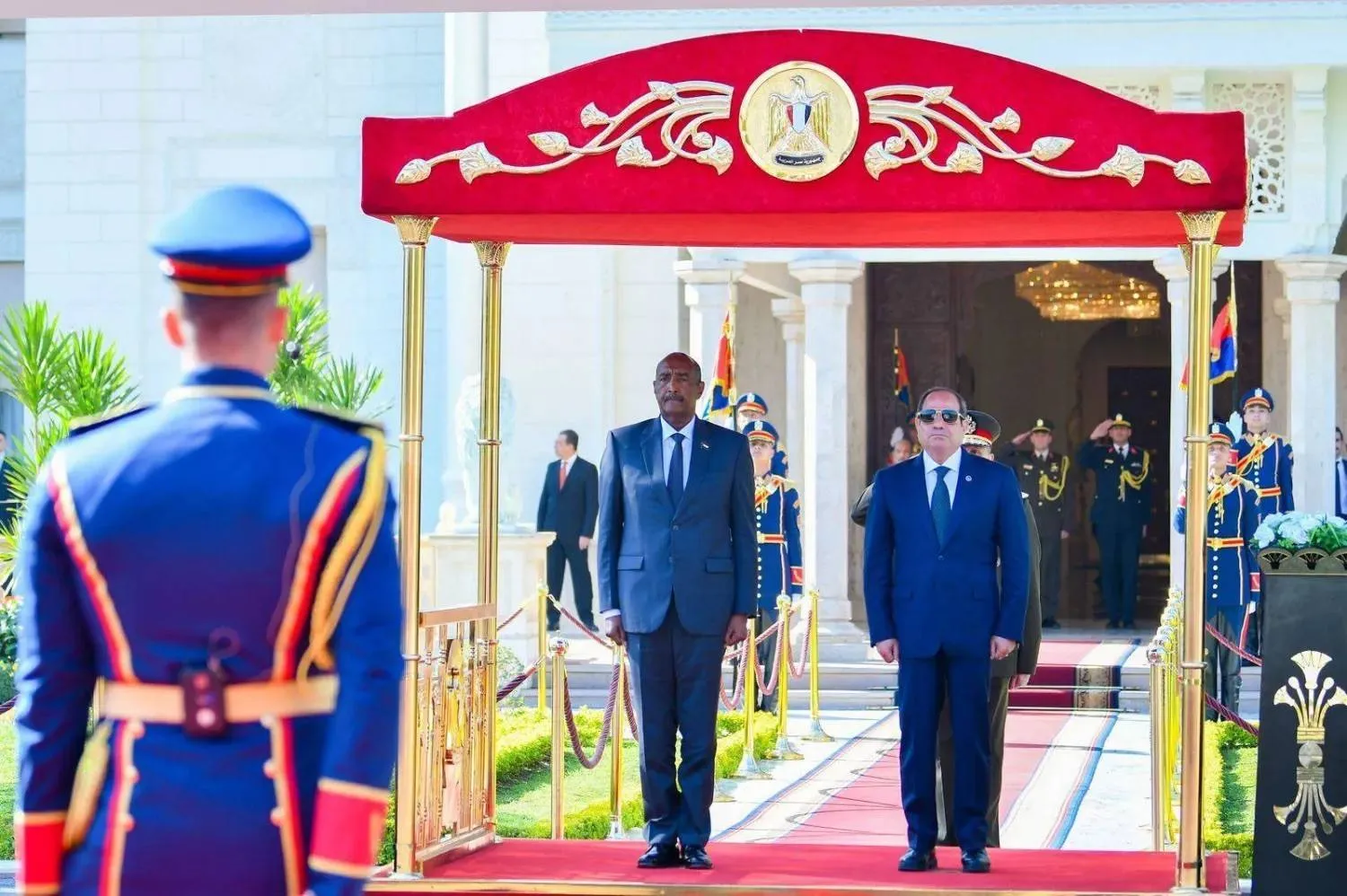
Abdel Fattah el-Sisi during the reception of Abdel Fattah al-Burhan in Cairo on Thursday (Egyptian Presidency)
TT

Egypt Signals Possible Activation of Joint Defense Pact to Safeguard Sudan’s Unity

Abdel Fattah el-Sisi during the reception of Abdel Fattah al-Burhan in Cairo on Thursday (Egyptian Presidency)

Egypt has drawn explicit “red lines” regarding the conflict in Sudan, warning that any attempt to cross them would directly threaten Egyptian national security.

Cairo signaled it is prepared to take all measures permitted under the Joint Defense Agreement between the two countries, a position analysts describe as Cairo’s most forceful since the outbreak of war in Sudan in 2023.

The statement coincided with President Abdel Fattah el-Sisi receiving on Thursday Lt. Gen. Abdel Fattah al-Burhan, Chairman of Sudan’s Transitional Sovereignty Council.

El-Sisi reaffirmed Egypt’s “full support for the Sudanese people in overcoming the current critical phase,” stressing Cairo’s unwavering commitment to Sudan’s unity, sovereignty, security, and stability, according to presidential spokesman Mohamed El-Shennawy.

During the visit, Egypt also renewed its support for US President Donald Trump’s vision for achieving peace and stability in Sudan, aligning with Washington’s broader approach to de-escalation and conflict resolution.

For the first time since the conflict began, Cairo publicly articulated non-negotiable red lines, stressing that Sudan’s unity and territorial integrity are inseparable from Egypt’s own national security. These red lines include preventing the partition of Sudan, protecting the country’s resources, and preserving its state institutions.

The Egyptian presidency underscored that safeguarding Sudan’s institutions is highly important and affirmed Egypt’s “full right to take all necessary measures under international law,” including the possible activation of the Joint Defense Agreement to prevent any violations.

Egypt and Sudan signed a military cooperation agreement in March 2021 covering training, border security, and countering shared threats, building on a Joint Defense Agreement concluded in 1976 to confront external dangers.

Maj. Gen. Yahya Kadwani, a member of Egypt’s parliamentary Committee on Defense and National Security, warned that efforts to divide Sudan necessitate firm red lines to protect Sudanese state assets and Egypt’s own security.

He told Asharq Al-Awsat that invoking the joint defense pact signals strong coordination within international legitimacy and existing bilateral agreements.

The presidency said Egypt is deeply concerned by ongoing escalation in Sudan and the resulting “horrific massacres and flagrant violations of basic human rights,” particularly in El Fasher.

Cairo categorically rejected the creation or recognition of any parallel political or military entities, warning that such moves would undermine Sudan’s unity and territorial integrity.

Ambassador Salah Halima, a member of the Egyptian Council for Foreign Affairs, said Egyptian-Sudanese coordination aims to protect Egyptian, Sudanese, and Arab national security, noting that both countries are members of the Council of Red Sea Coastal States, which plays a strategic role in defense and development.

He added that Egypt’s stance aligns with the International Quartet initiative and a proposal advanced by Saudi Crown Prince and Prime Minister Mohammed bin Salman during his visit to the United States.

The roadmap calls for a three-month humanitarian truce, integration of the Rapid Support Forces into the Sudanese Armed Forces, and preservation of military cohesion.

The Quartet, which includes Saudi Arabia, Egypt, the United Arab Emirates, and the United States, proposed last August a plan for a three-month humanitarian ceasefire, followed by a permanent cessation of hostilities and a political process leading to an independent civilian government within nine months.

Al-Burhan’s visit to Cairo followed talks in Saudi Arabia, where he affirmed Sudan’s readiness to work with Trump, US Secretary of State Marco Rubio, and US envoy Massad Boulos to end the war.

Amani Al-Tawil, Director of the Africa Program at the Al-Ahram Center for Political and Strategic Studies, said Egypt’s position represents its strongest stance yet and aligns with Saudi and US calls to preserve Sudan’s unity, halt the war, reject parallel entities, and protect state institutions.



Report: Israel Aims to Ensure More Palestinians Are Let Out of Gaza Than Back in

 A general view of destroyed houses in areas marked as 'Yellow Line' by the Israeli military, in east of Gaza City, January 16, 2026. (Reuters)
A general view of destroyed houses in areas marked as 'Yellow Line' by the Israeli military, in east of Gaza City, January 16, 2026. (Reuters)
TT

Report: Israel Aims to Ensure More Palestinians Are Let Out of Gaza Than Back in

 A general view of destroyed houses in areas marked as 'Yellow Line' by the Israeli military, in east of Gaza City, January 16, 2026. (Reuters)
A general view of destroyed houses in areas marked as 'Yellow Line' by the Israeli military, in east of Gaza City, January 16, 2026. (Reuters)

Israel wants to restrict the number of Palestinians entering Gaza through the border crossing with Egypt to ensure that more are allowed out than in, three sources briefed on the matter told Reuters ahead of the border's expected opening next week.

The head of a transitional Palestinian committee backed by the US to temporarily administer Gaza, Ali Shaath, announced on Thursday that the Rafah Border Crossing - effectively the sole route in or out of Gaza for nearly all of the more than 2 million people who live there - would open next week.

The border was supposed to have opened during the initial phase of President Donald Trump's plan to end the war, under a ceasefire reached in October between Israel and Hamas.

Earlier this month, Washington announced that ‌the plan had now ‌moved into the second phase, under which Israel is expected to ‌withdraw ⁠troops further from ‌Gaza and Hamas is due to yield control of the territory's administration. The Gaza side of the crossing has been under Israeli military control since 2024.

The three sources, who spoke on condition of anonymity due to the sensitivity of the issue, said it was still not clear how Israel planned to enforce limits on the number of Palestinians entering Gaza from Egypt, or what ratio of exits to entries it aimed to achieve.

Israeli officials have spoken in the past about encouraging Palestinians to emigrate from Gaza, although they deny intending to transfer the population out by ⁠force. Palestinians are highly sensitive to any suggestion that Gazans could be expelled, or that those who leave temporarily could be barred from returning.

The ‌Rafah Crossing is expected to be staffed by Palestinians affiliated with the ‍Ramallah-based Palestinian Authority and monitored by EU personnel, ‍as took place during an earlier, weeks-long ceasefire between Israel and Hamas early last year.

The Israeli prime ‍minister's office did not immediately respond to a request for comment for this story. The military referred questions to the government, declining to comment.

An Israeli official told Reuters the government would determine when the border would open and that Palestinians would not be able to leave or enter Gaza without approval from Israel.

The three sources said that Israel also wants to establish a military checkpoint inside Gaza near the border, through which all Palestinians entering or leaving would be required to pass and be subjected to Israeli security checks.

The US ⁠Embassy in Israel did not immediately respond to a request for comment on whether Washington supported Israel in limiting the number of Palestinians entering Gaza or setting up a checkpoint to screen those entering and leaving.

Under the initial phase of Trump's plan, the Israeli military partially pulled back its forces within Gaza but retained control of 53% of the territory including the entire land border with Egypt. Nearly all of the territory's population lives in the rest of Gaza, under Hamas control and mostly in makeshift tents or damaged buildings.

The sources said that it was not clear how individuals would be dealt with if they were blocked by Israel's military from passing through its checkpoint, particularly those entering from Egypt.

The Israeli government has repeatedly objected to the opening of the border, with some officials saying Hamas must first return the body of an Israeli police officer held in Gaza, the final human ‌remains of a hostage due to be transferred under the ceasefire's first phase.

US officials in private say that Washington, not Israel, is driving the rollout of the president's plan to end the war.


Report: US Pressures Iraq to ‘Rapidly’ Disarm Iran-Backed Factions

Iraqi border security force personnel patrol in their armored vehicles along the border with Syria, in Sinjar district, northern Iraq on January 22, 2026. (AFP)
TT

Report: US Pressures Iraq to ‘Rapidly’ Disarm Iran-Backed Factions

Iraqi border security force personnel patrol in their armored vehicles along the border with Syria, in Sinjar district, northern Iraq on January 22, 2026. (AFP)

US officials have been pressuring Iraq to disarm Iran-backed armed factions, reported the Financial Times on Friday.

“In tense meetings with senior Iraqi political leaders tasked with forming the next government, US officials have in recent weeks also pushed the Iraqis to produce a ‘credible’ plan to rapidly disarm the groups,” it said.

Washington is exerting pressure on senior Iraqi politicians to form a government that excludes those factions, amid US President Donald Trump's efforts to curb Tehran's influence in Baghdad.

The newspaper quoted informed sources as saying that American officials threatened to take punitive measures if Baghdad did not do so, including economic measures, such as limiting dollar flows related to Iraqi oil sales.

Since 2003, under an arrangement after the American invasion of Iraq, Washington has been sending Baghdad cash shipments worth billions of dollars annually via monthly air freight flights, which are funds collected from Iraqi oil sales, the proceeds of which are deposited in the country's account with the Federal Reserve.

However, the United States has long been concerned that armed factions and Iran would use these funds. In 2015, Washington temporarily suspended dollar supplies to Baghdad amid concerns that they were flowing to Tehran and the ISIS extremist group.

The sources said that Iraqis fear instability and the outbreak of an economic crisis if Washington stops these supplies again.


Israel Aims to Ensure More Palestinians Are Let Out of Gaza than Back In

People stand at the gate of the border crossing between Egypt and the Gaza Strip, in Rafah, Egypt, February 11, 2025. REUTERS/Amr Abdallah Dalsh
TT

Israel Aims to Ensure More Palestinians Are Let Out of Gaza than Back In

People stand at the gate of the border crossing between Egypt and the Gaza Strip, in Rafah, Egypt, February 11, 2025. REUTERS/Amr Abdallah Dalsh

Israel wants to restrict the number of Palestinians entering Gaza through the border crossing with Egypt to ensure that more are allowed out than ​in, three sources briefed on the matter said ahead of the border's expected opening next week.

The head of a transitional Palestinian committee backed by the US to temporarily administer Gaza, Ali Shaath, announced on Thursday that the Rafah Border Crossing - effectively the sole route in or out of Gaza for nearly all of the more than 2 million people who live there - would open next week.

The border was supposed to have opened during the initial phase of President Donald Trump's plan to end the war, under a ceasefire reached in October between Israel and Hamas.

Earlier this month, Washington announced that the plan had now ‌moved into the ‌second phase, under which Israel is expected to withdraw troops further from ‌Gaza ⁠and ​Hamas ‌is due to yield control of the territory's administration. The Gaza side of the crossing has been under Israeli military control since 2024.

The three sources, who spoke on condition of anonymity due to the sensitivity of the issue, said it was still not clear how Israel planned to enforce limits on the number of Palestinians entering Gaza from Egypt, or what ratio of exits to entries it aimed to achieve, Reuters reported.

Israeli officials have spoken in the past about encouraging Palestinians to emigrate from Gaza, although they deny intending to transfer the population out by force. Palestinians ⁠are highly sensitive to any suggestion that Gazans could be expelled, or that those who leave temporarily could be barred from returning.

The Rafah ‌Crossing is expected to be staffed by Palestinians affiliated with the ‍Ramallah-based Palestinian Authority and monitored by EU personnel, ‍as took place during an earlier, weeks-long ceasefire between Israel and Hamas early last year.

The Israeli ‍prime minister's office did not immediately respond to a request for comment for this story. The military referred questions to the government, declining to comment.

The three sources said that Israel also wants to establish a military checkpoint inside Gaza near the border, through which all Palestinians entering or leaving would be required to pass and be subjected to Israeli ​security checks.

Two other sources also said that Israeli officials had insisted on setting up a military checkpoint in Gaza to screen Palestinians moving in and out.

The US Embassy in ⁠Israel did not immediately respond to a request for comment on whether Washington supported Israel in limiting the number of Palestinians entering Gaza or setting up a checkpoint to screen those entering and leaving.

Under the initial phase of Trump's plan, the Israeli military partially pulled back its forces within Gaza but retained control of 53% of the territory including the entire land border with Egypt. Nearly all of the territory's population lives in the rest of Gaza, under Hamas control and mostly in makeshift tents or damaged buildings.

The sources said that it was not clear how individuals would be dealt with if they were blocked by Israel's military from passing through its checkpoint, particularly those entering from Egypt.

The Israeli government has repeatedly objected to the opening of the border, with some officials saying Hamas must first return the body of an Israeli police officer held in Gaza, the ‌final human remains of a hostage due to be transferred under the ceasefire's first phase.

US officials in private say that Washington, not Israel, is driving the rollout of the president's plan to end the war.