


Detainee Imad Amhaz Case Highlights Hezbollah’s Maritime Activities

Detainee Imad Amhaz Case Highlights Hezbollah’s Maritime Activities
TT

Detainee Imad Amhaz Case Highlights Hezbollah’s Maritime Activities

Detainee Imad Amhaz Case Highlights Hezbollah’s Maritime Activities

Israel’s disclosure of a naval commando operation in the northern Lebanese town of Batroun has thrust back into focus a case that straddles security, political, and legal fault lines.

The announcement, accompanied by Israeli claims surrounding Imad Amhaz, comes at a delicate moment, coinciding with ceasefire arrangements, meetings of the monitoring mechanism committee, and ongoing efforts to resolve the files of detainees and missing persons.

The Israeli announcement and security narrative

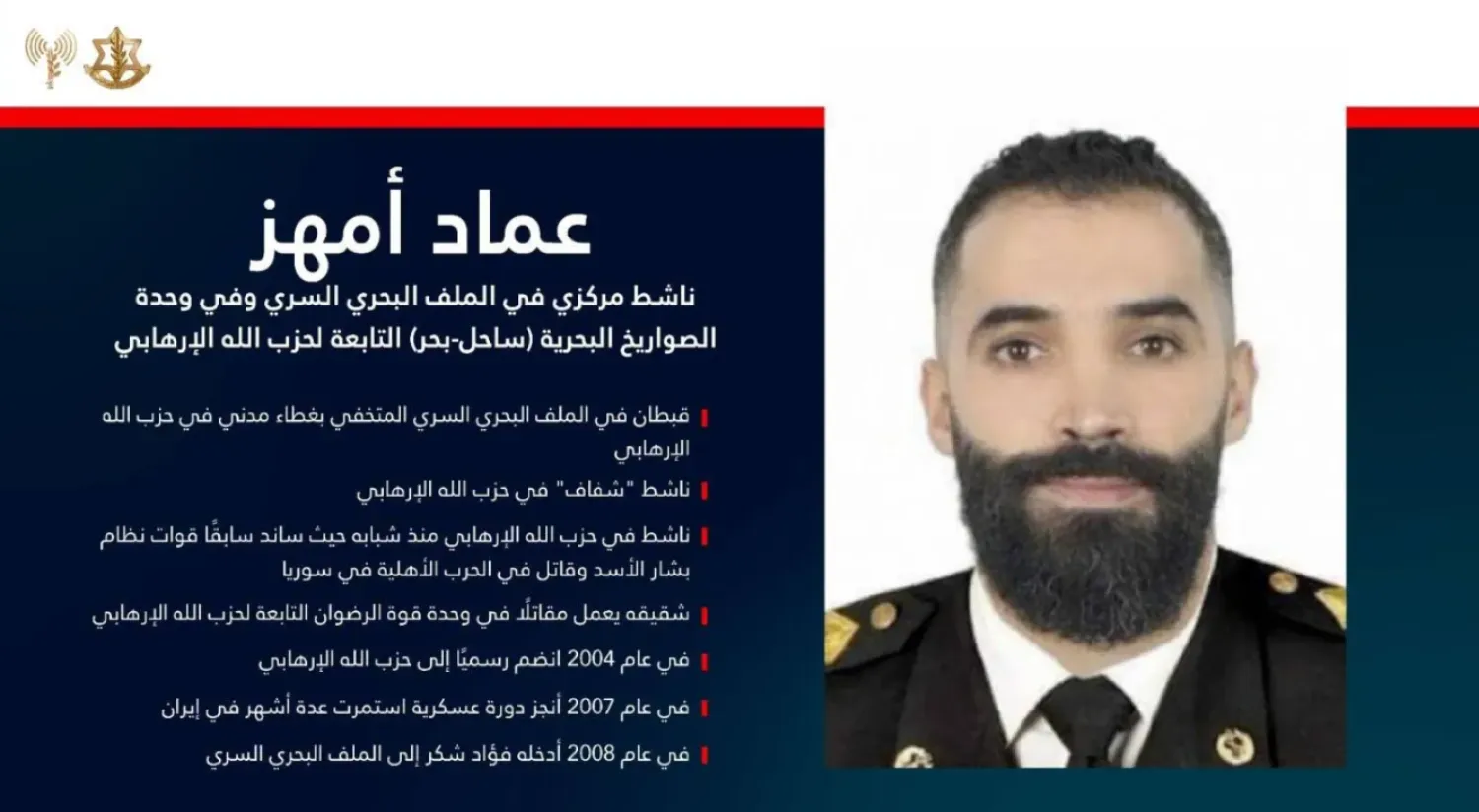
Israeli army spokesman Avichay Adraee said Israeli forces carried out an operation around a year ago in Batroun, far from the Lebanese Israeli border, during which Imad Amhaz was transferred to Israel for interrogation.

According to the Israeli account, Amhaz is linked to Hezbollah’s secret maritime file and its coastal missile unit, received military training inside and outside Lebanon, and acquired maritime expertise related to operational missions.

Adraee said the interrogation of Amhaz enabled, according to his statement, the acquisition of information related to organized maritime activities run under a secret framework and using civilian fronts.

He said this information helped obstruct the progress of this file at what he described as a sensitive stage, adding that Iran provided support for these activities.

A broader political and security context

In an analytical reading, security and defense researcher Riad Kahwaji told Asharq Al-Awsat that the case of Imad Amhaz and the timing of its disclosure could not be separated from the broader political and security context, particularly the meeting of the ceasefire monitoring mechanism committee and the ongoing negotiations.

He said Israel was trying through this timing to justify its refusal to withdraw from five points by arguing that Hezbollah remained present and continued to conduct military activity.

Kahwaji said the Israeli messages also aimed to show that Hezbollah’s role was far greater than perceived inside Lebanon, arguing that the group was no longer merely a local organization but part of a broad regional project led by Iran.

He said the issue was not related to a trench or one or two military positions, but rather to an integrated structure that included maritime capabilities, infrastructure, and strategic preparations.

He added that Iran had invested tens of millions of dollars in this project, saying Israel was seeking to highlight the scale of military investment in a country whose population was suffering severe internal pressures.

Kahwaji said the file went beyond the area south of the Litani River, noting that the issue was not limited to that region but included the maritime dimension and other areas, particularly since Amhaz was in Batroun in northern Lebanon at the time of the operation.

He said Israel was speaking about tunnels, weapons depots, and equipment in an attempt to show a contradiction between what the Lebanese state declared regarding the disarmament track and what Israel considered a continuation of Hezbollah’s military activity and armament.

He said attempts to strip Imad Amhaz of his civilian status fell within this context, explaining that Israel had from the outset sought to present him as linked to what it called Hezbollah’s naval weapons.

He added that the Lebanese state, in contrast, said the core problem lay in Israel’s continued occupation of the five points, while Israel responded that the main reason was that Hezbollah had not stopped arming itself and that the threat remained.

The Lebanese position and legal dimension

For his part, Nabih Awada, a member of the committee representing detainees and former prisoners in Israeli jails, told Asharq Al-Awsat that the case of Imad Amhaz was, from a legal perspective, that of a civilian abducted from a Lebanese area far from the border. He said his detention did not fall under military arrest.

Awada said this also applied to other documented cases, stressing that the file was being followed up with official Lebanese authorities and with the International Committee of the Red Cross.

He said the Lebanese state was dealing with Imad Amhaz on the basis that he was a civilian and considered that the location of his detention, its circumstances, and its nature did not fall within any military engagement or combat activity. He said this description was what the state relied on in addressing the file before international bodies.

Presidential stance regarding the detainees

Awada said the full details of the file were raised during a meeting with the president of the republic, who he said was fully convinced that the priority of the current stage was the release of Lebanese detainees.

He said the president stressed the need to start at least with civilians detained after the war, given that hostilities had stopped and there was no longer any legal justification for holding them.

He said the president had acted on this basis by communicating with the International Committee of the Red Cross, as well as international and US parties.

The Amhaz family’s stance

Alongside official positions, sources close to the family of Imad Amhaz told Asharq Al-Awsat they denied any knowledge of military activity attributed to him, saying Amhaz had been leading a normal civilian life and that the family had never been informed of any link between him and any military or security activity.

They said the information published did not reflect the family’s account.

Detainees and missing persons figures

On figures, Awada said the file submitted to the president included 20 Lebanese detainees whose presence in Israeli prisons had been confirmed, half of whom were arrested during the war and half afterward.

He said among those detained during the war were seven fighters and three civilians, including Imad Amhaz, who was considered a civilian.

Those detained after the ceasefire were all civilians, in addition to three people missing before the war and around 40 missing since it began.



Israel Permits 10,000 West Bank Palestinians for Friday Prayers at Al Aqsa

Palestinians attend Friday prayers in a mosque following an attack that local Palestinians said was carried out by Israeli settlers, in the village of Deir Istiya near Salfit in the Israeli-occupied West Bank November 14, 2025. REUTERS/Sinan Abu Mayzer
TT

Israel Permits 10,000 West Bank Palestinians for Friday Prayers at Al Aqsa

Palestinians attend Friday prayers in a mosque following an attack that local Palestinians said was carried out by Israeli settlers, in the village of Deir Istiya near Salfit in the Israeli-occupied West Bank November 14, 2025. REUTERS/Sinan Abu Mayzer

Israel announced that it will cap the number of Palestinian worshippers from the occupied West Bank attending weekly Friday prayers at the Al-Aqsa Mosque in east Jerusalem at 10,000 during the holy month of Ramadan, which began Wednesday.

Israeli authorities also imposed age restrictions on West Bank Palestinians, permitting entry only to men aged 55 and older, women aged 50 and older, and children up to age 12.

"Ten thousand Palestinian worshippers will be permitted to enter the Temple Mount for Friday prayers throughout the month of Ramadan, subject to obtaining a dedicated daily permit in advance," COGAT, the Israeli defense ministry agency in charge of civilian matters in the Palestinian territories, said in a statement, AFP reported.

"Entry for men will be permitted from age 55, for women from age 50, and for children up to age 12 when accompanied by a first-degree relative."

COGAT told AFP that the restrictions apply only to Palestinians travelling from the West Bank, which Israel has occupied since the 1967 Arab-Israeli war.

"It is emphasised that all permits are conditional upon prior security approval by the relevant security authorities," COGAT said.

"In addition, residents travelling to prayers at the Temple Mount will be required to undergo digital documentation at the crossings upon their return to the areas of Judea and Samaria at the conclusion of the prayer day," it said, using the Biblical term for the West Bank.

During Ramadan, hundreds of thousands of Palestinians traditionally attend prayers at Al-Aqsa, Islam's third holiest site, located in east Jerusalem, which Israel captured in 1967 and later annexed in a move that is not internationally recognized.

Since the war in Gaza broke out in October 2023, the attendance of worshippers has declined due to security concerns and Israeli restrictions.

The Palestinian Jerusalem Governorate said this week that Israeli authorities had prevented the Islamic Waqf -- the Jordanian-run body that administers the site -- from carrying out routine preparations ahead of Ramadan, including installing shade structures and setting up temporary medical clinics.

A senior imam of the Al-Aqsa Mosque, Sheikh Muhammad al-Abbasi, told AFP that he, too, had been barred from entering the compound.

"I have been barred from the mosque for a week, and the order can be renewed," he said.

Abbasi said he was not informed of the reason for the ban, which came into effect on Monday.

Under longstanding arrangements, Jews may visit the Al-Aqsa compound -- which they revere as the site of the first and second Jewish temples -- but they are not permitted to pray there.

Israel says it is committed to upholding this status quo, though Palestinians fear it is being eroded.

In recent years, a growing number of Jewish ultranationalists have challenged the prayer ban, including far-right politician Itamar Ben Gvir, who prayed at the site while serving as national security minister in 2024 and 2025.


EU Exploring Support for New Gaza Administration Committee, Document Says

Palestinians push a cart past the rubble of residential buildings destroyed during the two-year Israeli offensives, in Gaza City, February 17, 2026. REUTERS/Mahmoud Issa
TT

EU Exploring Support for New Gaza Administration Committee, Document Says

Palestinians push a cart past the rubble of residential buildings destroyed during the two-year Israeli offensives, in Gaza City, February 17, 2026. REUTERS/Mahmoud Issa

The European Union is exploring possible support for a new committee established to take over the civil administration of Gaza, according to a document produced by the bloc's diplomatic arm and seen by Reuters.

"The EU is engaging with the newly established transitional governance structures for Gaza," the European External Action Service wrote in a document circulated to member states on Tuesday.

"The EU is also exploring possible support to the National Committee for the Administration of Gaza," it added.

European foreign ministers will discuss the situation in Gaza during a meeting in Brussels on February 23.


Israel Military Says Soldier Killed in Gaza 

A drone view shows the destruction in a residential neighborhood, after the withdrawal of the Israeli forces from the area, amid a ceasefire between Israel and Hamas in Gaza, in Gaza City, October 21, 2025. (Reuters)
TT

Israel Military Says Soldier Killed in Gaza 

A drone view shows the destruction in a residential neighborhood, after the withdrawal of the Israeli forces from the area, amid a ceasefire between Israel and Hamas in Gaza, in Gaza City, October 21, 2025. (Reuters)

The Israeli military announced that one of its soldiers had been killed in combat in southern Gaza on Wednesday, but a security source said the death appeared to have been caused by "friendly fire".

"Staff Sergeant Ofri Yafe, aged 21, from HaYogev, a soldier in the Paratroopers Reconnaissance Unit, fell during combat in the southern Gaza Strip," the military said in a statement.

A security source, however, told AFP that the soldier appeared to have been "killed by friendly fire", without providing further details.

"The incident is still under investigation," the source added.

The death brings to five the number of Israeli soldiers killed in Gaza since a ceasefire took effect on October 10.