


Israel Turns Gaza ‘Yellow Line’ into Deadly Boundary

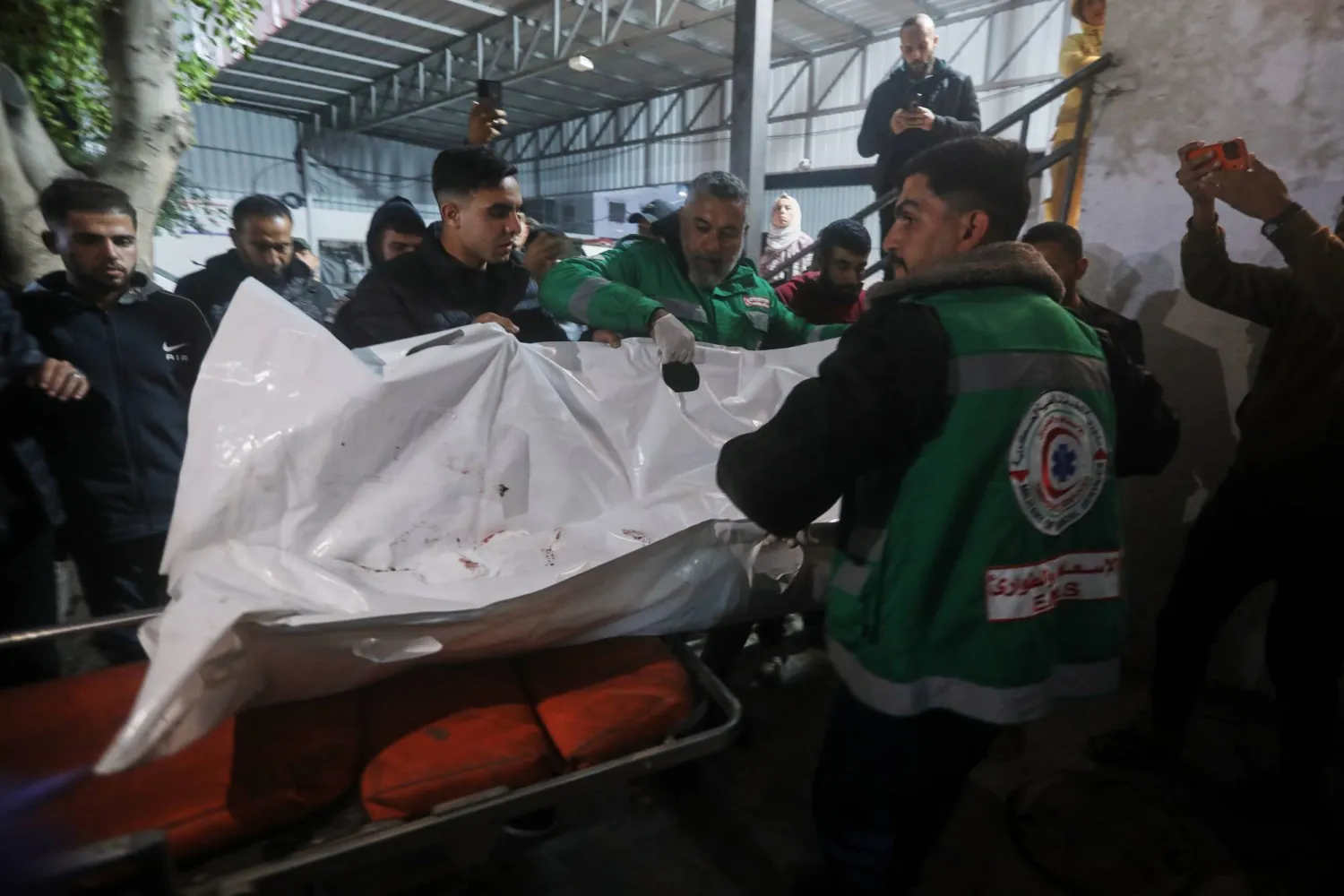
Palestinians carry the body of a person killed in an Israeli military strike as they arrive at Shifa Hospital in Gaza City, Friday, Dec. 19, 2025. (AP Photo/Yousef Al Zanoun)
TT

Israel Turns Gaza ‘Yellow Line’ into Deadly Boundary

Palestinians carry the body of a person killed in an Israeli military strike as they arrive at Shifa Hospital in Gaza City, Friday, Dec. 19, 2025. (AP Photo/Yousef Al Zanoun)

Israel has effectively turned the “yellow line” marked on the Gaza withdrawal map, part of a phased pullback agreed under the October ceasefire, into a de facto firing line, where approaching civilians are routinely shot, according to Palestinian officials, underscoring a widening pattern of Israeli violations of the truce.

Gaza’s health ministry and other local authorities report almost daily at least one fatal shooting near the line, whether in the north or south of the enclave, with fewer incidents in central Gaza. The highest number of cases has been recorded in the south.

Over the past 24 hours, from Thursday afternoon to Friday, four Palestinians, including a woman, were killed in the town of Bani Suheila, east of Khan Younis in southern Gaza, after repeated attacks on people trying to reach their homes. Most of the town lies at least 200 meters from the yellow line defined under the ceasefire.

Medical teams, civil defense crews and even international organizations were unable to retrieve the bodies, which remained on the ground, similar to cases reported previously.

Field sources told Asharq Al-Awsat that Israeli forces first shot and killed a woman. When a young man tried to recover her body, he was also killed. Two others were then shot dead while attempting to reach the bodies.

The sources said the number of casualties is rising due to ongoing violations around the yellow line, which Israeli forces have deliberately advanced further into Gaza.

This has caused confusion among residents trying to access what remains of their homes, areas they had previously reached safely before the line was moved deeper into the enclave.

Israel has effectively turned the yellow line into a “death trap,” the sources said, adding that most of those killed there were shot from a distance of at least 200 meters.

Nearly 400 Palestinians have been killed since the ceasefire came into force on Oct. 10 as a result of Israeli violations.

At least 220 were killed in airstrikes carried out during several major military escalations that included targeted killings of armed Palestinian faction members in homes, vehicles or gatherings.

Israel said those attacks were in response to Palestinian violations of the ceasefire, including shooting incidents in Rafah and elsewhere.

Most of the remaining deaths, about 150, resulted from gunfire and drone strikes or artillery shelling targeting Palestinians who approached the yellow line. Others were killed by unexploded ordnance or from complications related to earlier injuries.

Israel continues daily violations of the ceasefire through airstrikes, demolitions and live fire on both sides of the yellow line.

An Israeli security official told the Hebrew-language newspaper Israel Hayom on Thursday that the yellow line is now considered the new border and that Israel will not withdraw from it unless Hamas is disarmed.

The official said Israeli forces are preparing to remain there for an open period, allowing them to control roughly half of Gaza’s territory and impose new security arrangements. He added that any withdrawal would depend on political decisions determining the next phase.

A meeting is due to be held on Friday in Miami between the US president’s Middle East envoy, Steve Witkoff, and officials from Egypt, Qatar and Türkiye to discuss Gaza, including ceasefire violations and the second phase of the truce.

Hamas hopes the talks will lead to an end to the violations. Senior Hamas official Bassem Naim told AFP that Palestinians expect the participants to agree on stopping what he described as ongoing Israeli rampages, halting all violations and obliging Israel to adhere to the Sharm el-Sheikh agreement.

Hamas sources in Gaza told Asharq Al-Awsat that the movement and other Palestinian factions are counting on mediators to persuade the United States to pressure Israel to halt violations, allow the entry of aid including tents and prefabricated housing, begin genuine reconstruction and fully comply with humanitarian commitments under the agreement.

The sources said restraining Israel must be more effective on the part of Washington and the guarantor mediators to allow progress toward the second phase of the deal, warning that continued Israeli backtracking on the first phase could derail the next stage.

Humanitarian conditions

On the humanitarian front, the World Health Organization said more than 1,000 patients in Gaza have died while waiting for evacuation since July 2024.

WHO Director-General Tedros Adhanom Ghebreyesus said on X that 1,092 patients died while awaiting medical evacuation between July 2024 and November 2025, adding that the actual number was likely higher.

Doctors Without Borders (MSF) reported high rates of respiratory infections among Gaza’s population due to harsh winter conditions and worsening living standards, as the humanitarian crisis continues.

The organization said hundreds of thousands of Palestinians remain in makeshift, deteriorating tents flooded by rainwater, heightening health risks, particularly for children and the elderly.

It urged Israeli authorities to immediately allow a significant increase in humanitarian aid deliveries to Gaza, warning of further deterioration in health and humanitarian conditions if restrictions on essential supplies persist.



Israel Army Issues Evacuation Warning for Lebanon Village ahead of Strikes

 Smoke rises after Israeli strikes following Israeli military's evacuation orders, in Chehour, southern Lebanon November 19, 2025. REUTERS/Ali Hankir
Smoke rises after Israeli strikes following Israeli military's evacuation orders, in Chehour, southern Lebanon November 19, 2025. REUTERS/Ali Hankir
TT

Israel Army Issues Evacuation Warning for Lebanon Village ahead of Strikes

 Smoke rises after Israeli strikes following Israeli military's evacuation orders, in Chehour, southern Lebanon November 19, 2025. REUTERS/Ali Hankir
Smoke rises after Israeli strikes following Israeli military's evacuation orders, in Chehour, southern Lebanon November 19, 2025. REUTERS/Ali Hankir

The Israeli army issued an evacuation warning on Sunday for the village of Kafr Hatta in southern Lebanon ahead of air strikes on Hezbollah targets in the area, AFP reported.

"The Israeli (army) will soon, and once again, strike terrorist Hezbollah military infrastructure in the village, in order to address the prohibited attempts it is making to rebuild its activities there," Arabic-language spokesman Colonel Avichay Adraee wrote on X, posting a map of the expected target.

The Lebanese army said Thursday that it had completed disarming Hezbollah south of the Litani river, the first phase of a nationwide plan. Kafr Hatta is located north of the river.


Sudan PM Announces Govt Return to Khartoum from Wartime Capital

File Photo: Some shops reopen despite extensive damage (Asharq Al-Awsat)
TT

Sudan PM Announces Govt Return to Khartoum from Wartime Capital

File Photo: Some shops reopen despite extensive damage (Asharq Al-Awsat)

Sudan's Prime Minister Kamil Idris announced on Sunday the government's return to Khartoum, after nearly three years of operating from wartime capital of Port Sudan, AFP reported.

"Today, we return, and the Government of Hope returns to the national capital," Idris told reporters in Khartoum, ravaged by the war between the army and the Rapid Support Forces.

"We promise you better services, better healthcare and the reconstruction of hospitals, the development of educational services... and to improve electricity, water and sanitation services," he said.


Iran Protest Death Toll Rises as Alarm Grows over Crackdown 'Massacre'

Smoke rises as protesters gather amid evolving anti-government unrest at Vakilabad highway in Mashhad, Razavi Khorasan province, Iran, released on January 10, 2026, in this screen grab obtained from a social media video. SOCIAL MEDIA/via REUTERS
TT

Iran Protest Death Toll Rises as Alarm Grows over Crackdown 'Massacre'

Smoke rises as protesters gather amid evolving anti-government unrest at Vakilabad highway in Mashhad, Razavi Khorasan province, Iran, released on January 10, 2026, in this screen grab obtained from a social media video. SOCIAL MEDIA/via REUTERS

At least 192 protesters have been killed in Iran's biggest movement against the Islamic republic in more than three years, a rights group said Sunday, as warnings grew that authorities were committing a "massacre" to quell the demonstrations.

The protests, initially sparked by anger over the rising cost of living, have now become a movement against the theocratic system in place in Iran since the 1979 revolution and have already lasted two weeks.

The mass rallies are one of the biggest challenges to the rule of supreme leader Ali Khamenei, 86, coming in the wake of Israel's 12-day war against the Islamic republic in June, which was backed by the United States.

Protests have swelled in recent days despite an internet blackout that has lasted more than 60 hours, according to monitor Netblocks, with activists warning the shutdown was limiting the flow of information and the actual toll risks being far higher.

"Since the start of the protests, Iran Human Rights has confirmed the killing of at least 192 protesters," the Norway-based non-governmental organization said, warning that the deaths "may be even more extensive than we currently imagine".

Videos of large demonstrations in the capital Tehran and other cities over the past three nights have filtered out despite the internet cut that has rendered impossible normal communication with the outside world via messaging apps or even phone lines.

Video verified by AFP showed large crowds taking to the streets in new protests on Saturday night in several Iranian cities including Tehran and Mashhad in the east, where images showed vehicles set on fire.

Several circulating videos, which have not been verified by AFP, allegedly showed relatives in a Tehran morgue identifying bodies of protesters killed in the crackdown.

The US-based Center for Human Rights in Iran (CHRI) said it had received "eyewitness accounts and credible reports indicating that hundreds of protesters have been killed across Iran during the current internet shutdown".

"A massacre is unfolding in Iran. The world must act now to prevent further loss of life," it said.

It said hospitals were "overwhelmed", blood supplies were running low and that many protesters had been shot in the eyes in a deliberate tactic.


- 'Significant arrests' -


The US-based Human Rights Activists News Agency said it had confirmed the deaths of 116 people in connection with the protests, including 37 members of the security forces or other officials.

State TV on Sunday broadcast images of funeral processions for security forces killed in recent days, as authorities condemned "riots" and "vandalism".

National police chief Ahmad-Reza Radan said authorities made "significant" arrests of protest figures on Saturday night, without giving details on the number or identities of those arrested, according to state TV.

Iran's security chief Ali Larijani drew a line between protests over economic hardship, which he called "completely understandable", and "riots", accusing them of actions "very similar to the methods of terrorist groups", Tasnim news agency reported.

Iran's President Masoud Pezeshkian said "rioters" must not distrupt Iranian society.

"The people (of Iran) should not allow rioters to disrupt society. The people should believe that we (the government) want to establish justice," he told state broadcaster IRIB.

In Tehran, an AFP journalist described a city in a state of near paralysis.

The price of meat has nearly doubled since the start of the protests, and while some shops are open, many others are not.

Those that do open must close at around 4:00 or 5:00 pm, when security forces deploy in force.


- 'Legitimate targets' -


Reza Pahlavi, the exiled son of the ousted shah, who has played a prominent role in calling for the protests, called for new actions later Sunday.

"Do not abandon the streets. My heart is with you. I know that I will soon be by your side," he said.

US President Donald Trump has spoken out in support of the protests and threatened military action against Iranian authorities "if they start killing people".

Israel's Foreign Minister Gideon Saar urged the European Union on Sunday to designate Iran's Revolutionary Guards Corps as a "terrorist organization" over the suspected violence against protesters.

He also said Israel supports the Iranian people's "struggle for freedom".

Iran's parliament speaker Mohammad Bagher Ghalibaf said Iran would hit back if the US launched military action.

"In the event of a military attack by the United States, both the occupied territory and centers of the US military and shipping will be our legitimate targets," he said in comments broadcast by state TV.

He was apparently also referring to Israel, which the Islamic republic does not recognize and considers occupied Palestinian territory.