
Two Warnings, Arab and Western, ‘Tip the Balance’ in Iraq

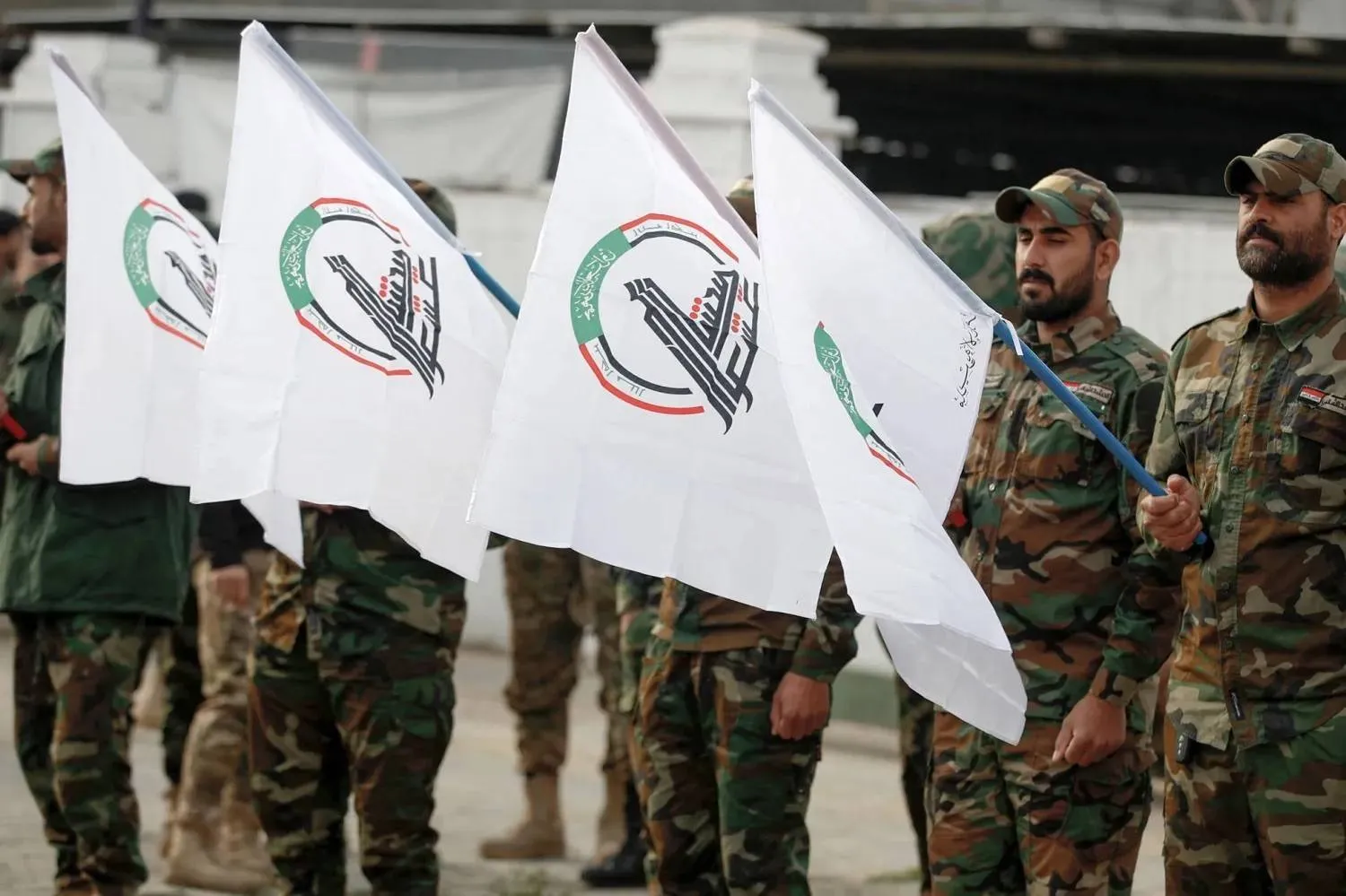
Members of the Popular Mobilization Forces during the funeral of comrades killed in a US strike (AFP). 
TT

Two Warnings, Arab and Western, ‘Tip the Balance’ in Iraq

Members of the Popular Mobilization Forces during the funeral of comrades killed in a US strike (AFP). 

In an unusual development, informed sources told Asharq Al-Awsat that the Iraqi government and influential political actors received two extraordinary warning messages over the past two weeks — one from an Arab country and another from a Western intelligence service — containing what were described as “serious” indications of impending, wide-ranging military strikes inside Iraq.

An Iraqi official confirmed that a “friendly state” had briefed Baghdad on the substance of the threat, prompting Shiite factions to move swiftly toward concessions.

According to the sources, potential targets could have included government institutions linked to Shiite factions and the Popular Mobilization Forces (PMF), powerful financial and military figures, sites and depots for drones and missiles, and training camps.

The two warnings are widely believed to have accelerated a recent wave of political statements by factions calling to “confine weapons to the state,” while simultaneously requesting time and freedom of action, within what they termed a “national framework”, to dismantle their military capabilities. This position remains a point of contention among leaders of the Coordination Framework.

A Message from a “Friendly State”

The threat level first rose with a message from an Arab country that maintains good relations with both Washington and Tehran. The message warned that Baghdad was perilously close to a swift military strike, likened to the targeting of Hamas’ political office in Doha in September 2025.

The message, delivered to Iraqi officials and politicians, stressed that the threat was “extremely serious” and that Israelis were now speaking openly of having received a green light from the United States to act unilaterally in the Iraqi theater.

Iraq has been among the arenas Israel has contemplated striking since the Oct. 7, 2023 attacks. Iraqi politicians told Asharq Al-Awsat in recent months that Washington had restrained Israel from operating in Iraq, while pressing Baghdad to remove the risks posed by weapons outside state control.

A Western diplomat said US officials felt Iraqi leaders did not fully grasp the gravity of the situation and had grown frustrated with what they saw as a weak response.

An Iraqi government official acknowledged receiving multiple warnings about armed groups from friendly states and Western embassies in Baghdad.

“A Massive File”

Days after the Arab message, Iraqi officials received what sources described as a “massive file” from a Western intelligence service. The file included Israeli-prepared lists packed with detailed information on Iraqi armed factions.

The breadth, precision, and depth of the intelligence stunned Iraqi officials. One told Asharq Al-Awsat that the timing of revealing the extent of Israel’s knowledge was critical. The lists reportedly detailed faction leaders, covert operatives within their inner circles, financiers and business figures tied to the groups, and government institutions serving as fronts for factional influence.

The Western service warned that Israel was on the verge of a broad operation now that the factions’ operational and financial capabilities and the deep networks underpinning their military structures had been exposed. After reviewing parts of the file, Shiite politicians reportedly recalled the pager explosions in Lebanon as a cautionary precedent.

“What Now?”

A senior Shiite leader within the Coordination Framework revealed that the two messages “changed the equation,” pushing party leaders to accelerate steps related to factional arms. Many are now grappling with a single question: what to do next? Disagreements persist over the method and the trusted authority to oversee a transitional phase of weapons consolidation.

The leader noted the first phase would involve handing over ballistic missiles and drones and dismantling and surrendering strategic camps north and south of Baghdad. A second phase, he claimed, would include removing faction-affiliated officials from the PMF, pending the US response.

An official in the State of Law Coalition said an agreement to remove heavy weapons had already existed within the Coordination Framework, even before US pressure intensified. Current disputes center on which state body would take custody of the weapons, amid US distrust of security institutions seen as influenced by factions.

Complicating matters, factions fear implementing disarmament amid fraught negotiations to form a new government. Caretaker Prime Minister Mohammad Shia al-Sudani is seeking a second term after winning the largest bloc within the Coordination Framework, a bid opposed by his rival Nouri al-Maliki, who favors a compromise candidate.

US Pressure

The Western intelligence message coincided with the arrival in Iraq of Senior Defense Official Colonel Stephanie Bagley. US defense funding will hinge on three conditions set out in the 2025 National Defense Authorization Act, passed on Dec. 11, 2025.

The law conditions assistance on Iraq’s ability to publicly and verifiably reduce the operational capacity of Iran-aligned armed groups not integrated into the security forces through disarmament, demobilization, and reintegration. It also requires strengthening the Iraqi prime minister’s authority as commander-in-chief and investigating and prosecuting militia members or security personnel operating outside the official chain of command if involved in attacks or destabilizing acts.

Western diplomatic sources said Bagley is expected to seek a clear, enforceable timeline from Iraqi officials. She met twice in one week with Army Chief of Staff Lt. Gen. Abdul Amir Yarallah in October 2025.

A former Iraqi official noted that Washington has repeatedly pressed Baghdad for a timeline to dismantle militia influence, especially ahead of 2026, when the US-led coalition is set to complete its mission. A US State Department spokesperson reaffirmed that Washington will continue to press for the disarmament of Iran-backed militias that undermine Iraq’s sovereignty and threaten Iraqis and Americans alike.


Gaza’s Rafah Border Crossing with Egypt Reopens for Limited Traffic in Key Step for Ceasefire

01 February 2026, Palestinian Territories, Khan Younis: Trucks carrying humanitarian aid arrive in Khan Yunis in the southern Gaza Strip, after passing through the Rafah border crossing from Egypt. Photo: Abed Rahim Khatib/dpa
TT

Gaza’s Rafah Border Crossing with Egypt Reopens for Limited Traffic in Key Step for Ceasefire

01 February 2026, Palestinian Territories, Khan Younis: Trucks carrying humanitarian aid arrive in Khan Yunis in the southern Gaza Strip, after passing through the Rafah border crossing from Egypt. Photo: Abed Rahim Khatib/dpa

Gaza’s Rafah border crossing with Egypt reopened on Monday for limited traffic, a key step as the Israeli-Hamas ceasefire moves ahead, according to Egyptian and Israeli security officials.

An Egyptian official said 50 Palestinians would cross in each direction in the first day of the crossing’s operation. The official, involved in talks related the implementation of the ceasefire deal, spoke to The Associated Press on condition of anonymity to discuss the issue.

State-run Egyptian media and an Israeli security official also confirmed the reopening, which for now at least, is largely symbolic. Few people will be allowed to travel in either direction, and no goods will be allowed to enter.

About 20,000 Palestinian children and adults needing medical care hope to leave devastated Gaza via the crossing, according to Gaza health officials. Thousands of other Palestinians outside the territory hope to enter and return home.

Israeli Prime Minister Benjamin Netanyahu has also said that Israel will allow 50 patients a day to leave. An official involved in the discussions, speaking on condition of anonymity to discuss the diplomatic talks, said each patient would be allowed to travel with two relatives, while some 50 people who left Gaza during the war would be allowed to return each day.

The Egyptian health ministry said in a statement on Monday that 150 hospitals across the country have been prepared to receive Palestinian patients and wounded who will be evacuated from Gaza through the Rafah crossing.

Israel has said it and Egypt will vet people for exit and entry through the crossing, which will be supervised by European Union border patrol agents with a small Palestinian presence. The numbers of travelers are expected to increase over time, if the system is successful.

Israeli troops seized the Rafah crossing in May 2024, calling it part of efforts to combat arms-smuggling for the Hamas group. The crossing was briefly opened for the evacuation of medical patients during a ceasefire in early 2025. Israel had resisted reopening the Rafah crossing, but the recovery of the remains of the last hostage in Gaza last week cleared the way to move forward.

The reopening is a key step as last year’s US-brokered ceasefire agreement that took effect on Oct. 10 moves into its second phase.

Before the war, Rafah was the main crossing for people moving in and out of Gaza. The territory’s handful of other crossings are all shared with Israel. Under the ceasefire terms, Israel’s military controls the area between the Rafah crossing and the zone where most Palestinians live.

Fearing that Israel could use the crossing to push Palestinians out of the enclave, Egypt has repeatedly said it must be open for them to enter and exit Gaza.

The current ceasefire halted more than two years of war between Israel and Hamas that began with the Hamas-led attack on southern Israel on Oct. 7, 2023. The truce’s first phase called for the exchange of all hostages held in Gaza for hundreds of Palestinians held by Israel, an increase in badly needed humanitarian aid and a partial pullback of Israeli troops.

The second phase of the ceasefire deal is more complicated. It calls for installing the new Palestinian committee to govern Gaza, deploying an international security force, disarming Hamas and taking steps to begin rebuilding.


Iraq Starts Investigations into ISIS Detainees Moved from Syria

A member of the Popular Mobilization Forces stands guard near a concrete wall at the Iraqi-Syrian border in Al-Qaim, west of Iraq on January 23, 2026. (AFP)
TT

Iraq Starts Investigations into ISIS Detainees Moved from Syria

A member of the Popular Mobilization Forces stands guard near a concrete wall at the Iraqi-Syrian border in Al-Qaim, west of Iraq on January 23, 2026. (AFP)

Iraq's judiciary announced on Monday it has begun its investigations into more than 1,300 ISIS group detainees who were transferred from Syria as part of a US operation.

"Investigation proceedings have started with 1,387 members of the ISIS terrorist organization who were recently transferred from the Syrian territory," the judiciary's media office said in a statement.

"Under the supervision of the head of Iraq's Supreme Judicial Council, several judges specializing in counterterrorism started the investigation."

Those detainees are among 7,000 ISIS suspects, previously held by Syrian Kurdish fighters, whom the US military said it would transfer to Iraq after Syrian government forces recaptured Kurdish-held territory.

They include Syrians, Iraqis and Europeans, among other nationalities, according to several Iraqi security sources.

In 2014, ISIS swept across Syria and Iraq, committing massacres. Backed by US-led forces, Iraq proclaimed the defeat of ISIS in the country in 2017, and the Kurdish-led Syrian Democratic Forces (SDF) ultimately beat back the group in Syria two years later.

The SDF went on to jail thousands of suspected extremists and detain tens of thousands of their relatives in camps.

Last month, the United States said the purpose of its alliance with Kurdish forces in Syria had largely expired, as Damascus pressed an offensive to take back territory long held by the SDF.

In Iraq, where many prisons are packed with ISIS suspects, courts have handed down hundreds of death sentences and life terms to people convicted of terrorism offences, including many foreign fighters.

Iraq's judiciary said its investigation procedures "will comply with national laws and international standards".


Israel Fears SDF-Like Agreement in South Syria

A resident greets Syrian government forces south of Hasakah, in northeastern Syria, on Jan. 20, 2026. (Credit: Omar Haj Kadour/AFP) 
TT

Israel Fears SDF-Like Agreement in South Syria

A resident greets Syrian government forces south of Hasakah, in northeastern Syria, on Jan. 20, 2026. (Credit: Omar Haj Kadour/AFP) 

As the United States seeks to activate the joint Syrian-Israeli Mechanism Committee and invite it to meet again within the next two weeks, political sources in Tel Aviv revealed that the government of Benjamin Netanyahu is further disputing with Washington over Damascus.

The government considers the US policy in Syria as “silly and not compatible with the nature of the broiling Middle East,” the sources said.

According to far-right newspaper Makor Rishon, “Israel expressed frustration with the US administration's policy in Syria, including Washington’s support and confidence in the rule of Syrian President Ahmad al-Sharaa, who has not yet proven he cleared his past associated to the Hay’at Tahrir al-Sham.”

Misgav Institute Fellow, Dr. Elie Klutstein, wrote that Washington is looking out for its own interests in Syria while placing Israel's security interests on the sidelines.

Klutstein said the Israeli government should confront Washington to insist on its interests at any cost.

Israel fears the new regime in Syria succeeds at consolidating itself. Tel Aviv bets on an ethnically and sectarian fragmented country and could not support the idea of a “united Syria.”

Israel is particularly angered by an agreement between the Syrian Democratic Forces (SDF) and the Syrian government in the north, that would guarantee the unity of the Syrian territory.

Today, Israel also fears al-Sharaa government will reach a similar agreement with the Druze in the province of Sweida, south of the country.

The majority of Druze leaders in the south are concerned with the unity of Syria, and are ready to ink an agreement with the government in return of guarantees that attacks by its forces will not be repeated.

The leaders also argue that only a small Druze community opposes al-Sharaa regime and therefore, will eventually succumb to an agreement if the government is serious in granting them minority rights.

Last week, Hebrew media outlets said the comprehensive agreement between Kurdish-led Syrian SDF factions and the Syrian government to integrate with the Syrian army is not an arrangement between two equal parties.

“This is a Kurdish submission to Ahmed al-Sharaa that happened after government supporters dismantled the SDF from the inside, and brought several factions closer to the regime,” the Hebrew media wrote.

Earlier, US sources said Türkiye informed the US administration it supports a centralized Syrian state and rejects any Kurdish canton in the northeast.

In return, Israel’s government conveyed to Washington its opposition to a centralized Syria, preferring a federal model.

Sources said Netanyahu is angered by the outcome in northeastern Syria and considers US Special Envoy to Syria tom Barrack biased toward Ankara.

The Israeli circles see Türkiye as the 'biggest winner' from the collapse of the SDF.

Therefore, the Israeli government reiterated that it will not accept Turkish troop presence in Syria and insists on protecting Druze communities in southern Syria.

Tel Aviv’s response to the agreement between SDF forces and al-Sharaa’s government was translated on Friday, when Israeli forces entered two locations in southern Syria: the Saida al-Hanout village in the southern Quneitra countryside and the village of Samdaniya al-Sharqiya in the northern Quneitra countryside.

An Israeli patrol, consisting of seven military vehicles, erected a barrier west the village of Saida in Hanout, before withdrawing from the area.

This development came while the US plans to invite the joint Syrian-Israeli Mechanism Committee to again meet in Amman within the next two weeks and resume direct official talks between the two countries.

The joint fusion mechanism -- a dedicated communication cell -- aims to facilitate immediate and ongoing coordination on the two countries’ intelligence sharing, military de-escalation and diplomatic engagement under the supervision of the United States.