
Gazans Fear Renewed Displacement after Israeli Strikes

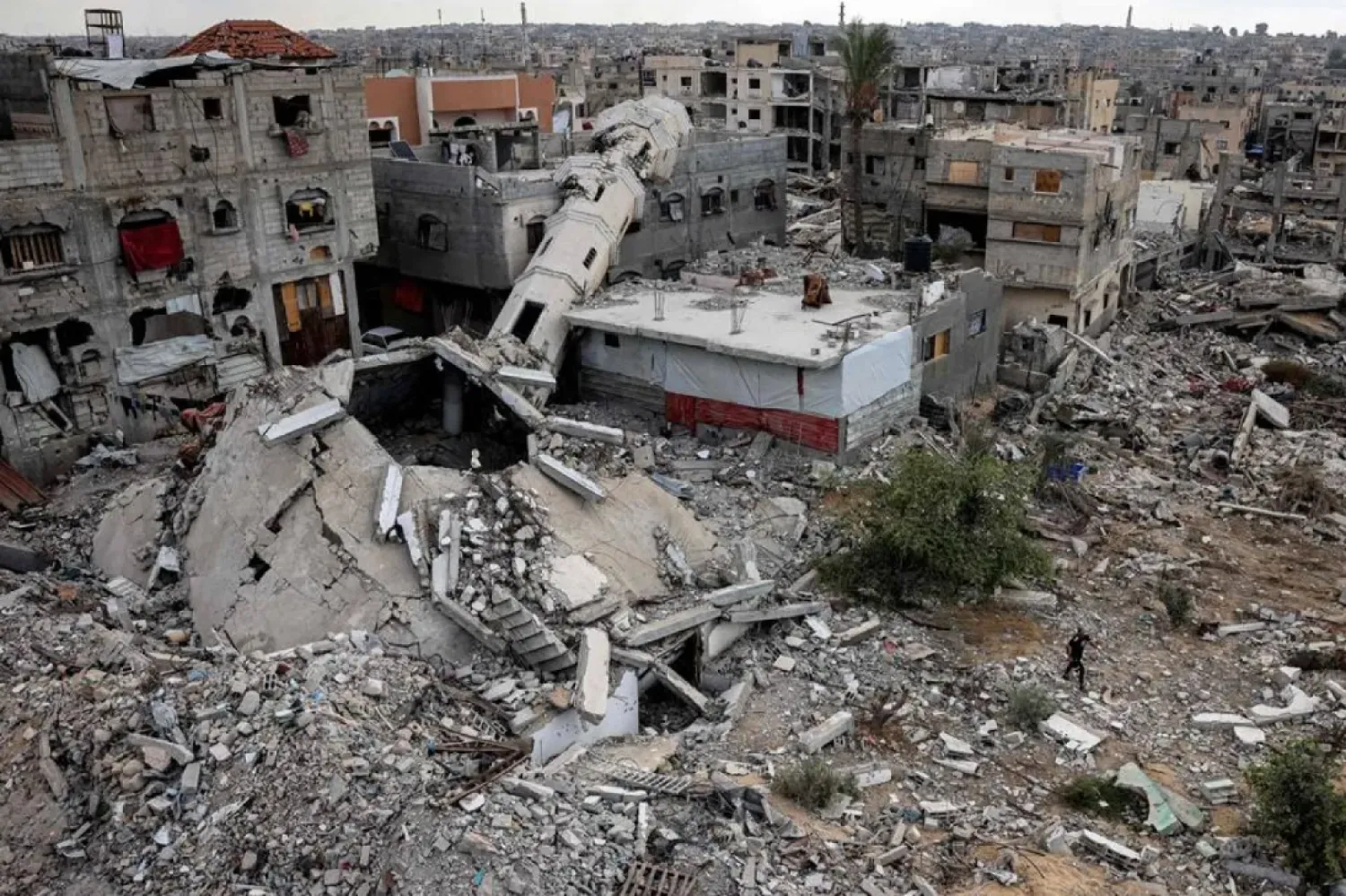
This overview shows a destroyed mosque and other buildings in Khan Younis in the southern Gaza Strip on October 7, 2024 on the first anniversary of the ongoing war in the Palestinian territory between Israel and Hamas. (AFP)
TT

Gazans Fear Renewed Displacement after Israeli Strikes

This overview shows a destroyed mosque and other buildings in Khan Younis in the southern Gaza Strip on October 7, 2024 on the first anniversary of the ongoing war in the Palestinian territory between Israel and Hamas. (AFP)

When her children, trembling with fear, ask where the family can go to escape Israel's continued bombardment in southern Gaza's Khan Yunis area, Umm Ahmed has no answer.

In her small, devastated village near Khan Yunis city, recent Israeli drone and artillery strikes shattered the tenuous sense of peace delivered by a ceasefire that has largely held since October 10, AFP said.

Residents say the strikes have targeted neighborhoods east of the so-called Yellow Line -- a demarcation established under the truce between Israel and Hamas.

The Israeli military says its troops are deployed in the area in accordance with the ceasefire framework, accusing Hamas militants of "crossing the Yellow Line and carrying out terrorist activities".

More than two years after Hamas's October 7 attack on Israel sparked a devastating war, tens of thousands of Gazans still live in tents or damaged homes in these areas, where the Israeli army maintains control and operates checkpoints.

Now, many fear being forced from their homes, compelled to move west of the Yellow Line.

"We don't sleep at night because of fear. The bombardments in the east are relentless," said Umm Ahmed, 40.

"My children tremble at every explosion and ask me, 'Where can we go?' And I have no answer."

Her home in Bani Suheila has been completely destroyed, yet the family has stayed, pitching a tent beside the ruins.

"Staying close to our destroyed home is easier than facing the unknown," Umm Ahmed said.

Crossing the Yellow Line to Al-Mawasi, west of Khan Yunis, is not an option for them.

There, makeshift camps stretch as far as the eye can see, housing tens of thousands of Palestinians who fled the fighting.

"There is no place left for anyone there, and not enough food or water," Umm Ahmed said, as Gaza remains trapped in a catastrophic humanitarian crisis.

- 'We will not leave' -

The Israeli military blames continued threats from the Hamas group for its actions in the area.

The Israeli military said in a statement to AFP that the army’s “current operations in Gaza, and their deployment in the Yellow Line area in particular, are carried out to address direct threats from terrorist organizations in Gaza.”

The war in Gaza began with Hamas's attack on Israel on October 7, 2023 that resulted in the deaths of 1,221 people, mostly civilians, according to an AFP tally based on official Israeli figures.

Since the war began, more than 70,000 people have been killed in Gaza, according to the Hamas-run territory's health ministry.

The vast majority of Gaza's more than two million residents were displaced during the war, many multiple times.

A fragile ceasefire has been in place since October 10, though both sides regularly accuse each other of violations.

Under the truce, Israeli forces withdrew to positions east of the Yellow Line.

Earlier this month, Israeli army chief Lieutenant General Eyal Zamir described the Yellow Line as the "new border line" with Israel.

"The Yellow Line is a new border line -- serving as a forward defensive line for our communities and a line of operational activity," he said to reserve soldiers in Gaza.

For Palestinian officials, the line is seen as a tool for permanent displacement.

"The objective is to frighten residents, expel them from their areas, and force them west," said Alaa al-Batta, mayor of Khan Yunis, denouncing the bombardments as "violations of the ceasefire agreement".

Mahmud Baraka, 45, from Khuzaa, east of Khan Yunis, described constant artillery fire and home demolitions in the area.

"It feels like we are still living in a war zone," he said.

"Explosions happen as if they are right next to us. The objective of the occupation is clear: to intimidate us and drive us out, so the region is emptied."

For now, residents feel trapped between bombardment and displacement, uncertain how long they can endure.

Despite the danger, Abdel Hamid, 70, refuses to leave his home located north of Khan Yunis, where he lives with his five children.

"We will not leave... this is our land," he said.

"Moving would not be a solution, but yet another tragedy."


Sudan’s Military Says It Breaks RSF’s Siege of a Key Town

A member of security walks in front of a destroyed building as efforts to restore the city's infrastructure resumes after nearly three years of devastation caused by war, in the Sudanese capital Khartoum on January 17, 2025. (AFP)
TT

Sudan’s Military Says It Breaks RSF’s Siege of a Key Town

A member of security walks in front of a destroyed building as efforts to restore the city's infrastructure resumes after nearly three years of devastation caused by war, in the Sudanese capital Khartoum on January 17, 2025. (AFP)

Sudan’s military said Monday it has broken a siege imposed by the paramilitary Rapid Support Forces on a key town in the central Kordofan region during the country's civil war.

In a statement, the military said it had opened a route leading to Dilling town in South Kordofan province, which the RSF for months has attempted to control. Holding the town means control over major supply lines.

“Our forces inflicted heavy losses on the enemy, both personal and equipment,” the statement said.

There was no immediate comment from the RSF, which has been at war with the military for nearly three years.

Sudan plunged into chaos in April 2023 when a power struggle between the military and the RSF exploded into open fighting in the capital, Khartoum, and elsewhere. The war has killed more than 40,000 people, according to UN figures, but aid groups say the true number could be many times higher.

The fighting has created the world’s largest humanitarian crisis, with over 14 million people forced to flee their homes. Parts of the country have been pushed into famine.

Dilling has reportedly experienced severe hunger, but the world's leading authority on food security, the Integrated Food Security Phase Classification, didn’t declare famine there in its November report because of a lack of data.

After being forced out of Khartoum in 2025, the paramilitary group has focused on Kordofan and the city of el-Fasher, which was the military’s last stronghold in the sprawling Darfur region until the RSF seized it in October.


Syria, Jordan Sign Gas Supply Deal to Bolster Syrian Power Grid

Syrian soldiers raise the Syrian national flag in front of the Syrian Defense Ministry building, which was heavily damaged by Israeli airstrikes last Wednesday, in Damascus, Syria, Saturday, July 19, 2025. (AP)
TT

Syria, Jordan Sign Gas Supply Deal to Bolster Syrian Power Grid

Syrian soldiers raise the Syrian national flag in front of the Syrian Defense Ministry building, which was heavily damaged by Israeli airstrikes last Wednesday, in Damascus, Syria, Saturday, July 19, 2025. (AP)

Syria and Jordan signed an agreement on Monday to supply natural gas to Syria via Jordanian territory, ​aiming to bolster Syria's fragile electricity grid, officials said.

The deal between the Syrian Petroleum Company and Jordan's National Electric Power Company, which was signed at Syria's Ministry of Energy in Damascus, provides for the delivery of about 4 million ‌cubic metres ‌of gas per ‌day — ⁠roughly ​140 million ‌cubic feet, Reuters reported.

The agreement builds on a broader energy arrangement signed last year to supply gas to Syria through Jordan, which is being financed by Qatar, part of regional efforts to ease Syria's acute power ⁠shortages after years of war and infrastructure damage, Syrian ‌and Jordanian officials have ‍said.

Jordan's energy minister, ‍Saleh al-Kharabsheh was quoted by Syrian state ‍media on Monday as saying deliveries began on January 1, with current volumes ranging between 30 million and 90 million cubic feet ​per day.

The deal would help Syria diversify its energy supply sources, the ⁠country's energy minister Mohamed al-Bashir said.

Supplies are being delivered via the Energos Force regasification vessel, leased from Egypt and docked at Jordan's Red Sea port of Aqaba until the end of March.

Jordan's National Electric Power Company has started procedures to lease a new floating storage and regasification unit to replace the existing vessel, ‌ensuring a continuous gas supply beyond March, Kharabsheh added.


UN Says Over 3 Million Sudanese Displaced by War Return Home

A Sudanese men who fled the conflict in Sudan's Darfur region, and was previously internally displaced in Sudan, walks past makeshift shelters near the border between Sudan and Chad, while taking refuge in Borota, Chad, May 13, 2023. © Zohra Bensemra, Reuters
TT

UN Says Over 3 Million Sudanese Displaced by War Return Home

A Sudanese men who fled the conflict in Sudan's Darfur region, and was previously internally displaced in Sudan, walks past makeshift shelters near the border between Sudan and Chad, while taking refuge in Borota, Chad, May 13, 2023. © Zohra Bensemra, Reuters

More than three million Sudanese people displaced by nearly three years of war have returned home, the United Nations migration agency said on Monday, even as heavy fighting continues to tear through parts of the country.

Since April 2023, Sudan has been locked in a devastating war pitting the regular army against the Rapid Support Forces (RSF).

The conflict has killed tens of thousands of people and created what the UN describes as the world's largest displacement and hunger crisis. At its peak, the war had displaced around 14 million people both internally and across borders.

In a report released on Monday, the International Organization for Migration (IOM) said an estimated 3.3 million displaced Sudanese had made their way back home by November of last year, AFP reported.

The rise in returns follows a sweeping offensive launched by the Sudanese army in late 2024 to retake central regions seized earlier in the conflict by the RSF.

The campaign culminated in the recapture of Khartoum in March 2025, prompting many displaced families to try to go back.

According to the IOM, more than three-quarters of those returning came from internal displacement sites, while 17 percent travelled back from abroad.

Khartoum saw the largest number of returns -- around 1.4 million people -- followed by the central state of Al-Jazira, where roughly 1.1 million have gone back.

Earlier this month, the army-backed government announced plans to return to the capital after nearly three years of operating from the Red Sea city of Port Sudan in the country's east.

Reconstruction work in Khartoum has been underway since the army retook the city.

Although Khartoum and several army-held cities in central and eastern Sudan have seen a relative lull in fighting, the RSF has continued to launch occasional drone strikes, particularly targeting infrastructure.

Elsewhere, violence remains intense.

In the country's south, RSF forces have pushed deeper into the Kordofan region after seizing the army's final stronghold in Darfur last October.

Reports of mass killings, rape, abductions and looting emerged after El-Fasher's RSF takeover, and the International Criminal Court launched a formal investigation into "war crimes" by both sides.