


STC Accused of Committing Hundreds of Violations in Yemen's Hadhramaut 

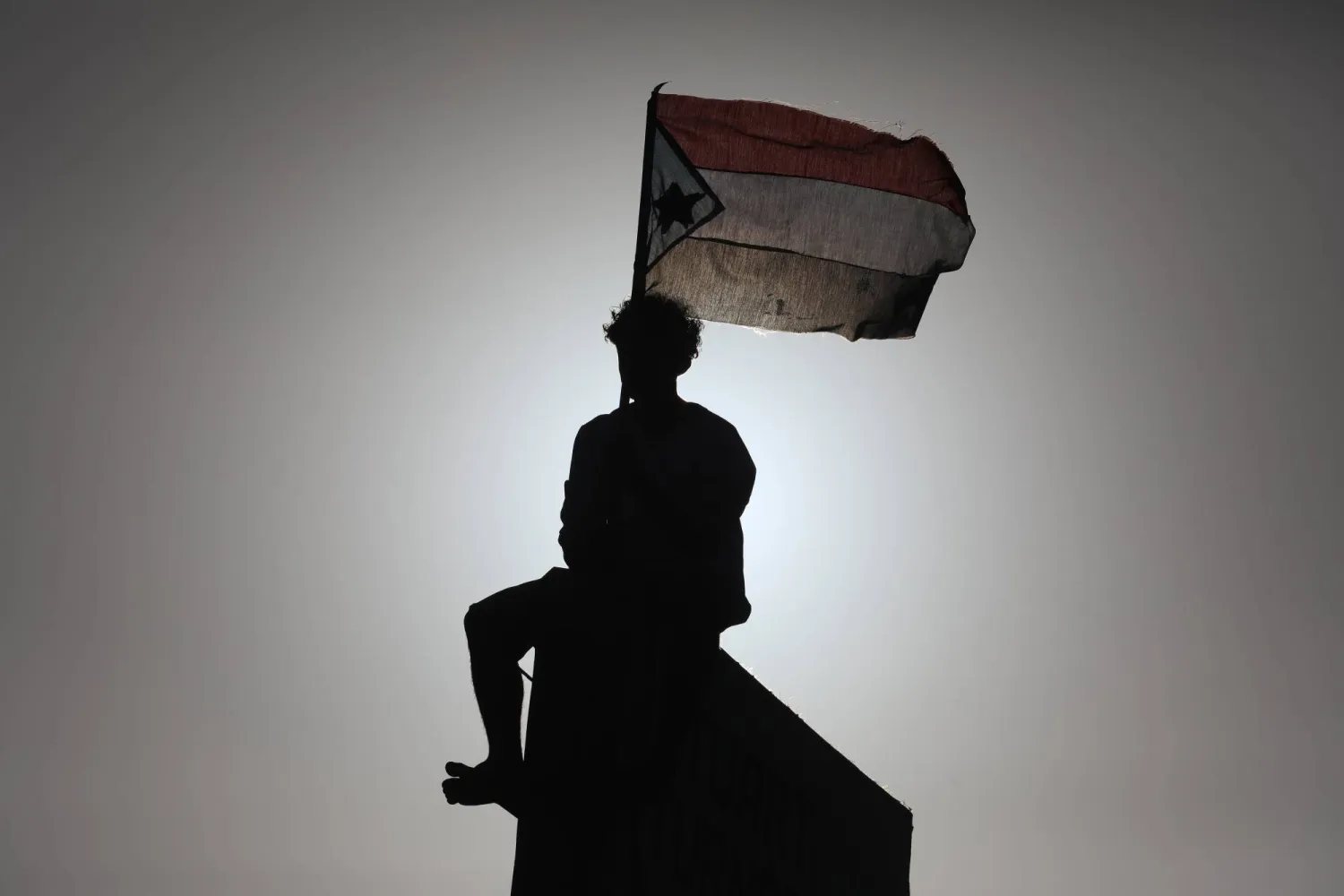
A person waves a South Yemen flag during a rally in the southern port city of Aden, Yemen, 25 December 2025. (EPA)
TT

STC Accused of Committing Hundreds of Violations in Yemen's Hadhramaut 

A person waves a South Yemen flag during a rally in the southern port city of Aden, Yemen, 25 December 2025. (EPA)

Yemeni Defense Minister Mohsen Mohammed al-Daeri welcomed on Monday Saudi Defense Minister Prince Khalid bin Salman's message to the Yemeni people in which he called on the Southern Transitional Council (STC) to withdraw its forced from the Hadhramaut and al-Mahra governorates.

He said the message underscores "Saudi Arabia's firm support to Yemen and its legitimate authorities and its constant keenness on backing its unity."

The Kingdom has backed Yemen's efforts to restore state institutions, liberate all of its territories and achieve the goals of the Arab coalition and therefore bolster security and stability in Yemen and the region, he added in a post on Facebook.

He expressed his "absolute trust in the Saudi leadership and its ability to overcome and resolve any differences to help guide both northern and southern Yemen to safety."

He hailed the "Saudi sacrifices and its continuous generous support" to Yemen in all fields, voicing his pride "in this strategic partnership that will remain a cornerstone to completing the liberation and building a secure and prosperous future."

Hundreds of violations

Separately, as the STC continues its unilateral military escalation, reports have emerged of hundreds of violations it has committed in Hadhramaut.

The Yemeni Network for Rights and Freedoms (YNRF) documented 614 violations in the governorate between December 2 and 25. It spoke of a "systematic" targeting of civilians and social infrastructure that has displaced some 5,000 families.

In a report on Monday, it said that the "extent of the violations reflects a systematic pattern of practices that cannot be described as incidental. Rather, they are part of a methodical policy that threatens social peace and undermines the rule of law in one of Yemen's most relatively stable governorates."

The violations include murder, extrajudicial killings, arbitrary arrests, forced disappearances and displacement, and looting of private and public property. It documented the killing of 35 members of the army and 12 civilians, and the injury of 56 others, in Hadhramaut.

It documented seven cases of extrajudicial killings of prisoners and 316 cases of arbitrary arrest against civilians. It reported 216 cases of forced disappearances in Hadhramaut, Raymah, Hajjah, Taiz, Dhumar, Abyan, Ibb and other provinces.

The network noted the looting of 112 homes and 56 commercial establishments.

It said that it has received dozens of notices about the detention and forced disappearance of civilians. It revealed that hundreds of military personnel have been reported missing in grave violation of national law and international standards.

The network said the STC violations are a flagrant violation of international humanitarian law and commitments that have been made in Yemen. Some of the violations can also amount to war crimes and crimes against humanity.

It warned of the "catastrophic" humanitarian consequences of the violations, such as the breakup of the social fabric, greater internal displacement, and collapse of the local economy.

It demanded clear international condemnation of the violations in Hadhramaut, urging an immediate and unconditional end to them. It called for the immediate release of all arbitrarily held detainees and that looted property be returned to their owners. It also demanded that those responsible be held to account.

The developments in Hadhramaut "were not an isolated incident, but part of a systematic pattern that undermines the opportunities for stability and peace in Yemen," it warned.



Egypt’s Prime Minister and FM Head to Washington for Trump Peace Council Meeting

Egyptian Foreign Minister Badr Abdelatty speaks during a joint press conference with Kenyan Prime Cabinet Secretary/Cabinet Secretary for Foreign Diaspora Affairs Musalia Mudavadi in Nairobi, Kenya, Monday, Feb. 16, 2026. (AP)
TT

Egypt’s Prime Minister and FM Head to Washington for Trump Peace Council Meeting

Egyptian Foreign Minister Badr Abdelatty speaks during a joint press conference with Kenyan Prime Cabinet Secretary/Cabinet Secretary for Foreign Diaspora Affairs Musalia Mudavadi in Nairobi, Kenya, Monday, Feb. 16, 2026. (AP)

Egypt's Prime Minister Mostafa Madbouly headed to Washington on Tuesday ‌to ‌participate in ‌the inaugural ⁠meeting of a "Board of Peace" established by US President Donald ⁠Trump, the ‌cabinet ‌said.

Madbouly is ‌attending ‌on behalf of President Abdel ‌Fattah al-Sisi and is accompanied by ⁠Foreign ⁠Minister Badr Abdelatty.

Foreign Minister Gideon Saar will represent Israel at the inaugural meeting, his office said on Tuesday.

Hamas, meanwhile, called on the newly-formed board to pressure Israel to halt what it described as ongoing violations of the ceasefire in Gaza.

The Board of Peace, of which Trump is the chairman, was initially designed to oversee the Gaza truce and the territory's reconstruction after the war between Hamas and Israel.

But its purpose has since morphed into resolving all sorts of international conflicts, triggering fears the US president wants to create a rival to the United Nations.

Saar will first attend a ministerial level UN Security Council meeting in New York on Wednesday, and on Thursday he "will represent Israel at the inaugural session of the board, chaired by Trump in Washington DC, where he will present Israel's position", his office said in a statement.

It was initially reported that Prime Minister Benjamin Netanyahu might attend the gathering, but his office said last week that he would not.

Ahead of the meeting, Hamas spokesman Hazem Qassem told AFP that the Palestinian movement urged the board's members "to take serious action to compel the Israeli occupation to stop its violations in Gaza".

"The war of genocide against the Strip is still ongoing -- through killing, displacement, siege, and starvation -- which have not stopped until this very moment," he added.

He also called for the board to work to support the newly formed Palestinian technocratic committee meant to oversee the day-to-day governance of post-war Gaza "so that relief and reconstruction efforts in Gaza can commence".

Announcing the creation of the board in January, Trump also unveiled plans to establish a "Gaza Executive Board" operating under the body.

The executive board would include Turkish Foreign Minister Hakan Fidan and Qatari diplomat Ali Al-Thawadi.

Netanyahu has strongly objected to their inclusion.

Since Trump launched his "Board of Peace" at the World Economic Forum in Davos in January, at least 19 countries have signed its founding charter.


Palestinian Child Dies After Stepping on Mine in West Bank

Israeli troops conduct a military raid in the village of Al-Yamoun, west of Jenin, West Bank, 17 February 2026. (EPA)
TT

Palestinian Child Dies After Stepping on Mine in West Bank

Israeli troops conduct a military raid in the village of Al-Yamoun, west of Jenin, West Bank, 17 February 2026. (EPA)

A Palestinian child died after stepping on a mine near an Israeli military camp in the occupied West Bank on Tuesday, the Palestinian Red Crescent said, with an Israeli defense ministry source confirming the death.

"Our crews received the body of a 13-year-old child who was killed after a mine exploded in one of the old camps in Jiftlik in the northern Jordan Valley," the Red Crescent said in a statement.

A source at COGAT, the Israeli defense ministry's agency in charge of civilian matters in the Palestinian territories, confirmed the death to AFP and identified the boy as Mohammed Abu Dalah, from the village of Jiftlik.

Israel's military had previously said in a statement that three Palestinians were injured "as a result of playing with unexploded ordnance", without specifying their ages.

It added that the area of the incident, Tirzah, is "a military camp in the area of the Jordan Valley", near Jiftlik and close to the Jordanian border.

"This area is a live-fire zone and entry into it is prohibited," the military said.

Jiftlik village council head Ahmad Ghawanmeh told AFP that three children, the oldest of whom was 16, were collecting herbs near the military base when they detonated a mine.

Jiftlik as well as the nearby Tirzah base are located in the Palestinian territory's Area C, which falls under direct Israeli control.

Israel has occupied the West Bank since 1967.

Much of the area near the border with Jordan -- which Israel signed a peace deal with in 1994 -- remains mined.

In January, Israel's defense ministry said it had begun demining the border area as part of construction works for a new barrier it says aims to stem weapons smuggling.


Hezbollah Rejects Disarmament Plan and Government’s Four-Month Timeline

29 July 2024, Iran, Tehran: Then Hezbollah deputy leader Sheikh Naim Qassem is pictured during a meeting in Tehran. (Iranian Presidency/dpa)
TT

Hezbollah Rejects Disarmament Plan and Government’s Four-Month Timeline

29 July 2024, Iran, Tehran: Then Hezbollah deputy leader Sheikh Naim Qassem is pictured during a meeting in Tehran. (Iranian Presidency/dpa)

Hezbollah rejected on Tuesday the Lebanese government's decision to grant the army at least four months to advance the second phase of a nationwide disarmament plan, saying it would not accept what it sees as a move serving Israel.

Lebanon's cabinet tasked the army in August 2025 with drawing up and beginning to implement a plan to bring all armed groups' weapons under state control, a bid aimed primarily at disarming Hezbollah after its devastating ‌war with ‌Israel in 2024.

In September 2025 the cabinet formally ‌welcomed ⁠the army's plan to ⁠disarm the Iran-backed Shiite party, although it did not set a clear timeframe and cautioned that the military's limited capabilities and ongoing Israeli strikes could hinder progress.

Hezbollah Secretary-General Sheikh Naim Qassem said in a speech on Monday that "what the Lebanese government is doing by focusing on disarmament is a major mistake because this issue serves the goals of Israeli ⁠aggression".

Lebanon's Information Minister Paul Morcos said during a press ‌conference late on Monday after ‌a cabinet meeting that the government had taken note of the army's monthly ‌report on its arms control plan that includes restricting weapons in ‌areas north of the Litani River up to the Awali River in Sidon, and granted it four months.

"The required time frame is four months, renewable depending on available capabilities, Israeli attacks and field obstacles,” he said.

Hezbollah lawmaker Hassan ‌Fadlallah said, "we cannot be lenient," signaling the group's rejection of the timeline and the broader approach to ⁠the issue of ⁠its weapons.

Hezbollah has rejected the disarmament effort as a misstep while Israel continues to target Lebanon, and Shiite ministers walked out of the cabinet session in protest.

Israel has said Hezbollah's disarmament is a security priority, arguing that the group's weapons outside Lebanese state control pose a direct threat to its security.

Israeli officials say any disarmament plan must be fully and effectively implemented, especially in areas close to the border, and that continued Hezbollah military activity constitutes a violation of relevant international resolutions.

Israel has also said it will continue what it describes as action to prevent the entrenchment or arming of hostile actors in Lebanon until cross-border threats are eliminated.