


Sudan: How One Hospital Saved Thousands of Lives Amid War

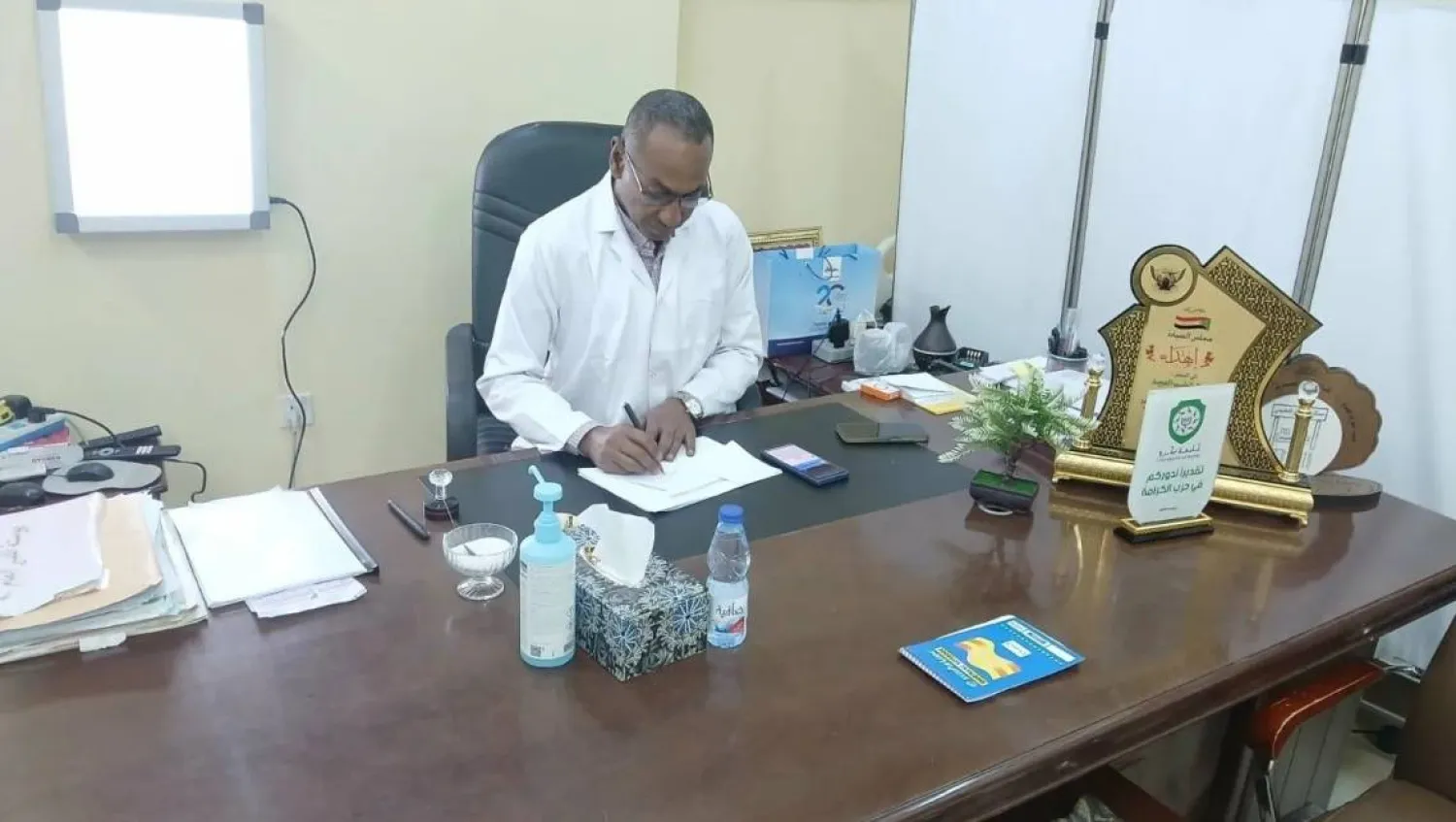
Al Nao Hospital Director Dr. Jamal Eltaeb (Asharq Al-Awsat)
TT

Sudan: How One Hospital Saved Thousands of Lives Amid War

Al Nao Hospital Director Dr. Jamal Eltaeb (Asharq Al-Awsat)

As Sudan’s war dragged on and fighting engulfed the capital Khartoum, the health system collapsed almost entirely. Hospitals shut their doors one after another, until only a single facility remained in operation in the city of Omdurman.

Al Nao Hospital, perched west of the city on the front line of fierce military confrontations, became the capital’s last functioning emergency hospital, receiving the wounded, responding to urgent cases, and saving thousands of lives under relentless fire.

Despite severe security and psychological pressure, a small group of doctors, health workers, volunteers, and technicians held out to keep the hospital running amid indiscriminate shelling, falling rockets and artillery rounds, severe shortages of supplies, power and water outages, the collapse of communications, and an ever-increasing flow of emergency cases.

Throughout the siege and restrictions imposed on the hospital, doctors, medical staff, and volunteers treated the wounded using just three worn-out ambulances.

Their meals were limited to beans and lentils for breakfast and dinner, as no restaurants were operating in the surrounding area, which was saturated with the smell of blood and gunpowder.

Their efforts earned them the Aurora Prize for Awakening Humanity, which is awarded to individuals who risk their lives, freedom, or health to save others.

Harsh days

The field hospital demonstrated its ability to function in the darkest of times.

“I was deeply affected by the deaths of children, and they were in large numbers,” hospital director Dr. Jamal Eltaeb told Asharq Al-Awsat.

“We were receiving more than 100 cases a day, sometimes within a single hour, around 4,000 a month, with injuries ranging from severe to minor, and we treated large numbers of wounded.”

Eltaeb said the hospital began operating on April 17, 2023, just days after the outbreak of the war, through an initiative launched by young volunteers and with extremely limited capabilities to treat the wounded.

“The injuries caused by indiscriminate shelling shook me deeply, especially among children and women,” he said.

“The deaths of young children were the most painful. Even if you are a doctor, you never get used to seeing children with amputated limbs or their abdomens torn open.”

Drowning in chaos

While the streets of Omdurman sank into chaos, the hospital remained alive with activity.

“We worked with the medical staff available and the limited medicines we had,” Eltaeb said. “The Dutch organization Doctors Without Borders provided us with major support.”

He added that after the war began, he moved from Khartoum to Omdurman as a volunteer, before Khartoum State’s health ministry personally asked him to formally manage the hospital in July 2023.

Alongside colleagues Dr. Amir Mohammed Al-Hassan, a specialist in internal medicine and cardiology, and Dr. Yasser Shamboul, a specialist in internal medicine, he began work with limited resources.

“Ministries and institutions were absent,” Eltaeb said.

“The wounded, the sick, the elderly, and children accept no excuses. They just want someone to treat them.”

Painful scenes

In February 2025, a powerful explosion rocked a popular market in Omdurman, quickly flooding the hospital’s emergency room with bodies and injured victims. “That was one of the most difficult days,” Eltaeb said.

“Sabreen Market was crowded with shoppers. We received around 170 injured people in less than two hours, transported by trucks because there was no ambulance service.”

Those who attempted to help were not doctors or health workers, he said, leading to chaotic transport that mixed the dead with the wounded.

Hospital staff sorted the bodies from the living inside the trucks and confirmed 48 deaths, alongside patients with varying injuries, some of whom lost limbs or were left with permanent disabilities.

“But thank God, we saved the lives of the rest,” he said.

The hospital itself came under indiscriminate shelling, yet doctors and medical staff insisted on continuing their work.

Eltaeb said several hospital workers were killed by shelling and rockets, one volunteer died inside the adjacent mosque, two security guards were killed, and a soldier was wounded by a sniper’s bullet inside the hospital.

Aurora humanitarian prize

The Aurora Foundation for Awakening Humanity awarded its 2025 prize, worth $1 million, to Dr. Jamal Eltaeb in recognition of his efforts managing a hospital that served as a final medical line of defense in Khartoum during the armed conflict.

The prize is one of the world’s leading humanitarian awards, honoring those who risk their lives, freedom, or health to save others and alleviate suffering in situations of conflict, crimes against humanity, or human rights violations.

“I do not know who nominated me for this prize,” Eltaeb said. “I was selected from among 880 nominees without my knowledge. When the shortlist was reduced to 25 people, I learned that I had been nominated.”

He said the prize committee searched for him by sending inquiries to hospitals across Europe, looking for a doctor named Jamal Eltaeb. A colleague in anesthesia in London emailed a message to a fellow doctor at Al Nao Hospital, who forwarded it to him.

“When I read the message, I thought it was some kind of joke and did not reply,” he said. After being encouraged to respond, he shared his contact details and received a call the following day, as the shortlist narrowed to 15, then four, before he was named the final winner.

“The prize does not represent me personally,” Eltaeb said. “It represents the hospital family, the doctors, administrators, and workers. I was only leading them. I am no more deserving of this prize than they are.”



MSF Says May Have to Halt Gaza Operations in March

Palestinians walk past destroyed buildings in the northern Gaza Strip, Friday, Jan. 2, 2026. (AP Photo/Jehad Alshrafi)
TT

MSF Says May Have to Halt Gaza Operations in March

Palestinians walk past destroyed buildings in the northern Gaza Strip, Friday, Jan. 2, 2026. (AP Photo/Jehad Alshrafi)

Banned from the Gaza Strip with 36 aid bodies, medical charity Doctors Without Borders said Saturday it will have to end its operations there in March if Israel does not reverse its decision.

UN secretary general Antonio Guterres called on Friday for Israel to end a ban on humanitarian agencies that provided aid in Gaza, saying he was "deeply concerned" at the development.

Israel confirmed on Thursday it is barring 37 major international humanitarian organizations from entering the Gaza Strip, accusing them of failing to provide the list of their employees' names, which is now officially required for "security" reasons.

MSF called this demand a "scandalous intrusion" but Israel says is needed to stop jihadists from infiltrating into humanitarian structures, AFP reported.

"To work in Palestine, in the occupied Palestinian territories, we have to be registered ... That registration expired on December 31, 2025," said Isabelle Defourny, a physician and president of MSF France, on France Inter.

"Since July 2025, we have been involved in a re-registration process and to date, we have not received a response. We still have 60 days during which we could work without being re-registered, and so we would have to end our activities in March" if Israel maintains its decision, she said.

MSF has around 40 international staff in the Gaza Strip and works with 800 Palestinian staff across eight hospitals.

"We are the second-largest distributor of water (in the Gaza Strip). Last year, in 2025, we treated just over 100,000 people who were wounded, burned, or victims of various traumas. We are second in terms of the number of deliveries performed," the president of MSF France said.

According to her, the Israeli decision is explained by the fact that NGOs "bear witness to the violence committed by the Israeli army" in Gaza.


Yemen Consultation, Reconciliation Body Says National Shield Camp Takeover is Peaceful

Yemen Consultation, Reconciliation Body Says National Shield Camp Takeover is Peaceful
TT

Yemen Consultation, Reconciliation Body Says National Shield Camp Takeover is Peaceful

Yemen Consultation, Reconciliation Body Says National Shield Camp Takeover is Peaceful

Akram al-Amri, deputy head of Yemen’s Consultation and Reconciliation Commission, stated that the operation to take over military camps, led by the National Shield forces under the command of Salem al-Khanbashi, Governor of Hadhramaut and head of the security committee, is not a military offensive operation.

Al-Amri said the move is peaceful in nature and aims to take over “military and security sites occupied by forces of the Southern Transitional Council (STC) that came from outside Hadhramaut.”

He said that all directives had been issued and all possible means had been exhausted to have the sites vacated voluntarily, in response to the demands of the people of the governorate.

Al-Amri, who also serves as secretary general of the Hadhramaut Inclusive Conference, called on the people of the governorate to stand by the National Shield forces and welcome them.

He also urged the STC leadership in Hadhramaut to opt for peace and preserve their land, saying, “There is no cause for concern. We are brothers, united by Hadhramaut.”

“Hadhramaut has launched a new political, economic, and development phase with comprehensive support from our brothers in the Kingdom of Saudi Arabia, which will be announced soon,” he revealed.

Separately, the Hadhramaut Inclusive Conference welcomed the announcement by al-Khanbashi, launching the “camp takeover” operation, describing it as a responsible step aimed at assuming control of military sites in a peaceful and orderly manner that strengthens state authority and preserves Hadhramaut’s security and stability.

In a statement, the conference stressed that the operation does not target any specific political or social group, does not impact civilians or citizens’ interests, and does not constitute an escalation or a declaration of war.

It stated that the move is a preventive measure to protect Hadhramaut from chaos and to prevent the use of military camps from threatening its security.

The conference commended the efforts of the legitimate state authorities, with the support of Saudi Arabia, to establish channels of dialogue and understanding, emphasizing that political solutions remain the most effective way to address disputes.

It added that obstructing these efforts compels the state to assume its constitutional responsibilities to protect citizens and prevent a slide into chaos.

The Hadhramaut Inclusive Conference reaffirmed its support for all prudent efforts that safeguard social peace and protect state institutions, and commended the Hadhramaut governor’s call on various social forces to play their national role during this sensitive phase.


UN Force in Lebanon Says Israeli Army Fired Near its Peacekeepers Twice

Joint patrol of the Lebanese army and UNIFIL (UNIFIL via Telegram)
TT

UN Force in Lebanon Says Israeli Army Fired Near its Peacekeepers Twice

Joint patrol of the Lebanese army and UNIFIL (UNIFIL via Telegram)

The United Nations Interim Force in Lebanon (UNIFIL) said gunfire from an Israeli position hit close to its peacekeepers twice on Friday, reporting no casualties but decrying a “concerning trend.”

UNIFIL has repeatedly reported Israeli fire near or towards its personnel in recent months, and last week said an Israeli attack near one of its positions lightly wounded a peacekeeper.

Personnel patrolling in south Lebanon on Friday “reported 15 rounds of small arms fire that struck no more than 50 meters away from them,” a UNIFIL statement said, according to AFP.

Shortly afterwards, “peacekeepers in a second patrol in the same area reported approximately 100 rounds of machine-gun fire struck approximately 50 meters from them,” it added, reporting no damage or injuries.

“Peacekeepers assessed that the fire came from an Israel army position south of the Blue Line in both cases,” the statement said, referring to the de facto border, and “sent a ‘stop fire’ request through its liaison channels.”

It said UNIFIL had informed the Israeli army about the peacekeepers’ activities in advance.

“Incidents like these are happening on a too-regular basis, and becoming a concerning trend,” the statement said.

“We reiterate our call to the Israeli army to cease aggressive behavior and attacks on or near peacekeepers working for peace and stability along the Blue Line.”

UNIFIL has acted as a buffer between Israel and Lebanon for decades, and recently has been working with Lebanon’s army to support a year-old ceasefire between Israel and Hezbollah.

The force on Friday noted that “attacks on or near peacekeepers are serious violations” of a 2006 UN Security Council resolution that formed the basis of the current ceasefire.

Under the November 2024 truce, Israel was to withdraw its forces from south Lebanon, but it has kept them at five areas it deems strategic and carries out regular strikes on Lebanon, usually saying it is targeting Hezbollah sites and operatives.

Under heavy US pressure and fears of expanded Israeli strikes, Lebanon has committed to disarming Hezbollah, starting in the south near the frontier.

Last August, the UN Security Council voted for the peacekeepers to leave Lebanon in 2027.