




Aqil Hussein, a Syrian activist and journalist from Aleppo, reflects on his ties to the neighborhoods of Sheikh Maqsoud and Ashrafieh, now the scene of fighting in and around them between the Syrian Democratic Forces and the Syrian government.
He was involved in the civil protest movement that erupted with the Syrian uprising in March 2011 and reported from the ground, particularly in the eastern districts of the city, which later came under intense bombardment and suffered widespread destruction at the hands of forces loyal to then president Bashar al-Assad.
This is the testimony of the young man who was recently elected to parliament for Aleppo province. Contrary to claims promoted by supporters of the Syrian Democratic Forces, Sheikh Maqsoud and Ashrafieh are home to an Arab majority, not a Kurdish one.
The two neighborhoods that have become known as Kurdish in recent years were, 50 years ago, little more than small residential clusters inhabited by a limited number of poor Christians, mainly Syriacs and Armenians.
Over time, people from the northern and eastern countryside of Aleppo, including residents of Afrin, Jandaris and Ain al-Arab (Kobani), moved there in search of better opportunities in the city, drawn by relatively affordable living costs and proximity to industrial zones.
What led many to label the neighborhoods as Kurdish was the rare and unprecedented concentration of Kurds in one area of Aleppo.
Until the 1970s, Aleppans knew Sheikh Maqsoud as Jabal al-Sayyida, named after the Virgin Mary. After a mosque bearing the name of a Kurdish Sufi sheikh, Sheikh Maqsoud, was built at the site where Kurds had begun to gather, the new name became widely used.
The neighboring Ashrafieh district emerged around the same time as an unplanned extension of the Syriac Christian quarter.
Aleppans did not view the two neighborhoods as Kurdish strongholds in a political sense until 2004, when Kurds in Syria’s Jazira region rose up in what became known as the Qamishli events.
Ashrafieh and Sheikh Maqsoud then witnessed clashes between cadres of Kurdish political parties and security forces.
Before that, the most visible Kurdish presence in the two districts appeared during Nowruz celebrations, which were previously banned in Syria and often accompanied by skirmishes with the authorities, especially involving elements of the Kurdistan Workers Party, which the Assad government had used since the 1980s to control any anti-government Kurdish political activity.
After the popular uprising against Assad began in 2011 and as the government sought to keep Kurds out of the protest movement, Syrian intelligence handed the two neighborhoods to the Kurdish self-administration in 2012.
They gradually slipped out of state control before authority settled in the hands of the Syrian Democratic Forces, through their security arm known as the Internal Security Forces, or Asayish, in the same manner applied in majority Kurdish cities in the country’s northeast.
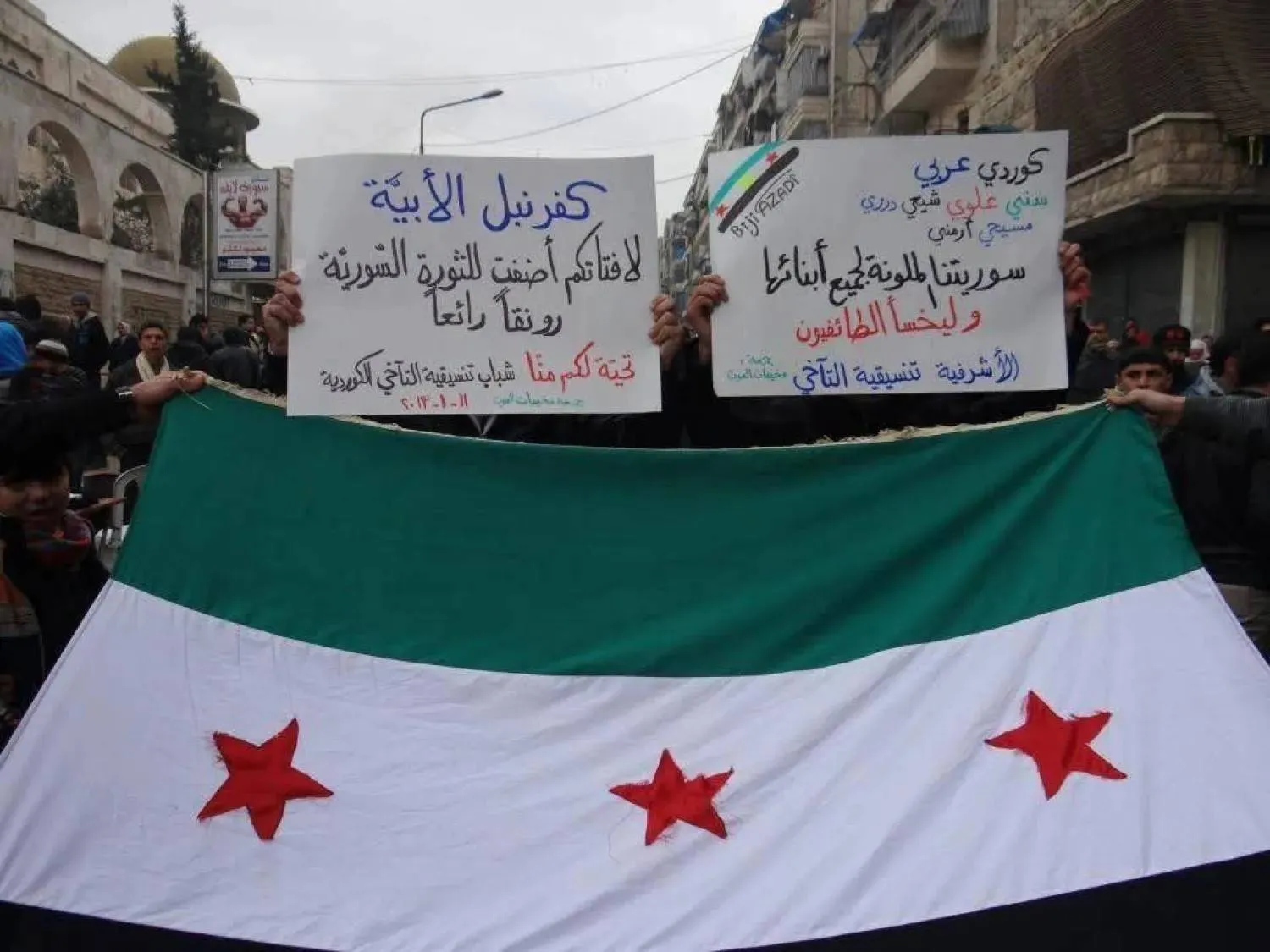
Initially, Ashrafieh saw a civil protest movement led by local activists under the banner of the Brotherhood Coordination, which brought together prominent Arab and Kurdish figures and stood out as a peaceful revolutionary initiative.
Its members later found themselves pursued by the Kurdistan Workers Party’s Syrian branch, which cracked down on any activity linked to the uprising in areas it took over from the government, establishing security and police bodies as well as military recruitment centers that exercised full control. This further entrenched the perception of the neighborhoods as Kurdish.
The most severe blow to relations between the Kurdistan Workers Party and Syria’s opposition came at the end of 2016, when the Syrian Democratic Forces cooperated with Assad’s forces in taking control of eastern Aleppo. The operation resulted in the displacement of most residents and the destruction of large parts of the area.
Later, the Syrian Democratic Forces joined forces with Lebanon’s Hezbollah and Iran’s Revolutionary Guard Corps in seizing Sunni Arab towns and villages in the northern Aleppo countryside, especially the town of Tal Rifaat, whose residents were almost entirely displaced at the time.
Supporters of the Kurdish region in Syria then began describing it as a Kurdish area as well.
Today, as Aleppo faces renewed tension over the Syrian Democratic Forces’ refusal to hand over Sheikh Maqsoud and Ashrafieh to the Syrian government’s administration, supporters of the group are waging a fresh media campaign to assert the Kurdish identity of the two neighborhoods.
Tens of thousands of Arabs live there, particularly members of the Baggara tribe and the Batoush clan, alongside a significant Kurdish presence whose weight cannot be denied.


