


Israel Casts Doubt on Hezbollah Disarmament South of the Litani

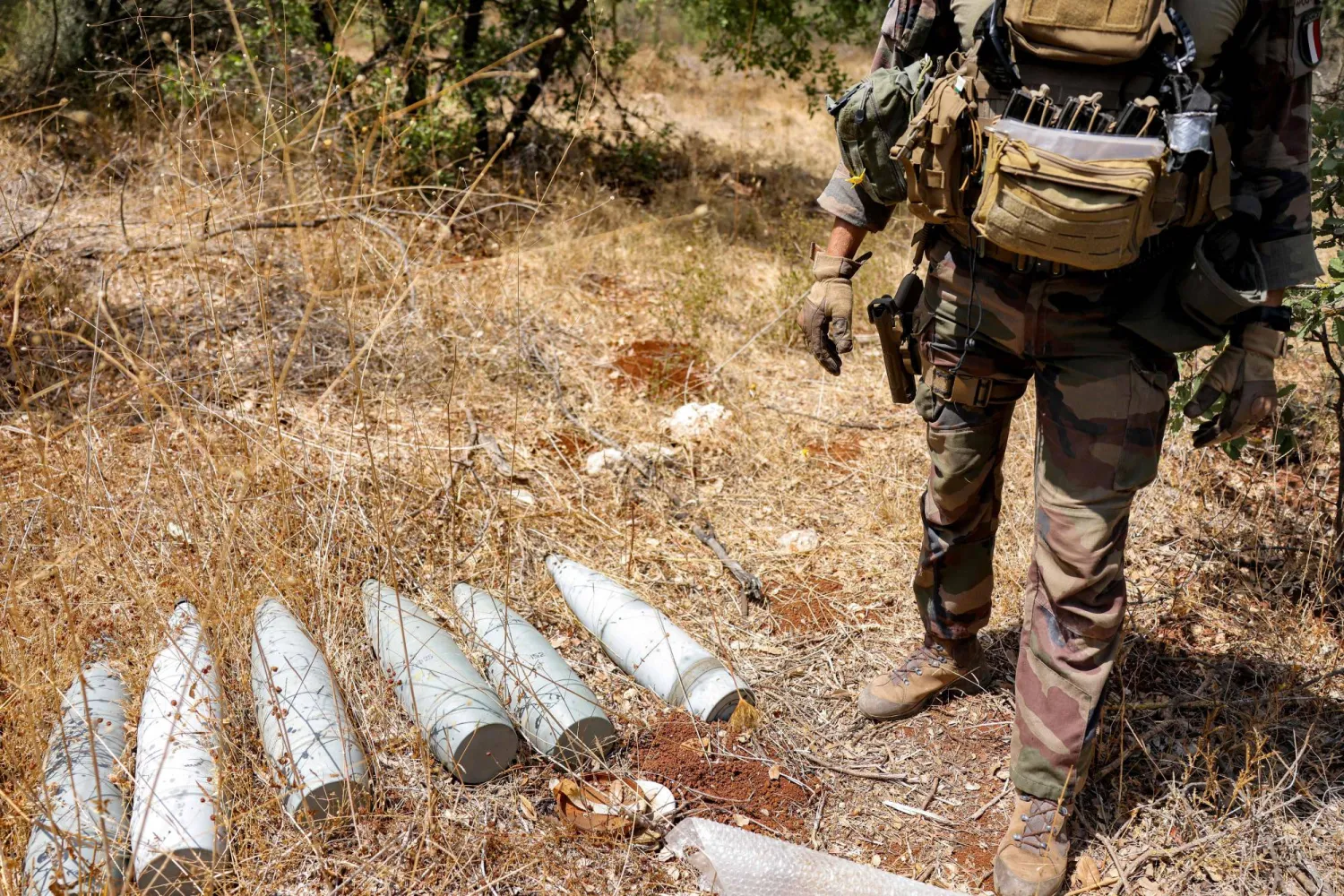
A French peacekeeper of the United Nations Interim Force in Lebanon (UNIFIL) stands by munitions formerly used by Iran-backed Hezbollah at a position that was held by the group in the Khraibeh Valley in el-Meri in south Lebanon on August 27, 2025. (AFP)
TT

Israel Casts Doubt on Hezbollah Disarmament South of the Litani

A French peacekeeper of the United Nations Interim Force in Lebanon (UNIFIL) stands by munitions formerly used by Iran-backed Hezbollah at a position that was held by the group in the Khraibeh Valley in el-Meri in south Lebanon on August 27, 2025. (AFP)

Israel on Thursday voiced skepticism over the Lebanese Army’s announcement that its plan to seize weapons from southern Lebanon has reached an advanced stage, calling the effort insufficient.

The reaction came even as Israeli Prime Minister Benjamin Netanyahu described the move as an “encouraging beginning,” while reiterating accusations that Hezbollah is rearming with Iranian support.

In a statement, Netanyahu’s office said the efforts by the Lebanese government and army to disarm Hezbollah amount to “a promising start, but absolutely not enough.”

It accused the group of attempting to rebuild its military infrastructure with backing from Iran, stressing that the US-brokered ceasefire agreement clearly calls for Hezbollah’s complete disarmament.

Israel’s Foreign Ministry echoed this skepticism, saying Hezbollah’s military infrastructure south of the Litani River remains intact and that the goal of disarming the group in southern Lebanon “is still far from being achieved.”

The ministry described the Lebanese Army’s efforts as limited, repeating claims that Hezbollah continues to rearm with Iranian assistance.

The Israeli security establishment adopted a sharper tone. Army Radio quoted military sources as saying statements by the Lebanese Army about disarmament in the south “do not reflect reality on the ground,” asserting that Hezbollah fighters and infrastructure are still present south of the Litani.

A military source told Haaretz that Israel’s assessment of the disarmament process “is not based on declarations, but on data and operational results,” adding that as long as Hezbollah’s military structures remain in place, there can be no talk of genuine disarmament.

Yedioth Ahronoth, citing military sources, reported that the Lebanese announcement had been expected and that Israel is inclined to reject claims that the area south of the Litani has been effectively disarmed.

According to the paper, the Israeli army believes Hezbollah still maintains combat capabilities there, describing the Lebanese Army’s performance as slow and partial, despite reaching sites where it was tasked with collecting Hezbollah weapons.

Lebanese parliamentary sources said Israel’s skeptical stance comes as no surprise. MP Mohammed Khawaja, of the Development and Liberation bloc, warned that Israeli threats against Lebanon “have not stopped and continue through its media,” stressing that the danger is aimed at all Lebanese, not a specific group or faction.

Speaking to Asharq Al-Awsat, Khawaja said Israel is openly threatening the region and that Lebanon has long been part of its ambitions.

MP Waddah Al-Sadek said Netanyahu’s recent remarks suggest that, from Israel’s perspective, the continuation of the ceasefire is now conditional on Hezbollah’s full disarmament.

He argued that Israel’s description of Lebanese efforts as encouraging but inadequate may be a sign that an escalation could happen in the future despite assurances from Lebanon’s leaders and army command of their commitment to the ceasefire.

In Israel’s view, he said, such commitments are meaningless without concrete measures and a clear timetable for disarmament, conditions that risk providing Israel with justification for further escalation.



Lebanon FM Urges Iran to Find ‘New Approach’ on Hezbollah Arms

Iranian Foreign Minister Abbas Araghchi (L) shakes hands with Lebanese Minister of Foreign Affairs and Emigrants Youssef Raggi (R) at the Foreign Ministry in downtown Beirut, Lebanon, 09 January 2026. (EPA)
TT

Lebanon FM Urges Iran to Find ‘New Approach’ on Hezbollah Arms

Iranian Foreign Minister Abbas Araghchi (L) shakes hands with Lebanese Minister of Foreign Affairs and Emigrants Youssef Raggi (R) at the Foreign Ministry in downtown Beirut, Lebanon, 09 January 2026. (EPA)

Lebanese Foreign Minister Youssef Raggi on Friday urged his visiting Iranian counterpart to find a "new approach" to the thorny issue of disarming the Iran-backed Hezbollah group.

Lebanon is under heavy US pressure to disarm Hezbollah, which was heavily weakened in more than a year of hostilities with Israel that largely ended with a November 2024 ceasefire, but Iran and the group have expressed opposition to the move.

Iran has long wielded substantial influence in Lebanon by funding and arming Hezbollah, but as the balance of power shifted since the recent conflict, officials have been more critical towards Tehran.

"The defense of Lebanon is the sole responsibility of the Lebanese state", which must have a monopoly on weapons, Raggi told Iranian Foreign Minister Abbas Araghchi, a Lebanese foreign ministry statement said.

Raggi called on Iran to engage in talks with Lebanon to find "a new approach to the issue of Hezbollah's weapons, drawing on Iran's relationship with the party, so that these weapons do not become a pretext for weakening Lebanon".

He asked Araghchi "whether Tehran would accept the presence of an illegal armed organization on its own territory".

Last month, Raggi declined an invitation to visit Iran and proposed meeting in a neutral third country.

Lebanon's army said Thursday that it had completed the first phase of disarming Hezbollah, doing so in the south Lebanon area near the border with Israel, which called the efforts "far from sufficient".

Araghchi also met President Joseph Aoun on Friday and was set to hold talks with several other senior officials.

After arriving on Thursday, he visited the mausoleum of former Hezbollah leader Hassan Nasrallah, who was killed in a massive Israeli air strike on south Beirut in September 2024.

Last August, Lebanese leaders firmly rejected any efforts at foreign interference during a visit by Iran's security chief Ali Larijani, with the prime minister saying Beirut would "tolerate neither tutelage nor diktat" after Tehran voiced opposition to plans to disarm Hezbollah.


Hamas Says Israeli Strikes on Gaza ‘Cannot Happen without American Cover’

 Palestinians inspect damaged tents at a displacement camp following an Israeli strike in Gaza City, Friday, Jan. 9, 2026. (AP)
Palestinians inspect damaged tents at a displacement camp following an Israeli strike in Gaza City, Friday, Jan. 9, 2026. (AP)
TT

Hamas Says Israeli Strikes on Gaza ‘Cannot Happen without American Cover’

 Palestinians inspect damaged tents at a displacement camp following an Israeli strike in Gaza City, Friday, Jan. 9, 2026. (AP)
Palestinians inspect damaged tents at a displacement camp following an Israeli strike in Gaza City, Friday, Jan. 9, 2026. (AP)

A Hamas official said Friday that Israeli strikes on Gaza "cannot happen without American cover", the day after Israeli attacks killed at least 13 people according to the Palestinian territory's civil defense agency.

Since October 10, a fragile US-sponsored truce in Gaza has largely halted the fighting between Israeli forces and Hamas, but both sides have alleged frequent violations.

Gaza's civil defense agency -- which operates as a rescue force under Hamas authority -- said Israeli attacks across the territory on Thursday killed at least 13 people, including five children.

In a statement on Friday morning, the Israeli military said it "precisely struck Hamas terrorists and terror infrastructure" in response to a "failed projectile" launch.

"Just yesterday, 13 people were killed in different areas of the Strip on fabricated pretexts, in addition to the hundreds of killed and wounded who preceded them after the ceasefire," Hamas political bureau member, Bassem Naim, wrote on Telegram.

"This cannot happen without American cover or a green light."

Israeli forces have killed at least 439 Palestinians in Gaza since the ceasefire took effect, according to the health ministry in the Hamas-run territory.

The Israeli military said gunmen have killed three of its soldiers during the same period.

Media restrictions in Gaza and difficulties in accessing many areas mean AFP is unable to independently verify the tolls and details provided by both sides.

Naim also accused Israeli Prime Minister Benjamin Netanyahu of "evading his commitments and escalating in order to sabotage the agreement and return to war".

He said the Palestinian movement had "complied with all its obligations under the agreement" and was "ready to engage positively and constructively with the next steps of the plan".

Israel has previously said it is awaiting the return of the last hostage body held in Gaza before beginning talks on the second phase of the ceasefire and has insisted that Hamas disarm.

Hamas officials told AFP that search operations for the remains of deceased hostage Ran Gvili resumed on Wednesday after a two-week pause due to bad weather.


Germany Calls on Israel to Halt E1 Settlement Plan

A view of Israeli settlement of Maale Adumim, in the West Bank, Sunday, June 18, 2023. (AP)
TT

Germany Calls on Israel to Halt E1 Settlement Plan

A view of Israeli settlement of Maale Adumim, in the West Bank, Sunday, June 18, 2023. (AP)

Germany calls on Israel to halt its controversial ​E1 settlement project, said a foreign ministry spokesperson in Berlin on Friday, warning that construction carries the risk of ‌creating more ‌instability in the ‌West ⁠Bank ​and ‌the region.

"The plans for the E1 settlement project, it must be said, are part of a comprehensive ⁠intensification of settlement policy in ‌the West Bank, ‍which ‍we have recently ‍observed," said the spokesperson at a regular government press conference.

"It carries the ​risk of creating even more instability, as it ⁠would further restrict the mobility of the Palestinian population in the West Bank," as well as jeopardize the prospects of a two-state solution, the spokesperson added.