


Syrian Authorities Transferring Kurdish Fighters from Aleppo to Northeast

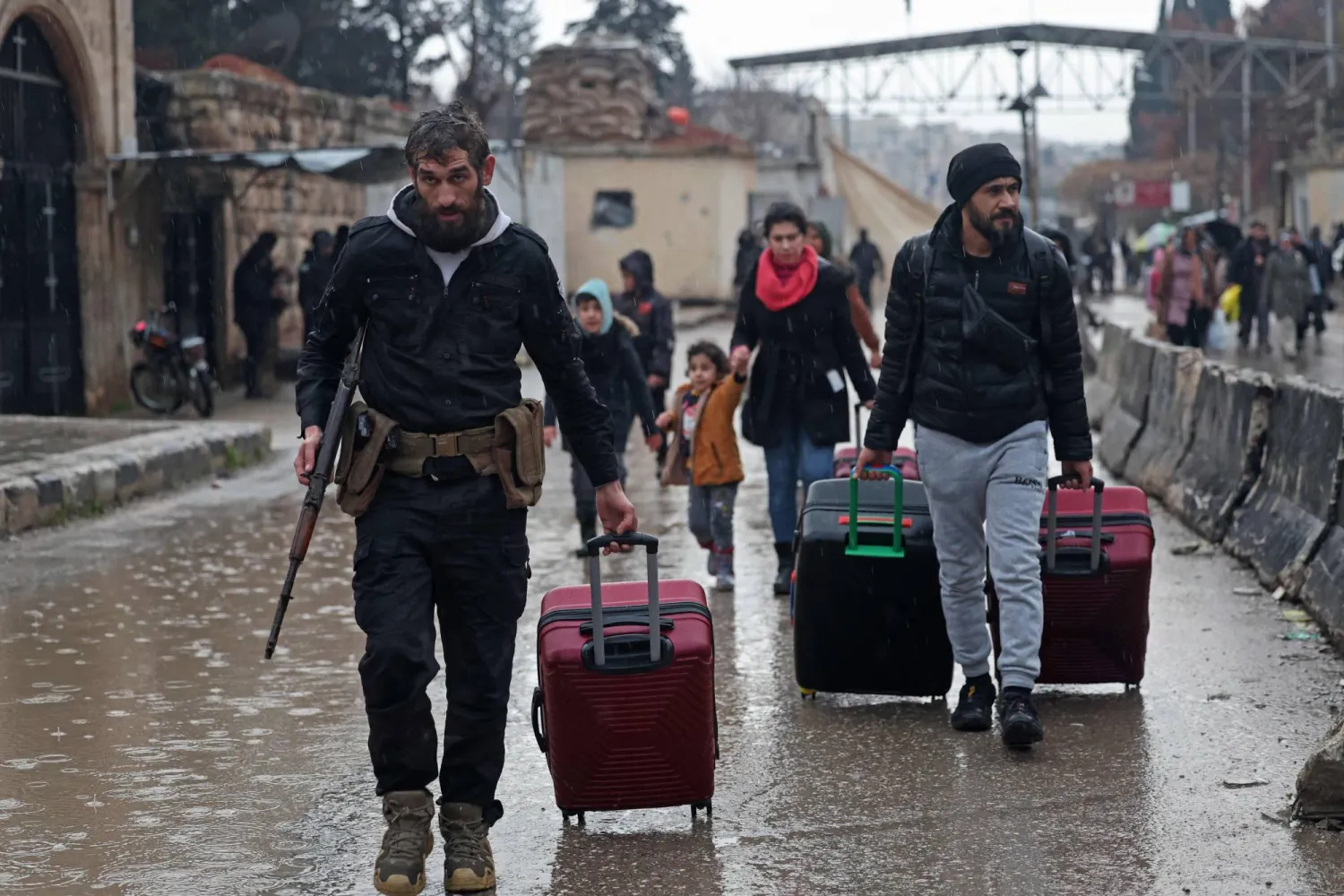
TOPSHOT - Residents of Aleppo's Sheikh Maqsud area evacuate their neighborhood after warnings from the Syrian army that called on civilians to get out of harms way, following the refusal of Kurdish fighter forces to leave Aleppo, on January 9, 2026. (Photo by OMAR HAJ KADOUR / AFP)
TT

Syrian Authorities Transferring Kurdish Fighters from Aleppo to Northeast

TOPSHOT - Residents of Aleppo's Sheikh Maqsud area evacuate their neighborhood after warnings from the Syrian army that called on civilians to get out of harms way, following the refusal of Kurdish fighter forces to leave Aleppo, on January 9, 2026. (Photo by OMAR HAJ KADOUR / AFP)

Syrian authorities on Saturday began transferring Kurdish fighters from the country's second city Aleppo to areas they control in the country's northeast, state television reported, after days of deadly clashes. 

The violence in Aleppo erupted after efforts to integrate the Kurds' de facto autonomous administration and military into the country's new government stalled. 

Since the fighting began on Tuesday, at least 21 civilians have been killed, according to figures from both sides, while Aleppo's governor said 155,000 people have been displaced. 

On Saturday evening, state television reported that Kurdish fighters "who announced their surrender... were transported by bus to the city of Tabaqa" in the Kurdish-controlled northeast. 

An AFP correspondent saw at least five buses on Saturday carrying fighters leaving the Kurdish-majority Sheikh Maqsud district accompanied by security forces. 

Their departure came as US envoy Tom Barrack on Saturday met with Syrian President Ahmed al-Sharaa, and afterwards issued a call for a "return to dialogue" with the Kurds in accordance with an integration agreement sealed last year. 

In a statement to the official SANA news agency, the military announced earlier on Saturday "a halt to all military operations in the Sheikh Maqsud neighborhood". 

A Syrian security source had told AFP that the last Kurdish fighters had entrenched themselves in the area of al-Razi hospital in Sheikh Maqsud, before being evacuated by authorities. 

On the outskirts of Sheikh Maqsud, families who were unable to flee the violence were leaving, accompanied by Syrian security forces, according to an AFP correspondent. 

Men were carrying their children on their backs as women and children wept, before entering buses taking them to shelters. 

Dozens of young men in civilian clothing were separated from the rest, with security forcing them to sit on the ground, heads down, before being taken by bus to an unknown destination, according to the correspondent. 

Government forces began striking the district overnight after a deadline elapsed for Kurdish fighters to withdraw during a ceasefire. 

- Residents waiting to return - 

At the entrance to the district, 60-year-old resident Imad al-Ahmad waited for permission from the security forces to return home. 

"I left four days ago... I took refuge at my sister's house," he told AFP. "I don't know if we'll be able to return today." 

Nahed Mohammad Qassab, a 40-year-old widow also waiting to return, said she left before the fighting to attend a funeral. 

"My three children are still inside, at my neighbor's house. I want to get them out," she said. 

The clashes, some of the most intense since Syria's new authorities took power, present yet another challenge as the country struggles to forge a new path after the ousting of longtime ruler Bashar al-Assad in December 2024. 

Both sides have blamed the other for starting the violence in Aleppo. 

- 'Fierce' resistance - 

Kurdish forces earlier reported coming under artillery and drone attacks, and claimed on social media to be mounting a "fierce and ongoing resistance". 

The army said three soldiers had been killed by Kurdish fighters, while state television accused them of launching drones at residential areas of Aleppo. 

A flight suspension at Aleppo airport was extended until late Saturday. 

The Kurdish-led Syrian Democratic Forces (SDF) control swathes of the country's oil-rich north and northeast, and were key to the 2019 territorial defeat of the ISIS group. 

But Türkiye, a close ally of neighboring Syria's new leaders, views its main component as an extension of the Kurdistan Workers' Party (PKK), which agreed last year to end its four-decade armed struggle against Ankara. 

Türkiye has launched successive offensives to push Kurdish forces from the frontier. 

Elham Ahmad, a senior official in the Kurdish administration in Syria's northeast, accused Syrian authorities of "choosing the path of war" by attacking Kurdish districts and of "seeking to put an end to the agreements that have been reached". 

"We are committed to them and we are seeking to implement them," she told AFP. 

The March integration agreement was meant to be implemented last year, but differences, including Kurdish demands for decentralized rule, have stymied progress. 

Ahmad welcomed on X a proposal by international mediators to evacuate the Kurdish forces from Sheikh Maqsud, but on condition that the local Kurdish population is protected. 

Nanar Hawach, senior Syria analyst at the International Crisis Group, said the renewed clashes cast doubt on the government's ability to unite the country after years of civil war. 


Israel Military Says Soldier Killed in Gaza 

A drone view shows the destruction in a residential neighborhood, after the withdrawal of the Israeli forces from the area, amid a ceasefire between Israel and Hamas in Gaza, in Gaza City, October 21, 2025. (Reuters)
TT

Israel Military Says Soldier Killed in Gaza 

A drone view shows the destruction in a residential neighborhood, after the withdrawal of the Israeli forces from the area, amid a ceasefire between Israel and Hamas in Gaza, in Gaza City, October 21, 2025. (Reuters)

The Israeli military announced that one of its soldiers had been killed in combat in southern Gaza on Wednesday, but a security source said the death appeared to have been caused by "friendly fire".

"Staff Sergeant Ofri Yafe, aged 21, from HaYogev, a soldier in the Paratroopers Reconnaissance Unit, fell during combat in the southern Gaza Strip," the military said in a statement.

A security source, however, told AFP that the soldier appeared to have been "killed by friendly fire", without providing further details.

"The incident is still under investigation," the source added.

The death brings to five the number of Israeli soldiers killed in Gaza since a ceasefire took effect on October 10.


Syria: SDF’s Mazloum Abdi Says Implementation of Integration Deal May Take Time

People sit outdoors surrounded by nature, with the Tigris river flowing in the background, following a long atmospheric depression, near the Syrian-Turkish border in Derik, Syria, February 16, 2026 REUTERS/Orhan Qereman
TT

Syria: SDF’s Mazloum Abdi Says Implementation of Integration Deal May Take Time

People sit outdoors surrounded by nature, with the Tigris river flowing in the background, following a long atmospheric depression, near the Syrian-Turkish border in Derik, Syria, February 16, 2026 REUTERS/Orhan Qereman

Mazloum Abdi, commander of the Syrian Democratic Forces, said the process of merging the SDF with Syrian government forces “may take some time,” despite expressing confidence in the eventual success of the agreement.

His remarks came after earlier comments in which he acknowledged differences with Damascus over the concept of “decentralization.”

Speaking at a tribal conference in the northeastern city of Hasakah on Tuesday, Abdi said the issue of integration would not be resolved quickly, but stressed that the agreement remains on track.

He said the deal reached last month stipulates that three Syrian army brigades will be created out of the SDF.

Abdi added that all SDF military units have withdrawn to their barracks in an effort to preserve stability and continue implementing the announced integration agreement with the Syrian state.

He also emphasized the need for armed forces to withdraw from the vicinity of the city of Ayn al-Arab (Kobani), to be replaced by security forces tasked with maintaining order.


Israeli Far-Right Minister to Push for ‘Migration’ of West Bank, Gaza Palestinians 

A Palestinian man checks leather belts as people prepare for Ramadan, in the old city of Hebron in the Israeli-occupied West Bank, February 17,2026. (Reuters)
TT

Israeli Far-Right Minister to Push for ‘Migration’ of West Bank, Gaza Palestinians 

A Palestinian man checks leather belts as people prepare for Ramadan, in the old city of Hebron in the Israeli-occupied West Bank, February 17,2026. (Reuters)

Israel's far-right Finance Minister Bezalel Smotrich said he would pursue a policy of "encouraging the migration" of Palestinians from the occupied West Bank and Gaza Strip, Israeli media reported Wednesday.

"We will eliminate the idea of an Arab terror state," said Smotrich, speaking at an event organized by his Religious Zionism Party late on Tuesday.

"We will finally, formally, and in practical terms nullify the cursed Oslo Accords and embark on a path toward sovereignty, while encouraging emigration from both Gaza and Judea and Samaria.

"There is no other long-term solution," added Smotrich, who himself lives in a settlement in the West Bank.

Since last week, Israel has approved a series of measures backed by far-right ministers to tighten control over the West Bank, including in areas administered by the Palestinian Authority under the Oslo Accords, in place since the 1990s.

The measures include a process to register land in the West Bank as "state property" and facilitate direct purchases of land by Jewish Israelis.

The measures have triggered widespread international outrage.

On Tuesday, the UN missions of 85 countries condemned the measures, which critics say amount to de facto annexation of the Palestinian territory.

"We strongly condemn unilateral Israeli decisions and measures aimed at expanding Israel's unlawful presence in the West Bank," they said in a statement.

"Such decisions are contrary to Israel's obligations under international law and must be immediately reversed.

"We underline in this regard our strong opposition to any form of annexation."

UN Secretary-General Antonio Guterres on Monday called on Israel to reverse its land registration policy, calling it "destabilizing" and "unlawful".

The West Bank would form the largest part of any future Palestinian state. Many on Israel's religious right view it as Israeli land.

Israeli NGOs have also raised the alarm over a settlement plan signed by the government which they say would mark the first expansion of Jerusalem's borders into the occupied West Bank since 1967.

The planned development, announced by Israel's Ministry of Construction and Housing, is formally a westward expansion of the Geva Binyamin, or Adam, settlement situated northeast of Jerusalem in the West Bank.

The current Israeli government has fast-tracked settlement expansion, approving a record 52 settlements in 2025.

Excluding Israeli-annexed east Jerusalem, more than 500,000 Israelis live in West Bank settlements and outposts, which are illegal under international law.
