


Syrian Authorities Transferring Kurdish Fighters from Aleppo to Northeast

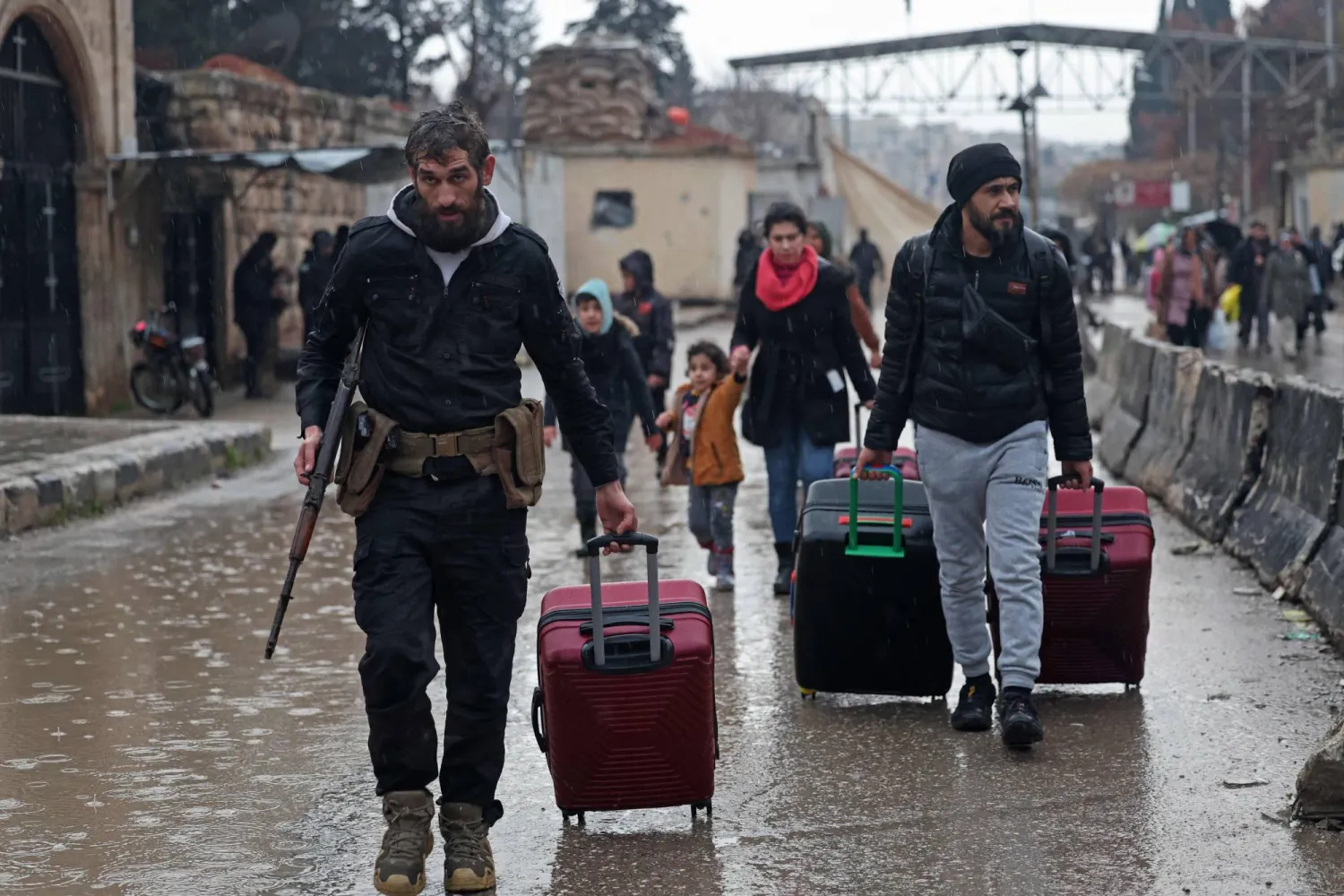
TOPSHOT - Residents of Aleppo's Sheikh Maqsud area evacuate their neighborhood after warnings from the Syrian army that called on civilians to get out of harms way, following the refusal of Kurdish fighter forces to leave Aleppo, on January 9, 2026. (Photo by OMAR HAJ KADOUR / AFP)
TT

Syrian Authorities Transferring Kurdish Fighters from Aleppo to Northeast

TOPSHOT - Residents of Aleppo's Sheikh Maqsud area evacuate their neighborhood after warnings from the Syrian army that called on civilians to get out of harms way, following the refusal of Kurdish fighter forces to leave Aleppo, on January 9, 2026. (Photo by OMAR HAJ KADOUR / AFP)

Syrian authorities on Saturday began transferring Kurdish fighters from the country's second city Aleppo to areas they control in the country's northeast, state television reported, after days of deadly clashes. 

The violence in Aleppo erupted after efforts to integrate the Kurds' de facto autonomous administration and military into the country's new government stalled. 

Since the fighting began on Tuesday, at least 21 civilians have been killed, according to figures from both sides, while Aleppo's governor said 155,000 people have been displaced. 

On Saturday evening, state television reported that Kurdish fighters "who announced their surrender... were transported by bus to the city of Tabaqa" in the Kurdish-controlled northeast. 

An AFP correspondent saw at least five buses on Saturday carrying fighters leaving the Kurdish-majority Sheikh Maqsud district accompanied by security forces. 

Their departure came as US envoy Tom Barrack on Saturday met with Syrian President Ahmed al-Sharaa, and afterwards issued a call for a "return to dialogue" with the Kurds in accordance with an integration agreement sealed last year. 

In a statement to the official SANA news agency, the military announced earlier on Saturday "a halt to all military operations in the Sheikh Maqsud neighborhood". 

A Syrian security source had told AFP that the last Kurdish fighters had entrenched themselves in the area of al-Razi hospital in Sheikh Maqsud, before being evacuated by authorities. 

On the outskirts of Sheikh Maqsud, families who were unable to flee the violence were leaving, accompanied by Syrian security forces, according to an AFP correspondent. 

Men were carrying their children on their backs as women and children wept, before entering buses taking them to shelters. 

Dozens of young men in civilian clothing were separated from the rest, with security forcing them to sit on the ground, heads down, before being taken by bus to an unknown destination, according to the correspondent. 

Government forces began striking the district overnight after a deadline elapsed for Kurdish fighters to withdraw during a ceasefire. 

- Residents waiting to return - 

At the entrance to the district, 60-year-old resident Imad al-Ahmad waited for permission from the security forces to return home. 

"I left four days ago... I took refuge at my sister's house," he told AFP. "I don't know if we'll be able to return today." 

Nahed Mohammad Qassab, a 40-year-old widow also waiting to return, said she left before the fighting to attend a funeral. 

"My three children are still inside, at my neighbor's house. I want to get them out," she said. 

The clashes, some of the most intense since Syria's new authorities took power, present yet another challenge as the country struggles to forge a new path after the ousting of longtime ruler Bashar al-Assad in December 2024. 

Both sides have blamed the other for starting the violence in Aleppo. 

- 'Fierce' resistance - 

Kurdish forces earlier reported coming under artillery and drone attacks, and claimed on social media to be mounting a "fierce and ongoing resistance". 

The army said three soldiers had been killed by Kurdish fighters, while state television accused them of launching drones at residential areas of Aleppo. 

A flight suspension at Aleppo airport was extended until late Saturday. 

The Kurdish-led Syrian Democratic Forces (SDF) control swathes of the country's oil-rich north and northeast, and were key to the 2019 territorial defeat of the ISIS group. 

But Türkiye, a close ally of neighboring Syria's new leaders, views its main component as an extension of the Kurdistan Workers' Party (PKK), which agreed last year to end its four-decade armed struggle against Ankara. 

Türkiye has launched successive offensives to push Kurdish forces from the frontier. 

Elham Ahmad, a senior official in the Kurdish administration in Syria's northeast, accused Syrian authorities of "choosing the path of war" by attacking Kurdish districts and of "seeking to put an end to the agreements that have been reached". 

"We are committed to them and we are seeking to implement them," she told AFP. 

The March integration agreement was meant to be implemented last year, but differences, including Kurdish demands for decentralized rule, have stymied progress. 

Ahmad welcomed on X a proposal by international mediators to evacuate the Kurdish forces from Sheikh Maqsud, but on condition that the local Kurdish population is protected. 

Nanar Hawach, senior Syria analyst at the International Crisis Group, said the renewed clashes cast doubt on the government's ability to unite the country after years of civil war. 


UN Says Al-Hol Camp Population Has Dropped Sharply as Syria Moves to Relocate Remaining Families

US military vehicles escort buses transporting ISIS detainees from Syria to Iraq, according to a security source from the Syrian Democratic Forces, in Qamishli, Syria, February 8, 2026. (Reuters)
TT

UN Says Al-Hol Camp Population Has Dropped Sharply as Syria Moves to Relocate Remaining Families

US military vehicles escort buses transporting ISIS detainees from Syria to Iraq, according to a security source from the Syrian Democratic Forces, in Qamishli, Syria, February 8, 2026. (Reuters)

The UN refugee agency said Sunday that a large number of residents of a camp housing family members of suspected ISIS group militants have left and the Syrian government plans to relocate those who remain.

Gonzalo Vargas Llosa, UNHCR's representative in Syria, said in a statement that the agency “has observed a significant decrease in the number of residents in al-Hol camp in recent weeks."

“Syrian authorities have informed UNHCR of their plan to relocate the remaining families to Akhtarin camp in Aleppo Governorate (province) and have requested UNHCR’s support to assist the population in the new camp, which we stand ready to provide,” he said.

He added that UNHCR “will continue to support the return and reintegration of Syrians who have departed al-Hol, as well as those who remain.”

The statement did not say how residents had left the camp or how many remain. Many families are believed to have escaped either during the chaos when government forces captured the camp from the Kurdish-led Syrian Democratic Forces last month or afterward.

There was no immediate statement from the Syrian government and a government spokesperson did not respond to a request for comment.

At its peak after the defeat of ISIS in Syria in 2019, around 73,000 people were living at al-Hol. Since then, the number has declined with some countries repatriating their citizens. The camp’s residents are mostly children and women, including many wives or widows of ISIS members.

The camp’s residents are not technically prisoners and most have not been accused of crimes, but they have been held in de facto detention at the heavily guarded facility.

Forces of Syria’s central government captured the al-Hol camp on Jan. 21 during a weekslong offensive against the SDF, which had been running the camp near the border with Iraq for a decade. A ceasefire deal has since ended the fighting.

Separately, thousands of accused ISIS militants who were held in detention centers in northeastern Syria have been transferred to Iraq to stand trial under an agreement with the US.

The US military said Friday that it had completed the transfer of more than 5,700 adult male ISIS suspects from detention facilities in Syria to Iraqi custody.

Iraq’s National Center for International Judicial Cooperation said a total of 5,704 suspects from 61 countries who were affiliated with ISIS — most of them Syrian and Iraqi — were transferred from prisons in Syria. They are now being interrogated in Iraq.


Rubio: US Satisfied with Overall ‘Trajectory’ in Syria

US Secretary of State Marco Rubio gives a thumbs-up as he boards a plane while departing Bratislava Airport in Bratislava, Slovakia, Sunday, Feb. 15, 2026. (Reuters)
TT

Rubio: US Satisfied with Overall ‘Trajectory’ in Syria

US Secretary of State Marco Rubio gives a thumbs-up as he boards a plane while departing Bratislava Airport in Bratislava, Slovakia, Sunday, Feb. 15, 2026. (Reuters)

US Secretary of State Marco Rubio said on Sunday that Washington is pleased with the "trajectory" in Syria, which has launched talks with Kurdish minority groups, despite troubles.

"There's been some days that have been very concerning, but we like the trajectory," Rubio said on a brief visit to Bratislava. "We have to keep it on that trajectory. We've got good agreements in place."

Rubio added, however, that a deal between Syrian authorities and the Kurdish minority must now be implemented.

"That's not going to be easy and there other such agreements that they need to reach with the Druze, with the Bedouins, with the Alawites -- with all the elements of a very diverse society in Syria," Rubio said.

Syrian leaders in Damascus and Kurdish officials announced in January, after months of deadlock and armed clashes, that they had reached an agreement to integrate Kurdish forces and autonomous areas of Syria into the Syrian state.

A de facto separate Kurdish state was established in northeast of the country during Syria's civil war (2011-2024).

The United States had supported Kurdish forces in their fight against the ISIS group starting in 2014.

But after the overthrow of Bashar al-Assad at the end of 2024, the President Donald Trump's administration backed Syrian leader Ahmed al-Sharaa -- whose opposition forces drove Assad from power -- in his bid to impose authority over the entire country.

Rubio on Sunday defended the administration's embrace of Sharaa -- even against the former Kurdish allies -- by arguing that Washington faced a difficult decision in Syria.

The process, "as difficult as it's been, is far better than a Syria that would've been broken up into eight pieces with all kinds of fighting going on, all kinds of mass migration," Rubio said. "So we were very positive about that."


Indonesia Says 8,000 Troops Ready for Possible Peacekeeping Mission in Gaza by June

Women walk down a hill overlooking a camp for displaced Palestinians in Khan Younis, in the southern Gaza Strip, on February 14, 2026. (AFP)
TT

Indonesia Says 8,000 Troops Ready for Possible Peacekeeping Mission in Gaza by June

Women walk down a hill overlooking a camp for displaced Palestinians in Khan Younis, in the southern Gaza Strip, on February 14, 2026. (AFP)

Indonesia's military said Sunday that up to 8,000 troops are expected to be ready by the end of June for a potential deployment to Gaza as part of a humanitarian and peace mission, the first firm commitment to a critical element of US President Donald Trump’s postwar reconstruction plan.

The Indonesian National Armed Forces, known as TNI, has finalized its proposed troop structure and a timeline for their movement to Gaza, even as the government has yet to decide when the deployment will take place, army spokesperson Brig. Gen. Donny Pramono said.

“In principle, we are ready to be assigned anywhere,” Pramono told The Associated Press, “Our troops are fully prepared and can be dispatched at short notice once the government gives formal approval.”

Pramono said the military prepared a composite brigade of 8,000 personnel, based on decisions made during a Feb. 12 meeting for the mission.

Under the schedule, troops will undergo health checks and paperwork throughout February, followed by a force readiness review at the end of the month, Pramono said. He also revealed that about 1,000 personnel are expected to be ready to deploy as an advance team by April, followed with the rest by June.

Pramono said that being ready does not mean the troops will depart. The deployment still requires a political decision and depends on international mechanisms, he said.

Indonesia's Foreign Ministry has repeatedly said any Indonesian role in Gaza will be strictly humanitarian. Indonesia’s contribution would focus on civilian protection, medical services, reconstruction, and its troops would not take part in any combat operations or actions that could lead to direct confrontation with armed groups.

Indonesia would be the first country to formally commit troops to the security mission created under Trump’s Board of Peace initiative for Gaza, where a fragile ceasefire agreement between Israel and Hamas has held since Oct. 10 following two years of devastating war.

Indonesia, the world’s most populous Muslim majority nation, does not have formal diplomatic relations with Israel and has long been a strong supporter of a two-state solution. It has been deeply involved in providing humanitarian aid to Gaza, including funding a hospital.

Indonesian officials have justified joining the Board of Peace by saying it was necessary to defend Palestinian interests from within, since Israel is included on the board but there is no Palestinian representation.

The Southeast Asian country has experience in peacekeeping operations as one of the top 10 contributors to United Nations missions, including in Lebanon.
