

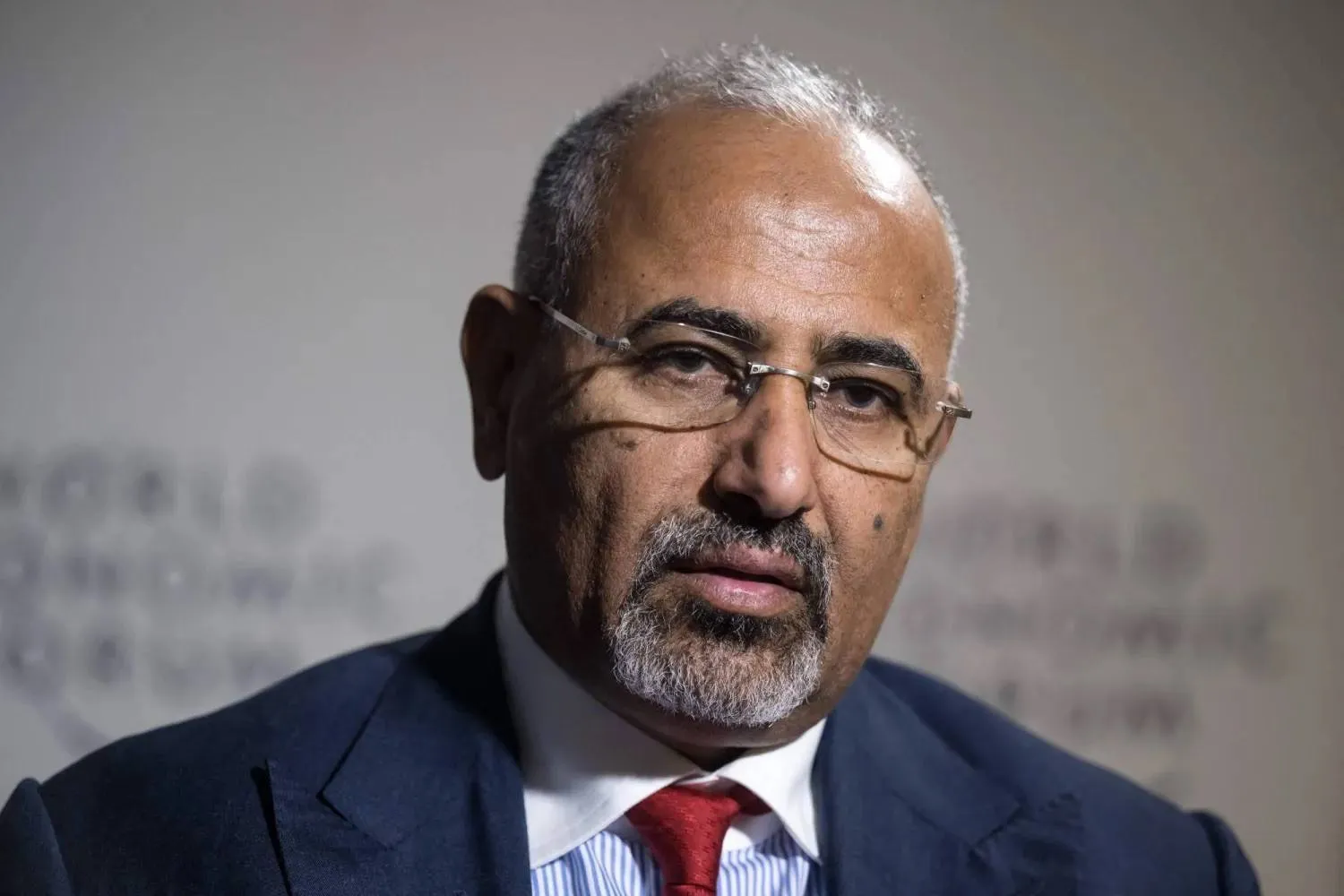

Aidarous al-Zubaidi Faces Corruption, Land-Grabbing Investigations

 Aidarous al-Zoubaidi (AFP) 
 Aidarous al-Zoubaidi (AFP) 
TT

Aidarous al-Zubaidi Faces Corruption, Land-Grabbing Investigations

 Aidarous al-Zoubaidi (AFP) 
 Aidarous al-Zoubaidi (AFP) 

Yemen’s Attorney General, Qaher Mustafa, has ordered the formation of a judicial committee to investigate allegations of corruption, illicit enrichment, and related crimes attributed to Aidarous al-Zubaidi, according to a decision issued on Saturday. The committee has been instructed to proceed in accordance with the law.

The probe will examine accusations including abuse of power, land seizures, illicit oil trading, and involvement in commercial companies. Observers say these practices have deepened political and social divisions in Yemen’s southern governorates, fueling public anger over financial and administrative corruption.

Dr. Fares al-Bayl, head of the Future Center for Yemeni Studies, told Asharq Al-Awsat that al-Zubaidi “lacks political capital and administrative experience,” but rose to senior positions amid Yemen’s worst economic and political crisis. He alleged that al-Zubaidi exploited these posts to seize public funds, undermine state institutions, and conspire with external actors.

Al-Bayl said al-Zubaidi diverted large budgets - estimated at 10 billion Yemeni riyals monthly - under the name of the Southern Transitional Council, without legal authorization. He accused him of withholding revenues from the Port of Aden, customs, and taxes from the Central Bank, and channeling funds to armed formations outside state control.

Additional claims include the imposition of illegal levies on traders and citizens, the creation of multiple revenue-collection checkpoints, and the failure to transfer taxes on qat, fuel, cement, transport, tourism projects, and private investments to the state treasury.

Administratively, al-Bayl alleged that al-Zubaidi dismantled state institutions, replaced qualified personnel with loyalists, paralyzed essential services such as electricity, water, and the judiciary, and established parallel security bodies, creating administrative chaos and a lack of accountability. He also cited documented allegations of secret prisons, torture, enforced disappearances, and unlawful detentions of political opponents and journalists.

Security analyst Ibrahim Jalal described the alleged corruption as a reflection of power dominance and the monopolization of wealth and authority, often through illegal means and at the expense of citizens’ livelihoods.

Economist Adel Shamsan said the swift move by the Attorney General to open investigations carries important political and legal implications, reinforcing accountability and the rule of law. He noted that the action could help contain political fallout, ease polarization, and reassure markets and donors, supporting financial stability and reducing uncertainty.

According to documents reviewed by Asharq Al-Awsat, al-Zubaidi allegedly seized vast tracts of land in Aden. Many of these properties were reportedly registered in the names of relatives or close associates.

Additional allegations include oil shipments through Qena Port in Shabwa and corruption cases involving exchange and furniture companies based in Aden.


Israeli Settler Violence Rises in West Bank Under Iran War Curbs

Mourners carry the bodies of three Palestinians killed in a reported attack by Israeli settlers in the town of Abu Falah, northeast of Ramallah in the occupied West Bank, during the funeral on March 8, 2026. (Photo by Zain JAAFAR / AFP)
TT

Israeli Settler Violence Rises in West Bank Under Iran War Curbs

Mourners carry the bodies of three Palestinians killed in a reported attack by Israeli settlers in the town of Abu Falah, northeast of Ramallah in the occupied West Bank, during the funeral on March 8, 2026. (Photo by Zain JAAFAR / AFP)

Israeli settlers in the occupied West Bank are taking advantage of curbs on movement imposed during the war on Iran to attack Palestinians, with military roadblocks preventing ambulances reaching victims quickly, rights groups and medics say.

Settlers have killed at least five Palestinians in the West Bank since the United States and Israel began airstrikes against Iran on February 28, according to the Palestinian health ministry. A sixth man died after inhaling teargas fired during an attack, according to Israeli rights group B'Tselem.

Israel's military blocked many West Bank roads with iron gates and mounds of earth on the first day of the war, and has largely shut crossings with Israel.

The Israeli military says the curbs are preemptive measures while it is carrying out airstrikes on Iran and against Lebanese group Hezbollah, which has fired missiles at Israel in solidarity with Tehran.

Palestinians in remote West Bank villages say the roadblocks have left them increasingly exposed to settler violence.

The Israeli military has also continued to carry out the raids it frequently conducts in Palestinian cities and towns during peacetime to arrest Palestinians, often without charge, they say.

A spokesperson for the Yesha Council, which represents Jewish settlements, did not immediately respond to a Reuters request for comment on the attacks.

Malak ⁠Beirat's husband, Thaer, ⁠was one of two Palestinians who residents and the Palestinian health ministry say were shot dead by settlers before dawn on Sunday in Abu Falah, north of the city of Ramallah.

"Thaer loved life. I never expected he would die," said Beirat, fighting back tears as she sat with her two children.

Witnesses told Reuters that when over 100 settlers gathered on the outskirts of Abu Falah, a local WhatsApp group rallied men to protect the small village. The initial confrontation involved stone throwing, but armed settlers arrived later and began shooting, they said.

Beirat's husband was shot dead while trying to protect a house from attack, a man who helped defend the village said.

Blood could still be seen on Monday in olive groves at the scene of the attack, where villagers have erected ⁠two Palestinian flags at the spots where the two men were killed - one for each victim.

A third Palestinian died after the attack. B'Tselem said his death was probably caused by the effect of teargas fired by Israeli troops deployed to the village during the attack.

The Israeli military says an investigation has been launched into the incident and that it condemns "violence of any kind".

Medics say the new roadblocks have led to delays in reaching injured Palestinians.

"There are obstacles - and even attacks by settlers and the military on the (medical) crews," said Ahmed Jibril, spokesman for the Palestinian Red Crescent ambulance service.

There have been over 109 reports of settler violence against Palestinians in the West Bank since the start of the war with Iran including shootings, physical assaults, property damage, and threats, said Israeli monitoring group Yesh Din.

All the reported killings of Palestinians by settlers this year were in the last week, B'Tselem said.

Settlers shot dead Amir Muhammad Shanaran in a village near the city of Hebron on Saturday, and brothers Muhammad and Fahim ‘Azem were shot dead in Qaryut southeast of the city of Nablus last Monday, the Palestinian health ministry said.

"Taking advantage of the war, armed settler ⁠militias, often operating with support from the ⁠army, continue to attack and harass Palestinian communities across the West Bank in an effort to force them out," B'Tselem said.

In three of the settler shootings, the settlers were wearing Israeli army uniform, Yesh Din said. The Israeli military did not immediately respond to a request for comment.

Palestinians accuse the military of protecting settlers rather than villagers. Israel's military denies this.

Israeli indictments of settler violence are rare. At the end of 2025, Yesh Din said that of the hundreds of cases of settler violence it had documented since the Hamas-led attacks on Israel in October 2023 that led to the Gaza war, only 2% resulted in indictments.

The United Nations says nearly 700 Palestinians were displaced by settler violence from the start of 2025 through early February 2026.

Israel's government has expanded settlements in a construction push that Finance Minister Bezalel Smotrich says is aimed at burying the idea of a Palestinian state.

Right-wing Israeli minister Yossi Dagan announced on Wednesday the establishment of a new settlement in a strategic position in the mountain overlooking Nablus, one of 22 new settlements announced by the Israeli government last May.

Palestinians have long sought an independent state in the West Bank, Gaza and East Jerusalem, territories Israel captured and occupied in the 1967 Middle East war.

Over 700,000 settlers live in East Jerusalem and the West Bank among more than 3 million Palestinians, according to a European Union report in 2024.
Most of the world considers Israel's settlement activity in the West Bank illegal under international law relating to military occupations. Israel disputes this view.


Pope Laments Death of Children in Iran War, Pledges Closeness to Lebanon

Civilians gather in the courtyard of a school where they take shelter, following an escalation between Hezbollah and Israel, amid the US-Israeli conflict with Iran, in Beirut, Lebanon, March 11, 2026. (Reuters)
TT

Pope Laments Death of Children in Iran War, Pledges Closeness to Lebanon

Civilians gather in the courtyard of a school where they take shelter, following an escalation between Hezbollah and Israel, amid the US-Israeli conflict with Iran, in Beirut, Lebanon, March 11, 2026. (Reuters)

Pope Leo on Wednesday lamented the death of numerous civilians in the Iran war and also expressed closeness to people in Lebanon, saying the country, targeted by Israeli strikes, was going through a "great trial."

Leo, who has appealed several times for an end to the expanding conflict and warned that ‌the violence ‌could spiral out of control, called on ‌pilgrims ⁠in his weekly ⁠audience in St. Peter's Square to pray for peace.

"Let us continue to pray for peace in Iran, and throughout the Middle East, especially for the many civilian victims, including many innocent children," said the pontiff, as the war continued into ⁠its 12th day.

He made no mention ‌of any specific incident ‌involving children.

A girls' school in Minab, in southern Iran, ‌was hit on February 28 during the first ‌day of US and Israeli attacks on the country. Iran's ambassador to the UN in Geneva, Ali Bahreini, said the strike killed 150 students. Reuters could not independently ‌confirm the death toll.

The US military is investigating the incident.

Leo also lamented ⁠the ⁠death of a priest who was killed on Monday in strikes on southern Lebanon, where Israel is attacking the Iran-backed group Hezbollah, which has fired into Israel from Lebanon in solidarity with the government in Iran.

The pope said Rev. Pierre El Rahi was a "true shepherd" who was killed while trying to offer aid to parishioners who had been injured in a strike.

Leo visited Lebanon in December as part of his first overseas trip as pope.


Erdogan: War Must be Stopped 'Before it Engulfs Entire Region in Flames'

Turkish President Recep Tayyip Erdogan speaks after a cabinet meeting in Ankara, Türkiye, March 9, 2026. Mustafa Kamaci/Presidential Press Office/Handout via REUTERS
TT

Erdogan: War Must be Stopped 'Before it Engulfs Entire Region in Flames'

Turkish President Recep Tayyip Erdogan speaks after a cabinet meeting in Ankara, Türkiye, March 9, 2026. Mustafa Kamaci/Presidential Press Office/Handout via REUTERS

The war raging in much of the Middle East must be stopped before it engulfs the entire region at increasing cost to the global economy, Turkish President Recep Tayyip Erdogan said Wednesday.

"This war must be stopped before it becomes bigger and completely engulfs the region in flames," he said, describing the Middle East as "once again enveloped in a smell of blood and gunpowder".

"If diplomacy is given a chance, this is entirely possible," he insisted, a day after Iran's top diplomat Abbas Araghchi effectively ruled out negotiations with Washington, saying Tehran had had "a very bitter experience of talking with Americans".

The war, sparked by the US-Israeli strikes on Iran on February 28, has caused death, displacement and destruction while roiling oil markets and leading to a spike in oil prices.

"If this senseless, lawless and irregular war continues, there will be more loss of life and property, and the cost to the global economy will increase even further," Erdogan added, saying Türkiye was pursuing efforts to find a diplomatic solution.

Since the war began, Tehran has retaliated with strikes across the Middle East.

Aside from two ballistic missile interceptions in Turkish airspace by NATO defense systems over the course of five days, Türkiye appears to have been spared.

Türkiye has no natural gas or fuel supply problems and currently does not foresee any, Energy Minister Alparslan Bayraktar said ⁠on Wednesday, despite worries ⁠about supply constraints pushing prices higher.
